
· 10 min read
McKinsey AI Interview: The AI Prep Tool, Lilli and How to Prepare (2026)
What McKinsey has said and what the press has reported about its AI Prep Tool and the Lilli interview pilot, what is not published, and a step-by-step prep plan with practice prompts.
McKinsey now uses AI in its hiring process in two ways that candidates can see. Invited candidates get a free AI Prep Tool to practice the quantitative part of the case interview. And McKinsey is piloting a small number of AI-enabled interview experiences, which press reports say ask some US final-round candidates to work through a case with its internal assistant, Lilli. McKinsey says the pilot needs no extra preparation, and that people, not AI, make hiring decisions. It hasn't published the format, timing or scoring of the AI exercise, so anything beyond that is reporting, not policy.
Soreno isn't affiliated with McKinsey & Company. We checked McKinsey's careers pages and the press coverage cited below in early October 2026. Where a detail isn't published, this article says so instead of filling the gap.
What is known and not known (as of October 2026)
Stated by McKinsey on its own careers pages
- Candidates invited to interview have access to an AI Prep Tool built to help them practice the quantitative portion of the case interview (AI at McKinsey).
- The firm says it is piloting a small number of AI-enabled interview experiences. If you are invited to one, you are told in advance, and "no additional preparation is required" (same page).
- AI is not used to make autonomous hiring or interview-selection decisions. Recruiters and interviewers decide who moves forward (same page).
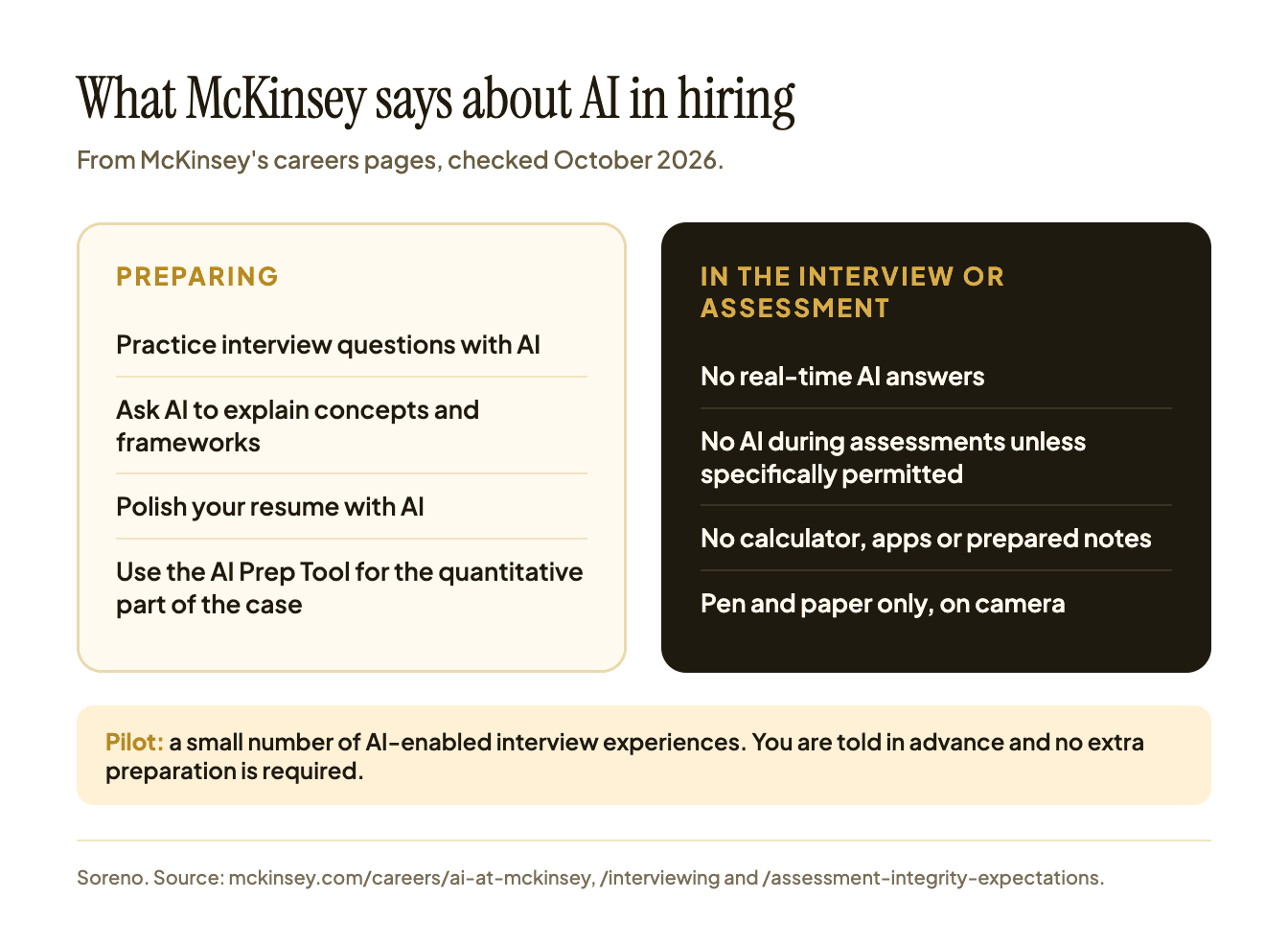
- Using AI to prepare is fine. Practicing interview questions, polishing a resume and asking an AI to explain concepts or frameworks are listed as encouraged (Interviewing at McKinsey).
- Generating real-time answers during an interview, or using AI during an assessment unless it is specifically permitted, is not allowed (same page).
- The assessment integrity rules say you participate alone, on camera, on one screen, with pen and paper, and that you don't use generative AI, a calculator, other apps or prepared notes. Breaking the rules can lead to disqualification or a rescinded offer (Assessment Integrity Expectations).
- The AI Prep Tool sits behind a sign-in at prep-partner.mckinsey.com. A notice on its page says the case is AI-generated, may contain inaccuracies, is for practice only and isn't part of the recruitment assessment.
Reported by the press
- Business Insider reported on May 24, 2026 that the tool launched in April, offers unlimited attempts, generates new quantitative case questions across 15 industries, and lets you reveal the answer with the calculation steps. It said McKinsey doesn't track how candidates use it or how good their answers are, and that about 10,000 people had used it in its first month. Business Insider described it as open to entry-level business analyst and associate applicants globally (Yahoo Finance syndication).
- The Guardian reported on January 14, 2026, noting that the Financial Times first reported it, that McKinsey was adding an "AI interview" to some final rounds for business school graduates. The detail came from CaseBasix, a US interview-prep company, which said candidates in "select final rounds" in the US use Lilli for practical consulting tasks. McKinsey declined to comment (The Guardian).
- CaseBasix describes the exercise as prompting the AI, reviewing its output and applying judgment, with the focus on collaboration and reasoning rather than technical AI knowledge. It says the exercise sits alongside the problem-solving and personal experience interviews (CaseBasix). That is a prep company's account based on candidate feedback, not a McKinsey document.
Not published, as far as we could find
- How long the AI exercise lasts, what the screen looks like and what tasks you get.
- Whether it is scored, how it is weighted against the other interviews, and what a strong performance looks like. Some prep sites call the pilot non-evaluative. We found no McKinsey statement confirming that.
- Which offices, roles and school years are included beyond the US business school reports, and whether the pilot will continue or expand.
- Whether the AI Prep Tool is open to every applicant or only invited candidates. McKinsey's page says invited candidates, Business Insider said applicants globally. Check your own invitation.
- How the Prep Tool's difficulty compares with a real interview, and whether it has anything to do with the Lilli exercise. It is a practice tool for the quantitative part only.
The image below sums up the rules that matter most for your prep.
How to prepare, step by step
- Confirm what you are actually getting. Read your invitation and ask your recruiter what the interview day includes. McKinsey says it will tell you in advance if you are in an AI pilot. Don't spend weeks on a format you may never see.
- Use the AI Prep Tool when you get access. It exists for the quantitative part of the case, and the person who does the most reps on it is you. Treat each question as timed, do the math on paper and only then reveal the steps.
- Make your math pen-and-paper fast. The integrity rules say no calculator in McKinsey assessments, which is different from some other firms. Work on percentages, growth rates, breakeven and quick estimates. Our guide to improving mental math gives drills.
- Do not skip the standard case. The problem-solving interview is still the core of the process. McKinsey publishes sample cases such as Beautify and Diconsa on its interviewing page, and our McKinsey case interview guide and McKinsey practice case walk through the format. Prepare your stories for the personal experience interview too.
- Rehearse the habits the AI exercise is reported to test. From the reporting, the likely skills are framing a clear question, reading the output critically, catching what is wrong and adapting the answer to the client. We are inferring these from press accounts. McKinsey hasn't published a rubric. Practice them with any chatbot on a practice case, which McKinsey's own page says is fine when you are preparing.
- Think out loud about what you kept and changed. If a pilot does let you use Lilli, you will probably need to explain your choices. Practice a 60-second summary of what you asked, what you accepted, what you rejected and why.
- Keep a hard line on live use. In a real interview or assessment, don't use AI for answers unless the instructions say it is part of the exercise.
- In the last week, run two full timed cases, one mock with a human and one full run-through of your PEI stories.
Practice prompts (ours, not McKinsey's)
These are original prompts we wrote in the style the reporting describes. They are not from McKinsey or the AI Prep Tool, and the companies and numbers are fictional. Do the first four on paper, no calculator.
Prompt 1: margin hit. A bakery chain has 40 stores, each with $900,000 in annual revenue and a 6% operating margin. A flour price rise adds costs equal to 3% of revenue. What is total operating profit now, and what is the new margin?
Prompt 2: subscriber base. A software firm has 20,000 customers. Each month 2.5% leave and 600 join. How many customers does it have after three months, and at what number does the base stop growing?
Prompt 3: scan capacity. A hospital runs 3 MRI machines, 14 hours a day, 300 days a year. Each scan takes 40 minutes including turnover, and the machines are busy 75% of the time. How many scans a year?
Prompt 4: break-even. Adding a delivery route costs $60,000 a year for a van and driver. Each delivery earns $8 and costs $5 in fuel and packaging. How many deliveries a year to break even, and how many per day on 250 working days?
Prompt 5: compare structures. Take a case about a mid-size insurer losing customers to online rivals. Write three hypotheses on paper first. Then ask an AI assistant for its structure. List two differences, decide which structure you would use and say why.
Prompt 6: attack an assumption. Ask an AI assistant to size the market for scooter rental in a city of 2 million people. Pick one assumption you don't believe and replace it with a better-grounded one, out loud.
Prompt 7: find the error. Revenue by region went from $120M to $138M in Region A, $80M to $84M in Region B and $50M to $45M in Region C. An assistant says: "Revenue grew about 15% overall, driven by Region B." You have 60 seconds to say what is wrong.
Prompt 8: brief the partner. After using an AI assistant on any practice case, give a 90-second update: what you asked, what you kept, what you changed and what you would check next.
Prompt 9: client fit. An assistant recommends a mobile loyalty app for a 120-store grocery chain. The client's shoppers skew over 55, margins are 2%, and the CFO wants payback in 12 months. Rewrite the recommendation in three sentences.
Answers.
- Revenue is 40 × $900,000 = $36M. At 6%, profit was $2.16M. The cost rise is 3% of $36M = $1.08M, so profit is now $1.08M and the margin is 3%.
- After month 1: 20,000 × 0.975 + 600 = 20,100. Month 2: 20,100 × 0.975 + 600 = 20,197.5. Month 3: about 20,293. The base stops growing when losses equal joins: 600 ÷ 0.025 = 24,000.
- Per machine per day: 14 × 60 ÷ 40 = 21 slots, × 75% = 15.75 scans. × 300 days = 4,725, × 3 machines = about 14,175 a year.
- Margin per delivery is $8 − $5 = $3. $60,000 ÷ $3 = 20,000 deliveries a year, or 80 a day.
- A good answer notices where your structure and the AI's overlap and where one misses a client-specific factor, such as pricing, claims experience or distribution channels, and chooses on purpose.
- A good answer replaces the assumption with a reasoned one (for example trips per person, not guessed market size), and shows the effect on the final number.
- Total revenue rose from $250M to $267M, which is 6.8%, not 15%. Region A drove the growth with +$18M (+15%), B added +$4M (+5%), and C fell $5M (-10%). Region B was not the driver.
- A good update is short, names one thing the AI got wrong or left out, and ends with a specific next check.
- A good rewrite drops the generic app, picks something that fits older shoppers and thin margins, such as better in-store promotions or a simple card program, and states a payback logic the CFO can test.
Where Soreno fits
Soreno doesn't simulate McKinsey's AI Prep Tool or Lilli, and McKinsey's tool is free, so use it. What Soreno can help with is the rest of the process: consulting case practice with a voice AI interviewer that shows exhibits, checks your math and scores you with quotes from your answer, plus timed math and chart drills. You can try a free sample case, with no account, on the case interview partner page. See the comparison page for how it stacks up against other options, and pricing for plans. Every plan starts with a 7-day free trial.
FAQ
Does McKinsey interview you with AI? Partly, and only in a pilot. McKinsey says it is piloting a small number of AI-enabled interview experiences and will tell invited candidates in advance. Reports say this involves Lilli in some US final rounds. McKinsey's interviewing page still lists the personal experience interview and the problem-solving interview as the process for most client-facing roles.
Can I use ChatGPT during my McKinsey interview? No, unless an exercise explicitly allows an AI tool. McKinsey's pages say real-time AI answers and AI use during assessments are not allowed unless specifically permitted. Using AI to prepare is encouraged.
What is Lilli? Lilli is McKinsey's internal AI platform, which it says it equips employees to use. Candidates can't use it outside a McKinsey exercise.
Is the McKinsey AI Prep Tool free? It is free to candidates who have access, according to Business Insider. McKinsey's own page says invited candidates have access, so check your invitation.
Does the AI Prep Tool affect my application? McKinsey's notice on the tool says the case is for practice only and isn't part of the assessment. Business Insider also said McKinsey doesn't track how candidates use it.
Do I need prompt engineering skills? McKinsey says no extra preparation is needed for the pilot. Press accounts say the focus is judgment and reasoning rather than prompting tricks.
Is the AI exercise scored? We couldn't find a McKinsey statement. McKinsey says people make hiring decisions. How the AI exercise is weighted hasn't been published.
Does the AI exercise replace the case interview? Nothing we found says so. McKinsey's interviewing page still lists the personal experience interview and the problem-solving interview as the process for most client-facing roles.
If your target is BCG, read our guide to its Casey online case and the BCG case interview guide.