
· 12 min read
How to Practice Case Interviews With AI (What Works, What Doesn't)
How AI case interview practice works, where it beats a human partner and where it falls short, a two-week plan, a worked case opening, and how to choose a tool.
Practicing case interviews with AI means running a mock case out loud with an AI interviewer, then using its scored feedback to pick the next thing to drill. It works well for volume: math, structuring, chart reading, and getting comfortable talking through a problem. It works less well for the things a real interviewer judges by feel, like presence and how you handle an awkward pause. The best setup for most candidates is AI for daily reps plus one human mock a week.
This guide covers how AI case practice actually works, where it beats a human partner and where it doesn't, a two-week plan, a worked case opening with the kind of pushback you should expect, and how to pick a tool.
How AI case interview practice works
There are two ways to do it.
1. A general chatbot you prompt into the interviewer role. ChatGPT, Claude, and Gemini can all run a case if you tell them to. Most have a voice mode, so you can talk instead of type. It costs little or nothing. The catch is that you have to write the case setup, the data, and the grading rules yourself, and the model will drift. Ask it to be an interviewer and within ten minutes it often starts solving the case for you or praising an average structure.
2. A purpose-built case interview tool. These come with cases already written, including the numbers and exhibits, and an interviewer that has been told how a consulting case should run. You speak, it listens, it asks the next question, and at the end you get a score against a rubric. Soreno, CaseTutor, CasePrepared, Case Study Prep AI, and the AI practice product from MyConsultingCoach all sit in this group, with different case libraries, voices, and feedback styles.
Either way, a full AI mock follows the same arc as a real one:
- Prompt. The interviewer reads the client situation and the question.
- Clarifying questions. You confirm the objective, the timeframe, and anything odd in the prompt.
- Structure. You take a minute, then lay out how you would break the problem down.
- Analysis. The interviewer feeds you data, asks for a calculation, or shows an exhibit.
- Recommendation. You close with an answer, the reasons behind it, risks, and next steps.
The difference from reading a casebook is that you have to say everything out loud, in order, under a little time pressure. That is the skill being tested. If you are new to the format, read through a few case interview examples first so you know what each stage should sound like.
What AI is good at, and where a human partner still wins
AI case partners have one big advantage: they are always there. You can run a case at 11pm on a Tuesday, repeat the same type three times in a week, and get the same rubric every time. Human partners are harder to schedule and they grade differently from one session to the next.
But AI has blind spots, and you should know them before you trust a score.
| AI interviewer | Human partner or coach | |
|---|---|---|
| Availability | Any time, as many cases as you want | Needs scheduling; partners get tired |
| Consistency of grading | Same rubric every session | Varies by person and mood |
| Math checking | Catches wrong numbers reliably when the case has a fixed answer | Depends on whether they did the math themselves |
| Pushback on weak logic | Good tools challenge wrong answers; general chatbots tend to agree with you | Experienced interviewers push hard and improvise |
| Reading the room | Limited. Some tools score filler words and eye contact from video | Notices hesitation, confidence, rapport |
| Off-script follow-ups | Follows the case design; less creative | Can take the case somewhere unexpected |
| Fit and story questions | Can ask and grade structure | Better at judging whether a story feels real |
| Cost | Free to modest monthly fee | Free with peers; coaches charge per hour |
The two failure modes to watch for with AI:
- Agreeableness. Language models are trained to be helpful, so an untuned chatbot will often say "great structure" to something that is not MECE. If every case ends with praise, the tool is not grading you.
- Doing the work for you. If you pause, a general chatbot may fill the silence with the next step of the analysis. In a real interview, nobody rescues you. A good case tool is built to wait and to make you do your own math.
Neither of these means AI practice is bad. It means you should use AI for what it does reliably and keep a human in the loop for the rest.
The practice loop that actually makes you better
Running 40 AI cases in a row is not the goal. Most people plateau after their first ten because they keep making the same mistake in different cases. The fix is a short loop.
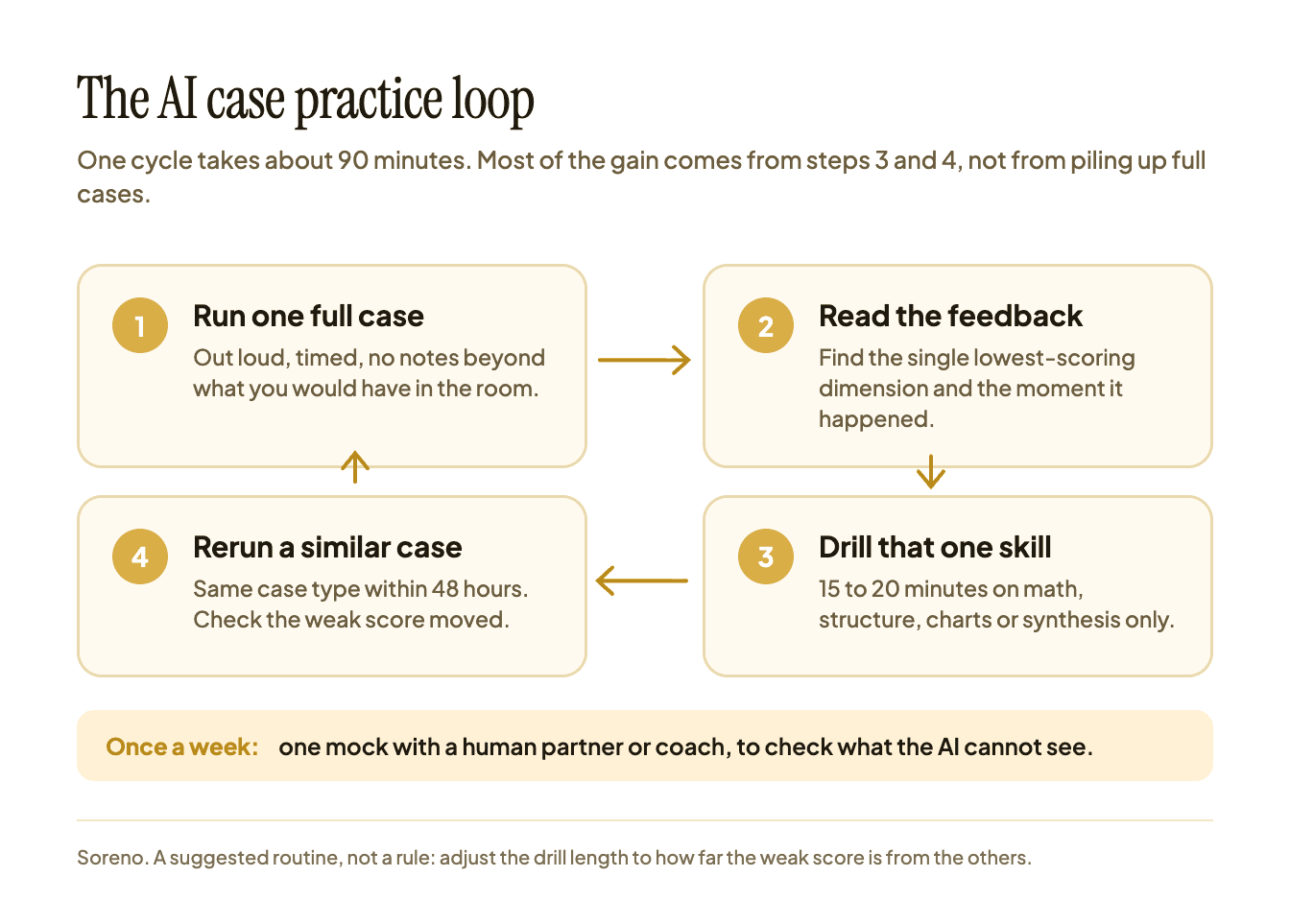
- Run one full case. Out loud, timed, with only the notes you would have in the room.
- Read the feedback. Find the lowest-scoring part and the exact moment it went wrong in the transcript. "Math was weak" is not useful. "I said 15% of 2.4 million is 240,000" is.
- Drill that one skill. Spend 15 to 20 minutes on just that: mental math, structuring openings, chart reading, or 60-second syntheses. If math is the weak spot, our guide on how to improve mental math has drills you can do without any tool.
- Rerun a similar case within 48 hours. Same case type, different client. Check whether the weak score moved.
Once a week, do one mock with a human partner or coach. Use it to check the things AI is worst at: how you come across, whether you can recover when the interviewer takes the case somewhere new, and whether your fit stories hold up.
A two-week AI case practice plan
This plan assumes 60 to 90 minutes a day and an interview roughly two to four weeks away. If you have longer, run it twice and make week two harder each time.
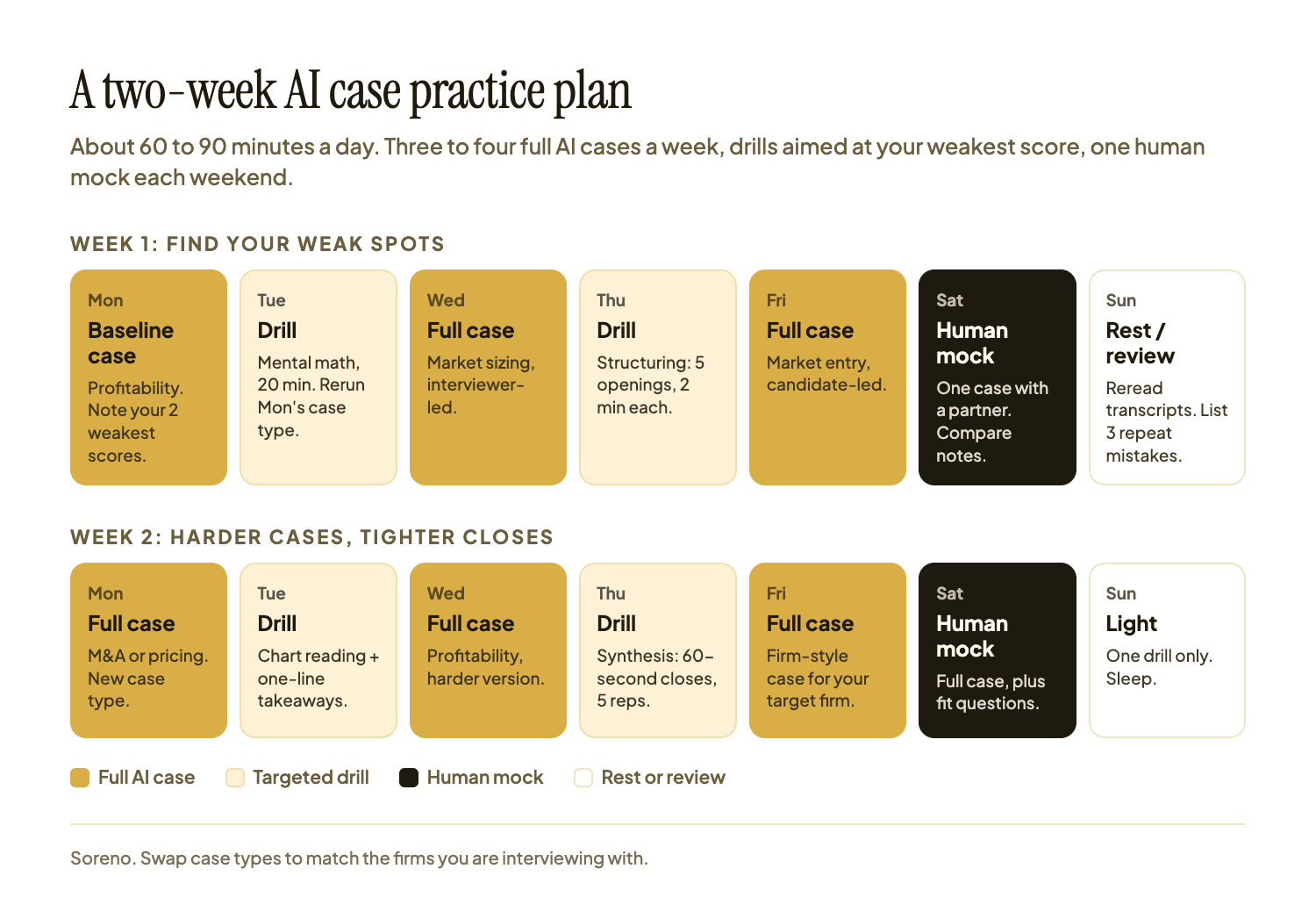
Week 1: find your weak spots.
- Monday. Baseline profitability case. Do not prepare. Write down your two weakest scores.
- Tuesday. 20 minutes of mental math, then rerun a profitability case.
- Wednesday. A market sizing case, interviewer-led. Practice stating assumptions before you calculate. Our list of market sizing interview questions is a good warm-up.
- Thursday. Structuring drill: take five case prompts and give a two-minute opening for each. No analysis, just the structure.
- Friday. A market entry case, candidate-led, where you have to drive the case yourself.
- Saturday. One case with a human partner. Compare their notes with what the AI flagged during the week.
- Sunday. Reread your transcripts and write down the three mistakes that showed up more than once.
Week 2: harder cases, tighter closes.
- Monday. A new case type: M&A or pricing.
- Tuesday. Chart reading drill. For each exhibit, say the one-line takeaway before you say anything else.
- Wednesday. A harder profitability case with more data and a messier answer.
- Thursday. Synthesis drill: five 60-second recommendations, each with an answer, two reasons, a risk, and a next step.
- Friday. A case in the style of the firm you are interviewing with. McKinsey cases tend to be interviewer-led; BCG and Bain cases often expect you to drive.
- Saturday. Full human mock, including fit questions.
- Sunday. One short drill. Rest.
Track one number per skill across the two weeks, not just your overall score. Overall scores bounce around with case difficulty. A math score that goes from weak to solid across four cases is real progress.
A worked example: a case opening and how an AI interviewer should push back
Here is a short, made-up profitability case to show what good AI pushback looks like. The client is a regional grocery chain with 40 stores. Profits fell from $30 million to $21 million over two years while revenue stayed flat.
Candidate opening:
"Thanks. So the client's profit dropped 30% while revenue was flat, which tells me costs went up. I'd like to look at three areas: costs, competition, and customers. Under costs I'd look at rent, labor, and cost of goods. Under competition, whether new stores opened nearby. And under customers, whether shopping habits changed."
This is a common opening, and it has two problems. An interviewer worth practicing with should catch both.
Pushback 1: the logic jump.
Interviewer: "You said flat revenue means costs went up. Is that the only possibility?"
Flat revenue can hide a mix shift. If customers moved from high-margin fresh food to low-margin packaged goods, revenue can hold while gross profit falls, with no change in costs at all. The candidate jumped to a conclusion before checking the revenue side.
Pushback 2: the structure overlaps.
Interviewer: "How does 'competition' differ from 'customers' in your structure? Where would a price war go?"
A price war would lower prices, which hits revenue per item, which is customers and competition at the same time. The buckets are not mutually exclusive. A cleaner structure splits profit into revenue (volume, price, mix) and costs (cost of goods, store costs, overhead), then asks which moved.
Pushback 3: forcing a hypothesis.
Interviewer: "If you had to bet now, where's the problem?"
A strong answer commits: "My first guess is gross margin, either a mix shift or higher supplier costs, because revenue held steady and grocery is a low-margin business where a few points of margin is most of the profit. I'd like to see gross margin by category over the two years."
What a weak AI partner does instead: says "Great structure! Let's dive into costs," and hands over cost data. You finish the case feeling good and learn nothing.
What useful feedback looks like
After a case like this, feedback should be specific enough that you know what to do tomorrow. Compare:
- Vague: "Good structure, could be more MECE. Math was fine. Work on your conclusion."
- Useful: "Your structure mixed drivers (costs) with external causes (competition, customers), so a price war fits two buckets. Start from the profit equation next time. You assumed costs rose without checking revenue mix. Your recommendation took 2 minutes 40 seconds; aim for under 90. You said 'basically' 11 times in the opening."
The useful version points at moments, gives a fix, and is measurable. If your tool only gives you the vague version, you will need a human to fill the gap.
For more on building structures that hold up to this kind of pushback, see our guide to frameworks for case interviews.
How to choose an AI case interview tool
Tools change fast, so check these yourself during a free trial rather than trusting any list, including this one.
| Criterion | What to check in your first session |
|---|---|
| Voice, not just text | Can you speak your whole answer and get interrupted like in a real interview? Typing hides hesitation. |
| Pre-built cases with real data | Does the case come with fixed numbers and exhibits, or does the AI make them up as it goes? Made-up data makes math feedback unreliable. |
| Interviewer-led and candidate-led formats | You need both if you are applying to more than one firm. |
| Pushback | Give a deliberately weak structure. Does it challenge you, or praise you? |
| Feedback you can act on | Does the report quote what you said and tell you what to do differently? Is there a model answer to compare against? |
| Delivery feedback | Does it say anything about pace, filler words, or eye contact? A human will notice these. |
| Drills | Can you practice one skill (math, charts, structure) without running a full case? |
| Progress over time | Can you see whether a specific skill is improving across sessions? |
| Price and trial | Can you run at least one full case before paying? |
A general chatbot passes some of these if you write a good prompt, and it is a sensible place to start if budget is tight. A useful prompt includes: the full case with numbers, an instruction to never do your math or suggest the next step, an instruction to challenge any structure that overlaps, and a request to grade you at the end on structure, math, and synthesis with quotes from your answers. Expect to re-prompt it when it drifts.
Where Soreno fits
Soreno is the tool we build, so weigh this section accordingly. It is designed around the loop above:
- A voice AI interviewer. You talk through the case out loud. You can pick an interviewer style, including McKinsey, BCG, and Bain styles, a strict interviewer, or a coach who gives more help. The AI is MBB-trained.
- Cases with fixed data and exhibits. The library has 500+ practice questions, including 80+ full case studies, alongside technical and behavioral questions. Exhibits appear on screen mid-case and the interviewer asks follow-up questions about them. It will not do your math for you. Cases are tagged interviewer-led or candidate-led, across profitability, market entry, market sizing, M&A, pricing, and operations, at three difficulty levels.
- Rubric-based feedback. Each case is scored out of 100, broken into components such as structure, quantitative accuracy, and synthesis, with strengths and weaknesses that quote what you said, an action plan, and a model answer to compare against.
- Delivery analysis. Your webcam recording is analyzed for filler words, eye contact, and body language, so you get feedback on how you sound and look, not just what you said.
- Targeted drills. Consulting math speed, case structuring, market sizing, chart interpretation, and brainstorming drills, so step 3 of the loop takes 15 minutes instead of a full case.
There is a 7-day free trial. A reasonable test is to run the Monday baseline case from the plan above, give a deliberately overlapping structure, and see whether the feedback catches it. You can see how it works for consulting candidates here.
FAQ
Can AI replace a human case partner?
Not fully. AI is better for volume, consistency, and math. A human is better at judging presence, improvising follow-ups, and telling you whether your fit stories feel genuine. Most candidates do best with AI for daily practice and a human mock once a week.
Is ChatGPT good enough for case interview practice?
It can work for drills and simple mocks if you write a detailed prompt with the case data and strict rules. The main problems are that it tends to agree with weak answers, sometimes solves the case for you, and may invent inconsistent numbers. Purpose-built tools fix most of this with pre-written cases and tuned interviewers.
How many AI mock cases should I do before an interview?
There is no magic number. Focus on whether your weakest skill is improving rather than on case count. The two-week plan above includes seven full AI cases (one of them a rerun) plus two human mocks, which is a solid base for someone who already knows the basics.
Is it cheating to practice case interviews with AI?
No. Practicing with AI before an interview is the same as practicing with a casebook or a friend. Using AI during a live interview or an online assessment is a different thing; assume it is not allowed unless the firm says otherwise.
Can AI help with the McKinsey PEI or fit questions?
Yes, for structure and repetition. An AI interviewer can ask follow-up questions, flag missing details in a story, and point out when you said "we" instead of "I." A human is still better at judging whether the story is convincing.
Do AI case tools work for finance or product management interviews?
Some do. Case-style practice carries over to strategy roles, product cases, and PE case studies. Check whether the tool has cases and drills for your specific role before you commit.
What if the AI's feedback is wrong?
It sometimes is. If a score feels off, reread the transcript and compare your answer with the model answer. When you disagree with the AI and your human partner agrees with you, trust the human.
Firms are adding AI to hiring too. See how McKinsey's AI Prep Tool and Lilli interview pilot work, and what BCG's Casey online case involves.