







AI market entry case practice

Market entry case interview practice with AI

Realistic market entry cases with exhibits and math, graded instantly. Start your free week with full feedback.

User
User
User
User
Join 15,000+ candidates this cycle
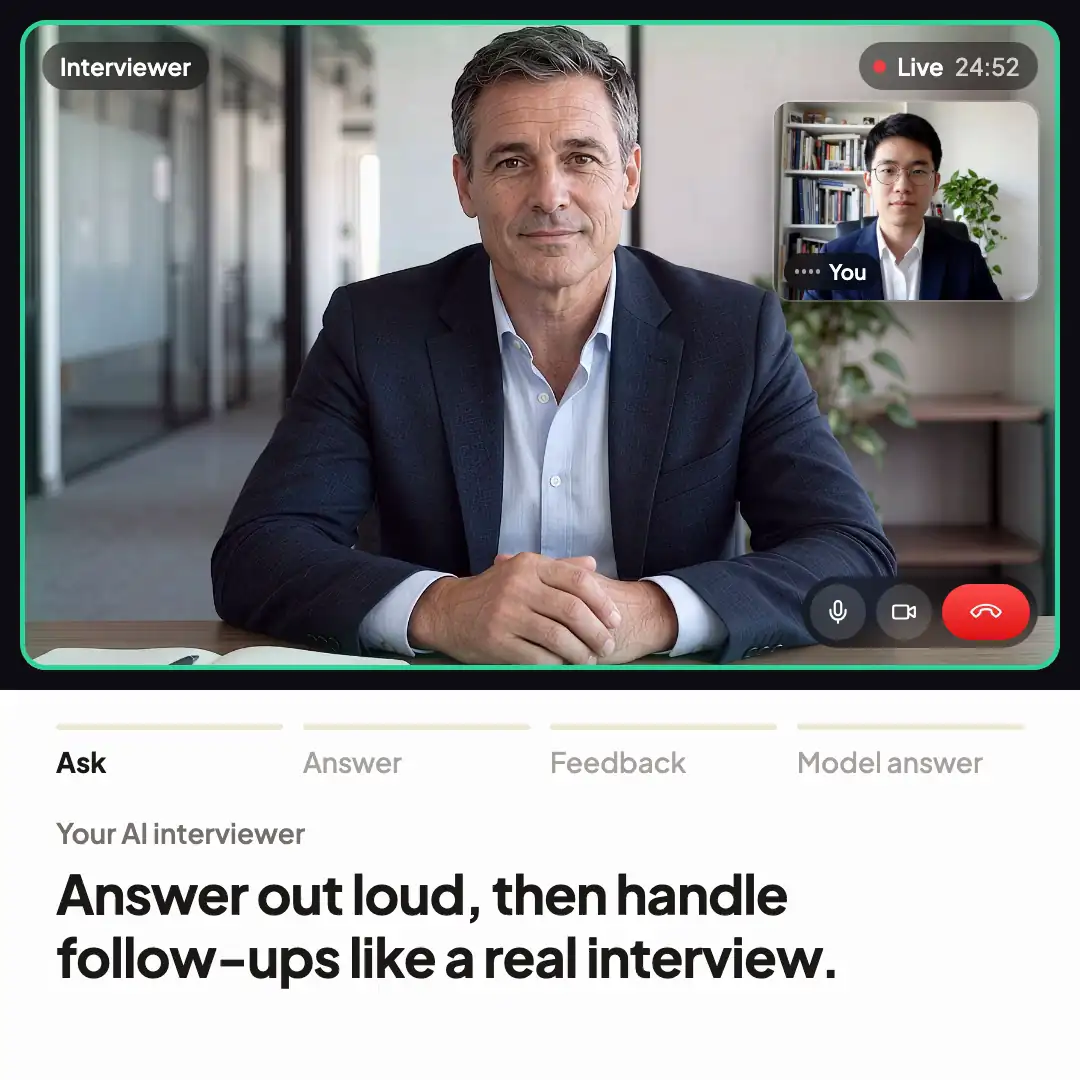
A live Soreno case mock: the AI interviewer gives a profitability case, you answer out loud, then see your score and a model answer
“Soreno quoted the exact moment my answer went vague, then gave me the line I should have said next.”
— Rachel K. · Offer from Oliver Wyman

11,900+ applicants accepted at top firms, with over 1.2 million minutes of practice completed.

What is a market entry case interview?

A market entry case interview asks whether a company should enter a new market, such as a country, customer segment or product category, and how. The structure has four questions: is the market attractive, can the company win there, would entry make money (the break-even share) and which entry mode fits. Spend most of your time on the economics, then recommend with a first step.

Last checked November 4, 2026

Try the free sample case, no sign-upSee a case worked in fullMarket entry framework

One answer, scored

See one recommendation go from 73 to 84

Soreno scores every mock out of 100, then gives you clear, specific fixes to exactly what you said.

A premium fitness chain saw its EBITDA margin fall 380 bps

Final question · What do you recommend to the CEO?

Score 73 out of 100
+0 points

What you said

“The margin drop is meaningful, so I would look at pricing and operations next. I think they should fix discounting and cut some costs.”

Here's how to say it better

  1. “The margin drop is meaningful…”

    +4

    Leads with the dollar impact, so the size of the problem is clear.

  2. “…so I would look at pricing and operations next.”

    +4

    Ranks the levers instead of listing them.

  3. “I think they should fix discounting and cut some costs. ”

    +3

    Ends on one decision, a reason and a next step.

Get your answers scored
About 30 minutes a mock

How a Soreno mock works

Get the case, answer out loud, then see exactly where the answer stands and what to change.

  1. Your client is a premium fitness chain...
    1

    Get the case

    An AI interviewer gives you the case out loud, shares exhibits and answers your clarifying questions.

  2. You

    12:40

    I'd split this into price, volume and unit cost, then test which one explains most of the margin drop

    2

    Answer out loud

    Structure it, do the math and make your recommendation while the interviewer probes, the way a real one does.

  3. This mock

    84 / 100

    B+ · +11

    Your answer, upgraded

    Lead with the $48M, then rank pricing, mix and cost before you recommend.

    3

    A score on every mock

    Structure, content (your math and judgment) and communication scored out of 100, with your own words quoted and a model answer to compare.

Scored out of 100 on every mock

Every case, scored like an interviewer would

Interviewers judge your structure, your content (the math and the business judgment) and how clearly you say it. Soreno scores each one, quotes the moment that cost you points, and shows the stronger answer.

  • A score out of 100 on every mock

    Plus a letter grade and how far you moved since the last one.

  • A score for each skill

    See whether structure, content or communication held the case back.

  • Your own words, quoted and fixed

    Timestamped moments from your answer, with the line to say next time.

Get your first case scored
Free sample case

A market entry case you can try now

A sequence of questions: size the opportunity, find the break-even, choose the channel, recommend.

Step 1. Read the case

Voltstride: entering the US e-bike market

The interviewer reads you the case

Your client is Voltstride, a European maker of electric bicycles that sells only in Europe. Its board is considering entering the US market and has a target of 3% share of the market within three years. The CEO asks whether to enter and how.

An original practice case written by Soreno. Everything stays in your browser.

Step 2. Ask clarifying questions

In a market entry case, confirm the goal, the economics per unit and the cost of entry, then structure.

Step 3. Structure your answer

Take two minutes. Structure the market entry question: is the market attractive, can Voltstride win, and what would it earn. Write it, then say it out loud.

2:00

Now do a full case out loud

Soreno's AI interviewer gives you a full case, asks follow-up questions on your structure and math, and scores your answer. The 7-day free trial.

Continue with the AI interviewer

Account required to start the trial. Cancel anytime before it ends.

Framework outline

How a market entry case is structured

A market entry strategy answers two things: would the company make money in the new market, and is that worth the cost and risk of getting in. Here is the market entry framework in the order you would use it in the room, with the math that usually settles it.

The market entry framework as a tree

Should the client enter this market, and how?

  • Is the market attractive?

    • Size and growth
    • Margins incumbents earn
    • Competition and concentration
    • Regulation and barriers
  • Can the client win?

    • Why customers would switch
    • Cost position after tariffs and freight
    • Access to channels
  • Would entry make money?

    • Contribution per unit
    • Yearly fixed cost of entry
    • Break-even units and share
    • Payback
  • How to enter?

    • Export, license or franchise
    • Partner or joint venture
    • Build or buy
    • How easy it is to back out
  1. 01

    Clarify the goal

    Why this market, and why now? Ask what success means to the client: a revenue figure, a share target, a payback period. A board's share target is something to test against the numbers later.

  2. 02

    Is the market worth it?

    Size it top-down or bottom-up, then ask how fast it grows, what margins the incumbents earn and how concentrated it is. A big market held by three entrenched players on thin margins can be worse than a smaller, fragmented one.

  3. 03

    Can this company win there?

    Why would customers pick it? Check whether its cost advantage survives tariffs, shipping and local wages, and whether it can reach buyers at all through dealers, retailers, licenses or online.

  4. 04

    Run the entry economics

    Contribution per unit is price minus variable cost. Divide the yearly fixed cost of entry by that contribution to get break-even units, then by the market's unit sales that year to get break-even share. If break-even needs more share than a newcomer could plausibly win, entry is hard to justify.

  5. 05

    Pick the entry mode

    Build, partner or buy, and through which channel. Exporting, licensing and franchising are the lighter options. Compare routes on profit after their own costs and on how easy they are to unwind. A distributor brings reach fast and keeps part of the margin. An acquisition buys share along with an integration job.

  6. 06

    Recommend, with a first step

    Enter, wait or stay out. Then the move that limits the downside: one region, one channel or a pilot with a clear target that releases the next round of spending.

Use these steps as a checklist, then build your structure from the client's question. Kearney tells candidates to avoid forcing a solution into a standard framework, and McKinsey asks for tailored solutions over standard frameworks.

Worked example

A market entry case, worked in full

An original case with illustrative numbers that add up. Read the prompt, try your own structure first, then compare.

Maple Ridge Foods: a Canadian yogurt maker eyes the US Northeast

Maple Ridge makes yogurt in Ontario and sells only in Canada. The board wants US sales within three years, profitable by year three. Should it enter the US Northeast, and how?

  1. 1. Clarify the goal

    Success means a profit by year three, not just sales. That rules out paying for share at a loss for a long time. The plant has spare capacity of 25 million cups a year.

  2. 2. Is the market attractive?

    Grocery yogurt in the Northeast sells about 400 million cups a year and grows about 3% a year. Four brands hold 70% of it. Large, slow-growing and concentrated: entry is possible, but share will be hard to win.

  3. 3. Can Maple Ridge win?

    Its cost is $0.55 a cup at home. Freight to the Northeast adds about $0.05, so it lands at $0.60 against a $1.00 price to retailers. Assume no tariff on this route (check it in a real case). Its edge is a thick, high-protein recipe, but it has no US brand awareness.

  4. 4. Run the entry economics

    A branded launch earns $0.40 a cup and needs $6 million a year in sales staff, retailer slotting fees and marketing. Break-even is $6 million divided by $0.40, or 15 million cups: 3.75% of today's market (about 3.4% of the year-three market). The number five brand holds about 4%. Private label (making store-brand yogurt for one grocery chain) earns less per cup but needs almost no marketing.

    Two ways in (illustrative)
    Year threeOwn brandPrivate label
    Price per cup$1.00$0.75
    Variable cost per cup$0.60$0.60
    Contribution per cup$0.40$0.15
    Yearly fixed cost$6.0M$0.5M
    Cups sold8M (2% share)20M (one chain)
    Profitminus $2.8M$2.5M
  5. 5. Pick the entry mode

    At a plausible 2% of today's market by year three, the branded launch still loses $2.8 million. The private-label contract makes $2.5 million, fits within the spare 25 million cups and is easy to exit when the contract ends.

The answer, top-down

Enter, but through private label first. A branded launch needs 3.75% of the market to break even, close to the fifth-largest brand, and would still lose about $2.8 million in year three. Making store-brand yogurt for one chain earns about $2.5 million a year with little risk and teaches Maple Ridge the US buyers. Revisit a branded launch once it has a retailer relationship and US cost data.

4 market entry case prompts to practice

Original prompts written by Soreno. Give yourself two minutes to structure each one out loud, then open the outline.

  1. 1A ride-hailing app wants to launch in a city of 1 million people. Should it?

    Answer outline
    • Size trips per year from people, trips per person and the share who use ride-hailing.
    • Check driver supply and what the current player pays drivers.
    • Find contribution per trip and the trips needed to cover city launch costs.
    • Recommend with the competitor's likely response and a target that ends the test.
  2. 2A Japanese coffee chain plans 50 stores in Canada within five years.

    Answer outline
    • Work out one store's economics: cups a day, price, cost and rent.
    • Find break-even cups per day and compare with local chains.
    • Ask whether the brand travels and which cities to open first.
    • Recommend a first wave of stores with a store-level target before the rest.
  3. 3A maker of hospital monitors wants to sell a version for patients at home.

    Answer outline
    • Treat it as a new customer segment: who pays, the patient, the insurer or the hospital?
    • Size patients who would qualify and the share that would be prescribed one.
    • Compare the channel it needs (pharmacies, home-care firms) with what it has.
    • Recommend whether to build the channel, partner or license.
  4. 4A European supermarket chain is considering opening stores in the US.

    Answer outline
    • Ask why the US and which region, then size grocery spending there.
    • Test its edge, for example low prices from a small range, against local discounters.
    • Find store break-even and how many stores a distribution center needs to pay off.
    • Recommend a cluster of stores around one distribution center, or buying a local chain.

Three market entry cases to practice

Three cases from Soreno's case bank, with invented clients. Sketch a structure on paper first, then run the case with the AI interviewer.

  1. Vestiura

    Retail and consumer · Medium · Interviewer-led

    Vestiura, a fast-fashion retailer with stores and an online shop in several countries, has had flat revenue for two years, and more shoppers say they want to buy fewer new clothes. It ran a six-month pilot of a monthly clothing rental subscription in one city. Would launching it be profitable for Vestiura as a whole, and how should it be positioned so it doesn't hurt the stores?

    How to start. A launch decision with a pilot to read. Before you look at the results, set out how you would judge whether the service is worth launching.

    The case, part by part

    1. 1Goal and structure: restate the question and lay out how you will answer it.
    2. 2Read the pilot: say what each result shows before you use it.
    3. 3Plan economics: work out what each plan earns.
    4. 4Positioning: decide how the service should be presented.
    5. 5Recommendation: the decision, the risks and the next steps.
    Sign up free, then run Vestiura from the question bank
  2. Marivelle Cruises

    Travel · Hard · Candidate-led

    Marivelle Cruises runs large ocean ships in the Caribbean on thin margins and wants to reach wealthier travelers. It is looking at luxury river cruises on a large river in Southeast Asia, with week-long trips between temples, markets and villages. It has never run river ships and would build its own. Should Marivelle enter this market, and if so, what kind of ship should it build?

    How to start. You get two decisions in one: whether to enter, and what to build. Size the market first, then list what you would need to know to choose a ship.

    Sign up free, then run Marivelle Cruises from the question bank
  3. Corvelle Beauty

    Retail and consumer · Medium · Candidate-led

    Corvelle Beauty, a European makeup and skincare brand, has entered every country so far through department stores, with a regional distributor that buys the products and runs the counters. The board wants $200 million of sales in Southeast Asia, at consumer prices, within five years. The plan copies the usual approach. Can it reach the goal, and if not, what should Corvelle do instead?

    How to start. Our case bank files this one as a growth case, and it works well as entry practice. Start by testing whether the current plan can reach the board's goal.

    Sign up free, then run Corvelle Beauty from the question bank

Where candidates lose points

  • Opening with entry modes (joint venture, acquisition, greenfield) before anyone knows whether the market is worth entering.
  • Spending twenty minutes on market size and two on whether the company would make money.
  • Taking the board's share target as the plan without checking it against the break-even share or what the channel can deliver.
  • Picking the channel with the widest reach. What it earns after its own costs is the better test.
  • Copying home-market prices and costs into the new country without asking about tariffs, freight or local wages.
  • Forgetting that staying out is an option, and sometimes the right one.

Market entry frameworkA European e-bike maker entering the USA US coffee chain opening in IndiaCoffee shop break-even in cups a dayThe CEO asks for your recommendationAll case interview questionsFrameworks for case interviewsMECE, with examplesMarket sizing interview questionsMarket sizing guideMarket sizing practiceCase math drillsCase interview partnerAll practice by firm and case type

Side by side

How Soreno compares to other ways to practice

A course from zero, a live AI case interviewer that follows up on what you say, and a score out of 100 on every mock, all in one place and ready whenever you are.

FeatureSorenoA coach
Practice any time, day or nightScheduled
A live interviewer who probes and shares exhibitsAI interviewer
A course that starts from zeroZero to HeroVaries
Practice one stage of a case at a timeAbout 6 minOn request
A score out of 100 on every mockTheir notes
Unlimited mocks on a paid planPer session
Consulting and finance rolesTheir specialty
Video recording and playbackVaries
PriceFree week, then $199/moPer hour
FeatureSorenoA coachA courseA case buddy
Practice any time, day or nightScheduledSelf-pacedScheduled
A live interviewer who probes and shares exhibitsAI interviewerSelf-studyA peer
A course that starts from zeroZero to HeroVariesSelf-study
Practice one stage of a case at a timeAbout 6 minOn requestSelf-studyOn request
A score out of 100 on every mockTheir notesSelf-checkTheir notes
Unlimited mocks on a paid planPer sessionSelf-pacedAs scheduled
Consulting and finance rolesTheir specialtyVariesVaries
Video recording and playbackVariesVariesVaries
PriceFree week, then $199/moPer hourOne-off feeFree
Verified offers

What Soreno candidates say

Real candidates, real offers, in their own words.

McKinsey & Company

“What sold me on Soreno was being able to jump straight into a mock case without knowing anything…”

Alex Chen

McKinsey offer after 28 sessions

Boston Consulting Group

“The AI asks pretty tough follow up questions and the evaluation is quite strict…”

Daniel C.

BCG offer after 22 sessions

Bain & Company

“I recommend everyone to start with the drills, they're kinda like mini cases, then work up to full mocks.”

Maya Singh

Bain offer, score up 16 points

Deloitte

“…there's no judgment when you mess something up. You can just restart and go again.”

Priya N.

Deloitte offer after 18 sessions

Oliver Wyman

“I loved how Soreno was able to let me know exactly what I did good and bad during the interview…”

Rachel K.

From 0 to an Oliver Wyman offer in 8 weeks

Soreno in numbers

11,900+
applicants accepted at top firms
1.2M+
minutes practiced on Soreno
Plans and Pricing

Choose your best plan

Start your free week, then choose a plan. Cancel anytime.

1 week

For a round that is days away

Unlimited mock interviews

  • = about $11 a day
  • Cases, banking technicals and fit, out loud
$79

per week

Start your free week

Billed weekly

Included at no extra cost

  • Zero to Hero courseCase or finance
  • Day-by-day prep planEach interview
  • Skill drillsUnlimited
  • Session recordingsWith feedback

Practice library

  • Full case interviews100+
  • Banking interview questions1,800+
  • Consulting fit questions100+
  • Banks with fit questions29
  • A voice AI interviewer that asks follow‑up questions
  • Exhibits and a model answer for every case
  • A score out of 100 after every mock
  • Feedback that quotes your answer, with a next-step plan
  • Filler-word and eye-contact notes on recorded sessions
  • Drills for case math, market sizing, structuring and charts
  • Consulting, banking and behavioral practice in one plan
  • Add your own practice questions

1 month

Save 42%Recommended

For steady practice across recruiting

Unlimited mock interviews

  • = about $7 a day
  • Cases, banking technicals and fit, out loud
$199vs $342 a month on Weekly

per month

Start your free week

Save $143 a month compared to weekly

Included at no extra cost

  • Zero to Hero courseCase or finance
  • Day-by-day prep planEach interview
  • Skill drillsUnlimited
  • Session recordingsWith feedback

Practice library

  • Full case interviews100+
  • Banking interview questions1,800+
  • Consulting fit questions100+
  • Banks with fit questions29
  • A voice AI interviewer that asks follow‑up questions
  • Exhibits and a model answer for every case
  • A score out of 100 after every mock
  • Feedback that quotes your answer, with a next-step plan
  • Filler-word and eye-contact notes on recorded sessions
  • Drills for case math, market sizing, structuring and charts
  • Consulting, banking and behavioral practice in one plan
  • Add your own practice questions

1 year

Save 76%BEST VALUE

For several roles, firms or rounds

Unlimited mock interviews

  • = about $2 a day
  • Cases, banking technicals and fit, out loud
$48vs $199 a month on Monthly

per month, billed $579 yearly

Start your free week

Save $1,809 compared to monthly

Included at no extra cost

  • Zero to Hero courseCase or finance
  • Day-by-day prep planEach interview
  • Skill drillsUnlimited
  • Session recordingsWith feedback

Practice library

  • Full case interviews100+
  • Banking interview questions1,800+
  • Consulting fit questions100+
  • Banks with fit questions29
  • A voice AI interviewer that asks follow‑up questions
  • Exhibits and a model answer for every case
  • A score out of 100 after every mock
  • Feedback that quotes your answer, with a next-step plan
  • Filler-word and eye-contact notes on recorded sessions
  • Drills for case math, market sizing, structuring and charts
  • Consulting, banking and behavioral practice in one plan
  • Add your own practice questions
FAQ's

Frequently Asked Questions

Everything you need to know about Soreno, answered in one place.

Start with the client's goal, then ask four questions in order: is the market attractive, can the company win, would it make money (the break-even share) and how should it enter. The four questions, the entry modes compared and a fully worked case are in the market entry framework guide.
The plan for whether and how a company gets into a new country, customer segment or product market. It covers the decision to enter and the mode: exporting or selling online, licensing or franchising, a partner or joint venture, buying a local player, or building its own operation. The lighter modes are faster and cheaper to undo. The heavier ones give more control and keep more of the margin.
A market entry case interview asks whether a company should enter a new market, such as a country, customer segment or product category, and how. The structure has four questions: is the market attractive, can the company win there, would entry make money (the break-even share) and which entry mode fits. Spend most of your time on the economics, then recommend with a first step.
Use one as a checklist, not as your answer. Kearney tells candidates to avoid forcing a solution into a standard framework, McKinsey asks for tailored solutions over standard frameworks, and Capital One says it encourages candidates to develop their own framework. Build the structure from the client's question, then check it covers the market, the right to win, the economics and the entry mode.
Divide the yearly fixed cost of being in the market by the contribution per unit to get break-even units, then divide by the market size in the year you are testing. Spread one-time entry costs over the years you expect to recover them. The sample case walks through it.
Most fall into three groups: a new geography (a country or city), a new customer segment (selling to homes instead of hospitals) and a new product category. The framework is the same, but the right to win changes. In a new segment it is usually channel access, and in a new country it is cost and brand.
No. The sample case runs in your browser with no sign-up, and nothing you type is saved or sent.
Every plan starts with a 7-day free trial. After that, plans are $199 a month or $579 a year, or $79 a week. See the pricing page for details.
User
User
User
User
Join 15,000+ candidates

Run a market entry case tonight

Start your free week. Your first score in about 30 minutes.

Start your free weekTry 3 free mocks