
Your Guide to Case Interview Preparation
Master case interview preparation with our guide to frameworks, drills, and practice. Learn proven strategies to land your dream consulting job.

Cracking the case interview is all about having a smart, personalized game plan. It’s not just about grinding through hundreds of cases; it's about knowing yourself, setting a realistic pace, and focusing on the skills that will actually move the needle—from mental math to structured problem-solving.
Building Your Personalized Prep Plan
Jumping into case prep without a strategy is a recipe for disaster. It's chaotic, stressful, and incredibly inefficient. A good plan acts as your roadmap, making sure you cover all your bases methodically, whether you have three months or just three weeks to get ready. The goal isn't to memorize every framework out there, but to build a targeted approach that gets you interview-ready without burning out.
This simple flow shows how it works: you figure out where you stand, build a schedule around it, and then practice deliberately.
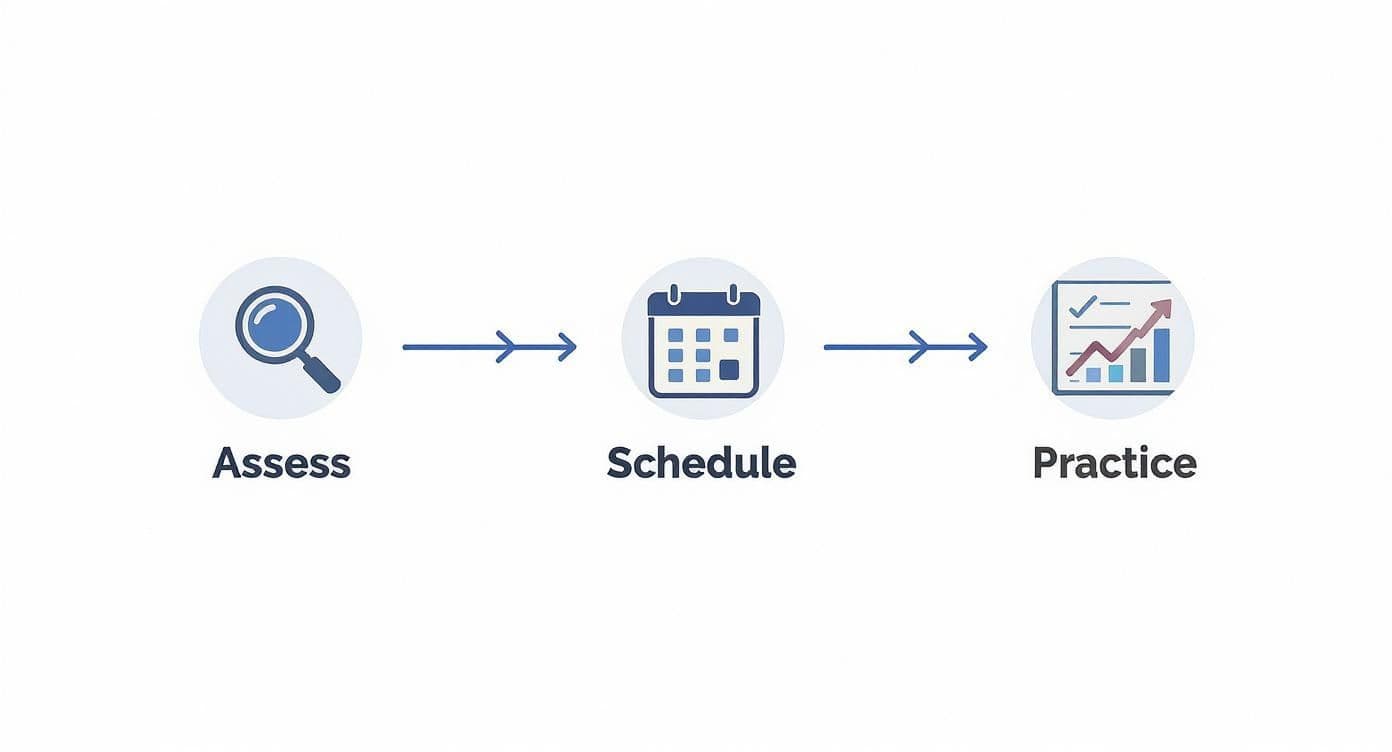
It’s a cycle. Your practice sessions will give you feedback, which helps you reassess your skills and tweak your schedule as you go.
Start With an Honest Self-Assessment
Before you even think about frameworks or mock interviews, you need a clear picture of where you are right now. This first step is crucial. It stops you from wasting time on things you’re already good at and forces you to face the areas where you're weak.
You have to be brutally honest with yourself. Ask these questions:
- Quantitative Skills: How’s your mental math under pressure? Can you nail percentage calculations, find a break-even point, or size a market on the fly, no calculator allowed?
- Structured Thinking: Can you take a big, messy problem and break it down into a clean, logical structure? Think MECE (Mutually Exclusive, Collectively Exhaustive).
- Business Acumen: Are you solid on the fundamentals? Things like profitability drivers, market dynamics, and basic competitive strategy should feel familiar.
A great way to get a quick read is to time yourself on a couple of market-sizing drills. Or grab a practice case from a firm’s website and just try to structure it. The results will immediately show you where to start.
Set a Realistic Schedule
Your timeline is the scaffolding for your entire prep plan. It sets the pace and focus of your practice. If you're a student with a whole semester, you can afford a slow and steady ramp-up. But if you're an experienced professional with a deadline looming, you’ll need a much more intense, compressed schedule.
The key is consistency over cramming. A focused hour every day is far more powerful than a frantic eight-hour marathon once a week. That steady rhythm builds mental muscle and keeps the concepts sharp.
Let's be real—sticking to a plan is tough. Getting a handle on some actionable self-discipline techniques can make all the difference. Committing to a schedule you can actually manage is the best way to avoid flaming out right before the big day.
Tailored Preparation Timelines by Candidate Profile
Not everyone's prep journey looks the same. Your background—whether you're coming from an MBA program, undergrad, or another industry—shapes what you need to focus on. Use this table to get a sense of a timeline and focus that fits your profile.
| Candidate Profile | Recommended Timeline | Key Focus Areas | Weekly Practice Goal |
|---|---|---|---|
| MBA Student | 10-12 Weeks | Business intuition, advanced frameworks (M&A, PE), peer practice. | 3-4 live cases |
| Undergraduate | 8-10 Weeks | Foundational frameworks, quantitative drills, structuring practice. | 2-3 live cases |
| Experienced Hire | 4-6 Weeks | Industry-specific cases, storytelling, translating experience. | 4-5 live cases |
Remember, these are just starting points. The most important thing is to adapt the plan based on your initial assessment and how you progress.
Select the Right Resources
There's a firehose of prep material out there—online libraries with over 500 cases, video courses, and countless drills. It's easy to get overwhelmed.
Don't try to boil the ocean. Instead, curate a small, high-quality toolkit. A couple of trusted case books are great for the fundamentals. Find one good source for practice cases. Then, line up a partner or a platform for mock interviews. The point is to pick resources that click with your learning style and then stick with them.
Mastering Core Case Frameworks
Frameworks are the mental scaffolding you build to break down messy business problems. They're absolutely essential, but they're also where so many candidates go wrong. The biggest trap is treating them like rigid templates you just memorize and spit back out.
Let me be clear: top firms aren't looking for someone who can just list the 4Ps. They want a strategic thinker who gets the logic behind the framework and can mold it to fit any situation.
Think of frameworks as a customizable toolkit, not a script. Your job is to pick the right tool—or sometimes combine a few—to build a structure that actually solves the problem in front of you. Simply "framework dumping" a generic structure onto a nuanced case is one of the fastest ways to get a "no." The real goal is to internalize why a framework works so you can think on your feet when the pressure is on.

When you can customize your approach, you’re showing genuine business insight. It proves you're not just following a formula; you're actively trying to solve the client's specific issue.
From Memorization To True Understanding
The first real step is to get past rote learning. Don't just know what the 3Cs are (Company, Customers, Competition). You need to ask yourself why those are the critical pillars for almost any strategic question. Understanding that underlying logic is what gives you the flexibility to adapt.
A great way to practice this is to take a core framework and apply it to a company you know inside and out, like Nike or Apple. How would you analyze their profitability? Who are their key customer segments, and what are their competitors' biggest weaknesses? This little exercise turns abstract concepts into practical, usable tools. For a deeper look at this process, check out our complete guide on building a solid framework for any case interview.
Let’s walk through how to apply this kind of thinking to a few essential frameworks.
-
Profitability Framework (Revenue – Costs = Profit): This is the bedrock. You should always break revenue down into its core drivers (e.g., price x volume) and costs into fixed versus variable buckets. In a real case about a struggling airline, you wouldn't just say, "costs are up." You'd dig deeper. Are fuel costs (variable) surging, or are the new aircraft leases (fixed) the real problem?
-
4Ps Framework (Product, Price, Promotion, Place): This is your go-to for any marketing or product launch case. Picture a tech company launching a new smartwatch. You'd use the 4Ps to guide your questions: What unique features does the product have? What price point makes sense against competitors? Which promotion channels (social media, influencers) will reach our audience? And where will we sell it (place)—online only, or in retail stores?
-
Porter's Five Forces: Pull this out when you need to assess how attractive an industry is, especially for market entry or investment cases. It helps you get the full picture of the competitive landscape by looking at the power of buyers and suppliers, the threat of new entrants and substitutes, and the intensity of existing rivalry. It forces you to think systematically about market dynamics, not just the obvious competitors.
The Power Of Business Intuition And Key Data
Frameworks give you the structure, but your business acumen is what fills in the details. A huge part of your prep should involve building a mental database of key statistics that allow you to make logical, defensible assumptions. Interviewers expect you to have a feel for fundamental figures, especially during market sizing drills, to ground your analysis in reality.
You don’t need to be an encyclopedia, but knowing core population figures, economic indicators, and business benchmarks is non-negotiable. It’s what separates a wild guess from an educated estimate.
This means you’ll need to memorize some essential data points. The world population is roughly 8 billion, and the Gross World Product is about $96 trillion. The United States has about 330 million people, and knowing key city populations—like New York City with 8.9 million, Los Angeles with 3.9 million, and Chicago with 2.8 million—can be incredibly helpful benchmarks.
Similarly, knowing that the US corporate tax rate is 21% or that around 30% of Americans have a bachelor's degree can add instant credibility to your calculations. These aren't just trivia; they are the facts that will make your analysis believable.
Developing Skills Through Targeted Drills
Knowing the frameworks is one thing. Executing them flawlessly under pressure is another. The real gap between good and great candidates is closed by consistent, focused practice. Once you’ve got a handle on the core structures, it’s time to build muscle memory through targeted drills. Think of it less like studying and more like live-fire exercises that get you comfortable with the pace and pressure of a real interview.
Drilling specific case types over and over again hardens your analytical skills. It makes your thinking faster, your questions sharper, and your structure tighter. The goal is to reach a point where you’re not consciously trying to recall a framework; you're just intuitively applying a logical structure to the problem in front of you. That’s the kind of fluid problem-solving top firms are looking for.
Deconstructing Market Sizing Drills
Market sizing questions are an absolute classic. They’re a fantastic way for interviewers to test your logical thinking, your comfort with numbers, and your ability to make reasonable assumptions on the fly. You'll get prompts like, "Estimate the annual revenue for electric scooters in Chicago," or "How many golf balls are sold in the U.S. each year?"
You really only have two ways to attack these:
- The Top-Down Approach: You start with a huge, known number—like the entire U.S. population—and methodically slice it down with logical assumptions.
- The Bottom-Up Approach: Here, you start small with a single unit, like one coffee shop or one consumer, and build your way up to the total market size.
For instance, if you're asked to size the U.S. market for organic toothpaste, a top-down approach would start with the U.S. population of roughly 329 million. From there, you'd start filtering: segment by age, assume what percentage of each group buys organic products, estimate how often they buy, and finally, tack on an average price. Getting comfortable with both approaches is non-negotiable.
Mastering Profitability Cases
Profitability cases are another pillar of consulting interviews. The setup is simple: a company's profits are tanking, and you need to figure out why and what to do about it. The entire case boils down to one powerful equation: Profit = Revenue - Costs.
Your first move, always, should be to break the problem down along that line. Is this a revenue problem or a cost problem? But don’t stop there. A strong candidate immediately drills down another level on each side of the equation.
Saying "we need to increase revenues" gets you nowhere. A consultant asks, "Have our prices changed? Has our sales volume dropped, and if so, in which region? Are we losing a specific customer segment?" That kind of specificity is what demonstrates real business instinct.
This is all about a methodical diagnostic process. Once you’ve isolated the driver—let's say it's a drop in sales volume for a high-margin product—you can then shift gears and start brainstorming sharp, actionable solutions.
Tackling M&A And Market Entry Questions
Ready to think bigger? Merger & Acquisition (M&A) and Market Entry cases test your strategic thinking on a much larger scale. These are about evaluating massive business decisions with huge financial implications, and the key is to stay balanced. You have to weigh the exciting opportunities against the very real risks.
A clear, logical structure is your best friend here. Before you can recommend a course of action, you need to understand the landscape from multiple angles.
The table below breaks down some of the most common case types and the critical clarifying questions you should be asking right from the start.
Common Case Types and Key Questions to Ask
| Case Type | Primary Objective | Initial Questions for Your Interviewer |
|---|---|---|
| Market Entry | Decide if a company should enter a new market. | What is the size and growth rate of this market? Who are the key competitors and what is their market share? What are the primary barriers to entry (e.g., regulations, capital)? |
| M&A | Advise a company on acquiring another business. | What are the strategic goals of this acquisition (e.g., market share, new capabilities)? What are the potential synergies (cost and revenue)? What is the target company's financial health? |
| Profitability | Diagnose the root cause of declining profits. | By how much have profits declined and over what period? Has this been an industry-wide trend or is it specific to our company? Can you break down revenues by product/region and costs by fixed/variable? |
| Pricing | Determine the optimal price for a new product. | What is the objective of our pricing strategy (e.g., maximize profit, gain market share)? What are our competitors' prices for similar products? What is the perceived value to the customer? |
Using these questions as a starting point helps you build a solid, MECE (mutually exclusive, collectively exhaustive) framework that impresses the interviewer and sets you up for success.
Interpreting Charts And Data
In a lot of modern interviews, you’ll be handed a chart or a data table and asked, “So, what does this tell you?” This is not just a test of your reading comprehension; it’s a test of your ability to quickly synthesize information and pull out a meaningful business insight. This is where your numerical reasoning skills are put to the test.
The interviewer is looking for three things:
- The "So What?": Don't just narrate the data ("Sales went up in Q3"). Find the insight ("Sales spiked in Q3, which lines up perfectly with our new marketing campaign, suggesting a strong ROI").
- Pattern Recognition: Can you spot the trend? The outlier? The meaningful comparison between two different data sets?
- Hypothesis Generation: Use the data to form a hypothesis you can then explore throughout the rest of the case.
There’s no shortcut here—you just need practice. To sharpen your quantitative edge, our guide on preparing for a numerical reasoning test is packed with useful drills. The more charts you work through, the less likely you are to be caught off guard when one is slid across the table.
Getting Battle-Ready with Mock Interviews and Feedback
Drilling case problems on your own builds a solid analytical foundation, but it's only half the battle. You can have the most brilliant framework in your head, but if you can't communicate it under pressure, it won't land. The interview isn't a test you take in a vacuum; it’s a live performance.
This is where mock interviews become your most powerful tool. They bridge the gap between theory and reality, turning your hard-earned knowledge into a skill that holds up when the pressure is on.

Practicing with a live partner forces you to think out loud, pivot when new data comes in, and handle those curveball questions that interviewers love to throw. Think of it as a full-dress rehearsal—it’s your chance to stumble and get your nerves out of the way in a low-stakes setting. Every mistake you make in a mock is one less mistake you'll make when it really counts.
Finding the Right Practice Partners
The quality of your mock interviews hinges entirely on who you practice with. You need partners who are just as invested in this process as you are—people who will give you structured, brutally honest, and actionable feedback.
Here’s where to look:
- University Career Centers: If you're an MBA or undergrad, your school likely has a system for connecting students for case practice. Use it.
- Online Platforms: Websites like LinkedIn and specialized case prep forums are goldmines for finding partners outside your immediate circle.
- Your Network: Tap into your connections. Find peers or alumni who have been through the consulting recruiting gauntlet recently. They get it.
Once you find someone, lay down some ground rules. Agree to take both roles—interviewer and candidate—seriously. A great partner won’t just hand you the case; they’ll challenge your assumptions and push you with tough follow-ups, just like a real interviewer.
How to Run a Killer Mock Session
A productive mock isn't just about "doing a case." It needs structure to maximize learning for both people. I've found the sweet spot is a 60-minute session, broken into three parts.
This approach ensures you get the practice and the deep-dive analysis needed to actually get better.
- The Live Case (30 minutes): One person plays the interviewer, setting the scene and guiding the case. The other is the candidate, solving the problem against the clock. The key is to stay in character. No breaks, no hints unless they’re part of the script.
- The Feedback Exchange (25 minutes): This is where the magic happens. The "interviewer" should give detailed, constructive feedback based on a rubric—hitting on structure, quant skills, business judgment, and communication.
- The Quick Debrief (5 minutes): Wrap up by identifying the 1-2 biggest areas for the candidate to work on. Keep it focused and actionable.
To take your self-analysis to the next level, I highly recommend using screen recording for training to capture your sessions. It can be cringe-worthy to watch yourself, but it's the best way to see exactly where you stumbled over your words or how you presented your framework on paper.
Turning Feedback into Real Improvement
Getting feedback is a skill. Your instinct might be to get defensive, but you have to fight it. Listen intently and ask clarifying questions to get to the root of the issue. Don't just nod along—dig in.
Feedback is a gift. It's a direct, personalized roadmap showing you exactly what you need to fix. The candidates who improve the fastest are the ones who actively seek out and implement harsh, honest feedback.
Once you have that feedback, close the loop. If your math gets sloppy under pressure, your next few drills should be purely quant-focused. If your recommendations are feeling weak, practice delivering a top-down summary five times in a row until it feels natural.
This is the cycle that drives real progress: practice, get feedback, drill the weakness, and repeat. It’s how you turn generic practice into a targeted system that plugs your gaps and builds unshakable confidence for interview day.
Your Final Week Interview Strategy
The finish line is in sight. This final week isn't about cramming; it's a strategic cool-down designed to get you mentally and physically primed. The goal is to taper your prep, consolidate what you know, and walk into that interview feeling sharp and calm—not burned out from a frantic final sprint.

Think of it like an elite athlete getting ready for a championship. The hardest training is already done. This week is all about light drills, reviewing the playbook, and getting your head in the game. You want to show up on game day rested and ready to perform at your absolute best.
Tapering Your Case Practice
Whatever you do, resist the urge to grind through ten more mock interviews. At this point, burnout is a much bigger risk than being underprepared. You need to shift your focus from learning new things to simply keeping your existing skills sharp and ready.
A good final practice schedule might look something like this:
- 7 to 4 Days Out: Do one, maybe two, full mock interviews with a partner you trust. This is a good time to hit your weaker case types one last time to iron out any remaining kinks.
- 3 to 2 Days Out: Switch to lighter, solo drills. Run through a few market sizing or profitability exercises. This keeps your quant brain active without the full mental load of a complex case.
- The Day Before: No new cases. Seriously. Your only job is to relax. Skim your notes, look over your favorite frameworks one last time, and then put it all away.
This gradual step-down prevents mental fatigue and ensures your analytical horsepower is at its peak right when you need it.
Sharpening Your Fit and Behavioral Stories
As you ease up on case drills, you should ramp up your focus on the "fit" portion of the interview. These behavioral questions are just as important, and having polished, ready-to-go stories will do wonders for your confidence.
An interviewer once told me, "We hire for aptitude, but we promote for attitude." Your ability to tell a compelling story is just as critical as building a perfect profitability tree. They want to know if you're someone they'd want on their team at 11 PM during a tough project.
Pull out your resume and map out concise, impactful stories for the classic prompts: "Tell me about a time you led a team," or "Describe a situation where you had to influence a difficult stakeholder." Using the STAR method (Situation, Task, Action, Result) is a fantastic way to keep your answers structured and powerful.
Managing Nerves and Final Logistics
Don't underestimate the small stuff. Getting the practical details sorted out early eliminates a huge source of last-minute stress.
- Prepare Smart Questions: Brainstorm three to five genuinely insightful questions for your interviewers. Skip the generic stuff about "company culture." Ask about a specific project they worked on or a challenge their industry practice is grappling with right now.
- Plan Your Day: If it's a virtual interview, test your tech. Check your camera, mic, and internet connection. If it's in person, plan your route and figure out parking. Lay out your outfit the night before.
- Embrace the Nerves: It’s completely normal to be nervous. Simple breathing exercises are surprisingly effective. Before you walk in or click "Join Meeting," take a few slow, deep breaths. This small action can lower your heart rate, clear your mind, and help you start strong.
Your Top Case Interview Questions, Answered
As you get deeper into case prep, you're going to have questions. Everyone does. The internet is full of conflicting advice, and it's easy to get sidetracked. This section is here to cut through that noise.
Think of this as a straight-to-the-point FAQ from someone who's been in the trenches. We'll tackle everything from how many mocks you really need to do, to how you should deliver that final, high-stakes recommendation.
How Many Mock Interviews Should I Do?
There’s no magic number here. Anyone who tells you there is, is selling something. That said, most successful candidates land somewhere in the 20 to 40 range.
But here’s the critical part: it’s all about the quality of those mocks. I’d rather see a candidate do 20 incredible mocks with detailed, tough feedback than 50 where they’re just going through the motions.
Break down your practice into phases:
- First 10 Mocks: This is purely about getting your reps in. Your goal is to get comfortable thinking out loud, slapping a basic framework on a problem, and just managing the clock without panicking.
- Mocks 11-25: Time to broaden your horizons. You need to practice with as many different people as you can find. This is how you get exposed to different interview styles, new case types, and unexpected questions. It builds adaptability.
- Mocks 26 and beyond: Now, you need to be picky. Only practice with partners who give you structured, rubric-based feedback that can pinpoint exactly where you're weak. Every single session from here on out should give you a clear, actionable thing to work on.
Keep a simple log of your performance. If you notice you're consistently fumbling the math or rushing the conclusion, that's your cue to drill those specific skills.
What Are The Biggest Mistakes To Avoid?
A few classic mistakes can sink even a smart candidate. Knowing what they are is half the battle.
The absolute most common error is the dreaded "framework dump." This is when a candidate hears a prompt, immediately blurts out a generic framework like "Profitability," and then mechanically walks through it without actually listening to the case details. It screams "I memorized a script" instead of "I can think critically."
Another killer is an uncorrected math error. Look, everyone makes small calculation mistakes under pressure. That's fine. The real problem is when you don't sense-check your numbers and that small error completely derails your entire analysis. Always, always take a half-second to ask yourself, "Does this number seem reasonable?"
Finally, thinking silently is a non-starter. The interviewer isn't a mind reader. They are there to evaluate how you think, which means you have to narrate your thought process. Talk through your hypotheses, your assumptions, and your calculations.
Is Deep Industry Knowledge Required?
For most candidates, the answer is a firm no. A case interview is designed to test your problem-solving process, not your encyclopedic knowledge of a specific industry. The exception, of course, is if you're an experienced hire applying for a specialized role, like a supply chain expert for an operations practice.
You are expected to have a good dose of business acumen. Understanding basic concepts like revenue, costs, market dynamics, and competition is table stakes. You are not expected to be an expert on the nuances of the German chemical industry or the Latin American fintech market.
A truly great candidate shines when they tackle a case in an industry they know nothing about. They prove their mettle by asking smart, clarifying questions and breaking down the problem using pure logic and a first-principles approach.
That being said, it doesn't hurt to be well-read on a few industries that you find genuinely interesting. It can add a bit of color and commercial awareness to your ideas, but it should never be a crutch that replaces a solid, structured analysis.
How Should I Structure A Final Recommendation?
This is it—the grand finale. Your final recommendation is the last impression you'll leave. It needs to be sharp, confident, and grounded in the data you've uncovered. No waffling.
The best recommendations follow a simple, top-down structure:
- State Your Recommendation Upfront: Get straight to the point. Start with a direct, unambiguous answer. "Yes, based on my analysis, I recommend our client enter the U.S. electric scooter market."
- Give Your Top Supporting Reasons: Immediately back up your claim with your two or three most powerful arguments. Each one should be tied to a specific number or insight from your analysis. For example, "...this is driven by a potential market size of $2.4 billion, strong projected profit margins, and a fragmented competitive landscape ripe for disruption."
- Acknowledge Risks & Outline Next Steps: Show you've thought it through by briefly mentioning the main risks ("The key risks to consider are potential regulatory hurdles and the threat of intense price competition."). Then, give them a clear, actionable path forward ("As an immediate next step, I would recommend launching a pilot program in three key cities to validate our demand assumptions.").
This structure proves you can synthesize a mountain of information, make a decisive call, and think strategically about how to make it happen. For more practice on making solid, data-backed assumptions, especially during the initial phases of a case, check out our detailed guide on tackling market sizing questions.
At Soreno, we believe that targeted, on-demand practice is the key to walking into your interview with confidence. Our AI-powered platform provides unlimited mock interviews with an MBB-trained AI, offering instant, rubric-based feedback on everything from your structure to your communication style. Stop waiting for partners and start accelerating your case interview preparation today at https://soreno.ai.