














AI new product launch case practice

New product launch case interview practice with AI

Realistic new product launch cases with exhibits and math, graded instantly. Start your free week with full feedback.

User
User
User
User
Join 15,000+ candidates this cycle
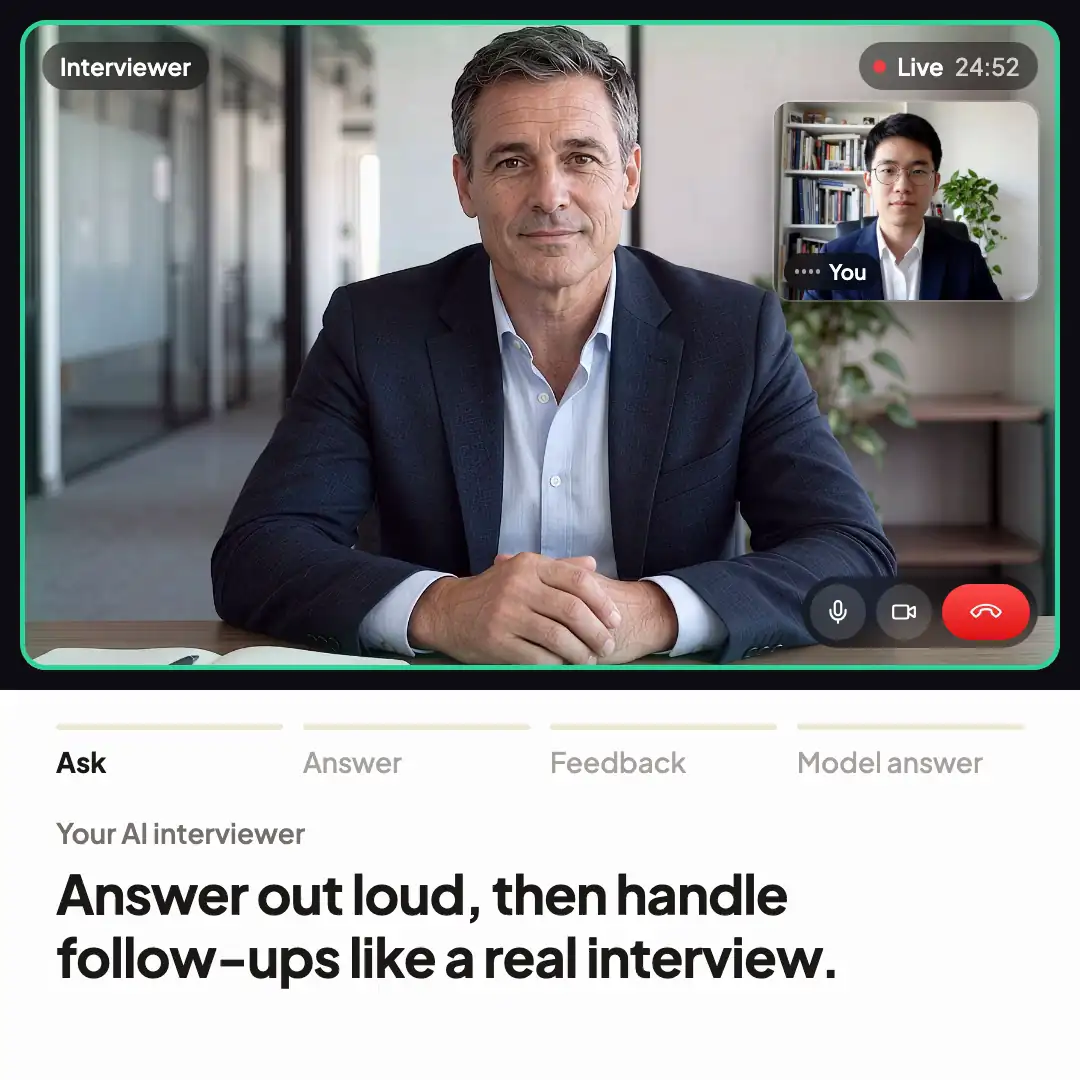
A live Soreno case mock: the AI interviewer gives a profitability case, you answer out loud, then see your score and a model answer
“Soreno quoted the exact moment my answer went vague, then gave me the line I should have said next.”
— Rachel K. · Offer from Oliver Wyman

11,900+ applicants accepted at top firms, with over 1.2 million minutes of practice completed.

What is a new product launch case interview?

A new product launch case interview asks whether a company should launch a product. Check the market size and the customer need, competitors and the company's ability to make and sell it, then run the economics: volume ramp times margin, less fixed costs, against the launch cost. Take out cannibalization, find break-even and payback and make a go or no-go call.

Last checked November 21, 2026

Try the free sample case, no sign-upSee a case worked in fullNew product launch case interview guide

One answer, scored

See one recommendation go from 73 to 84

Soreno scores every mock out of 100, then gives you clear, specific fixes to exactly what you said.

A premium fitness chain saw its EBITDA margin fall 380 bps

Final question · What do you recommend to the CEO?

Score 73 out of 100
+0 points

What you said

“The margin drop is meaningful, so I would look at pricing and operations next. I think they should fix discounting and cut some costs.”

Here's how to say it better

  1. “The margin drop is meaningful…”

    +4

    Leads with the dollar impact, so the size of the problem is clear.

  2. “…so I would look at pricing and operations next.”

    +4

    Ranks the levers instead of listing them.

  3. “I think they should fix discounting and cut some costs. ”

    +3

    Ends on one decision, a reason and a next step.

Get your answers scored
About 30 minutes a mock

How a Soreno mock works

Get the case, answer out loud, then see exactly where the answer stands and what to change.

  1. Your client is a premium fitness chain...
    1

    Get the case

    An AI interviewer gives you the case out loud, shares exhibits and answers your clarifying questions.

  2. You

    12:40

    I'd split this into price, volume and unit cost, then test which one explains most of the margin drop

    2

    Answer out loud

    Structure it, do the math and make your recommendation while the interviewer probes, the way a real one does.

  3. This mock

    84 / 100

    B+ · +11

    Your answer, upgraded

    Lead with the $48M, then rank pricing, mix and cost before you recommend.

    3

    A score on every mock

    Structure, content (your math and judgment) and communication scored out of 100, with your own words quoted and a model answer to compare.

Scored out of 100 on every mock

Every case, scored like an interviewer would

Interviewers judge your structure, your content (the math and the business judgment) and how clearly you say it. Soreno scores each one, quotes the moment that cost you points, and shows the stronger answer.

  • A score out of 100 on every mock

    Plus a letter grade and how far you moved since the last one.

  • A score for each skill

    See whether structure, content or communication held the case back.

  • Your own words, quoted and fixed

    Timestamped moments from your answer, with the line to say next time.

Get your first case scored
Free sample case

A new product launch case you can try now

A sequence of questions: the volume, the economics, cannibalization and a go or no-go call.

Step 1. Read the case

Brightwell Appliances: launch a smart countertop oven?

The interviewer reads you the case

Your client is Brightwell Appliances, a US maker of small kitchen appliances sold through large retailers. Its product team wants to launch a smart countertop oven that cooks from a phone app. The CEO asks whether Brightwell should launch it. The board wants any launch to pay back within 3 years. Brightwell Appliances and every number here are invented.

An original practice case written by Soreno. Everything stays in your browser.

Step 2. Ask clarifying questions

Restate the decision and the board's test in one line, then ask two or three questions.

Step 3. Structure your answer

Question 1 from your interviewer: "How would you decide whether Brightwell should launch this oven?" Take a minute to write your structure, then say it out loud.

1:30

Now do a full case out loud

Soreno's AI interviewer gives you a full case, asks follow-up questions on your structure and math, and scores your answer. The 7-day free trial.

Continue with the AI interviewer

Account required to start the trial. Cancel anytime before it ends.

Framework outline

How a new product launch case is structured

A new product launch case asks for a decision, not a marketing plan. This framework checks whether the market and the customer are there, whether the company can win, and whether the numbers pay back the launch cost in time.

The new product launch framework as a tree

Should the client launch this product?

  • Market and customer

    • Units sold a year and growth
    • The unmet need
    • Segments that care most
  • Competition

    • Close substitutes and their share
    • How rivals would respond
  • Capabilities

    • Make it or partner
    • Channels to sell it
    • Support after the sale
  • Economics

    • Price and unit cost
    • Volume ramp
    • Fixed and one-time launch cost
    • Break-even and payback
  • Cannibalization and risks

    • Margin lost from own products
    • Slower ramp or price war
    • Go or no-go gate
  1. 01

    Name the decision and the test

    Ask what the client wants from the launch (profit, share or defending a position) and how it will judge it. A payback limit or a minimum return turns a vague question into one you can answer with numbers.

  2. 02

    Size the market and the need

    How many units sell a year, is the market growing, and what does the new product do that buyers cannot get today? A real customer need is what makes a share forecast believable.

  3. 03

    Check competitors and capabilities

    Who sells something close, how they would react and what share they hold. Then ask whether the client can make it, sell it through its channels and support it, or would need a partner.

  4. 04

    Run the launch economics

    Volume ramp times margin per unit, less fixed costs each year, against the one-time launch cost. Keep per-unit, yearly fixed and one-time costs apart. Find the break-even volume and the payback year.

  5. 05

    Take out cannibalization

    Some buyers of the new product would have bought one of the client's own products. Subtract that lost margin per unit. It often decides a close call.

  6. 06

    Make the call and name the risks

    Go or no-go, with the number it rests on. Say how far volume can fall before it fails, the biggest risks and a checkpoint that would stop or scale the launch.

Use these steps as a checklist, then build your structure from the client's question. Kearney tells candidates to avoid forcing a solution into a standard framework, and McKinsey asks for tailored solutions over standard frameworks.

Worked example

A new product launch case, worked in full

An original case with illustrative numbers that add up. Read the prompt, try your own structure first, then compare.

Pinecrest Coffee: should it launch canned cold brew?

Pinecrest Coffee runs cafes in one region and wants to sell canned cold brew in grocery stores there. It wants the launch to pay back within 2 years. Should it launch? Pinecrest and every number here are invented.

  1. 1. Name the decision and the test

    This is a launch decision with a clear test: the $600,000 one-time cost for the recipe, packaging design and first run must pay back within 2 years.

  2. 2. Size the volume

    Grocery stores in the region sell about 50,000,000 cans of cold brew a year. Pinecrest's brand is known there, and a test shelf suggests 4% of the market in year 1 and 6% in year 2. That is 2,000,000 cans, then 3,000,000.

  3. 3. Margin per can and fixed cost

    Grocers pay $2.00 a can. Coffee, the can, the co-packer's fee and freight cost $1.20 a can, so margin is $0.80 a can. Slotting fees and marketing are $1,000,000 a year, fixed whatever the volume. Before anything else, the two years earn $2,000,000, more than three times the launch cost.

  4. 4. Take out cannibalization

    About 10% of can buyers would otherwise have bought a cold brew in a Pinecrest cafe, which earns $3.00. That costs $0.30 a can, so the real margin is $0.50.

    Two years of canned cold brew profit (illustrative)
    YearCansCan marginCafe margin lostFixed costProfit
    Year 12,000,000$1,600,000$600,000$1,000,000$0
    Year 23,000,000$2,400,000$900,000$1,000,000$500,000
  5. 5. Check payback and the risks

    Over two years the launch earns $500,000, $100,000 short of the $600,000 launch cost. At $0.50 a can it takes 2,000,000 cans a year just to cover the fixed cost, which is all of the year 1 plan. Any slip in volume makes it worse.

The answer, top-down

Do not launch as planned. After the cafe sales it takes, the cold brew earns $500,000 over two years, $100,000 short of the $600,000 launch cost. Without cannibalization it would look like an easy yes at $2,000,000. Test it first in stores far from Pinecrest's cafes, where fewer buyers would come from its own cups, and launch wider only if that holds.

4 new product launch case prompts to practice

Original prompts written by Soreno. Give yourself two minutes to structure each one out loud, then open the outline.

  1. 1A sports drink maker is thinking about launching a sugar-free version. Should it?

    Answer outline
    • Size the sugar-free market and how fast it grows against the regular one.
    • Estimate how many buyers would switch from the regular drink and the margin lost.
    • Compare the new margin per bottle and launch cost with the payback the client wants.
    • Recommend go or no-go and what share would change the answer.
  2. 2A bank wants to launch a credit card for small businesses. How would you decide?

    Answer outline
    • Size the target businesses and how many already have a card they like.
    • Check what the bank brings: existing business customers, branches and approval data.
    • Model fees and interest per card, less losses on bad loans and the cost to win each customer.
    • Find break-even cards and the year the launch pays back.
  3. 3A car maker is deciding whether to launch a cheaper electric model. What do you look at?

    Answer outline
    • Size demand at the lower price and which buyers it reaches.
    • Check whether the plant and suppliers can hit the unit cost.
    • Count sales taken from its own pricier models and from its gas cars.
    • Weigh the launch investment against margin per car and the payback.
  4. 4A software company built a new analytics product. Should it sell it on its own or add it to its main product?

    Answer outline
    • Find who needs it and whether they already pay for the main product.
    • Compare new revenue sold on its own with fewer customers leaving if it is added.
    • Count the fixed cost to support it either way.
    • Recommend one option and the measure to check after six months.

Where candidates lose points

  • Answering how to market the product before deciding whether to launch it.
  • Counting every unit as new profit and forgetting sales taken from the client's own products.
  • Mixing per-unit, yearly fixed and one-time launch costs, so the payback is wrong.
  • Taking the share forecast as fact without checking it against the market and rivals' shares.
  • Giving a number with no go or no-go call, or a call with no number behind it.
  • Ignoring whether the client can actually make, sell and support the product.

Product launch case interviewLaunching a premium pet food lineMarket entry case practicePricing case practiceBreak-even calculatorAll case interview questionsCase math drillsCase interview partnerAll practice by firm and case type

Side by side

How Soreno compares to other ways to practice

A course from zero, a live AI case interviewer that follows up on what you say, and a score out of 100 on every mock, all in one place and ready whenever you are.

FeatureSorenoA coach
Practice any time, day or nightScheduled
A live interviewer who probes and shares exhibitsAI interviewer
A course that starts from zeroZero to HeroVaries
Practice one stage of a case at a timeAbout 6 minOn request
A score out of 100 on every mockTheir notes
Unlimited mocks on a paid planPer session
Consulting and finance rolesTheir specialty
Video recording and playbackVaries
PriceFree week, then $199/moPer hour
FeatureSorenoA coachA courseA case buddy
Practice any time, day or nightScheduledSelf-pacedScheduled
A live interviewer who probes and shares exhibitsAI interviewerSelf-studyA peer
A course that starts from zeroZero to HeroVariesSelf-study
Practice one stage of a case at a timeAbout 6 minOn requestSelf-studyOn request
A score out of 100 on every mockTheir notesSelf-checkTheir notes
Unlimited mocks on a paid planPer sessionSelf-pacedAs scheduled
Consulting and finance rolesTheir specialtyVariesVaries
Video recording and playbackVariesVariesVaries
PriceFree week, then $199/moPer hourOne-off feeFree
Verified offers

What Soreno candidates say

Real candidates, real offers, in their own words.

McKinsey & Company

“What sold me on Soreno was being able to jump straight into a mock case without knowing anything…”

Alex Chen

McKinsey offer after 28 sessions

Boston Consulting Group

“The AI asks pretty tough follow up questions and the evaluation is quite strict…”

Daniel C.

BCG offer after 22 sessions

Bain & Company

“I recommend everyone to start with the drills, they're kinda like mini cases, then work up to full mocks.”

Maya Singh

Bain offer, score up 16 points

Deloitte

“…there's no judgment when you mess something up. You can just restart and go again.”

Priya N.

Deloitte offer after 18 sessions

Oliver Wyman

“I loved how Soreno was able to let me know exactly what I did good and bad during the interview…”

Rachel K.

From 0 to an Oliver Wyman offer in 8 weeks

Soreno in numbers

11,900+
applicants accepted at top firms
1.2M+
minutes practiced on Soreno
Plans and Pricing

Choose your best plan

Start your free week, then choose a plan. Cancel anytime.

1 week

For a round that is days away

Unlimited mock interviews

  • = about $11 a day
  • Cases, banking technicals and fit, out loud
$79

per week

Start your free week

Billed weekly

Included at no extra cost

  • Zero to Hero courseCase or finance
  • Day-by-day prep planEach interview
  • Skill drillsUnlimited
  • Session recordingsWith feedback

Practice library

  • Full case interviews100+
  • Banking interview questions1,800+
  • Consulting fit questions100+
  • Banks with fit questions29
  • A voice AI interviewer that asks follow‑up questions
  • Exhibits and a model answer for every case
  • A score out of 100 after every mock
  • Feedback that quotes your answer, with a next-step plan
  • Filler-word and eye-contact notes on recorded sessions
  • Drills for case math, market sizing, structuring and charts
  • Consulting, banking and behavioral practice in one plan
  • Add your own practice questions

1 month

Save 42%Recommended

For steady practice across recruiting

Unlimited mock interviews

  • = about $7 a day
  • Cases, banking technicals and fit, out loud
$199vs $342 a month on Weekly

per month

Start your free week

Save $143 a month compared to weekly

Included at no extra cost

  • Zero to Hero courseCase or finance
  • Day-by-day prep planEach interview
  • Skill drillsUnlimited
  • Session recordingsWith feedback

Practice library

  • Full case interviews100+
  • Banking interview questions1,800+
  • Consulting fit questions100+
  • Banks with fit questions29
  • A voice AI interviewer that asks follow‑up questions
  • Exhibits and a model answer for every case
  • A score out of 100 after every mock
  • Feedback that quotes your answer, with a next-step plan
  • Filler-word and eye-contact notes on recorded sessions
  • Drills for case math, market sizing, structuring and charts
  • Consulting, banking and behavioral practice in one plan
  • Add your own practice questions

1 year

Save 76%BEST VALUE

For several roles, firms or rounds

Unlimited mock interviews

  • = about $2 a day
  • Cases, banking technicals and fit, out loud
$48vs $199 a month on Monthly

per month, billed $579 yearly

Start your free week

Save $1,809 compared to monthly

Included at no extra cost

  • Zero to Hero courseCase or finance
  • Day-by-day prep planEach interview
  • Skill drillsUnlimited
  • Session recordingsWith feedback

Practice library

  • Full case interviews100+
  • Banking interview questions1,800+
  • Consulting fit questions100+
  • Banks with fit questions29
  • A voice AI interviewer that asks follow‑up questions
  • Exhibits and a model answer for every case
  • A score out of 100 after every mock
  • Feedback that quotes your answer, with a next-step plan
  • Filler-word and eye-contact notes on recorded sessions
  • Drills for case math, market sizing, structuring and charts
  • Consulting, banking and behavioral practice in one plan
  • Add your own practice questions
FAQ's

Frequently Asked Questions

Everything you need to know about Soreno, answered in one place.

A new product launch case interview asks whether a company should launch a product. Check the market size and the customer need, competitors and the company's ability to make and sell it, then run the economics: volume ramp times margin, less fixed costs, against the launch cost. Take out cannibalization, find break-even and payback and make a go or no-go call.
A launch case decides whether to launch at all, from the market, the company's strengths and the payback. A go-to-market case starts once the answer is yes and asks how to sell it: which customers, which channels and what price.
Sales of the new product that would otherwise have gone to one of the client's own products. Multiply the share of buyers who would have switched by the margin on the old product, and subtract that from the new product's margin per unit.
Add up profit after fixed costs year by year until it covers the one-time launch cost. The year it crosses is the payback year. Compare it with the limit the client set.
No. The sample case runs in your browser with no sign-up, and nothing you type is saved or sent.
Every plan starts with a 7-day free trial. After that, plans are $199 a month or $579 a year, or $79 a week. See the pricing page for details.
User
User
User
User
Join 15,000+ candidates

Run a new product launch case tonight

Start your free week. Your first score in about 30 minutes.

Start your free weekTry 3 free mocks