

















AI go-to-market case practice

Go-to-market case interview practice with AI

Realistic go-to-market cases with exhibits and math, graded instantly. Start your free week with full feedback.

User
User
User
User
Join 15,000+ candidates this cycle
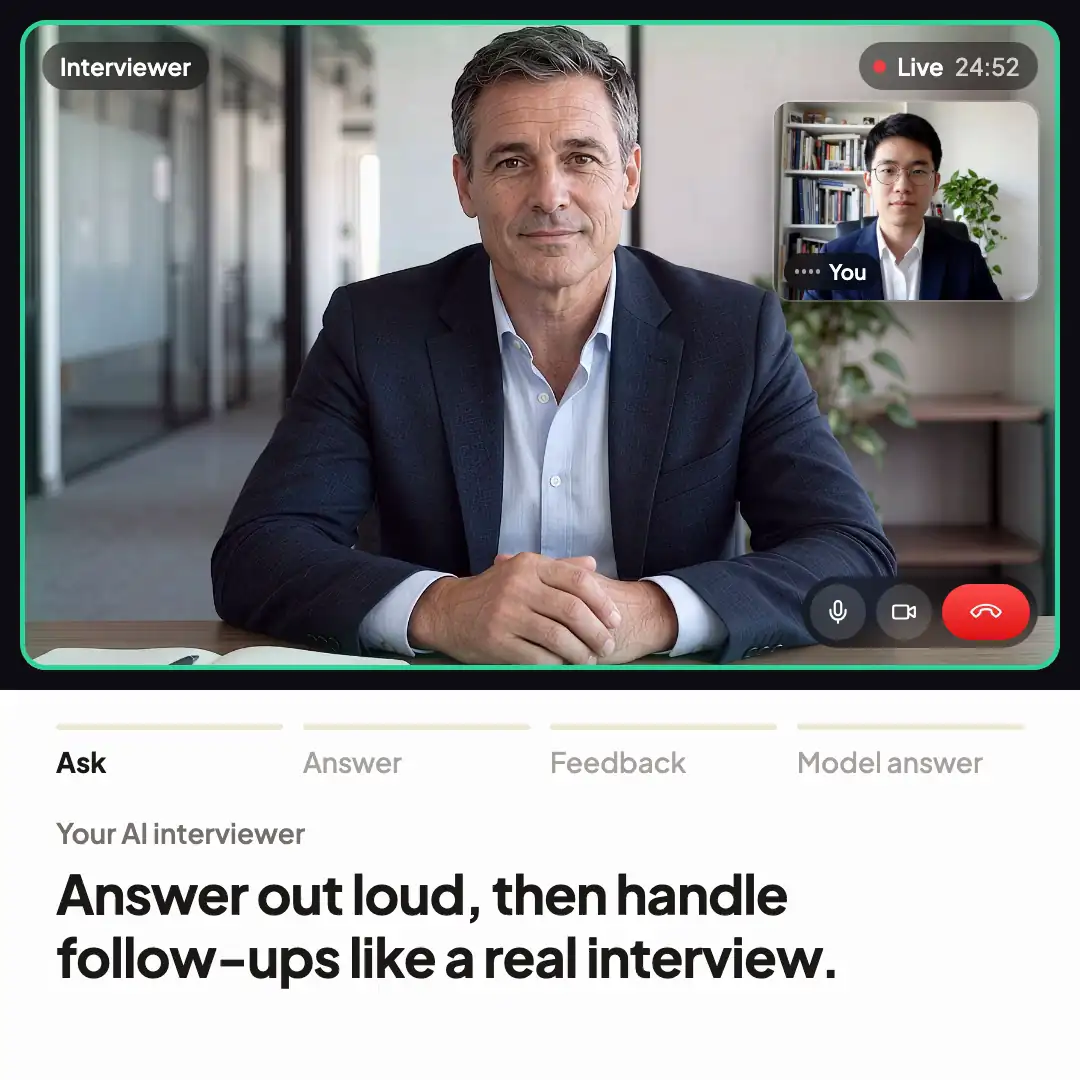
A live Soreno case mock: the AI interviewer gives a profitability case, you answer out loud, then see your score and a model answer
“Soreno quoted the exact moment my answer went vague, then gave me the line I should have said next.”
— Rachel K. · Offer from Oliver Wyman

11,900+ applicants accepted at top firms, with over 1.2 million minutes of practice completed.

What is a go-to-market case interview?

A go-to-market case interview asks how to sell a product that is already decided. Segment the customers and find what each account is worth, then price each channel: direct sales, partners and online. Compare the cost to win a customer with monthly contribution and lifetime value, apply hiring and budget limits, and recommend which segments and channels go first.

Last checked November 21, 2026

Try the free sample case, no sign-upSee a case worked in fullGo-to-market case interview guide

One answer, scored

See one recommendation go from 73 to 84

Soreno scores every mock out of 100, then gives you clear, specific fixes to exactly what you said.

A premium fitness chain saw its EBITDA margin fall 380 bps

Final question · What do you recommend to the CEO?

Score 73 out of 100
+0 points

What you said

“The margin drop is meaningful, so I would look at pricing and operations next. I think they should fix discounting and cut some costs.”

Here's how to say it better

  1. “The margin drop is meaningful…”

    +4

    Leads with the dollar impact, so the size of the problem is clear.

  2. “…so I would look at pricing and operations next.”

    +4

    Ranks the levers instead of listing them.

  3. “I think they should fix discounting and cut some costs. ”

    +3

    Ends on one decision, a reason and a next step.

Get your answers scored
About 30 minutes a mock

How a Soreno mock works

Get the case, answer out loud, then see exactly where the answer stands and what to change.

  1. Your client is a premium fitness chain...
    1

    Get the case

    An AI interviewer gives you the case out loud, shares exhibits and answers your clarifying questions.

  2. You

    12:40

    I'd split this into price, volume and unit cost, then test which one explains most of the margin drop

    2

    Answer out loud

    Structure it, do the math and make your recommendation while the interviewer probes, the way a real one does.

  3. This mock

    84 / 100

    B+ · +11

    Your answer, upgraded

    Lead with the $48M, then rank pricing, mix and cost before you recommend.

    3

    A score on every mock

    Structure, content (your math and judgment) and communication scored out of 100, with your own words quoted and a model answer to compare.

Scored out of 100 on every mock

Every case, scored like an interviewer would

Interviewers judge your structure, your content (the math and the business judgment) and how clearly you say it. Soreno scores each one, quotes the moment that cost you points, and shows the stronger answer.

  • A score out of 100 on every mock

    Plus a letter grade and how far you moved since the last one.

  • A score for each skill

    See whether structure, content or communication held the case back.

  • Your own words, quoted and fixed

    Timestamped moments from your answer, with the line to say next time.

Get your first case scored
Free sample case

A go-to-market case you can try now

A sequence of questions: the segments, the cost of each channel, the budget split and a recommendation.

Step 1. Read the case

Tallypoint: how to sell a restaurant inventory app

The interviewer gives you a prompt and questions

Tallypoint has built an app that tracks food stock and orders for restaurants. It will charge $100 per location per month. The product is ready and the launch is set. The CEO wants to know who to sell it to first and through which channels. Tallypoint and every number here are invented.

An original practice case written by Soreno. Everything stays in your browser.

Step 2. Ask clarifying questions

Restate the question as who to sell to and how, then ask about the goal, the costs and the customers.

Step 3. Structure your answer

Question 1: "How would you decide who Tallypoint sells to first and through which channels?" Take a moment to organize your thoughts, then answer out loud.

1:30

Now do a full case out loud

Soreno's AI interviewer gives you a full case, asks follow-up questions on your structure and math, and scores your answer. The 7-day free trial.

Continue with the AI interviewer

Account required to start the trial. Cancel anytime before it ends.

Framework outline

How a go-to-market case is structured

A go-to-market case starts after the decision to launch. The question is who to sell to, through which channels, at what cost and in what order. This framework matches each segment to a channel its accounts can pay for, then lets capacity and budget set the plan.

The go-to-market framework as a tree

How should the client sell this product?

  • Goal and givens

    • Customers, revenue or share
    • Budget and time frame
    • Price and product fixed
  • Segments

    • Size and count
    • Value per account
    • How each one buys
  • Channels

    • Direct sales
    • Partners and resellers
    • Online self-serve
  • Economics

    • Cost to win a customer
    • Payback in months
    • Lifetime value over cost
  • Plan

    • Hiring and channel limits
    • Budget split
    • Launch order and risks
  1. 01

    Confirm the goal and the givens

    Ask what success means in year one: customers, revenue or market share, and within what budget. Check what is fixed, such as the product and the price, so you spend your time on how to sell.

  2. 02

    Segment the customers

    Split buyers by size, need or how they buy. For each segment find how many there are and what one account is worth per month and over its life. A big account and a small one need different ways to reach them.

  3. 03

    Price each channel

    Direct sales, partners and online each have a cost to win a customer. Reps are fixed cost spread over the deals they close. Partner fees and ads are per customer. Divide to get the cost per customer, then divide by monthly contribution to get payback.

  4. 04

    Check value over the customer's life

    Compare lifetime contribution with the cost to win. A cheap channel can still lose if its customers leave quickly. Say how long customers stay in each channel, not one number for all.

  5. 05

    Apply capacity and budget

    Reps take time to hire and train, partners can only bring so many and online demand has a ceiling. Fund the best channels first, up to their limits, and stop when the budget runs out.

  6. 06

    Sequence the launch and name the risks

    Say which segment and channel start first and why. Name the two or three numbers to track each month, such as cost per customer and churn by channel, and what would make you change course.

Use these steps as a checklist, then build your structure from the client's question. Kearney tells candidates to avoid forcing a solution into a standard framework, and McKinsey asks for tailored solutions over standard frameworks.

Worked example

A go-to-market case, worked in full

An original case with illustrative numbers that add up. Read the prompt, try your own structure first, then compare.

Corvane: selling a fleet tracker to trucking firms

Corvane has built a tracking service for trucks that shows where each truck is and how it is driven. It charges $30 per truck per month. How should it sell to trucking firms in its first year?

  1. 1. Confirm the goal

    The product and the price are set. Corvane wants the most trucks signed in year one, with each channel paying back within a year. So the question is which customers and which channels, not whether to launch.

  2. 2. Segment the fleets

    Serving a truck costs $10 a month for data and support, a per unit cost, so each truck adds $20 a month. A small fleet of 10 trucks is worth $200 a month. A large fleet of 200 trucks is worth $4,000 a month.

  3. 3. Price each channel

    A rep costs $160,000 a year, a fixed cost, and signs 5 large fleets or 40 small ones. Truck dealers take $1,000 per small fleet. Online ads cost about $1,800 per small fleet won. Payback is the cost to win a fleet divided by its monthly contribution.

    Cost to win a fleet and payback by channel (illustrative)
    ChannelSegmentCost per fleetContribution a monthPayback
    RepsLarge fleets$32,000$4,0008 months
    DealersSmall fleets$1,000$2005 months
    OnlineSmall fleets$1,800$2009 months
    RepsSmall fleets$4,000$20020 months
  4. 4. Match segments to channels

    Reps pay back in 8 months on large fleets but 20 months on small ones, so reps sell only to large fleets. Dealers already see small fleet owners when they buy trucks and pay back in 5 months. Online works too at 9 months, so it is a second channel for small fleets.

  5. 5. Size year one

    3 reps sign 15 large fleets, 3,000 trucks, for $480,000. Dealers sign 300 small fleets, 3,000 trucks, for $300,000. That is 6,000 trucks and $120,000 a month of contribution for $780,000 of spend.

  6. 6. Sequence and risks

    Hire reps first, since large fleets take months to close. Sign dealers in parallel and test online with a small budget. Track cost per fleet and how long fleets stay in each channel, and watch that dealers do not discount the price to close deals.

The answer, top-down

About 6,000 trucks in year one for $780,000, paid back in about 6.5 months. Sell to large fleets with 3 direct reps, which pay back in 8 months, and to small fleets through truck dealers, which pay back in 5 months. Keep online as a second channel for small fleets and never send reps after small fleets, where payback is 20 months.

4 go-to-market case prompts to practice

Original prompts written by Soreno. Give yourself two minutes to structure each one out loud, then open the outline.

  1. 1A maker of a new electric lawn mower must choose between selling through big hardware chains and selling online direct to homeowners. How should it go to market?

    Answer outline
    • Compare margin per mower after the retailer's cut with the cost of ads and shipping online.
    • Estimate volume in each channel and how fast each can scale.
    • Weigh control of the brand and customer data against reach.
    • Recommend a mix and the order to open each channel.
  2. 2A software firm has built a payroll tool for clinics. Should it sell through a sales team, accountants who advise clinics, or both?

    Answer outline
    • Segment clinics by size and how they choose software.
    • Work out the cost to win a clinic in each channel and the payback.
    • Check how many reps can be hired and how many accountants will refer.
    • Recommend which segment each channel serves and what to track.
  3. 3A food startup has a new protein snack. Which stores should it launch in first?

    Answer outline
    • Segment stores: gyms, grocery chains, convenience stores and online.
    • Compare shelf fees, the retailer's margin and expected sales per store.
    • Find where repeat buying is most likely, to prove demand.
    • Recommend a first channel and the signal that triggers the next.
  4. 4A medical device maker will sell a new monitor to hospitals. How big a sales team does it need?

    Answer outline
    • Count target hospitals and how many a rep can cover.
    • Estimate the sales cycle and the deals a rep closes a year.
    • Compare the cost of a rep with the contribution of the deals they close.
    • Recommend team size, hiring pace and where distributors fill gaps.

Where candidates lose points

  • Arguing about whether to launch, when the case says the product is decided and asks how to sell it.
  • Choosing a channel without the cost to win a customer and the months to pay it back.
  • Using one value per customer for every segment, so a large account and a small one look the same.
  • Mixing fixed and per unit costs, such as dividing a rep's salary by revenue instead of by deals closed.
  • Ignoring how long customers stay, so a cheap channel with fast churn looks like the best one.
  • Spending the whole budget on the best channel without checking its capacity, such as how many reps can be hired.

Go-to-market case interview guidePricing case practiceMarket entry case practiceGrowth strategy case practiceCase interview mathAll case interview questionsCase math drillsCase interview partnerAll practice by firm and case type

Side by side

How Soreno compares to other ways to practice

A course from zero, a live AI case interviewer that follows up on what you say, and a score out of 100 on every mock, all in one place and ready whenever you are.

FeatureSorenoA coach
Practice any time, day or nightScheduled
A live interviewer who probes and shares exhibitsAI interviewer
A course that starts from zeroZero to HeroVaries
Practice one stage of a case at a timeAbout 6 minOn request
A score out of 100 on every mockTheir notes
Unlimited mocks on a paid planPer session
Consulting and finance rolesTheir specialty
Video recording and playbackVaries
PriceFree week, then $199/moPer hour
FeatureSorenoA coachA courseA case buddy
Practice any time, day or nightScheduledSelf-pacedScheduled
A live interviewer who probes and shares exhibitsAI interviewerSelf-studyA peer
A course that starts from zeroZero to HeroVariesSelf-study
Practice one stage of a case at a timeAbout 6 minOn requestSelf-studyOn request
A score out of 100 on every mockTheir notesSelf-checkTheir notes
Unlimited mocks on a paid planPer sessionSelf-pacedAs scheduled
Consulting and finance rolesTheir specialtyVariesVaries
Video recording and playbackVariesVariesVaries
PriceFree week, then $199/moPer hourOne-off feeFree
Verified offers

What Soreno candidates say

Real candidates, real offers, in their own words.

McKinsey & Company

“What sold me on Soreno was being able to jump straight into a mock case without knowing anything…”

Alex Chen

McKinsey offer after 28 sessions

Boston Consulting Group

“The AI asks pretty tough follow up questions and the evaluation is quite strict…”

Daniel C.

BCG offer after 22 sessions

Bain & Company

“I recommend everyone to start with the drills, they're kinda like mini cases, then work up to full mocks.”

Maya Singh

Bain offer, score up 16 points

Deloitte

“…there's no judgment when you mess something up. You can just restart and go again.”

Priya N.

Deloitte offer after 18 sessions

Oliver Wyman

“I loved how Soreno was able to let me know exactly what I did good and bad during the interview…”

Rachel K.

From 0 to an Oliver Wyman offer in 8 weeks

Soreno in numbers

11,900+
applicants accepted at top firms
1.2M+
minutes practiced on Soreno
Plans and Pricing

Choose your best plan

Start your free week, then choose a plan. Cancel anytime.

1 week

For a round that is days away

Unlimited mock interviews

  • = about $11 a day
  • Cases, banking technicals and fit, out loud
$79

per week

Start your free week

Billed weekly

Included at no extra cost

  • Zero to Hero courseCase or finance
  • Day-by-day prep planEach interview
  • Skill drillsUnlimited
  • Session recordingsWith feedback

Practice library

  • Full case interviews100+
  • Banking interview questions1,800+
  • Consulting fit questions100+
  • Banks with fit questions29
  • A voice AI interviewer that asks follow‑up questions
  • Exhibits and a model answer for every case
  • A score out of 100 after every mock
  • Feedback that quotes your answer, with a next-step plan
  • Filler-word and eye-contact notes on recorded sessions
  • Drills for case math, market sizing, structuring and charts
  • Consulting, banking and behavioral practice in one plan
  • Add your own practice questions

1 month

Save 42%Recommended

For steady practice across recruiting

Unlimited mock interviews

  • = about $7 a day
  • Cases, banking technicals and fit, out loud
$199vs $342 a month on Weekly

per month

Start your free week

Save $143 a month compared to weekly

Included at no extra cost

  • Zero to Hero courseCase or finance
  • Day-by-day prep planEach interview
  • Skill drillsUnlimited
  • Session recordingsWith feedback

Practice library

  • Full case interviews100+
  • Banking interview questions1,800+
  • Consulting fit questions100+
  • Banks with fit questions29
  • A voice AI interviewer that asks follow‑up questions
  • Exhibits and a model answer for every case
  • A score out of 100 after every mock
  • Feedback that quotes your answer, with a next-step plan
  • Filler-word and eye-contact notes on recorded sessions
  • Drills for case math, market sizing, structuring and charts
  • Consulting, banking and behavioral practice in one plan
  • Add your own practice questions

1 year

Save 76%BEST VALUE

For several roles, firms or rounds

Unlimited mock interviews

  • = about $2 a day
  • Cases, banking technicals and fit, out loud
$48vs $199 a month on Monthly

per month, billed $579 yearly

Start your free week

Save $1,809 compared to monthly

Included at no extra cost

  • Zero to Hero courseCase or finance
  • Day-by-day prep planEach interview
  • Skill drillsUnlimited
  • Session recordingsWith feedback

Practice library

  • Full case interviews100+
  • Banking interview questions1,800+
  • Consulting fit questions100+
  • Banks with fit questions29
  • A voice AI interviewer that asks follow‑up questions
  • Exhibits and a model answer for every case
  • A score out of 100 after every mock
  • Feedback that quotes your answer, with a next-step plan
  • Filler-word and eye-contact notes on recorded sessions
  • Drills for case math, market sizing, structuring and charts
  • Consulting, banking and behavioral practice in one plan
  • Add your own practice questions
FAQ's

Frequently Asked Questions

Everything you need to know about Soreno, answered in one place.

A go-to-market case interview asks how to sell a product that is already decided. Segment the customers and find what each account is worth, then price each channel: direct sales, partners and online. Compare the cost to win a customer with monthly contribution and lifetime value, apply hiring and budget limits, and recommend which segments and channels go first.
A launch case asks whether to bring a product to market at all. A go-to-market case starts after that decision and asks how to sell it: which customers first, through which channels, at what cost and in what order.
What a channel spends to sign one customer. For reps, divide the yearly cost of a rep by the deals they close. For partners and ads, add the fee or ad spend per customer to any fixed program cost spread over the customers it brings.
Work out the cost to win a customer in each channel and divide by monthly contribution to get payback. Then check lifetime value over cost, since customers from some channels leave sooner, and how many customers each channel can bring.
No. The sample case runs in your browser with no sign-up, and nothing you type is saved or sent.
Every plan starts with a 7-day free trial. After that, plans are $199 a month or $579 a year, or $79 a week. See the pricing page for details.
User
User
User
User
Join 15,000+ candidates

Run a go-to-market case tonight

Start your free week. Your first score in about 30 minutes.

Start your free weekTry 3 free mocks