

















AI consumer goods case practice

Consumer goods case interview practice with AI

Realistic consumer goods cases with exhibits and math, graded instantly. Start your free week with full feedback.

User
User
User
User
Join 15,000+ candidates this cycle
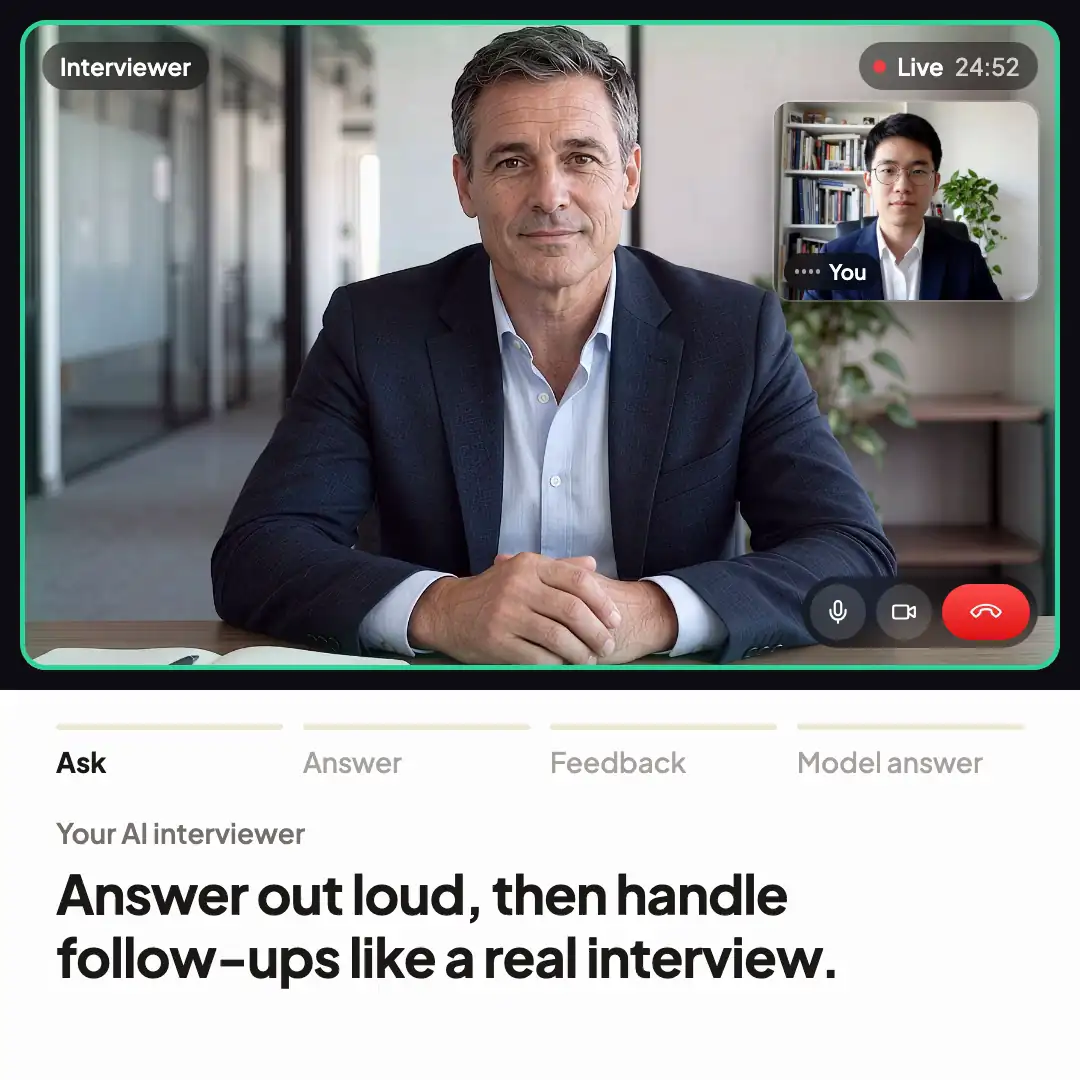
A live Soreno case mock: the AI interviewer gives a profitability case, you answer out loud, then see your score and a model answer
“Soreno quoted the exact moment my answer went vague, then gave me the line I should have said next.”
— Rachel K. · Offer from Oliver Wyman

11,900+ applicants accepted at top firms, with over 1.2 million minutes of practice completed.

What is a consumer goods case interview?

A consumer goods case interview asks about a brand sold through retailers: falling share, a price move, a new channel or private label pressure. Split revenue into volume, price and mix, then follow each dollar from the shelf price through the retailer's margin and trade spend to the brand's own margin, and check shelf space and distribution before you recommend.

Last checked November 21, 2026

Try the free sample case, no sign-upSee a case worked in fullConsumer goods case interview guide

One answer, scored

See one recommendation go from 73 to 84

Soreno scores every mock out of 100, then gives you clear, specific fixes to exactly what you said.

A premium fitness chain saw its EBITDA margin fall 380 bps

Final question · What do you recommend to the CEO?

Score 73 out of 100
+0 points

What you said

“The margin drop is meaningful, so I would look at pricing and operations next. I think they should fix discounting and cut some costs.”

Here's how to say it better

  1. “The margin drop is meaningful…”

    +4

    Leads with the dollar impact, so the size of the problem is clear.

  2. “…so I would look at pricing and operations next.”

    +4

    Ranks the levers instead of listing them.

  3. “I think they should fix discounting and cut some costs. ”

    +3

    Ends on one decision, a reason and a next step.

Get your answers scored
About 30 minutes a mock

How a Soreno mock works

Get the case, answer out loud, then see exactly where the answer stands and what to change.

  1. Your client is a premium fitness chain...
    1

    Get the case

    An AI interviewer gives you the case out loud, shares exhibits and answers your clarifying questions.

  2. You

    12:40

    I'd split this into price, volume and unit cost, then test which one explains most of the margin drop

    2

    Answer out loud

    Structure it, do the math and make your recommendation while the interviewer probes, the way a real one does.

  3. This mock

    84 / 100

    B+ · +11

    Your answer, upgraded

    Lead with the $48M, then rank pricing, mix and cost before you recommend.

    3

    A score on every mock

    Structure, content (your math and judgment) and communication scored out of 100, with your own words quoted and a model answer to compare.

Scored out of 100 on every mock

Every case, scored like an interviewer would

Interviewers judge your structure, your content (the math and the business judgment) and how clearly you say it. Soreno scores each one, quotes the moment that cost you points, and shows the stronger answer.

  • A score out of 100 on every mock

    Plus a letter grade and how far you moved since the last one.

  • A score for each skill

    See whether structure, content or communication held the case back.

  • Your own words, quoted and fixed

    Timestamped moments from your answer, with the line to say next time.

Get your first case scored
Free sample case

A consumer goods case you can try now

A sequence of questions: the margin on a bag, a price cut, a store brand deal and a recommendation.

Step 1. Read the case

Crestline Pretzels: losing share to store brands

The interviewer gives you a prompt and questions

Crestline Pretzels sells bagged pretzels through a large US grocery group. Its volume there fell from 40 million to 34 million bags in a year while the category stayed flat, and the group's own store brand grew. The CEO asks what to do. Crestline Pretzels and every number here are invented.

An original practice case written by Soreno. Everything stays in your browser.

Step 2. Ask clarifying questions

Restate the goal in one line, then ask two or three questions. The share number and the store brand price are the ones that matter most.

Step 3. Structure your answer

Question 1: "How would you work out why Crestline is losing share and what it should do?" Take a moment to organize your thoughts, then answer out loud.

1:30

Now do a full case out loud

Soreno's AI interviewer gives you a full case, asks follow-up questions on your structure and math, and scores your answer. The 7-day free trial.

Continue with the AI interviewer

Account required to start the trial. Cancel anytime before it ends.

Framework outline

How a consumer goods case is structured

Consumer goods cases cover packaged food, drinks, personal care and other brands sold through stores. The brand rarely sells to the shopper itself, so this framework follows each dollar from the shelf through the retailer to the brand and keeps the retailer's interests in view.

The consumer goods framework as a tree

How does the brand grow profit through its retailers?

  • Revenue

    • Volume
    • Price
    • Mix of sizes and flavors
  • Margin per unit

    • Shelf price less the retailer's margin
    • Trade spend
    • Product cost
  • Retailer and shelf

    • Distribution and facings
    • Store brand pressure
  • Brand and shopper

    • Why shoppers pay more
    • Price gap to rivals
  • Options

    • Price and promotions
    • New products or channels
  1. 01

    Name the brand's problem

    Lost share, a price change, a new channel, a launch or pressure from store brands. Ask what the client wants to grow, profit or share, and in which retailers.

  2. 02

    Split revenue into volume, price and mix

    Did fewer units sell, did each sell for less, or did sales shift to cheaper sizes and flavors? Compare the brand with its category to see if the market or the brand moved.

  3. 03

    Follow the dollar from shelf to brand

    Start at the shelf price, take off the retailer's margin and trade spend, then product cost. What is left is the brand's margin on a unit. Keep fixed costs like marketing and plants apart.

  4. 04

    Look at the retailer's side

    Retailers decide shelf space and push their own store brands, which earn them more per unit. Ask what the brand gives the retailer: traffic, margin or promotions that sell.

  5. 05

    Check distribution and shelf space

    A brand cannot sell where it is not stocked. Count stores, facings and how often shelves run empty before blaming the price.

  6. 06

    Compare options on profit

    Price moves, trade spend, new products, new channels or making store brands. Work out the profit of each, and the volume change that would make it pay.

Use these steps as a checklist, then build your structure from the client's question. Kearney tells candidates to avoid forcing a solution into a standard framework, and McKinsey asks for tailored solutions over standard frameworks.

Worked example

A consumer goods case, worked in full

An original case with illustrative numbers that add up. Read the prompt, try your own structure first, then compare.

Lakeview Cold Brew: should it launch in club stores?

Lakeview Cold Brew sells canned coffee in grocery stores as a 4-pack for $10.00. A warehouse club chain offers to stock a 12-pack at $18.00. Lakeview expects to sell about 400,000 packs a year there. Should it launch? Lakeview and every number here are invented.

  1. 1. Name the question

    This is a channel decision. The answer is the extra profit the club adds after its own fixed costs and after the grocery sales it takes away. Club revenue alone is not the answer.

  2. 2. Margin on each pack

    Clubs keep a smaller margin than grocers but sell for less per can, $1.50 against $2.50. Each can costs $0.90 to make and ship, and club pallets add $0.60 a pack. All of these are per unit.

    Margin per pack by channel (illustrative)
    ChannelShelf priceRetailer keepsTrade spendProduct and freightMargin per packPer can
    Grocery 4-pack$10.00$2.50$0.50$3.60$3.40$0.85
    Club 12-pack$18.00$1.80$0.00$11.40$4.80$0.40
  3. 3. Club profit before cannibalization

    400,000 packs x $4.80 = $1,920,000. The listing, in-store demos and a club sales lead cost $900,000 a year, fixed. That leaves $1,020,000.

  4. 4. Sales taken from grocery

    The club sells 4,800,000 cans. If 15% would have been bought in grocery anyway, that is 720,000 cans, or 180,000 grocery 4-packs at $3.40 each = $612,000 lost. Net gain: $408,000.

  5. 5. Break-even and risks

    The launch still pays as long as fewer than 25% of club cans come from grocery shoppers. The other risk is the grocer: a lower price per can in clubs can push it to ask for more trade spend.

The answer, top-down

Launch: the club adds about $408,000 a year. 400,000 packs at $4.80 earn $1,920,000, less $900,000 of fixed cost and $612,000 of grocery sales it takes. It breaks even if 25% of club cans come from grocery shoppers, so track grocery sales near each club in the first months.

4 consumer goods case prompts to practice

Original prompts written by Soreno. Give yourself two minutes to structure each one out loud, then open the outline.

  1. 1A shampoo brand's sales are flat, but its profit fell 10%. What happened?

    Answer outline
    • Split revenue into volume, price and mix: sales may have shifted to cheaper sizes.
    • Check trade spend: deeper promotions lower the price the brand keeps.
    • Check product and freight costs per unit.
    • Say what data would separate the causes, such as sales by size.
  2. 2A cereal maker wants to sell directly to shoppers online. Should it?

    Answer outline
    • Margin per box online: no retailer margin, but shipping and packing per order.
    • How many shoppers would buy direct, and how much they would order.
    • How retailers might react, such as cutting shelf space.
    • Recommend a small test with a clear profit target.
  3. 3A grocery chain asks a juice brand for more trade spend to keep its shelf space. How should the brand decide?

    Answer outline
    • Margin per unit now, and after the extra trade spend.
    • Volume the brand would lose without the space.
    • Compare the two on profit, and find the break-even.
    • Look for something else to offer, such as a display the shopper notices.
  4. 4A snack brand is thinking about a premium line at twice its usual price. How would you size it?

    Answer outline
    • Who buys premium snacks and how many in its current retailers.
    • Margin per unit after the retailer's margin and higher product cost.
    • How much of the new line's volume comes from its own core line.
    • Fixed costs: a launch campaign and new packaging.

Where candidates lose points

  • Using the shelf price as the brand's revenue and forgetting the retailer's margin.
  • Cutting the price without working out how much more volume it needs to pay.
  • Mixing fixed costs like marketing with per unit costs like product and freight.
  • Ignoring the retailer, who decides shelf space and sells its own store brand.
  • Counting a new channel's sales as all new, with no sales taken from existing channels.
  • Blaming the brand when the whole category is shrinking, or the reverse.

Retail case interviewPricing case practiceProfitability case practiceMarket entry case practiceCase interview mathAll case interview questionsCase math drillsCase interview partnerAll practice by firm and case type

Side by side

How Soreno compares to other ways to practice

A course from zero, a live AI case interviewer that follows up on what you say, and a score out of 100 on every mock, all in one place and ready whenever you are.

FeatureSorenoA coach
Practice any time, day or nightScheduled
A live interviewer who probes and shares exhibitsAI interviewer
A course that starts from zeroZero to HeroVaries
Practice one stage of a case at a timeAbout 6 minOn request
A score out of 100 on every mockTheir notes
Unlimited mocks on a paid planPer session
Consulting and finance rolesTheir specialty
Video recording and playbackVaries
PriceFree week, then $199/moPer hour
FeatureSorenoA coachA courseA case buddy
Practice any time, day or nightScheduledSelf-pacedScheduled
A live interviewer who probes and shares exhibitsAI interviewerSelf-studyA peer
A course that starts from zeroZero to HeroVariesSelf-study
Practice one stage of a case at a timeAbout 6 minOn requestSelf-studyOn request
A score out of 100 on every mockTheir notesSelf-checkTheir notes
Unlimited mocks on a paid planPer sessionSelf-pacedAs scheduled
Consulting and finance rolesTheir specialtyVariesVaries
Video recording and playbackVariesVariesVaries
PriceFree week, then $199/moPer hourOne-off feeFree
Verified offers

What Soreno candidates say

Real candidates, real offers, in their own words.

McKinsey & Company

“What sold me on Soreno was being able to jump straight into a mock case without knowing anything…”

Alex Chen

McKinsey offer after 28 sessions

Boston Consulting Group

“The AI asks pretty tough follow up questions and the evaluation is quite strict…”

Daniel C.

BCG offer after 22 sessions

Bain & Company

“I recommend everyone to start with the drills, they're kinda like mini cases, then work up to full mocks.”

Maya Singh

Bain offer, score up 16 points

Deloitte

“…there's no judgment when you mess something up. You can just restart and go again.”

Priya N.

Deloitte offer after 18 sessions

Oliver Wyman

“I loved how Soreno was able to let me know exactly what I did good and bad during the interview…”

Rachel K.

From 0 to an Oliver Wyman offer in 8 weeks

Soreno in numbers

11,900+
applicants accepted at top firms
1.2M+
minutes practiced on Soreno
Plans and Pricing

Choose your best plan

Start your free week, then choose a plan. Cancel anytime.

1 week

For a round that is days away

Unlimited mock interviews

  • = about $11 a day
  • Cases, banking technicals and fit, out loud
$79

per week

Start your free week

Billed weekly

Included at no extra cost

  • Zero to Hero courseCase or finance
  • Day-by-day prep planEach interview
  • Skill drillsUnlimited
  • Session recordingsWith feedback

Practice library

  • Full case interviews100+
  • Banking interview questions1,800+
  • Consulting fit questions100+
  • Banks with fit questions29
  • A voice AI interviewer that asks follow‑up questions
  • Exhibits and a model answer for every case
  • A score out of 100 after every mock
  • Feedback that quotes your answer, with a next-step plan
  • Filler-word and eye-contact notes on recorded sessions
  • Drills for case math, market sizing, structuring and charts
  • Consulting, banking and behavioral practice in one plan
  • Add your own practice questions

1 month

Save 42%Recommended

For steady practice across recruiting

Unlimited mock interviews

  • = about $7 a day
  • Cases, banking technicals and fit, out loud
$199vs $342 a month on Weekly

per month

Start your free week

Save $143 a month compared to weekly

Included at no extra cost

  • Zero to Hero courseCase or finance
  • Day-by-day prep planEach interview
  • Skill drillsUnlimited
  • Session recordingsWith feedback

Practice library

  • Full case interviews100+
  • Banking interview questions1,800+
  • Consulting fit questions100+
  • Banks with fit questions29
  • A voice AI interviewer that asks follow‑up questions
  • Exhibits and a model answer for every case
  • A score out of 100 after every mock
  • Feedback that quotes your answer, with a next-step plan
  • Filler-word and eye-contact notes on recorded sessions
  • Drills for case math, market sizing, structuring and charts
  • Consulting, banking and behavioral practice in one plan
  • Add your own practice questions

1 year

Save 76%BEST VALUE

For several roles, firms or rounds

Unlimited mock interviews

  • = about $2 a day
  • Cases, banking technicals and fit, out loud
$48vs $199 a month on Monthly

per month, billed $579 yearly

Start your free week

Save $1,809 compared to monthly

Included at no extra cost

  • Zero to Hero courseCase or finance
  • Day-by-day prep planEach interview
  • Skill drillsUnlimited
  • Session recordingsWith feedback

Practice library

  • Full case interviews100+
  • Banking interview questions1,800+
  • Consulting fit questions100+
  • Banks with fit questions29
  • A voice AI interviewer that asks follow‑up questions
  • Exhibits and a model answer for every case
  • A score out of 100 after every mock
  • Feedback that quotes your answer, with a next-step plan
  • Filler-word and eye-contact notes on recorded sessions
  • Drills for case math, market sizing, structuring and charts
  • Consulting, banking and behavioral practice in one plan
  • Add your own practice questions
FAQ's

Frequently Asked Questions

Everything you need to know about Soreno, answered in one place.

A consumer goods case interview asks about a brand sold through retailers: falling share, a price move, a new channel or private label pressure. Split revenue into volume, price and mix, then follow each dollar from the shelf price through the retailer's margin and trade spend to the brand's own margin, and check shelf space and distribution before you recommend.
Money a brand pays retailers to sell its products: price promotions, display fees and payments for shelf space. It comes off the price the brand keeps, so it belongs in the margin per unit.
Store brands are made for the retailer and usually sell for less, while earning the retailer more per unit. They take share from brands and give the retailer a reason to cut a brand's shelf space.
A way to split a change in revenue: how many units sold, the price of each and the blend of sizes, flavors or channels. It shows whether a brand sold less, sold for less or sold more of its cheaper items.
No. The sample case runs in your browser with no sign-up, and nothing you type is saved or sent.
Every plan starts with a 7-day free trial. After that, plans are $199 a month or $579 a year, or $79 a week. See the pricing page for details.
User
User
User
User
Join 15,000+ candidates

Run a consumer goods case tonight

Start your free week. Your first score in about 30 minutes.

Start your free weekTry 3 free mocks