











AI procurement case practice

Procurement case interview practice with AI

Realistic procurement cases with exhibits and math, graded instantly. Start your free week with full feedback.

User
User
User
User
Join 15,000+ candidates this cycle
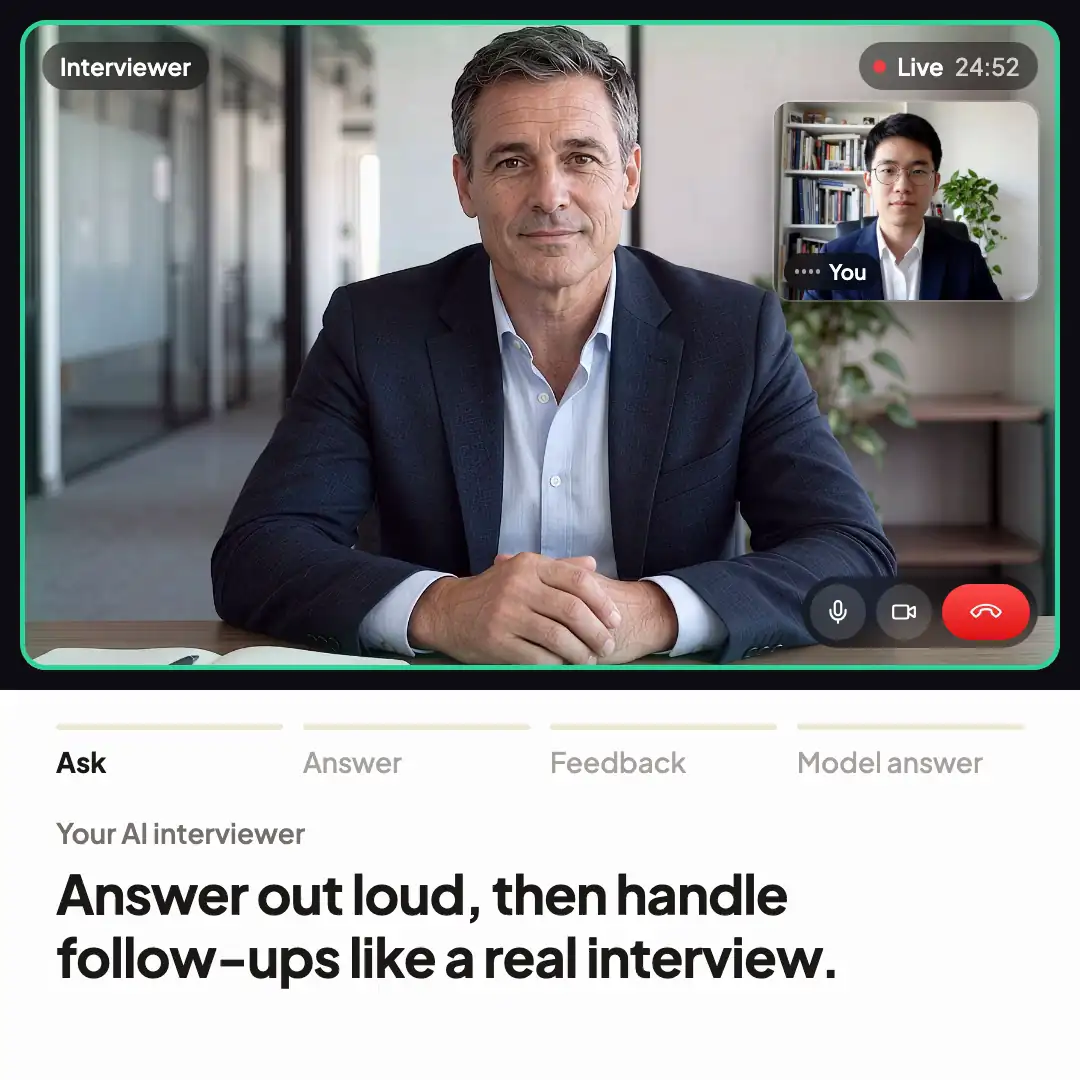
A live Soreno case mock: the AI interviewer gives a profitability case, you answer out loud, then see your score and a model answer
“Soreno quoted the exact moment my answer went vague, then gave me the line I should have said next.”
— Rachel K. · Offer from Oliver Wyman

11,900+ applicants accepted at top firms, with over 1.2 million minutes of practice completed.

What is a procurement case interview?

A procurement case interview asks how a company can spend less on what it buys. Build the baseline as volume times price by category and supplier. Then work on price by matching the best price, consolidating suppliers and renegotiating, and on demand by buying less. Weigh make or buy, and give the saving net of switching costs and supply risk.

Last checked November 21, 2026

Try the free sample case, no sign-upSee a case worked in fullProcurement case interview guide

One answer, scored

See one recommendation go from 73 to 84

Soreno scores every mock out of 100, then gives you clear, specific fixes to exactly what you said.

A premium fitness chain saw its EBITDA margin fall 380 bps

Final question · What do you recommend to the CEO?

Score 73 out of 100
+0 points

What you said

“The margin drop is meaningful, so I would look at pricing and operations next. I think they should fix discounting and cut some costs.”

Here's how to say it better

  1. “The margin drop is meaningful…”

    +4

    Leads with the dollar impact, so the size of the problem is clear.

  2. “…so I would look at pricing and operations next.”

    +4

    Ranks the levers instead of listing them.

  3. “I think they should fix discounting and cut some costs. ”

    +3

    Ends on one decision, a reason and a next step.

Get your answers scored
About 30 minutes a mock

How a Soreno mock works

Get the case, answer out loud, then see exactly where the answer stands and what to change.

  1. Your client is a premium fitness chain...
    1

    Get the case

    An AI interviewer gives you the case out loud, shares exhibits and answers your clarifying questions.

  2. You

    12:40

    I'd split this into price, volume and unit cost, then test which one explains most of the margin drop

    2

    Answer out loud

    Structure it, do the math and make your recommendation while the interviewer probes, the way a real one does.

  3. This mock

    84 / 100

    B+ · +11

    Your answer, upgraded

    Lead with the $48M, then rank pricing, mix and cost before you recommend.

    3

    A score on every mock

    Structure, content (your math and judgment) and communication scored out of 100, with your own words quoted and a model answer to compare.

Scored out of 100 on every mock

Every case, scored like an interviewer would

Interviewers judge your structure, your content (the math and the business judgment) and how clearly you say it. Soreno scores each one, quotes the moment that cost you points, and shows the stronger answer.

  • A score out of 100 on every mock

    Plus a letter grade and how far you moved since the last one.

  • A score for each skill

    See whether structure, content or communication held the case back.

  • Your own words, quoted and fixed

    Timestamped moments from your answer, with the line to say next time.

Get your first case scored
Free sample case

A procurement case you can try now

A sequence of questions: the baseline, a consolidation offer, buying less, one supplier or two and a recommendation.

Step 1. Read the case

Ostrander Appliances: cut spend on shipping cartons

The interviewer gives you a prompt and questions

Ostrander Appliances makes washing machines and dryers in four US plants. It buys about 10,000,000 shipping cartons a year from three suppliers. The new head of procurement wants to cut what it spends on cartons and has asked your team how. Ostrander Appliances and every number here are invented.

An original practice case written by Soreno. Everything stays in your browser.

Step 2. Ask clarifying questions

Restate the goal in one line, then ask two or three questions about the spend and the contracts.

Step 3. Structure your answer

Question 1: "How would you find savings on what Ostrander spends on cartons?" Take a moment to organize your thoughts, then answer out loud.

1:30

Now do a full case out loud

Soreno's AI interviewer gives you a full case, asks follow-up questions on your structure and math, and scores your answer. The 7-day free trial.

Continue with the AI interviewer

Account required to start the trial. Cancel anytime before it ends.

Framework outline

How a procurement case is structured

Procurement cases ask how a company can spend less on what it buys without hurting the business. This framework starts from where the money goes, works on price and on demand, and ends with savings net of what it costs to switch.

The procurement framework as a tree

How can the company spend less on what it buys?

  • Baseline

    • Spend by category
    • Spend by supplier
    • Volume times price
  • Price

    • Gap to the best price paid
    • Supplier consolidation
    • Renegotiation with an alternative
  • Demand

    • Buy less
    • Simpler specifications
    • Less waste
  • Make or buy

    • Fixed cost in house
    • Cost per unit
    • Break-even volume
  • Net saving

    • One-time switching costs
    • New costs per unit
    • Supply risk
  1. 01

    Build the baseline

    Split spend by category, then by supplier, and write each line as volume times price. Most savings sit in a few large categories, so rank them by size and by how easy they are to change.

  2. 02

    Compare prices for the same thing

    When different sites pay different prices for the same item, the gap to the best price is the first saving. It needs no new supplier, only a decision to buy at the best terms the company already has.

  3. 03

    Use volume to get a better price

    Fewer suppliers with more volume each can bid lower. Renegotiate with a real alternative in hand, such as quotes from other suppliers or a cost model of what the item should cost.

  4. 04

    Cut demand

    Ask whether the company needs as much, or as fancy a version. Changing a design, a rule or a habit often saves more than any price cut and needs no supplier to agree.

  5. 05

    Weigh make or buy

    Doing it in house trades a price per unit for fixed costs. Find the volume at which the two cost the same and check how far today's volume sits above it.

  6. 06

    Net out switching costs and risk

    Count one-time costs like trials and exit fees, new costs per unit like freight, and the risk of relying on one supplier. Give the saving net of all of them and the payback.

Use these steps as a checklist, then build your structure from the client's question. Kearney tells candidates to avoid forcing a solution into a standard framework, and McKinsey asks for tailored solutions over standard frameworks.

Worked example

A procurement case, worked in full

An original case with illustrative numbers that add up. Read the prompt, try your own structure first, then compare.

Harlow Hotels: renegotiate the laundry or wash in house?

Harlow Hotels runs 20 hotels and sends all its sheets and towels to an outside laundry. The laundry contract is up for renewal, and the finance team wants to cut what the chain spends. Harlow Hotels and every number here are invented. What should it do?

  1. 1. Build the baseline

    Harlow spends $40.0 million a year on what it buys outside of staff. Laundry is $6.0 million, 15% of it, and its contract ends this year, so it is the place to start.

    Harlow's spend by category (illustrative)
    CategorySpend a yearShare
    Food and drink$14.0 million35%
    Maintenance$10.0 million25%
    Energy$8.0 million20%
    Laundry$6.0 million15%
    Cleaning supplies$2.0 million5%
  2. 2. Volume times price

    The hotels send about 3,000,000 pounds of linen a year at $2.00 a pound: 3,000,000 x $2.00 = $6.0 million. Every cost here is per pound, so it moves with how full the hotels are.

  3. 3. Renegotiate

    Other laundries quote $1.70 a pound for the same service. At that price the bill is $5.1 million, a saving of $900,000 a year, 15% of laundry spend. With the quotes in hand, Harlow can ask its current laundry to match.

  4. 4. Make or buy

    An in-house laundry costs $1,500,000 a year for staff and the building lease whatever the volume, plus $0.90 a pound for water, energy and detergent. Machines cost $3,600,000 once and last 5 years, or $720,000 a year. In house costs $4,920,000 a year, only $180,000 less than the renegotiated contract.

    Cost a year of each option at 3,000,000 pounds (illustrative)
    OptionFixed a yearPer poundTotal a year
    Current contract$0$2.00$6,000,000
    Renegotiated contract$0$1.70$5,100,000
    In-house laundry$2,220,000$0.90$4,920,000
  5. 5. Check the break-even volume

    In house saves $0.80 a pound against the quote, so it needs $2,220,000 / $0.80 = 2,775,000 pounds a year to cover its fixed costs. That is only 7.5% below today's 3,000,000. A slow year at the hotels would make in house the more expensive choice.

The answer, top-down

Save $900,000 a year by renegotiating the contract to $1.70 a pound, 15% of laundry spend, with nothing paid up front. In house would save only $180,000 a year more, needs $3,600,000 for machines, and stops paying off if volume falls 7.5% below 3,000,000 pounds. Review make or buy again if the chain grows.

4 procurement case prompts to practice

Original prompts written by Soreno. Give yourself two minutes to structure each one out loud, then open the outline.

  1. 1An airline wants to cut what it spends on in-flight food by 15%. Where would you look?

    Answer outline
    • Split the spend by route, meal type and caterer, as meals times price.
    • Compare prices for the same meal at different airports.
    • Cut demand: fewer meals loaded per flight, based on how many are eaten.
    • Net the saving against any effect on customer satisfaction scores.
  2. 2A university pays for software licenses in every department. How could it spend less?

    Answer outline
    • List every license with its users and price per seat.
    • Find overlapping tools and licenses nobody has used in months.
    • Buy centrally to get a volume price from the main vendors.
    • Count the cost of moving staff to one tool and the time to do it.
  3. 3A bike maker buys its wheels from a supplier. Should it start making them?

    Answer outline
    • Compare the price per wheel with the in-house cost per wheel.
    • Add the fixed costs of a wheel line and find the break-even volume.
    • Check skills, quality and how sure the volume is.
    • Ask what the supplier would offer to keep the business.
  4. 4A grocery chain buys store supplies from 400 small vendors. Is that a problem?

    Answer outline
    • Rank vendors by spend and see how much sits in the long tail.
    • Estimate what each vendor costs to manage, beyond the price.
    • Move the tail to a few vendors or one catalog with agreed prices.
    • Keep local vendors where they win on price or speed.

Where candidates lose points

  • Asking for a flat discount from every supplier with no baseline of where the spend sits.
  • Counting the gross price cut as the saving and leaving out one-time switching costs.
  • Missing a new cost per unit, like freight on an ex-works price, that eats into the cut.
  • Only working on price and never asking whether the company needs to buy as much.
  • Moving all volume to one supplier without pricing the risk if that supplier fails.
  • In a make or buy question, comparing in-house cost per unit with the price and forgetting the fixed costs.

Kearney case practiceOperations case practiceCutting 10% of a retailer's costsCost per unit up 15% at a manufacturerCase interview mathAll case interview questionsCase math drillsCase interview partnerAll practice by firm and case type

Side by side

How Soreno compares to other ways to practice

A course from zero, a live AI case interviewer that follows up on what you say, and a score out of 100 on every mock, all in one place and ready whenever you are.

FeatureSorenoA coach
Practice any time, day or nightScheduled
A live interviewer who probes and shares exhibitsAI interviewer
A course that starts from zeroZero to HeroVaries
Practice one stage of a case at a timeAbout 6 minOn request
A score out of 100 on every mockTheir notes
Unlimited mocks on a paid planPer session
Consulting and finance rolesTheir specialty
Video recording and playbackVaries
PriceFree week, then $199/moPer hour
FeatureSorenoA coachA courseA case buddy
Practice any time, day or nightScheduledSelf-pacedScheduled
A live interviewer who probes and shares exhibitsAI interviewerSelf-studyA peer
A course that starts from zeroZero to HeroVariesSelf-study
Practice one stage of a case at a timeAbout 6 minOn requestSelf-studyOn request
A score out of 100 on every mockTheir notesSelf-checkTheir notes
Unlimited mocks on a paid planPer sessionSelf-pacedAs scheduled
Consulting and finance rolesTheir specialtyVariesVaries
Video recording and playbackVariesVariesVaries
PriceFree week, then $199/moPer hourOne-off feeFree
Verified offers

What Soreno candidates say

Real candidates, real offers, in their own words.

McKinsey & Company

“What sold me on Soreno was being able to jump straight into a mock case without knowing anything…”

Alex Chen

McKinsey offer after 28 sessions

Boston Consulting Group

“The AI asks pretty tough follow up questions and the evaluation is quite strict…”

Daniel C.

BCG offer after 22 sessions

Bain & Company

“I recommend everyone to start with the drills, they're kinda like mini cases, then work up to full mocks.”

Maya Singh

Bain offer, score up 16 points

Deloitte

“…there's no judgment when you mess something up. You can just restart and go again.”

Priya N.

Deloitte offer after 18 sessions

Oliver Wyman

“I loved how Soreno was able to let me know exactly what I did good and bad during the interview…”

Rachel K.

From 0 to an Oliver Wyman offer in 8 weeks

Soreno in numbers

11,900+
applicants accepted at top firms
1.2M+
minutes practiced on Soreno
Plans and Pricing

Choose your best plan

Start your free week, then choose a plan. Cancel anytime.

1 week

For a round that is days away

Unlimited mock interviews

  • = about $11 a day
  • Cases, banking technicals and fit, out loud
$79

per week

Start your free week

Billed weekly

Included at no extra cost

  • Zero to Hero courseCase or finance
  • Day-by-day prep planEach interview
  • Skill drillsUnlimited
  • Session recordingsWith feedback

Practice library

  • Full case interviews100+
  • Banking interview questions1,800+
  • Consulting fit questions100+
  • Banks with fit questions29
  • A voice AI interviewer that asks follow‑up questions
  • Exhibits and a model answer for every case
  • A score out of 100 after every mock
  • Feedback that quotes your answer, with a next-step plan
  • Filler-word and eye-contact notes on recorded sessions
  • Drills for case math, market sizing, structuring and charts
  • Consulting, banking and behavioral practice in one plan
  • Add your own practice questions

1 month

Save 42%Recommended

For steady practice across recruiting

Unlimited mock interviews

  • = about $7 a day
  • Cases, banking technicals and fit, out loud
$199vs $342 a month on Weekly

per month

Start your free week

Save $143 a month compared to weekly

Included at no extra cost

  • Zero to Hero courseCase or finance
  • Day-by-day prep planEach interview
  • Skill drillsUnlimited
  • Session recordingsWith feedback

Practice library

  • Full case interviews100+
  • Banking interview questions1,800+
  • Consulting fit questions100+
  • Banks with fit questions29
  • A voice AI interviewer that asks follow‑up questions
  • Exhibits and a model answer for every case
  • A score out of 100 after every mock
  • Feedback that quotes your answer, with a next-step plan
  • Filler-word and eye-contact notes on recorded sessions
  • Drills for case math, market sizing, structuring and charts
  • Consulting, banking and behavioral practice in one plan
  • Add your own practice questions

1 year

Save 76%BEST VALUE

For several roles, firms or rounds

Unlimited mock interviews

  • = about $2 a day
  • Cases, banking technicals and fit, out loud
$48vs $199 a month on Monthly

per month, billed $579 yearly

Start your free week

Save $1,809 compared to monthly

Included at no extra cost

  • Zero to Hero courseCase or finance
  • Day-by-day prep planEach interview
  • Skill drillsUnlimited
  • Session recordingsWith feedback

Practice library

  • Full case interviews100+
  • Banking interview questions1,800+
  • Consulting fit questions100+
  • Banks with fit questions29
  • A voice AI interviewer that asks follow‑up questions
  • Exhibits and a model answer for every case
  • A score out of 100 after every mock
  • Feedback that quotes your answer, with a next-step plan
  • Filler-word and eye-contact notes on recorded sessions
  • Drills for case math, market sizing, structuring and charts
  • Consulting, banking and behavioral practice in one plan
  • Add your own practice questions
FAQ's

Frequently Asked Questions

Everything you need to know about Soreno, answered in one place.

A procurement case interview asks how a company can spend less on what it buys. Build the baseline as volume times price by category and supplier. Then work on price by matching the best price, consolidating suppliers and renegotiating, and on demand by buying less. Weigh make or buy, and give the saving net of switching costs and supply risk.
What the company spends today, split by category and supplier and written as volume times price. It shows where the money sits and gives every saving a starting point to measure from.
A lower price can come with one-time costs, like trials and exit fees, and new costs per unit, like freight. The saving that matters is the price cut minus those costs, with a payback for the one-time part.
No. The sample case runs in your browser with no sign-up, and nothing you type is saved or sent.
Every plan starts with a 7-day free trial. After that, plans are $199 a month or $579 a year, or $79 a week. See the pricing page for details.
User
User
User
User
Join 15,000+ candidates

Run a procurement case tonight

Start your free week. Your first score in about 30 minutes.

Start your free weekTry 3 free mocks