







AI M&A and due diligence case practice

M&A case interview practice with AI

Realistic M&A and due diligence cases with exhibits and math, graded instantly. Start your free week with full feedback.

User
User
User
User
Join 15,000+ candidates this cycle
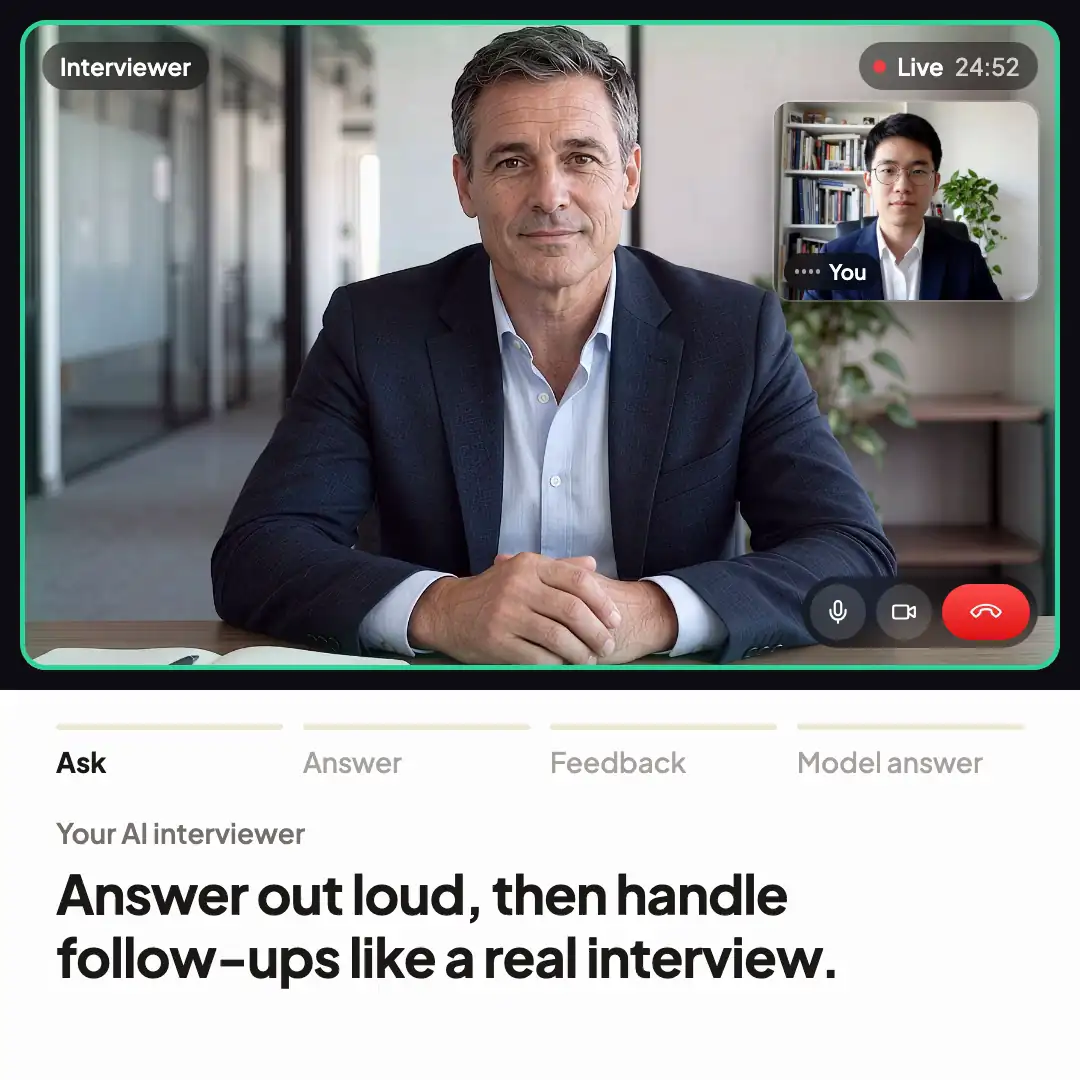
A live Soreno case mock: the AI interviewer gives a profitability case, you answer out loud, then see your score and a model answer
“Soreno quoted the exact moment my answer went vague, then gave me the line I should have said next.”
— Rachel K. · Offer from Oliver Wyman

11,900+ applicants accepted at top firms, with over 1.2 million minutes of practice completed.

What is an M&A case interview?

An M&A case interview asks whether a buyer should acquire a target and at what price. The structure covers four things: why the buyer wants it, what the target is worth on its own, what the synergies are worth after the cost of achieving them, and the walk-away price. A due diligence case adds checks of the target's market, customers and risks before the deal.

Last checked November 4, 2026

Try the free sample case, no sign-upSee a case worked in fullM&A case study: framework and worked example

One answer, scored

See one recommendation go from 73 to 84

Soreno scores every mock out of 100, then gives you clear, specific fixes to exactly what you said.

A premium fitness chain saw its EBITDA margin fall 380 bps

Final question · What do you recommend to the CEO?

Score 73 out of 100
+0 points

What you said

“The margin drop is meaningful, so I would look at pricing and operations next. I think they should fix discounting and cut some costs.”

Here's how to say it better

  1. “The margin drop is meaningful…”

    +4

    Leads with the dollar impact, so the size of the problem is clear.

  2. “…so I would look at pricing and operations next.”

    +4

    Ranks the levers instead of listing them.

  3. “I think they should fix discounting and cut some costs. ”

    +3

    Ends on one decision, a reason and a next step.

Get your answers scored
About 30 minutes a mock

How a Soreno mock works

Get the case, answer out loud, then see exactly where the answer stands and what to change.

  1. Your client is a premium fitness chain...
    1

    Get the case

    An AI interviewer gives you the case out loud, shares exhibits and answers your clarifying questions.

  2. You

    12:40

    I'd split this into price, volume and unit cost, then test which one explains most of the margin drop

    2

    Answer out loud

    Structure it, do the math and make your recommendation while the interviewer probes, the way a real one does.

  3. This mock

    84 / 100

    B+ · +11

    Your answer, upgraded

    Lead with the $48M, then rank pricing, mix and cost before you recommend.

    3

    A score on every mock

    Structure, content (your math and judgment) and communication scored out of 100, with your own words quoted and a model answer to compare.

Scored out of 100 on every mock

Every case, scored like an interviewer would

Interviewers judge your structure, your content (the math and the business judgment) and how clearly you say it. Soreno scores each one, quotes the moment that cost you points, and shows the stronger answer.

  • A score out of 100 on every mock

    Plus a letter grade and how far you moved since the last one.

  • A score for each skill

    See whether structure, content or communication held the case back.

  • Your own words, quoted and fixed

    Timestamped moments from your answer, with the line to say next time.

Get your first case scored
Free sample case

An M&A and due diligence case you can try now

You choose what to diligence, build standalone value and synergies and recommend a price.

Step 1. Read the case

Fresh Basket and MealMate: what is the target worth?

The interviewer reads you the case

Your client is Fresh Basket, a regional grocery chain. It is considering buying MealMate, a meal-kit company with $80 million of revenue. The seller asks $96 million. The CEO wants to know whether to buy it and what the most Fresh Basket should pay.

An original practice case written by Soreno. Everything stays in your browser.

Step 2. Ask clarifying questions

In an M&A case, confirm the buyer's rationale, what is being bought and how value is measured.

Step 3. Structure your answer

Take two minutes. Structure how you would decide whether to buy MealMate and what to pay. Write it, then say it out loud.

2:00

Now do a full case out loud

Soreno's AI interviewer gives you a full case, asks follow-up questions on your structure and math, and scores your answer. The 7-day free trial.

Continue with the AI interviewer

Account required to start the trial. Cancel anytime before it ends.

Framework outline

How an M&A and due diligence case is structured

An M&A case ends with a yes or no and a price, and the framework is there to get you to both. Work through it in this order.

The M&A and due diligence framework as a tree

Should the buyer acquire the target, and at what price?

  • Deal logic

    • Company or fund buyer
    • Growth, capability, scale or a competitor
    • Alternatives: build or partner
  • Standalone value

    • Market growth and share
    • Quality of earnings and one-off items
    • Customer concentration and churn
    • Multiple from comparable deals
  • Synergies

    • Cost synergies
    • Revenue synergies, discounted
    • Timing
    • One-time cost to achieve them
  • Price and risks

    • Walk-away price
    • Bid below it
    • Deal breakers
    • For a fund: debt and exit
  1. 01

    Why does the buyer want it?

    Name the deal logic before any numbers: buying growth, a capability, a competitor or the scale to cut costs. Ask whether the buyer is a company or a fund. A fund usually has fewer synergies to count and needs a clear exit.

  2. 02

    Value the target on its own

    Start from profit, often EBITDA, and a multiple from comparable companies or deals. Then test that profit: one-off items, customer concentration, churn, and owners who carry key relationships.

  3. 03

    Size the synergies line by line

    Cost synergies (overlapping sites, purchasing, back office) are easier to bank than revenue synergies (cross-selling, new channels). Put each in annual profit, say when it arrives (synergies often phase in over two or three years), then value it, and discount the revenue ones for the chance they never arrive.

  4. 04

    Subtract the cost to achieve them

    Integration teams, severance, systems and lease exits are one-time costs, and they come out of the value before you set a price.

  5. 05

    Set the walk-away price

    Standalone value plus the synergies the buyer can realize, minus the one-time integration cost. Bid below that so the buyer keeps part of the synergy value. If the seller asks more than the walk-away, the recommendation is to walk.

  6. 06

    Name the deal breaker

    Which single finding would flip your answer? Often it is customers leaving after the deal, key people quitting or a liability found in diligence. Say how you would check it before signing.

Use these steps as a checklist, then build your structure from the client's question. Kearney tells candidates to avoid forcing a solution into a standard framework, and McKinsey asks for tailored solutions over standard frameworks.

Worked example

An M&A and due diligence case, worked in full

An original case with illustrative numbers that add up. Read the prompt, try your own structure first, then compare.

Coolbridge Services: buying a heating and cooling rival

Coolbridge installs and services heating and air conditioning in one state. A smaller rival, Frostline, is for sale at $100 million. Coolbridge asks whether to buy it and what to offer.

  1. 1. Deal logic

    Coolbridge wants density: more customers on the same routes and depots. That points to cost synergies first. Revenue synergies come from selling its maintenance plans to Frostline's customers.

  2. 2. Value Frostline on its own

    Reported EBITDA is $10 million, but $1 million of it is a one-off legal settlement. Normalized EBITDA is $9 million. At 8 times EBITDA, the multiple for comparable deals, Frostline is worth $72 million on its own.

  3. 3. Size the synergies

    Closing three overlapping depots saves $2.0 million a year. Buying parts together cuts 2% off $40 million of spend, or $0.8 million. Selling maintenance plans to Frostline's customers could add $5 million of revenue at a 20% margin, $1.0 million of profit, but count it at half since it may not happen.

    Synergies counted (illustrative)
    SynergyYearly profitCounted
    Close three depots$2.0M$2.0M
    Combined parts buying$0.8M$0.8M
    Maintenance plans$1.0M$0.5M
    Total$3.8M$3.3M
  4. 4. Subtract the cost to achieve them

    At the same 8 times multiple, $3.3 million a year is worth $26.4 million. Severance, lease exits and moving to one system cost $4.0 million once. Net synergy value is $22.4 million. This assumes the savings arrive in full by year two. A slower ramp lowers it.

  5. 5. Set the walk-away price

    Standalone value of $72 million plus $22.4 million of net synergies gives a walk-away price of $94.4 million. The $100 million asking price is above it, so at that price Coolbridge would pay for more than the deal is worth to it.

  6. 6. Name the deal breaker

    Frostline's largest customer, a property manager, is 25% of revenue on a contract that ends next year. If it leaves, standalone value drops sharply. Check the renewal before signing.

The answer, top-down

Do the deal only at the right price. Frostline is worth $72 million on its own and $94.4 million to Coolbridge with synergies, so the $100 million ask is too high. Offer about $85 million, which keeps roughly $9 million of the synergy value for Coolbridge, and make the deal depend on the largest customer renewing. If the seller holds at $100 million, walk away.

4 M&A and due diligence case prompts to practice

Original prompts written by Soreno. Give yourself two minutes to structure each one out loud, then open the outline.

  1. 1A private equity fund wants to buy a chain of 60 vet clinics for $300 million.

    Answer outline
    • Find EBITDA per clinic and test it for one-offs and owner-vets who might leave.
    • Size growth from new clinics and price rises in a fragmented market.
    • Check how much debt the cash flow supports and the exit multiple in five years.
    • Recommend on the return against the fund's target, with vet retention as the deal breaker.
  2. 2A large bank wants to buy a fintech app with 2 million users and no profit.

    Answer outline
    • Ask what the bank is buying: users, technology or the team.
    • Value users on what they would earn the bank, net of those who leave.
    • Compare with the cost and time to build the same app in-house.
    • Recommend a price tied to keeping the founders and the users.
  3. 3A paint maker is considering buying its largest pigment supplier.

    Answer outline
    • Name the logic: secure supply, lower cost or margin capture.
    • Value the supplier on its own, including sales to the paint maker's competitors.
    • Ask whether those competitors would stop buying from it after the deal.
    • Recommend buy, a long-term contract or a second supplier.
  4. 4Two regional grocery chains want to merge. Is it a good idea?

    Answer outline
    • Map where their stores overlap and where they do not.
    • Size cost synergies: purchasing, distribution and head office.
    • Check competition rules in towns where they would hold most of the stores.
    • Recommend with the one-time costs and the stores they might have to sell.

Where candidates lose points

  • Listing generic deal risks without tying any of them to value or price.
  • Handing the seller every dollar of synergy. At that price the buyer has done the deal for nothing.
  • Counting revenue synergies at full value, from year one, with no integration cost.
  • Anchoring on the seller's asking price and debating whether it feels high.
  • In a services or subscription target, ignoring retention. The customers and the people are most of what is being bought.
  • Treating a fund buyer like a corporate one, then never mentioning the exit or how much debt the target can carry.

Buying a plant-based snack startupA PE firm buying a dental clinic chainSynergies when two regional airlines mergeA loss-making division: fix, sell or closeAll case interview questionsM&A case study: framework and worked examplePrivate equity case study guideEY-Parthenon case interviewCase math drillsCase interview partnerAll practice by firm and case type

Side by side

How Soreno compares to other ways to practice

A course from zero, a live AI case interviewer that follows up on what you say, and a score out of 100 on every mock, all in one place and ready whenever you are.

FeatureSorenoA coach
Practice any time, day or nightScheduled
A live interviewer who probes and shares exhibitsAI interviewer
A course that starts from zeroZero to HeroVaries
Practice one stage of a case at a timeAbout 6 minOn request
A score out of 100 on every mockTheir notes
Unlimited mocks on a paid planPer session
Consulting and finance rolesTheir specialty
Video recording and playbackVaries
PriceFree week, then $199/moPer hour
FeatureSorenoA coachA courseA case buddy
Practice any time, day or nightScheduledSelf-pacedScheduled
A live interviewer who probes and shares exhibitsAI interviewerSelf-studyA peer
A course that starts from zeroZero to HeroVariesSelf-study
Practice one stage of a case at a timeAbout 6 minOn requestSelf-studyOn request
A score out of 100 on every mockTheir notesSelf-checkTheir notes
Unlimited mocks on a paid planPer sessionSelf-pacedAs scheduled
Consulting and finance rolesTheir specialtyVariesVaries
Video recording and playbackVariesVariesVaries
PriceFree week, then $199/moPer hourOne-off feeFree
Verified offers

What Soreno candidates say

Real candidates, real offers, in their own words.

McKinsey & Company

“What sold me on Soreno was being able to jump straight into a mock case without knowing anything…”

Alex Chen

McKinsey offer after 28 sessions

Boston Consulting Group

“The AI asks pretty tough follow up questions and the evaluation is quite strict…”

Daniel C.

BCG offer after 22 sessions

Bain & Company

“I recommend everyone to start with the drills, they're kinda like mini cases, then work up to full mocks.”

Maya Singh

Bain offer, score up 16 points

Deloitte

“…there's no judgment when you mess something up. You can just restart and go again.”

Priya N.

Deloitte offer after 18 sessions

Oliver Wyman

“I loved how Soreno was able to let me know exactly what I did good and bad during the interview…”

Rachel K.

From 0 to an Oliver Wyman offer in 8 weeks

Soreno in numbers

11,900+
applicants accepted at top firms
1.2M+
minutes practiced on Soreno
Plans and Pricing

Choose your best plan

Start your free week, then choose a plan. Cancel anytime.

1 week

For a round that is days away

Unlimited mock interviews

  • = about $11 a day
  • Cases, banking technicals and fit, out loud
$79

per week

Start your free week

Billed weekly

Included at no extra cost

  • Zero to Hero courseCase or finance
  • Day-by-day prep planEach interview
  • Skill drillsUnlimited
  • Session recordingsWith feedback

Practice library

  • Full case interviews100+
  • Banking interview questions1,800+
  • Consulting fit questions100+
  • Banks with fit questions29
  • A voice AI interviewer that asks follow‑up questions
  • Exhibits and a model answer for every case
  • A score out of 100 after every mock
  • Feedback that quotes your answer, with a next-step plan
  • Filler-word and eye-contact notes on recorded sessions
  • Drills for case math, market sizing, structuring and charts
  • Consulting, banking and behavioral practice in one plan
  • Add your own practice questions

1 month

Save 42%Recommended

For steady practice across recruiting

Unlimited mock interviews

  • = about $7 a day
  • Cases, banking technicals and fit, out loud
$199vs $342 a month on Weekly

per month

Start your free week

Save $143 a month compared to weekly

Included at no extra cost

  • Zero to Hero courseCase or finance
  • Day-by-day prep planEach interview
  • Skill drillsUnlimited
  • Session recordingsWith feedback

Practice library

  • Full case interviews100+
  • Banking interview questions1,800+
  • Consulting fit questions100+
  • Banks with fit questions29
  • A voice AI interviewer that asks follow‑up questions
  • Exhibits and a model answer for every case
  • A score out of 100 after every mock
  • Feedback that quotes your answer, with a next-step plan
  • Filler-word and eye-contact notes on recorded sessions
  • Drills for case math, market sizing, structuring and charts
  • Consulting, banking and behavioral practice in one plan
  • Add your own practice questions

1 year

Save 76%BEST VALUE

For several roles, firms or rounds

Unlimited mock interviews

  • = about $2 a day
  • Cases, banking technicals and fit, out loud
$48vs $199 a month on Monthly

per month, billed $579 yearly

Start your free week

Save $1,809 compared to monthly

Included at no extra cost

  • Zero to Hero courseCase or finance
  • Day-by-day prep planEach interview
  • Skill drillsUnlimited
  • Session recordingsWith feedback

Practice library

  • Full case interviews100+
  • Banking interview questions1,800+
  • Consulting fit questions100+
  • Banks with fit questions29
  • A voice AI interviewer that asks follow‑up questions
  • Exhibits and a model answer for every case
  • A score out of 100 after every mock
  • Feedback that quotes your answer, with a next-step plan
  • Filler-word and eye-contact notes on recorded sessions
  • Drills for case math, market sizing, structuring and charts
  • Consulting, banking and behavioral practice in one plan
  • Add your own practice questions
FAQ's

Frequently Asked Questions

Everything you need to know about Soreno, answered in one place.

Work out why the buyer wants the target, what the target is worth on its own, what the synergies are worth and what they cost to achieve. Those give you the walk-away price. Close with the one risk that would change the answer.
An M&A case interview asks whether a buyer should acquire a target and at what price. The structure covers four things: why the buyer wants it, what the target is worth on its own, what the synergies are worth after the cost of achieving them, and the walk-away price. A due diligence case adds checks of the target's market, customers and risks before the deal.
The most the buyer should pay: the target's standalone value plus the synergies, minus the one-time cost to achieve them. In practice a buyer bids below it so that it keeps part of the synergy value.
The article works one deal from start to finish as a case study. This page gives the framework in short form and a different deal to practice against a timer.
A case where a buyer, often a private equity fund, wants an outside view on a target before it signs. You check the target's market, its position, its customers and its costs, then say whether the plan behind the price holds up.
No. The sample case runs in your browser with no sign-up, and nothing you type is saved or sent.
Every plan starts with a 7-day free trial. After that, plans are $199 a month or $579 a year, or $79 a week. See the pricing page for details.
User
User
User
User
Join 15,000+ candidates

Run an M&A and due diligence case tonight

Start your free week. Your first score in about 30 minutes.

Start your free weekTry 3 free mocks