
· 31 min read
M&A Case Study: Framework, Worked Example and Solution
How to solve a merger and acquisition case study: the 4-part framework, a worked deal with synergy math, accretion/dilution, and real M&A deals to learn from.

At its core, a merger and acquisition case study is an analytical deep dive built around one critical question: Does this deal actually create value? It’s a structured way to test your business instincts, forcing you to dissect a potential deal from every angle—strategic, financial, and operational—to arrive at a clear, defensible recommendation.
Quick answer: An M&A case study asks one question: should the client buy (or merge with) this company, and at this price? Solve it in four steps. (1) Strategic rationale: why this target, why now, and what the buyer could do instead. (2) Standalone value: value the target with peer multiples, usually EV/EBITDA, as a range. (3) Synergies: size cost synergies first, haircut revenue synergies, subtract one-time integration costs. (4) Risks and integration: what could stop the synergies, and the first 100 days. Then give a clear go or no-go with three reasons. A full worked case with the solution follows later in this guide.
Why M&A Case Studies Matter in Interviews
Think of an M&A case study as a high-stakes simulation. It’s not just some hypothetical business problem; it’s a direct reflection of the kind of industry-shaping decisions made in boardrooms. In consulting and finance interviews, this is the ultimate test of your analytical horsepower and strategic mind.
Interviewers aren't just looking for a junior analyst who can run a valuation model. They want to see if you can construct a compelling, data-driven narrative that accounts for the entire picture. It’s about connecting the dots.
You'll need to answer a series of interconnected questions to get there:
- Strategic Rationale: Does this deal even make sense for the buyer’s long-term plan? Are they buying new markets, life-changing tech, or a fresh customer base?
- Financial Soundness: Can they actually afford it? Is the price right, and where are the real financial synergies going to come from?
- Integration Feasibility: This is a big one. Can you realistically smash two different company cultures, IT systems, and operational workflows together without everything breaking?
- Risk Assessment: What could kill this deal? Think about everything from internal politics to external market shifts that could prevent those promised benefits from ever showing up.
This flowchart lays out the analytical path you should follow every single time. It's your roadmap for tackling any M&A case that comes your way.
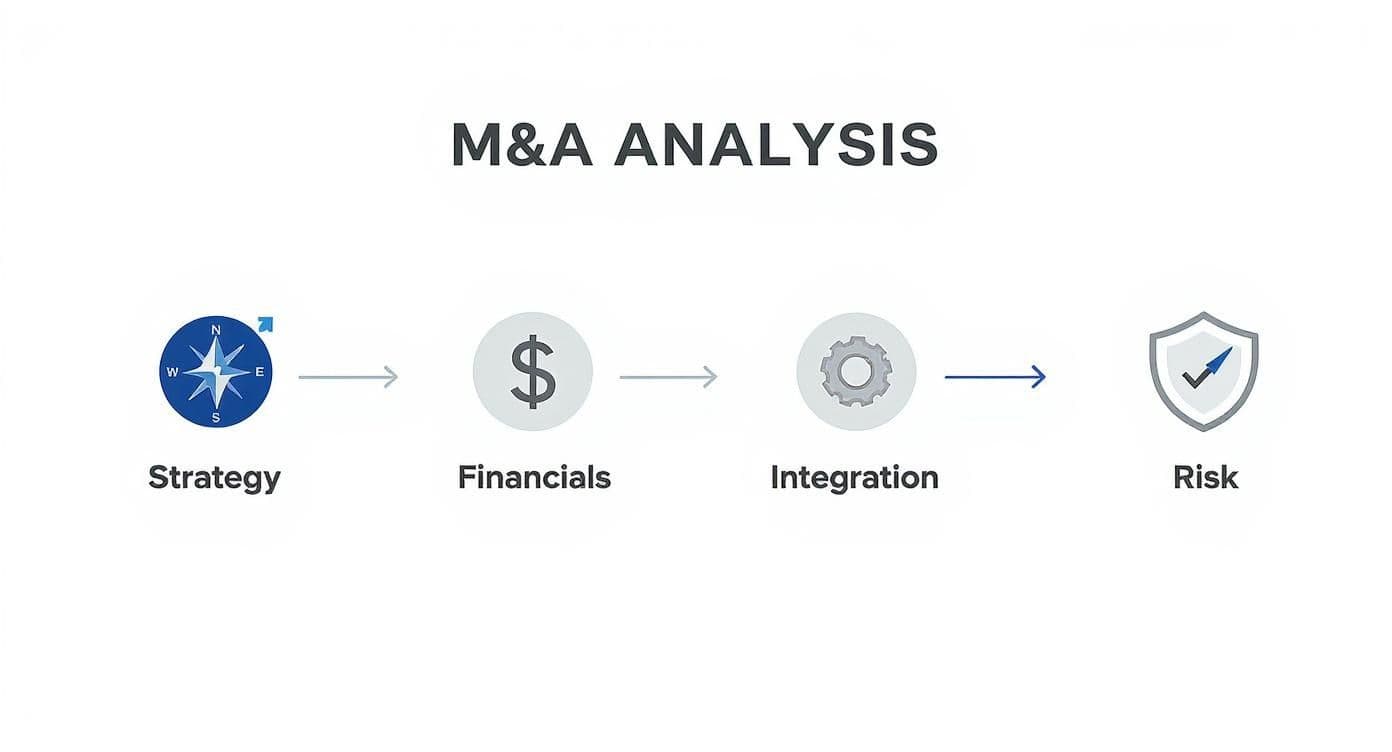
Visualizing the process this way is a great reminder that a killer recommendation needs to be balanced. You have to give equal weight to strategy, financials, integration, and risk.
The Four Pillars of M&A Case Study Analysis
To keep your thoughts organized when the pressure is on, frame your analysis around these four core pillars. The table below is your mental checklist during an interview—a simple framework to make sure you hit every crucial point before you give your final verdict.
For those looking for a deeper understanding of the drivers and regulations in a specific sector, this guide to mergers and acquisitions in banking is a useful resource.
Here’s a breakdown of the four key areas you must address to deliver a complete and convincing recommendation in any M&A case study.
| Pillar | Objective | Key Questions to Ask |
|---|---|---|
| Strategic Fit | Determine if the acquisition aligns with the company's long-term vision and market position. | Why this company? Why now? What competitive advantage does this deal create? |
| Financial Soundness | Assess the deal's economic viability and potential for value creation. | Is the target overvalued? What are the quantifiable revenue and cost synergies? How will the deal be financed? |
| Integration Feasibility | Evaluate the practical challenges of combining the two organizations. | Are the corporate cultures compatible? What is the plan for integrating key systems and retaining top talent? |
| Risk Assessment | Identify potential internal and external threats to the deal's success. | What are the biggest regulatory hurdles? Could competitors react negatively? What if synergies don't materialize? |
Treating these pillars as your guide ensures you build a robust, well-rounded argument instead of getting lost in the numbers or focusing too narrowly on just one aspect of the deal.
Building Your Framework for M&A Case Studies

Cracking an M&A case isn't about running through a generic checklist. The best candidates have a flexible, repeatable way of thinking that they can apply to any deal the interviewer throws at them. It’s less about memorizing steps and more about developing a sharp, strategic instinct for dissecting a deal's core logic.
Your analysis should always start with one simple question: Why is the acquirer doing this deal? You need to dig deeper than the press release. Are they buying their way into a new country? Is it a talent grab—an "acquihire"—to snag a team of hard-to-find engineers? Or is this a purely defensive play to take a disruptive competitor off the board?
Figuring out this "why" is the bedrock of your entire case. Without a compelling strategic rationale, even a deal that looks great on a spreadsheet is doomed. History is littered with examples of deals that lacked a coherent purpose, like eBay’s $2.6 billion acquisition of Skype—a deal undone by a fundamental misunderstanding of how people actually wanted to communicate.
Defining the Strategic Rationale
Once you’ve got a handle on the core motivation, it's time to test if it holds water. This means taking a hard look at the market, the competition, and what makes the target company special. Your goal is to tell a convincing story about how bringing these two companies together creates something bigger and better than the sum of its parts.
This is where a structured approach comes in handy. A solid framework for case interview scenarios helps you break the problem down into manageable chunks. Our guide to frameworks for case interviews covers the M&A structure alongside profitability and market entry.
For any M&A case, you should be probing these key areas:
- Market Attractiveness: How big is this market? Is it growing, flat, or shrinking? What are the big trends, and how does this deal help the acquirer ride those waves?
- Competitive Landscape: Who are the other major players? What keeps new entrants out? You have to consider if this acquisition will poke the bear and trigger a response from competitors that could wipe out the deal's value.
- Target's Standalone Value: Why this company? Do they have a patent fortress, a fanatically loyal customer base, or a killer cost advantage that no one else can replicate?
Pro Tip: Always pressure-test the "why now" of the deal. Is there a temporary market dip, a technology shift, or some other fleeting window of opportunity that makes this the perfect time to pull the trigger? Articulating this sense of urgency is a sign of advanced strategic thinking.
Kicking the Tires with Commercial Due Diligence
With the strategic vision in place, you have to shift gears and get into the weeds. This is where commercial due diligence comes in. You’re moving from the high-level "what if" to the on-the-ground "is this real?" Your job is to poke holes in the assumptions propping up the deal.
For instance, if the whole case for the deal is based on cross-selling products to each other's customers, you have to find out if that’s actually possible.
Start asking sharp questions:
- Do their customer lists even overlap?
- Are the products truly complementary, or will they just cannibalize each other's sales?
- Does the acquirer's sales team have the right skills and incentives to sell the target's stuff?
Likewise, if the deal is all about acquiring a cool piece of technology, you need to assess its actual strength. How defensible is the IP? Can it be easily integrated into the buyer's existing systems, or is it going to require a massive, expensive overhaul? Mattel's $3.8 billion acquisition of The Learning Company is a classic cautionary tale—the promised software synergies never happened because the products and cultures were a terrible match.
Putting Your Framework into Action
To make your analysis sharp and focused, think in terms of testable hypotheses. This turns a vague exploration into a targeted investigation. Instead of just saying, "the deal will increase market share," you should be asking direct, probing questions to guide your work.
Here’s how you can frame your thinking:
| Strategic Theme | Example Prompt to Ask Yourself |
|---|---|
| Market Entry | What are the top three barriers to entering this market organically that the acquisition solves? |
| Product Synergy | How would we test the assumption that we can cross-sell to the target's customers in the first 12 months? |
| Talent Acquisition | What specific retention bonuses and cultural initiatives do we need to keep the target’s key engineers from walking out the door? |
| Competitive Threat | What’s the most likely reaction from our biggest competitor, and how does that change our synergy forecast? |
This kind of structured questioning forces you to build a logical, evidence-based argument. It shows the interviewer you’re not just listing potential benefits but are thinking critically about how to validate them and make them happen—which is exactly what cracking an M&A case is all about.
Mastering the Financials: Valuation and Synergies

Once you've made a compelling case for why a deal makes strategic sense, it’s time to get to the numbers. This is where you prove that the story translates into real financial value. It’s less about building a flawless, complex model and more about using smart, back-of-the-envelope math to argue whether a deal is a winner or a dud.
Just look at the real world for context. In the first half of 2025, the M&A market saw a fascinating split: global deal volumes fell by about 9% from the previous year, but total deal value rose by about 15%. Why? A boom in mega-deals. Fewer deals are happening, but the ones that do are bigger and more strategically critical than ever. You can explore more on these global M&A trends to see what’s really driving the market.
This tells us that companies are willing to pay a serious premium for the right acquisition. That puts even more pressure on you to get the valuation and synergy math right.
Nailing the Valuation Without Overcomplicating It
In a 30-minute case interview, you simply don't have time to build a full-blown Discounted Cash Flow (DCF) model from scratch. Your interviewer isn't looking for that. They want to see if you can quickly and logically establish a reasonable valuation range to frame the rest of the conversation. The goal is to decide if the purchase price is in the right ballpark, not to calculate it to the penny.
The most practical and interview-friendly tool for this is comparable company analysis (comps). You're basically looking at what similar public companies are worth and applying their valuation multiples (like EV/EBITDA) to your target company. It’s fast, it’s intuitive, and it’s directly tied to what the market is paying for similar businesses right now.
Here’s how to do it without getting bogged down:
- Pick the Right Peers: Find a small group of highly relevant competitors. Explaining why they're a good comparison is far more impressive than just listing a dozen names.
- Grab the Key Multiple: For most industries, Enterprise Value to EBITDA (EV/EBITDA) is the go-to multiple. Stick with what's standard unless you have a good reason not to.
- Apply It to the Target: Take the target's EBITDA and multiply it by the median multiple from your peer group. That gives you a solid implied enterprise value.
A pro-tip that interviewers love: always frame your valuation as a range, not a single number. This shows you understand the inherent uncertainty in any valuation. For instance, "Based on peer multiples, I'm seeing a valuation range between $500M and $600M. The proposed $550M offer sits right in the middle of that, which feels reasonable."
Unpacking and Quantifying Synergies
Synergies are the magic ingredient in M&A. It's the whole "1 + 1 = 3" concept, where the combined company becomes more valuable than the two were on their own. In a merger and acquisition case study, your ability to pinpoint, categorize, and actually put a number on these synergies is what will make your answer stand out.
Just saying "the deal will create synergies" is a classic rookie mistake. You have to get specific. Synergies really fall into two big categories: cost synergies and revenue synergies.
Cost Synergies These are the low-hanging fruit. They are easier to estimate and, frankly, more believable to an interviewer because they involve cutting redundant costs.
- Headcount: Think consolidating corporate functions like HR, finance, or legal.
- Operations: Shutting down duplicate warehouses or using combined buying power to negotiate better deals with suppliers.
- IT & Systems: Getting rid of one company's expensive software licenses and consolidating data centers.
Revenue Synergies These are the exciting, high-upside opportunities, but they're also much harder to pull off and riskier.
- Cross-Selling: The classic example—selling the acquirer's products to the target's customers, or vice versa.
- Market Access: Using the target company’s sales team and distribution network to launch your products in a new country.
- Bundled Products: Combining products from both companies to create a new, more attractive offering that neither could provide alone.
To practice the questions that sit behind these projections, see the M&A interview questions with example answers.
A Quick Example of the Financials in Action
Let's bring this to life. Say your client wants to buy a target company that generates $50 million in EBITDA. You quickly find that its closest competitors are trading at an average EV/EBITDA multiple of 10x.
-
Establish a Valuation Range: The baseline valuation is pretty straightforward: $500 million ($50M EBITDA x 10x). To create a range, you might use 9x to 11x, giving you $450 million to $550 million. If the proposed offer is $525 million, you can confidently say it's within a defensible zone.
-
Calculate the Synergies: Now, you dig into the potential value creation.
- Cost Synergies: You estimate that consolidating back-office functions will save $10 million a year.
- Revenue Synergies: You project that cross-selling opportunities could generate $50 million in new revenue at a 20% profit margin, adding another $10 million to the bottom line.
-
Find the Total Value Created: The total annual synergy value is $20 million ($10M from cost savings + $10M from new revenue profit). If you apply that same 10x market multiple, these synergies are worth an additional $200 million in value ($20M x 10x). In a real deal you would also subtract one-time integration costs and allow two to three years for synergies to phase in, as the worked case below does.
This simple math lets you build a powerful recommendation. You can now conclude with confidence: "While the $525 million offer is at the high end of the target's standalone value, the deal has the potential to unlock an additional $200 million in synergy value, making it a financially compelling acquisition."
Precedent Transactions, Control Premium and the Enterprise Value Bridge
Comps tell you what similar public companies are worth today. Three more ideas complete the valuation toolkit, and interviewers often probe them when you present a price.
Precedent Transactions
Precedent transaction analysis looks at what acquirers actually paid for similar companies in the past, usually as a multiple such as EV/EBITDA. Because those prices include the extra amount buyers pay to gain control, this method usually gives a higher range than trading comps. Its weakness is that old deals may not reflect today's market, and good data can be hard to find. In a case, you can say: "Comps put the standalone value at $450 to $550 million. Past deals in this sector have been done at higher multiples because they include a control premium, so I would expect the price to land at the upper end."
Control Premium
A control premium is the amount an acquirer pays above the target's share price before the deal was announced. It is calculated as (offer price per share / pre-announcement price) minus 1. If a stock trades at $20 and the buyer offers $26, the premium is 30 percent. Premiums are often quoted in a range of roughly 20 to 40 percent, but this varies by deal and sector, so do not memorize a single number. The justification for paying it is synergies: the buyer must believe the combined business is worth more than the target alone, and the premium cannot exceed the value of the synergies if the deal is to make sense.
From Enterprise Value to Equity Value
Valuation multiples such as EV/EBITDA give you enterprise value, the value of the operating business to all investors. The offer price per share relates to equity value, the part that belongs to shareholders. The bridge is simple: equity value equals enterprise value minus net debt, where net debt is total debt minus cash. Debt holders are paid first, so debt is subtracted, and cash is subtracted from debt because it could repay some of it. In more complex deals you also adjust for items such as preferred stock and minority interests. State this bridge out loud whenever you move from a multiple to a price per share, because mixing the two is a common interview error.
How to Identify Risks and Plan for Integration

A good case study recommendation doesn't just end with a "yes." A great one anticipates everything that could go wrong after the deal is signed. This is where you shift from identifying opportunities to flagging the specific, deal-breaking risks and sketching out a credible plan to manage them. It shows the interviewer you’re thinking beyond the spreadsheet and into the messy reality of execution.
Generic risks won't get you very far. Saying "there might be cultural issues" is lazy. You have to pinpoint why and what to do about it. The infamous Daimler-Benz and Chrysler merger is the classic cautionary tale here; the rigid, process-driven German culture clashed spectacularly with Chrysler's more freewheeling, creative approach, ultimately destroying billions in value.
Pinpointing Specific Deal Risks
Your risk analysis should flow directly from your due diligence. For every synergy you've celebrated, there’s a flip side—the risk it never actually happens. The goal is to uncover these potential landmines before they blow up the deal's entire premise.
I always tell candidates to focus their attention on these high-impact areas:
- Overpayment Risk: Is the valuation built on a house of cards of overly optimistic synergy forecasts? Challenge it. Propose a sensitivity analysis showing how the ROI craters if only 50% of synergies are realized.
- Cultural Clash: If you’re merging a fast-moving startup with a legacy corporation, a culture clash isn't a risk; it's a certainty. Your mitigation plan needs to be concrete, like creating a joint integration team co-led by respected executives from both firms to build a new, unified culture from day one.
- Customer Attrition: Will the target's loyal customers jump ship after the acquisition? You need to suggest specific retention bonuses for key account managers or maybe a phased brand transition to ease everyone into the new reality.
- Key Talent Flight: The target’s most valuable assets often have feet. Propose targeted retention packages—"golden handcuffs"—for indispensable engineers or salespeople, tying their bonuses to both financial performance and hitting integration milestones.
As you dig into these risks, remember that managing the flow of sensitive information is critical. This Ultimate Due Diligence Data Room Guide is a great resource for understanding how to structure that process effectively.
Structuring a Credible Integration Plan
Spotting the risks is only half the job. You have to propose a clear, actionable post-merger integration (PMI) plan. A solid PMI shows you’ve thought through the operational headaches of actually making the deal work. Interviewers are looking for that practical, forward-thinking problem-solving.
Your plan doesn't need to detail every single step for the next two years, but it absolutely must cover the critical first moves. The 100-day plan is the perfect framework for this.
Pro Tip: In a case interview, the 100-day plan is your chance to show operational savvy. Don't boil the ocean. Just focus on a few high-priority initiatives that will build momentum and secure early wins, like nailing down the new leadership team or launching a unified communication strategy.
A strong integration outline will always hit on a few core components.
A well-crafted risk assessment not only identifies potential pitfalls but also lays the groundwork for overcoming them. Below is a table outlining some of the most common risks you'll encounter in an M&A case and how you can frame your mitigation strategies.
Common M&A Risks and Mitigation Strategies
| Risk Category | Example | Proposed Mitigation Strategy |
|---|---|---|
| Financial | Overpaying due to inflated synergy forecasts or an inaccurate valuation. | Conduct rigorous sensitivity analysis on synergy realization (e.g., model at 50% and 75%). Use multiple valuation methods (DCF, Comps) to triangulate a fair price. |
| Operational | Incompatible IT systems, clashing supply chains, or redundant facilities leading to disruption. | Create an integration task force with IT and operations leads from both companies. Prioritize system migration for critical functions within the first 100 days. |
| Cultural | A clash between a hierarchical, formal company and a flat, agile one, leading to employee disengagement and turnover. | Appoint a joint integration team to define a new "best of both" culture. Launch an immediate employee communication plan to address uncertainty and build trust. |
| Market | Post-acquisition, key customers leave due to perceived changes in service, quality, or branding. | Implement a proactive customer outreach program. Offer retention incentives to key account managers and consider a phased brand transition. |
| Regulatory | The deal is delayed or blocked by antitrust authorities due to concerns about market concentration. | Conduct upfront antitrust analysis. Prepare a divestiture plan for overlapping business units to proactively address regulatory concerns. |
Thinking through these scenarios demonstrates a mature, strategic mindset that goes beyond just the numbers.
Key Elements of a 100-Day Integration Plan
- Leadership and Governance: Decide who is in charge, immediately. Appoint an integration leader and form a steering committee with people from both companies to make fast, informed decisions.
- Communication Strategy: Control the narrative from day one. Have a clear plan to communicate with employees, customers, and investors to reduce uncertainty and keep morale from tanking.
- Synergy Capture Teams: Don’t just hope for synergies. Create dedicated teams responsible for delivering specific cost and revenue targets. Give them clear goals, timelines, and hold them accountable.
- Talent Retention: Execute the retention packages you flagged during your risk assessment. Go out and proactively talk to the top performers you absolutely cannot afford to lose.
This dual focus on risk and integration is especially important in a busy market. For instance, in the first nine months of 2025, global M&A deal values rose about 10% year-over-year, with North America making up roughly 62% of worldwide activity, according to an A&O Shearman study reported by Reuters. With that much capital in play, the pressure to execute well has never been higher.
This comprehensive approach—marrying sharp risk identification with a practical integration roadmap—is what separates a good answer from a great one. For those in finance-focused interviews, understanding these principles is key. You can see how this applies in a different context in our guide to the private equity case study. By showing you can anticipate and plan for the messy parts, you prove you're not just an analyst but a genuine strategic partner.
Presenting Your Final Recommendation with Impact
https://www.youtube.com/embed/8eo01Wlkd4o
You’ve done the heavy lifting—the market analysis, the financial modeling, the synergy calculations. Now comes the moment of truth. Getting the right answer in an M&A case is table stakes. How you deliver that answer is what separates a good candidate from a great one. This is your chance to pull everything together into a concise, powerful, and data-backed verdict that your interviewer won't forget.
The best way to kick things off? Be decisive. Don't meander or hedge your bets. Start with a firm "yes" or "no" on the deal, immediately followed by the top three reasons supporting your conclusion. This is the classic "answer-first" or top-down communication style that senior partners and clients expect and respect.
For instance, a rock-solid opening would sound something like this: "Our recommendation is a clear 'go' on this acquisition, and it's driven by three core factors: first, it gives us immediate access to a high-growth market; second, we project achievable cost synergies of $25 million annually; and third, this move effectively neutralizes a key competitor." That structure instantly signals confidence and clarity of thought.
Crafting a Compelling Narrative
Think of your final recommendation as the climax of your analytical story, not just a dry summary. Each of your three supporting points should act as a mini-headline. From there, you can unpack them with the most compelling data you uncovered during your analysis. This is where you masterfully connect your strategic rationale, financial model, and risk assessment into one cohesive argument.
Weave in the most impactful numbers you calculated to make your points hit harder:
- Valuation: "The offer price of $500 million comes out to a 10x EBITDA multiple. That’s right in line with the industry average, which tells us we’re looking at a reasonable entry point."
- Synergies: "We’ve identified $15 million in cost synergies just from consolidating back-office functions. That alone provides a significant buffer for the deal's ROI."
- Market Impact: "Pulling this off will boost our market share from 20% to 32%, making us the undeniable number two player in the space."
Grounding your strategic insights in hard evidence like this makes your recommendation infinitely more persuasive. It shows you didn’t just guess—you did the math.
Handling Interviewer Pushback and Next Steps
Once you’ve laid out your case, get ready for a challenge. A sharp interviewer will start poking holes in your logic to see how you handle pressure and to test the depth of your thinking. They might hit you with questions like, "What if your synergy forecast is off by 50%?" or "You haven't considered how our biggest competitor might react."
Don't get defensive. This is your opportunity to shine.
The best response starts by acknowledging their point. Then, calmly walk them through your backup plan. For example: "That's an excellent point. We actually modeled a downside scenario where we only capture half the projected synergies. Even then, the deal remains accretive by year three, though the payback period does get longer. This just underscores how critical a rigorous integration plan will be to make sure we capture those savings."
This kind of answer doesn't just address the question; it proves you've already thought several steps ahead.
Finally, bring it home by outlining clear, actionable next steps. This shows you're not just an analyst but a true advisor. You could propose a 100-day integration plan, suggest the key performance indicators (KPIs) to track the deal’s success, or recommend further due diligence on a specific risk you flagged.
This forward-looking perspective is crucial, especially in a hot market. For context, the U.S. M&A market saw a strong surge in deal value in the third quarter of 2025, with deal value reaching its highest quarterly level since 2021 (roughly $580 billion by some counts), largely fueled by a few blockbuster deals. You can read more on these significant M&A trends and their drivers. In an environment that active, proving you can manage a deal after the papers are signed is what sets you apart. By delivering a confident, data-driven, and forward-looking recommendation, you show them you're ready for the job.
Worked M&A Case Study With Solution
Here is a full case as an interviewer would run it. The company and figures are illustrative.
Prompt: "Our client is a large US pet food maker. It is considering buying a premium pet-treat brand for $400 million. Should it do the deal?"
Step 1: Clarify and set the goal. Ask what success looks like. Here the client wants growth in premium treats, a category it does not sell today, and wants the deal to pay back within about five years.
Step 2: Strategic rationale. Premium treats are growing faster than core pet food, the target is a top-three brand in natural channels, and the client could not build a brand like this quickly on its own. The client also has what the target lacks: national grocery distribution. The rationale holds, so move to price.
Step 3: Standalone value. The interviewer gives you:
| Data point | Value |
|---|---|
| Target revenue | $200M |
| Target EBITDA margin | 15% |
| Target cost of goods sold | $110M |
| Target SG&A | $40M |
| Other operating costs, excluding depreciation and amortization | $20M |
| Peer EV/EBITDA multiples | 11x to 13x |
Target EBITDA = $200M - $110M - $40M - $20M = $30M, matching the 15% margin. At 11x to 13x, standalone value is $330M to $390M, with a midpoint of $360M at 12x. The $400M price is about 13.3x EBITDA ($400M / $30M), so the client is paying a $40M premium over the midpoint. The question becomes: do synergies cover that premium with room to spare?
Step 4: Synergies.
| Synergy | Assumption | Annual run-rate value |
|---|---|---|
| Procurement (cost) | 3% savings on the target's $110M COGS through the client's buying power | $3.3M |
| Overhead (cost) | Remove 25% of the target's $40M SG&A | $10.0M |
| Distribution (revenue) | $30M of new sales through the client's grocery accounts at a 30% contribution margin = $9M, haircut 50% for execution risk | $4.5M |
| Total | $17.8M |
As a simplified steady-state valuation, apply the same 12x multiple to recurring EBITDA synergies: $17.8M x 12 = $213.6M. Subtract an assumed $15M of one-time integration costs and the net synergy value is about $199M ($213.6M - $15M = $198.6M).
Step 5: Sanity check. Under these simplifying assumptions, the indicative value ceiling is standalone value plus net synergies: $360M + $199M = about $559M. At $400M, the client hands the seller about 20% of the net synergy value ($40M / $198.6M) and keeps the rest. Even on cost synergies alone ($13.3M x 12 = $159.6M, minus $15M = $144.6M), the deal covers the $40M premium more than three times.
Payback check: Valuation upside does not establish five-year payback. Even treating the full $30M + $17.8M = $47.8M of annual run-rate EBITDA as cash from day one, the $400M price plus $15M integration cost takes about 8.7 years to recover ($415M / $47.8M). Five years would require $83M of annual net cash flow ($415M / 5). This rough check assumes no growth or resale proceeds and ignores taxes, capital expenditure and working capital; a phased synergy rollout would also delay recovery. Ask for those cash-flow inputs before modeling payback. The 12x synergy estimate above is a valuation shortcut, not a discounted cash-flow model or a safe bid ceiling.
Step 6: Risks. Retailer pushback if the brand loses its "independent" feel, key founders leaving, and the distribution synergy taking longer than planned. Mitigations: keep the brand and packaging separate, retention packages for the founding team, and a staged grocery rollout.
Recommendation: "Do not approve the $400M offer under a firm five-year payback requirement. The strategic fit and illustrative synergy valuation justify further diligence, but the cash-recovery goal is not supported by these numbers. I would test growth and synergy timing in a cash-flow model, negotiate the price, and confirm whether five-year payback is a hard constraint before recommending a deal."
This is the structure interviewers look for. For more cases in this format, see our case interview examples. If the math slows you down, our guide to improving mental math has drills for exactly these multiplications.
Merger Model Case Study: Is the Deal Accretive or Dilutive?
In investment banking interviews, "M&A case study" often means a quick merger model rather than a strategy case. The key question is whether the deal raises (accretive) or lowers (dilutive) the buyer's earnings per share (EPS).
Here is a simple all-stock example:
- Acquirer: net income $500M, 100M shares, so EPS is $5.00. Share price $80, so its P/E is 16x.
- Target: net income $60M. Purchase price $900M, paid fully in acquirer stock, so the buyer pays 15x the target's earnings.
- New shares issued: $900M / $80 = 11.25M.
- Pro forma EPS: ($500M + $60M) / (100M + 11.25M) = $560M / 111.25M = $5.03, about 0.7% accretive.
- With synergies: add $10M of after-tax synergies and EPS becomes $570M / 111.25M = $5.12, about 2.5% accretive.
The shortcut: in an all-stock deal with no synergies, the deal is accretive when the buyer's P/E is higher than the P/E it pays for the target (16x vs 15x here). For cash or debt deals, compare the after-tax cost of the cash or debt with the target's earnings yield (the inverse of the P/E paid). For the valuation side in more depth, see our guide to mergers and acquisitions valuation and these investment banking technical questions.
Real M&A Case Studies Worth Knowing
Pointing to a real deal helps. Each of these is widely documented and teaches one lesson:
| Deal | What happened | Lesson for your case |
|---|---|---|
| Disney / Pixar (2006) | Disney bought Pixar for about $7.4 billion in stock and kept Pixar's creative culture largely separate. | Capability deals work when you protect what you bought. |
| Facebook / Instagram (2012) | Facebook paid about $1 billion for a small team with a fast-growing mobile app. | Defensive and talent-driven deals can be worth far more than current earnings suggest. |
| eBay / Skype (2005) | eBay paid $2.6 billion up front, took a large write-down in 2007, and sold a majority stake in 2009. | No clear strategic link to the core business means no synergies. |
| Daimler-Benz / Chrysler (1998) | Billed as a merger of equals; Daimler sold 80.1% of Chrysler to Cerberus in 2007. | Culture and integration risk can wipe out the expected value. |
Use these as one-line support for a point ("this looks more like Disney and Pixar than Daimler and Chrysler, because..."), not as a substitute for the numbers.
Navigating the Tricky Parts of an M&A Case
Even with a great framework, you're going to hit some bumps. M&A cases are designed to test you on the fly, and certain questions or scenarios can easily derail your momentum if you're not ready.
Let's walk through a few of the most common curveballs I've seen trip up candidates. These are the practical, in-the-moment challenges that are tough to prepare for but make all the difference under pressure.
How Do I Prioritize When the Clock Is Ticking?
You'll never have enough time to analyze everything in a 30-minute case. You simply can't. The trick is to become ruthless in your prioritization.
Right out of the gate, form a quick hypothesis about the core of the deal. Is this about buying market share? Is it a pure cost-cutting play? Or are they after a specific technology? Let that initial gut check be your North Star.
For example, if you suspect the deal is all about cost synergies, that’s where you should spend most of your time. Dig into the numbers, quantify the potential savings, and don't get too bogged down in revenue synergies or a deep dive into cultural fit. On the other hand, if it's a strategic move to acquire a new piece of tech, then you'd better be spending your time on the target's intellectual property and competitive advantages, not their SG&A costs.
The key is to bring the interviewer along with you. Say something like:
"Given we only have about 20 minutes left, I'm going to hypothesize that the main value driver here is X. So, I'll focus my analysis there first. Does that sound reasonable?"
This does two things: it shows you can think strategically under pressure, and it gives the interviewer a chance to guide you if you're heading down the wrong path.
What If I'm Missing a Key Piece of Data?
This isn't an accident. Interviewers often leave out information on purpose to see how you handle ambiguity. The worst thing you can do is stop dead and say, "I can't solve it without that number."
Instead, flag the missing piece and make a smart, well-reasoned assumption to keep the case moving.
Let's say you need the target company's EBITDA margin to run a valuation, but it's nowhere to be found. You could say:
"To build out the valuation, I need an EBITDA figure. Since that's not available, I'm going to assume a 15% EBITDA margin, which is a fairly standard benchmark for this type of company in this industry. I'll flag this as a key assumption we'd need to validate in actual due diligence."
This move turns a roadblock into an opportunity. You're demonstrating problem-solving skills and business acumen, which is far more impressive than just plugging numbers into a formula.
Should I Always Land on a Clear 'Go' or 'No-Go'?
Yes, absolutely. A non-committal, "well, it depends..." answer is the kiss of death in an M&A case. The entire exercise is designed to see if you can take a mountain of complex information, synthesize it, and make a decisive recommendation.
Your final answer should be a direct "yes" or "no," immediately followed by your top three reasons why.
Remember, a "no" can be just as powerful as a "yes." In fact, it can be even more impressive. Showing that you've identified that a deal is overpriced, too risky, or a poor strategic fit demonstrates real commercial savvy. A widely cited rule of thumb, often attributed to Harvard Business Review authors, is that 70% to 90% of mergers fail to deliver their expected value, though the exact figure varies by study and definition of failure. Recommending against a bad deal shows you understand this.
Ultimately, your interviewer cares less about what you decide and more about how you got there. Your logic is what's being tested.
M&A Case Study FAQ
What is the best framework for an M&A case? Four parts cover almost every case: strategic rationale, standalone value of the target, synergies net of integration costs, and risks plus integration. Adapt the order to the prompt; if the client already wants the deal, start with price and synergies.
How is an M&A case different in consulting and investment banking interviews? Consulting cases focus on whether the deal makes strategic sense and how much it is worth to this buyer. Banking interviews more often test the mechanics: accretion/dilution, purchase price, and how the deal is financed. Prepare both if you are applying to either. Our finance interview questions guide covers the technical side.
Where can I find M&A case studies with solutions? University consulting club casebooks usually include several M&A cases with full solutions, and the worked case above follows the same format. Then practice saying your answer out loud to someone who pushes back.
Ready to master the M&A case and land your dream job in consulting or finance? At Soreno, we provide an AI-powered interview platform with an extensive library of cases and targeted drills to perfect your skills. Practice with a realistic AI interviewer, get instant, rubric-based feedback, and track your progress to turn weaknesses into strengths. Start your free trial today and prepare with confidence at Soreno.ai.
Related guides
- Consulting Case Study Examples: Where Firms Publish Theirs, Plus 2 Worked Cases
- What Is a Case Study Interview and How to Ace It
- Capital One Case Interview: Format, Tips and a Practice Case
- Bain Case Interview Examples: 12 Cases and How to Prepare
- Accenture Case Interview: Workbook, Process and Examples
- Mastering Frameworks for Case Interviews A Proven Guide