
What Is Market Size a Guide for Consulting Interviews
Master 'what is market size' for your consulting interview. Our guide breaks down TAM, SAM, and SOM with practical estimation methods and real examples.

When you're in a high-stakes interview, you need to deliver a sharp, clear answer. So, what is market size?
Put simply, market size is the total potential revenue a company can generate from a specific product or service in a given market. It's the ceiling for your sales opportunity.
Think about it like this: if you open a gourmet taco truck in New York City, your potential earnings are ultimately defined by the number of hungry customers in the areas you serve.
How to Define Market Size in Under 60 Seconds
Let’s stick with that taco truck example. Your market size isn't "everyone in NYC who eats." That’s too broad and shows a lack of focus.
Instead, your market is the total number of people who are willing and able to buy your specific kind of gourmet taco, in the locations you operate, at the price you charge. This is the kind of practical, grounded thinking interviewers are looking for.
But understanding market size isn't just about finding one magic number. It's about seeing the market in layers. Top consultants and analysts break it down into three core components, moving from a massive theoretical number to a realistic, actionable target. This layered approach is what separates a basic answer from a strategic one.
The Three Essential Layers: TAM, SAM, and SOM
To really nail this concept in an interview, you have to talk about its three distinct levels. These frameworks help you systematically filter from the entire universe of potential customers down to the segment you can actually win over.
Here’s a simple table breaking down these crucial concepts.
Deconstructing Market Size: TAM, SAM, and SOM
| Framework | Definition | Example (Gourmet Food Truck in NYC) |
|---|---|---|
| Total Addressable Market (TAM) | The total global demand for a product or service category. It's the "big picture" number. | The revenue from all food sales across the entire city—restaurants, street vendors, everything. |
| Serviceable Available Market (SAM) | The portion of TAM your business can realistically reach with your specific products, services, and geographic footprint. | The revenue from all food trucks operating in the specific neighborhoods you can physically get to. |
| Serviceable Obtainable Market (SOM) | The slice of SAM you can realistically win, considering your competition, capacity, and marketing. It's your initial target. | The share of local food truck revenue you aim to capture in your first one to two years of operation. |
This tiered perspective is incredibly powerful because it shows you can think like a strategist—moving from a high-level idea to a concrete business plan.
The TAM, SAM, and SOM framework is the absolute gold standard in consulting interviews. Using it proves you can move beyond a textbook definition and build a structured, defensible business case from the ground up.
Breaking down the market this way helps businesses create targeted strategies and set achievable goals. Each layer answers a different strategic question, turning a vague concept into an actionable roadmap.
For a deeper dive, you can learn more about the specific techniques used to calculate the size of a market. Mastering this structure is the key to impressing interviewers and showing you’re ready for the job.
Understanding the Three Layers of Market Analysis
When you're trying to answer the question, "what is market size," don't just think of a single, massive number. That's a rookie mistake. Real strategic thinking, the kind consultants and investors expect, involves breaking the market down into three distinct layers.
Think of it as a set of nested dolls. You start with the biggest one and work your way down to the most realistic, tangible opportunity. This framework isn't just an academic exercise; it's how you build a business plan that’s actually grounded in reality.
The hierarchy looks like this, filtering from the total universe of demand (TAM) down to the more practical SAM and SOM.
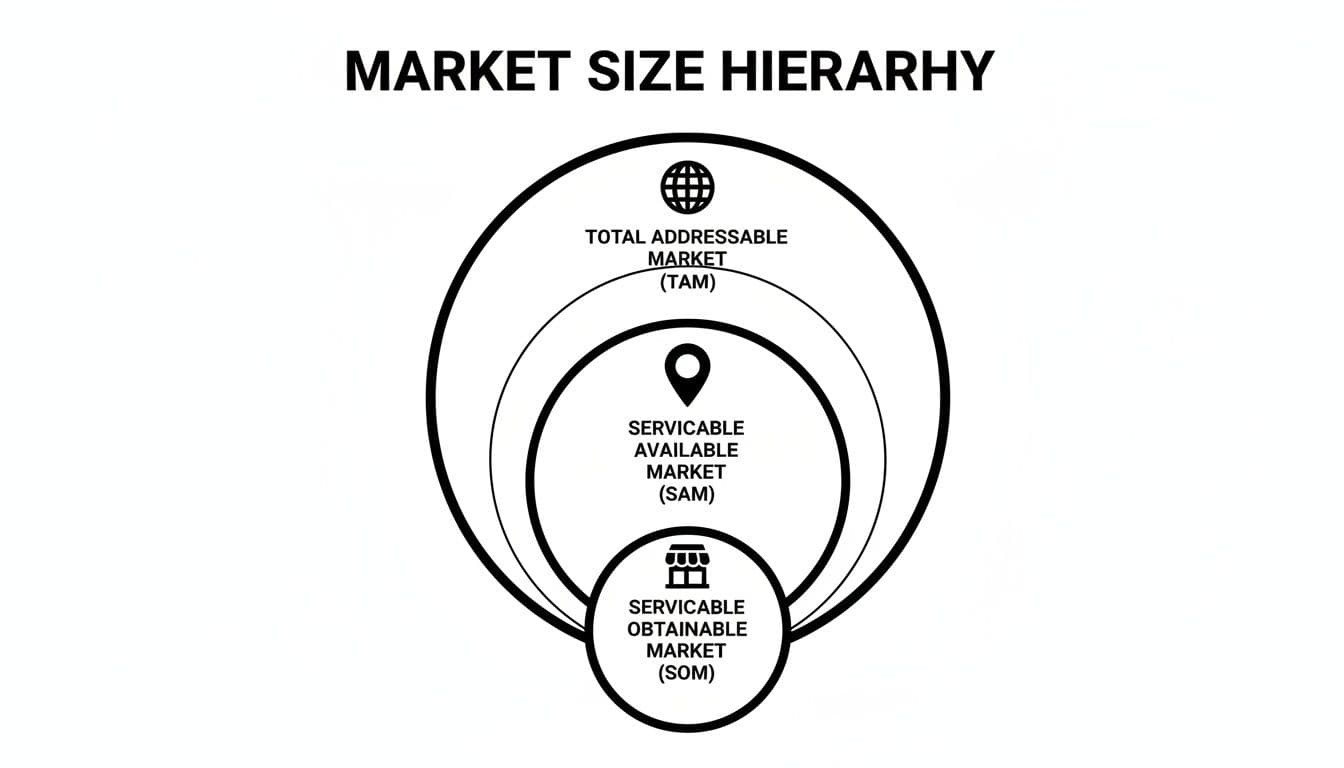
This process of narrowing your focus is the absolute core of sharp market analysis. It forces you to be honest about the true scope of your business from day one.
TAM: The Big Picture
First up is the Total Addressable Market (TAM). This is the absolute maximum revenue you could possibly make if you had zero competition and could sell to every single potential customer on the planet. It's the "blue sky" number that answers the question: "How big is the entire ocean?"
Imagine you're launching a new project management SaaS tool. Your TAM would be the total amount spent by all businesses, everywhere, on project management software. It’s a huge, aspirational figure that sets the ultimate boundary for your potential growth.
SAM: The Slice of the Pie
Now, let's get real. The Serviceable Available Market (SAM) is the chunk of the TAM you can actually reach. This is where your business model, product features, and geographic limits come into play. SAM answers a much more practical question: "How much of the ocean can my boat actually fish in?"
For our SaaS startup, this means filtering that massive TAM. If their software is only in English and is built for small-to-medium businesses (SMBs), their SAM is the total spending on project management tools by English-speaking SMBs in the countries they operate in. It’s their specific arena, the part of the market they can genuinely compete for.
Key Takeaway: An interviewer doesn't just want to see if you can calculate a big number (TAM). They want to see if you can apply realistic constraints to define a focused, addressable market (SAM). This demonstrates commercial awareness.
SOM: The First Bite
Finally, we have the Serviceable Obtainable Market (SOM). Sometimes called Share of Market, this is the portion of your SAM you can realistically win over in the near future. Here, you have to account for competitors, your marketing budget, the size of your sales team, and how well-known your brand is. SOM answers the most immediate question: "How many fish can I realistically catch in the first year?"
Our SaaS startup might forecast capturing just 1% of its SAM within the first two years. That number becomes their tangible sales target—something you can build a financial model and an operational plan around.
This kind of layered analysis is second nature in professional services. The global consulting industry, for example, is projected to hit US$1.06 trillion in revenue by 2025 and grow to US$1.32 trillion by 2029, and that growth is fueled by exactly this type of sharp, analytical thinking.
To truly get a handle on the market and its potential, you need to back up your numbers. This is why it is so important to know how to conduct market research effectively. Good research gives you the qualitative insights needed to build a credible and defensible TAM, SAM, and SOM model.
Choosing Your Estimation Method: Top-Down vs. Bottom-Up
Once you’ve got your head around the TAM, SAM, and SOM framework, the next big question is: how do you actually calculate these numbers? In an interview, the method you choose is just as important as the final number you land on. It’s a direct window into how you think and solve problems.
The two workhorse approaches you’ll lean on are top-down and bottom-up.
Imagine you’re asked to figure out how many windows are on a skyscraper. You have two ways to go about it.
The Top-Down Approach: Starting from the Sky
With the top-down method, you start with the biggest, most expansive number you can find and carve it down. You’re essentially starting with the whole universe and applying filters until you’re left with just your target market.
Think of it as starting with the skyscraper’s total square footage—a known figure from a city record. From there, you'd estimate the percentage of the exterior that’s actually glass, then maybe the average window size. It's a process of logical subtraction.
This approach is fast because it leans on readily available data from industry reports, government statistics, or big market research firms.
Let's say you're sizing the market for electric bicycles in Germany. A top-down approach would look something like this:
- Start with the total population of Germany.
- Narrow it down to the percentage of people in a target age range, say 18-65.
- Filter that group by the percentage living in urban areas where biking is practical.
- Finally, apply an estimated adoption rate for e-bikes within that specific group.
While it’s quick, the top-down method's main strength is also its biggest weakness. Every assumption you make introduces a new margin for error. A small mistake at the top of your funnel can snowball into a massive inaccuracy by the time you get to your final answer.
The Bottom-Up Approach: Building from the Ground
The bottom-up method is the exact opposite. Instead of starting with the whole skyscraper, you’d count the number of windows on a single floor and then multiply that by the total number of floors.
You’re building your market size from the smallest possible units. This could be individual customers, specific sales locations, or product categories. You aggregate these small pieces to construct the total market picture. It’s a far more granular and, frankly, more defensible method.
For that same German e-bike market, a bottom-up analysis would be completely different:
- First, you’d identify the primary sales channels: independent bike shops, major sporting goods chains, and direct-to-consumer websites.
- Then, you'd estimate the average number of e-bikes a typical store sells in a year.
- Multiply that average by the total number of relevant stores across Germany.
- Finally, you’d add a separate calculation for online sales.
Consulting and finance interviewers love this approach because it shows you can think through the mechanics of a business. Your assumptions are tangible and easier to justify ("I estimate the average bike shop sells 50 e-bikes a year because...") than broad demographic percentages.
A bottom-up analysis forces you to think like an operator, not just an observer. It connects the market size directly to the sales, distribution, and pricing realities a business would face, making it a powerful tool in any strategic discussion.
To give you a clearer picture, let's break down how these two methods stack up against each other.
Comparing Top-Down and Bottom-Up Estimation
| Attribute | Top-Down Approach | Bottom-Up Approach |
|---|---|---|
| Process | Starts with a large macro number (e.g., total population) and narrows down with filters and assumptions. | Starts with a single unit (e.g., one customer or store) and aggregates up to the total market. |
| Benefits | Fast to execute; good for a quick "back-of-the-envelope" calculation; useful when granular data is scarce. | More accurate and defensible; demonstrates deep analytical thinking; assumptions are easier to justify. |
| Drawbacks | Prone to significant error as assumptions compound; can feel disconnected from business reality. | Requires more detailed data and assumptions; can be time-consuming to build from scratch. |
| Interview Use Case | Best used as a "sanity check" to validate a bottom-up calculation or when you have very limited time. | The preferred primary method for most consulting and finance case interviews. |
Ultimately, a bottom-up approach usually provides a more realistic and compelling answer.
When a Third Method Makes Sense: Value Chain Analysis
Every so often, you'll encounter a market where neither top-down nor bottom-up feels quite right, especially in complex B2B industries. This is where value chain analysis comes in handy.
This method sizes a market by looking at the value added at each step of a product's journey, from raw materials to the final consumer.
For example, to size the market for smartphone camera sensors, you wouldn't count smartphones sold. Instead, you'd look at the sensor manufacturers, the price they sell their components for to phone makers like Apple or Samsung, and their total sales volume. This is brilliant for pinpointing where profit is concentrated within an industry.
Picking the right approach is a strategic decision. To see these methods in action, our comprehensive guide on how to estimate market size offers several worked-out examples.
Pro tip for your interview: The strongest candidates often build a robust bottom-up case and then use a quick top-down calculation as a sanity check. This shows you’re not just thorough but also have the commercial sense to know if your numbers land in the right ballpark.
A Practical Market Sizing Walkthrough
Theory is great, but in a high-pressure interview, it's your execution that counts. So, let's put the concepts into practice and tackle a classic market sizing question from start to finish. Remember, this isn't just a math quiz—it's a test of your structured thinking, communication, and business sense.
The Prompt: Estimate the annual market size for coffee shops in the United States.

We're going to use a bottom-up approach for this one. Why? Because it’s usually easier to defend your assumptions in an interview setting. Our game plan is to build a clear, logical structure, make some reasonable assumptions, and arrive at a number that makes sense.
Step 1: Clarify the Question
Before you even think about numbers, you need to define the sandbox you're playing in. This is a critical first step that shows your interviewer you’re thoughtful and precise.
- What exactly is a "coffee shop"? Are we only counting specialty cafes like Starbucks and your local independent shop? Or should we include places where coffee is on the menu but isn't the main event, like McDonald's or a bakery? Let's agree to focus on specialized coffee shops where coffee is the star of the show.
- How are we defining "market size"? Are we talking about total revenue in dollars, or the total number of cups sold? Let's aim for the annual revenue in U.S. dollars.
Nailing down these details prevents you from solving the wrong problem and immediately sets a professional, structured tone for your answer.
Step 2: Build Your Equation
Next, you need to lay out your roadmap. Think of this as the simple, logical equation that will guide your entire analysis. It's the backbone of your solution.
A solid structure might look something like this:
(Number of U.S. Adults) x (% Who Drink Coffee) x (Cups per Day) x (Average Price per Cup) x (Days per Year) x (% of Coffee Bought at Shops)
This formula is MECE (Mutually Exclusive, Collectively Exhaustive), which is just a fancy way of saying we've covered all the key parts without any overlap. Now, all we have to do is plug in some logical assumptions.
Step 3: Make and Defend Your Assumptions
This is where you really get to show off your business acumen. The actual numbers you pick are less important than your ability to justify them with common sense. Pro tip: use round, friendly numbers to make the mental math easier on yourself.
-
U.S. Population: Let's start with a number that's easy to remember. The U.S. population is about 330 million. Since kids aren't our main target, let's round the adult population down to a clean 250 million.
-
Coffee Drinker Segmentation: Not everyone drinks coffee, and those who do have different habits. Breaking the population into segments will make our estimate much more nuanced and realistic.
- Heavy Drinkers (25%): These are the folks who need about 3 cups a day to function.
- Moderate Drinkers (50%): This group enjoys a steady 1 cup per day.
- Non-Drinkers (25%): These people get their energy elsewhere—0 cups per day.
-
Average Price per Cup: A simple drip coffee might be cheap, but lattes and fancy cold brews can get pricey. Let’s land on an average of $4.00 per cup to balance things out.
-
Purchase Location: People don't buy every coffee they drink. Many brew it at home or grab a free cup at the office. So, let's assume 50% of all coffee consumed is actually purchased from a coffee shop.
Interviewer Insight: When you state an assumption, give a quick "why." For instance, "I'm assuming 50% of coffee is from shops because many people probably have their first cup at home before commuting and might grab a second one during the workday."
Step 4: Calculate the Market Size
Alright, it's time to do the math. The key here is to walk through it step-by-step so your interviewer can follow your logic.
-
Heavy Drinkers:
- (250M adults * 25%) = 62.5M people
- 62.5M people * 3 cups/day * $4/cup * 365 days * 50% from shops = $137 billion
-
Moderate Drinkers:
- (250M adults * 50%) = 125M people
- 125M people * 1 cup/day * $4/cup * 365 days * 50% from shops = $91 billion
Now, we just add the two segments together to get our grand total.
- Total Market Size: $137B + $91B = $228 billion
Step 5: Sanity Check Your Answer
You're not done yet! The final step is arguably the most important: does this number actually seem reasonable? A quick sanity check shows you have commercial awareness.
We can quickly compare our result to a massive figure, like the U.S. GDP, which is roughly $27 trillion. Our $228 billion estimate for coffee shops is less than 1% of that. For a large, but still specific, consumer market, that feels plausible. It passes the gut check.
This kind of structured thinking is exactly what's needed in high-stakes fields. For example, North America is the largest consulting market in the world, and the U.S. management consulting industry alone was valued at $374 billion in 2023. In that world, consultants have to size up opportunities quickly and logically—a skill you can read more about in these consulting statistics. Our coffee shop exercise is a perfect warm-up for that kind of real-world challenge.
Common Interview Mistakes and How to Avoid Them
Knowing the frameworks is one thing; executing them flawlessly when the pressure is on is another beast entirely. I've seen countless sharp candidates stumble, not because they lacked the knowledge, but because they fell into predictable traps. If you want to master the "what is the market size" question, you first have to understand where others go wrong.

Think of this as your pre-flight checklist. By seeing where the pitfalls are, you can navigate around them and deliver a polished, confident answer that shows you can think like a seasoned consultant.
Mistake 1: Making Unsupported Assumptions
This is hands-down the most common error. A candidate will just pull a number out of thin air, saying something like, "I'll assume 70% of people own a smartphone." It feels weak because it's a guess without a foundation.
A top-tier candidate, on the other hand, anchors their assumptions in logic. They might say, "Let's start with smartphone penetration. In developed markets, it's likely very high, maybe 80-90%. But to be conservative, I'll use 70% to account for older generations or kids who might not have one." See the difference? That small piece of reasoning shows you're thinking critically, not just guessing.
How to Avoid It: Never state a number without a "because." Attach a brief, common-sense reason to every assumption you make. It could be based on demographics, observable trends, or just a logical proxy. Most importantly, say your reasoning out loud.
Mistake 2: Diving Straight into the Math
Some candidates get so excited to show off their quantitative chops that they immediately start crunching numbers. This is a massive red flag. For the interviewer, it signals a complete lack of structure. The goal isn't just to get the right answer; it's to demonstrate a logical, organized thought process.
Before you multiply a single thing, you need to map out your plan. State your approach (like bottom-up), and lay out the simple equation you intend to follow. This proves you have a methodical, MECE (Mutually Exclusive, Collectively Exhaustive) mindset.
Here’s how to fix this:
- Verbalize Your Structure: Kick things off by saying, "Okay, to figure this out, I'm going to use a bottom-up approach. My overall equation will be (Number of Target Customers) x (Purchase Frequency) x (Average Price)."
- Get Buy-In: After you've laid out your structure, pause and ask the interviewer, "Does this approach seem reasonable to you?" This simple question turns your monologue into a collaborative problem-solving session and gets them on your side.
Mistake 3: Getting Lost in the Details
This is the "math rabbit hole." Some candidates try to build incredibly complex models on the fly, segmenting the coffee market by five age groups, three income levels, and four different regions. While the ambition is admirable, it's a recipe for disaster in a mental math scenario.
Your goal is to be directionally correct, not perfectly precise. An elegant, simple framework with just two or three clear segments is far more powerful than a convoluted mess you can't solve.
How to Avoid It:
- Keep Segments Simple: Stick to two or three high-impact segments. Think heavy users versus light users, or business versus personal use.
- Use Round Numbers: It’s so much easier to work with 250 million than 257.8 million. Using friendly numbers keeps the focus on your logic, not your arithmetic skills.
Mistake 4: Forgetting the Sanity Check
After all that mental gymnastics, it's tempting to state your final number and just stop. But the final step—the one that separates a good answer from a great one—is the sanity check. You have to step back and ask yourself: "Does this number actually make sense in the real world?"
If you calculate the U.S. market for toothbrushes and land on $50 billion, that should set off alarm bells. A quick back-of-the-envelope check tells you that's over $150 per person per year, which is obviously way too high. Taking a moment to do this shows commercial awareness and a grounded, practical perspective—qualities every firm is looking for.
Turn Market Sizing Theory into Interview Success
Knowing the frameworks is one thing, but actually using them under the pressure of an interview is a completely different ballgame. In a real case interview, when the questions start flying, just having the theory memorized isn't enough. You need to make the entire analytical process feel like second nature.
The only way to get there is through practice. It’s about moving beyond just reading examples and actively diving into problem-solving, again and again, until it feels automatic.
Build Your Interview Muscle Memory
Think of it like an athlete running drills. They practice the same moves over and over so that in the middle of a game, they don't have to think—they just react. That's exactly what you need to do for your interviews. You're building muscle memory for structured thinking.
Platforms like Soreno are built for this kind of training, giving you AI-driven mock interviews that feel just like the real thing. This is where the real work happens.
This kind of focused practice helps you:
- Rehearse in a Realistic Environment: You can get a feel for the pacing and pressure of a live case interview, all without needing to find a practice partner.
- Receive Immediate Feedback: Get instant notes on your structure, your logic, and how you communicate. This is crucial for spotting your weak points and fixing them fast.
- Run Drills Until Flawless: You can repeat scenarios until breaking down populations and defending your assumptions becomes completely seamless.
This transition from knowing the theory to flawlessly executing it under pressure is what separates a good candidate from a great one. Consistent practice is the bridge that gets you there.
This kind of training helps you internalize the structured thinking needed to calmly break down any question an interviewer throws your way. It turns fragile knowledge into a durable skill. For a great starting point, check out our guide to market sizing interview questions for practice scenarios and key tips.
Ultimately, this level of preparation ensures you walk into that interview room with more than just the right answers—you'll have the confidence to deliver them impressively.
Frequently Asked Questions About Market Sizing
Even after you've got the core concepts down, a few questions always seem to pop up. Let's tackle them head-on. Getting these cleared up will help you walk into any interview feeling ready for whatever they throw at you.
How Accurate Does My Final Estimate Need to Be?
This is probably the biggest misconception. The final number itself is the least important part of the exercise. Seriously. What the interviewer is really testing is your ability to think in a structured way and apply solid business judgment.
A logical process with well-reasoned assumptions will always beat a lucky guess, even if that guess happens to be closer to the "right" answer. Your job is to walk them through your thought process and, critically, do a quick sanity check at the end to show you know if your number smells right.
What if I Am Asked to Size a Market I Know Nothing About?
Good. That’s often the whole point. Interviewers want to see how you handle ambiguity and build a logical structure from scratch. They don’t expect you to be an encyclopedia of niche industries.
The best way to handle this is to own it. Acknowledge your lack of specific knowledge, but immediately pivot to creating a framework. For example, if you're asked to size the market for specialized lab equipment, you can start with what you can reasonably estimate, like the number of research universities or biotech companies.
Your ability to create a sound, defensible structure is what's being evaluated, not your pre-existing knowledge of a niche market.
Should I Use a Top-Down or Bottom-Up Approach?
While you could argue for either, the bottom-up approach is almost always preferred in consulting and finance interviews. It just shows a more rigorous, analytical way of thinking.
When you build your estimate from the ground up, each of your assumptions is smaller and easier to defend. Think about it: it’s much easier to justify an estimate for "sales per store" or "revenue per customer" than it is to pull a high-level market share percentage out of thin air.
But the real pros? They often use both. Here’s how:
- Build the primary estimate: They’ll do a detailed bottom-up analysis to get their main number.
- Perform a sanity check: Then, they’ll use a quick top-down calculation to make sure their bottom-up answer is in a reasonable ballpark.
This two-pronged strategy is impressive. It shows you’re not just a number-cruncher; you're commercially aware and can look at a problem from multiple angles. It’s a powerful way to signal to your interviewer that you understand not just what is market size, but how to strategically and confidently calculate it.
Mastering market sizing takes practice, not just reading. Soreno offers an AI-powered platform with over 80 guided drills and a 500+ case library to build that crucial muscle memory. You can get realistic mock interviews with instant, rubric-based feedback to turn theory into a job offer. Start your 7-day free trial at Soreno.ai.