
How to Estimate Market Size A Practical Founder's Guide
Learn how to estimate market size with proven, founder-focused methods. This guide covers top-down, bottom-up, and TAM SAM SOM with real-world examples.

Figuring out how to estimate market size is far more than an academic exercise. It's a fundamental test of your business idea, forcing you to define who your customers are and how much they'd realistically spend. This isn't just about finding a massive number; it's about proving an opportunity truly exists.
Why Market Sizing Is Your Startup's Strategic Compass

Too many founders treat market sizing as a chore—just another slide to cram into a pitch deck with a jaw-dropping number. But that's a huge mistake. A thoughtful analysis is less about the final dollar amount and more about the critical thinking it takes to get there. It’s the process that matters.
When you treat this exercise as your strategic compass, it stops being an obligation and becomes a powerful tool. It sharpens your focus, telling you where to point your resources, how to position your product, and what a realistic growth trajectory actually looks like. A credible estimate shows you’ve done your homework, and that’s a signal every investor looks for.
Beyond the Pitch Deck Numbers
Investors see inflated Total Addressable Market (TAM) figures all day long. What they're really looking for is proof that you understand the details and complexities of the market you're trying to win. A believable market sizing story shows you've wrestled with the tough questions:
- Customer Validation: Who is your real customer? Forget broad demographics. What specific problem are you solving for a specific group of people?
- Go-to-Market Strategy: How are you actually going to reach them? What channels make sense, and what’s your expected cost to acquire each customer?
- Product-Market Fit: Is there a genuine, burning need for what you’re building? And is that niche big enough to support a high-growth company?
This is exactly the kind of stuff that gets picked apart in investor meetings. For a deeper look at what VCs are looking for, this venture capital due diligence checklist shows how market analysis is just one piece of a much larger puzzle.
A founder who can defend their market size assumptions with real, bottom-up data and clear logic is infinitely more credible than one who simply quotes a generic industry report. It shows you've moved from theory to practical application.
A Tool for Strategic Decisions
At the end of the day, knowing how to estimate your market size is about building a smarter, more resilient business. I’ve seen this play out time and again. One founder I know ran a bottom-up analysis for a niche B2B software and had a painful realization: their initial target segment was way too small to build a venture-scale company. That early insight prompted a pivot to serve a larger, adjacent market—a move that ultimately saved the business.
On the flip side, I watched another startup fail after targeting a massive consumer market. Their analysis was purely top-down, based on the assumption they could easily capture 1% of a $100 billion industry. Without a concrete plan, they burned through their marketing budget and never gained traction. These examples aren't just hypotheticals; they show that market sizing has direct consequences for your product roadmap, hiring plan, and financial projections.
Choosing Your Approach: Top-Down vs. Bottom-Up Analysis
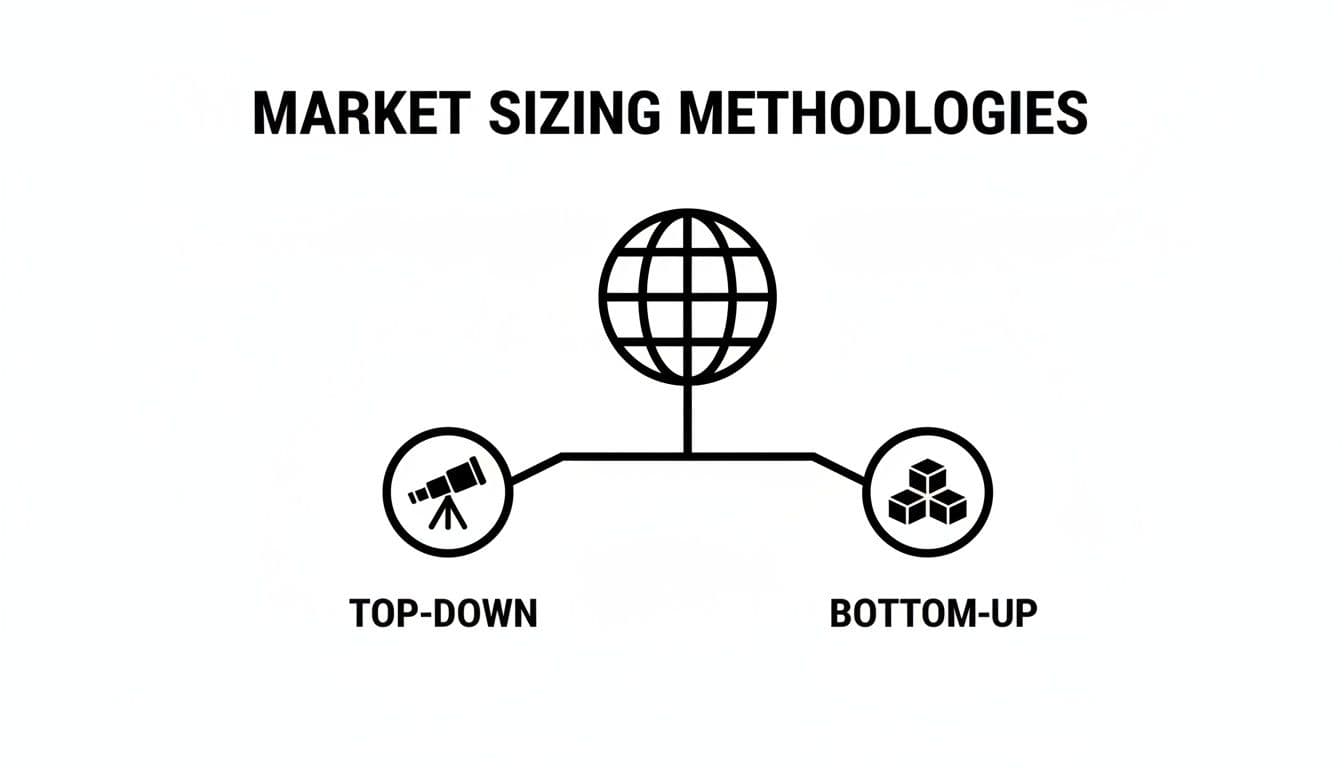
When it's time to figure out how big your market is, you'll quickly run into two classic methods: top-down and bottom-up analysis. Think of it like this: are you looking at the mountain from a satellite, or are you standing at the trailhead with a map? Both views are valuable, but they tell you very different things.
The top-down analysis is the satellite view. You start with a massive, bird's-eye number—say, the total global spend on a certain category of software—and then slice and dice it until you’ve carved out your little corner of the universe. It’s a game of logical filtering, taking a huge market and narrowing it down to what’s relevant for you.
On the other hand, the bottom-up analysis starts right at the trailhead. You begin with the most basic unit of your business, like a single customer or one sale, and build your market size from there. This approach is all about tangible, real-world numbers: your pricing, how you sell, and who you can realistically reach.
The Allure of Top-Down Thinking
Let's be honest, the top-down approach is often the fastest way to get a number on the page. It relies on data that’s usually easy to find from market research firms, industry groups, and government reports. If you're building a new project management tool, you might grab a headline stat that the global market is worth $6.68 billion.
You'll see high-level data like this all over the place from sources like Statista, which are great for getting a feel for the broader industry trends.
This macro view provides critical context. From that big number, you’d start applying your own assumptions to get to a specific figure.
For instance, your logic might go something like this:
- Start with the total $6.68 billion market.
- Narrow it down to North America, which accounts for 40% of the market.
- Then, focus on your target segment: small businesses (under 50 employees), which make up 25% of that spend.
- Finally, isolate your niche—say, tools for creative agencies—which you estimate is 10% of the small business segment.
This method gives you a big-picture number quickly, but it has a major weakness. The final estimate is only as good as the percentages you guessed along the way. Even a slightly optimistic assumption at each step can compound into a wildly inflated and frankly, indefensible, final number.
Building Credibility with a Bottom-Up Analysis
Investors, executives, anyone who has been around the block a few times—they almost always want to see a bottom-up analysis. Why? Because it’s rooted in reality. It proves you've thought through the actual mechanics of how you'll acquire customers.
This approach forces you to answer the tough, practical questions and shows you deeply understand your go-to-market strategy. Bottom-up estimates tend to be smaller, but they're far more believable.
For example, imagine your SaaS product targets the 1.2 million small businesses in the US. If you estimate your average annual contract value (ACV) is $1,200, then your potential market is a straightforward $1.44 billion. The calculation is transparent and tied directly to your business model.
A solid bottom-up estimate is built on concrete factors:
- Price: How much does a single customer pay you per year?
- Sales Channels: How many customers can you realistically reach and sell to through your website, your sales team, or your partners?
- Conversion Rates: Of all the people you can reach, what percentage will actually sign up and pay?
Nailing this kind of detailed estimation is the bedrock of a good financial forecast. For anyone looking to get sharper at this, building these models is a core theme in our guide on financial modeling best practices.
The bottom-up method isn't just a calculation; it's a sanity check on your entire business model. If you can't build a compelling market size from the ground up, you may need to rethink your pricing, distribution, or even your target customer.
Top-Down vs Bottom-Up At a Glance
To quickly see how these two methods stack up, here’s a simple comparison. It helps clarify when to use each approach and what to watch out for.
| Attribute | Top-Down Analysis | Bottom-Up Analysis |
|---|---|---|
| Starting Point | Total market size (e.g., global industry report) | A single unit (e.g., one customer, one store) |
| Pros | Quick to calculate, good for a high-level view | More credible, grounded in reality, forces operational planning |
| Cons | Prone to overestimation, relies heavily on assumptions | Takes more time and effort, requires detailed data |
| Best Use Case | Early-stage strategic planning, understanding the "pond" | Investor pitches, financial forecasting, operational planning |
Ultimately, having both perspectives gives you the most robust understanding of your market potential.
Combining Both for a Complete Picture
So, which one is better? The truth is, the sharpest operators don't pick one over the other—they use both to tell a cohesive story.
The top-down analysis sets the stage. It helps you confirm you're playing in a big enough sandbox to begin with. It answers the question, "Is this market even worth our time?"
The bottom-up analysis then provides the credible, operational plan. It shows exactly how you're going to go after that market. It answers the question, "Okay, how are we actually going to capture a piece of this?"
When your top-down and bottom-up numbers land in the same ballpark, you've got a powerful, well-validated market size. If they are worlds apart, that's a huge red flag. It signals that a core assumption is wrong, either about the macro environment or your own ability to execute. That discrepancy isn't a failure; it's an invaluable chance to stress-test your strategy before you sink serious time and money into it.
From Big Picture to Battlefield: The TAM, SAM, SOM Framework
Once you get your head around the top-down versus bottom-up approaches, you need a way to turn that thinking into a real-world business plan. This is exactly where the TAM, SAM, and SOM framework comes in. Think of it as a set of filters that take you from a massive, abstract market number down to a tangible, actionable target.
I've seen a lot of founders get tangled up in these acronyms, but the idea behind them is actually quite simple. You're just answering three layered questions:
- TAM (Total Addressable Market): What’s the absolute biggest revenue pie out there for my kind of product?
- SAM (Serviceable Addressable Market): Out of that giant pie, what’s the slice I can realistically serve with my business model right now?
- SOM (Serviceable Obtainable Market): And of that slice, what piece can I actually capture in the near future?
Let's walk through this with a practical example. Imagine we're launching a new direct-to-consumer brand of sustainably sourced coffee.
TAM: The Total Addressable Market
The Total Addressable Market (TAM) is the theoretical maximum. It’s the total revenue you could possibly generate if you somehow achieved 100% market share. It’s your universe. For our coffee startup, the TAM is the total global spending on coffee—every dollar spent in cafes, grocery stores, online, you name it.
This number is always going to be huge, maybe even a little intimidating. That's okay. Its main job is to show you and potential investors that you're playing in a big enough sandbox, not trying to build a business in a shrinking pond.
SAM: The Serviceable Addressable Market
Next, we get real with the Serviceable Addressable Market (SAM). This is where your business model starts putting some necessary constraints on that giant TAM. Your SAM is the segment of the TAM that your products and sales channels can actually get to.
Our sustainable coffee brand isn't going to sell to every single coffee drinker on the planet, at least not at first. We need to apply some filters based on our strategy:
- Geography: We’re launching in the United States and Canada only.
- Sales Channel: We're an e-commerce, direct-to-consumer (DTC) brand, so we can only serve people who shop for coffee online.
- Target Customer: Our brand is built for people who actively look for and will pay more for ethically produced, sustainable goods.
Suddenly, our market isn't "the world." By applying these filters, our SAM becomes the total online spending on premium, sustainable coffee by consumers in the U.S. and Canada. It’s a much more focused and relevant number. Defining this segment accurately is crucial, and the principles outlined in guides on Effective Market Segmentation for B2B can be surprisingly helpful here, even for a B2C business.
Moving from TAM to SAM requires you to make critical, data-backed assumptions. You can’t just pull numbers out of thin air. For example, starting with a TAM of $10 billion, you might apply a geographic filter for your target countries that captures 40% of that market, giving you a $4.0 billion SAM.
From there, you'd estimate that only 15% of that SAM is realistically reachable within your first three-year launch window. Just like that, you've arrived at a $600 million SOM. A realistic funnel can easily shrink your TAM by 70–95% by the time you've defined a near-term SOM.
SOM: The Serviceable Obtainable Market
Finally, we land on the Serviceable Obtainable Market (SOM). In my experience, this is the number that matters most for your day-to-day operations. Your SOM is the slice of the SAM you can realistically win over the next few years, considering your resources, budget, and the competition.
SOM isn't a guess; it's a target. It's the number that should directly inform your revenue forecasts, hiring plans, and go-to-market strategy. It answers the question, "What does success look like for us in the next 3-5 years?"
To figure out the SOM for our coffee brand, we have to get gritty and look at:
- Competition: Who are the other DTC sustainable coffee brands out there? What’s their market share?
- Marketing & Sales: With our budget, what’s our expected customer acquisition cost (CAC) and conversion rate?
- Brand Awareness: How fast can we build a brand that people actually care about?
- Operational Capacity: How much coffee can we realistically source, roast, and ship without everything falling apart?
Let's say after digging into all that, we confidently determine we can capture 2% of our SAM in the first three years. That 2% is our SOM. This is the figure you build your financial model around. It's grounded, defensible, and tied directly to your ability to execute.
This entire journey from TAM to SOM is a fundamental piece of building any solid https://soreno.ai/articles/market-entry-strategy-framework. When you do it right, you're not just sizing a market—you're laying the foundation for a credible business.
Where to Find Credible Data for Your Calculations
Let's be blunt: your market size estimate is only as good as the data you feed into it. A brilliant model built on shaky information is a house of cards, ready to tumble the moment an investor asks a tough question. The secret to a defensible analysis isn't finding one perfect number; it's about layering different types of data to build a complete, credible picture.
Think of it as building your case from three different angles: what the public record says, what industry experts have found, and what you can prove yourself. Using them together is what turns a back-of-the-napkin guess into a strategic asset.
Start with Public and Government Sources
The easiest place to begin is with freely available public data. Government agencies and international bodies are treasure troves of foundational numbers—the kind you need for a solid top-down analysis. Think population counts, business demographics, and broad economic indicators.
This data gives you the high-level context to start carving out your market. While it's reliable, it's almost never specific enough to be your only source. Its real power is in providing the initial, broad strokes.
Here are a few of the best places to start digging:
- Census Bureaus: The U.S. Census Bureau and its global equivalents are your go-to for population stats, income levels, and household data in specific regions.
- Economic Agencies: Organizations like the Bureau of Labor Statistics (BLS) or the Bureau of Economic Analysis (BEA) offer incredible detail on industry revenue, employment, and growth trends.
- International Bodies: The World Bank and the United Nations are fantastic for sizing international markets, providing global economic and demographic data.
The quality of these sources is generally very high. For instance, government and UN statistics often have a tiny sampling error of just 1–5%, making them a rock-solid foundation.
Layer in Paid Industry Intelligence
When you need to get more granular, it’s time to look at paid research. This is where market research firms like Gartner, Forrester, and Statista shine. They’ve done the heavy lifting of surveying industries to publish detailed reports on market size, growth forecasts (CAGR), and customer behavior.
These reports can be pricey, but they often contain the exact data you need to justify your assumptions. If a full report is out of budget, hunt for free summaries, press releases, or white papers—they often quote the headline stats.
Pro Tip: Before you pull out your credit card, check your local or university library. Many institutions provide free access to these expensive research databases. It’s a classic pro-move that can save you thousands.
Beyond traditional reports, don't forget about digital intelligence. You can leverage web analytics tools like Similarweb to get a real-time pulse on competitor traffic and digital market share, which is gold for bottom-up calculations.
Generate Your Own Proprietary Data
The most compelling data is the data you collect yourself. This is the heart of a truly convincing bottom-up analysis because it’s rooted in your reality, not industry averages. Nothing validates your assumptions better than real-world evidence from your own efforts.
There are a few straightforward ways to generate this data:
- Customer Surveys: Just ask. Directly poll potential customers about their buying habits, pain points, and what they'd be willing to pay. Even a simple survey can provide priceless data for your pricing strategy.
- Pilot Programs or Early Sales: Nothing speaks louder than actual sales. Data from a pilot launch or your first few dozen customers provides concrete proof of your average contract value (ACV) and initial adoption rates.
- Customer Interviews: Go deeper than a survey and have actual conversations. These qualitative insights help you understand the why behind the numbers, giving your story a depth that raw data alone can't provide.
Choosing the right data mix is crucial. Each source has its place, and understanding their strengths and weaknesses helps you build a more robust estimate. Here’s a quick breakdown to guide your research.
Data Source Reliability and Use Cases
| Data Source Type | Example | Cost | Best For |
|---|---|---|---|
| Government Data | U.S. Census Bureau, BEA | Free | Broad, top-down figures (population, GDP, industry revenue). |
| Paid Industry Reports | Gartner, Forrester, Statista | High ($) | Specific market sizes, CAGR, and competitive analysis. |
| Public Company Filings | SEC Filings (10-K, 10-Q) | Free | Competitor revenue, segment performance, and market commentary. |
| Web & App Analytics | Similarweb, App Annie | Freemium / Paid | Digital traffic estimates, user engagement, and online share. |
| Your Own Research | Surveys, Interviews, Pilots | Low (Time) | Bottom-up validation (willingness to pay, ACV, adoption rates). |
Ultimately, the strongest market sizing analyses don't rely on a single source. They blend the high-level credibility of public data with the specific insights from paid reports and ground it all in the reality of their own proprietary findings.
Common Market Sizing Mistakes to Avoid

Learning to estimate market size is part science, part art. While getting the numbers right is crucial, it's avoiding the common pitfalls that separates a credible analysis from a flimsy one. I've seen it happen countless times—a single flawed assumption can unravel an entire business case under the slightest scrutiny.
Many founders, driven by understandable optimism, fall into the same traps. These mistakes don’t just undermine your credibility with investors; they can send your team down a costly and misguided path. Spotting these errors is the first step to building a market model that actually stands up to pressure.
Confusing the Entire Pond with Your Fishing Spot
One of the most frequent and glaring errors is presenting the Total Addressable Market (TAM) as the number you're actively going after. It’s the classic "we only need 1% of a $100 billion market" fallacy. As soon as an investor hears that, it signals you haven't thought deeply about your specific customer or go-to-market strategy.
Your TAM is the big-picture context, not your battleground. The real work—and the real story—is in defining your Serviceable Obtainable Market (SOM), which is the slice you can realistically capture.
What Not to Do: Imagine a founder pitching a high-end vegan meal kit service. They might claim their market is the entire $1.2 trillion global food industry. That's irrelevant and frankly, lazy. A sharp analysis would instead focus on the subset of health-conscious, high-income households in their specific delivery zones who already purchase premium food online. That's a real market.
Making Assumptions Without Evidence
Every market sizing exercise involves assumptions, but they have to be logical and defensible. Pulling percentages out of thin air or making giant leaps of faith without citing a source is a major red flag. Each filter you apply to narrow down your market must be backed by something tangible—a government report, an industry analysis, or your own customer research.
Unsubstantiated claims scream "lack of diligence." A strong analysis, on the other hand, connects every assumption back to a piece of evidence. It creates a clear, logical trail for anyone to follow.
Be ready to answer questions like these:
- "How did you arrive at that penetration rate?" You need to point to early sales data, adoption rates of comparable products, or a solid analogue.
- "Why did you use that specific price point?" Your answer should be grounded in competitor pricing, customer surveys, or a value-based analysis.
- "What data supports this geographic filter?" You could cite census data showing where your target demographic is concentrated.
Relying on a Single, Biased Data Source
This one is a recipe for a skewed estimate: leaning on just one source, especially an overly optimistic industry report paid for by vendors in that space. Credible market sizing is built through triangulation. It’s the practice of cross-referencing multiple, independent data points to land on a more accurate and defensible conclusion.
A balanced approach blends different types of information. You might start with a top-down number from a government agency, refine it with a paid industry report from a source like Gartner or Forrester, and then validate it all with your own bottom-up analysis based on real customer conversations. This layered method shows you've done your homework and reduces the risk of being misled by any single source's bias.
Ignoring the Competitive Landscape
Forgetting about competitors is a surprisingly common oversight. You are not operating in a vacuum. Your Serviceable Obtainable Market (SOM) is directly constrained by the market share already held by established players and the moves other startups are making.
A credible estimate acknowledges that you won't capture 100% of your available market, especially not overnight. You have to account for customer loyalty to existing brands, the real costs of switching, and the marketing firepower of your rivals. Failing to do so paints an unrealistic picture and suggests a naive view of how markets actually work.
Remember, market share is earned, not given.
Answering Your Top Market Sizing Questions
Even after you get the hang of the frameworks, you're going to hit roadblocks. Estimating a market size in the real world is messy, and it’s perfectly normal to have nagging questions pop up. It's a sign you're digging deep enough.
Let’s walk through some of the most common sticking points I see founders grapple with. My goal here is to give you the nuance you need to not just find your numbers, but to stand behind them with real conviction.
How Often Should I Update My Market Size Estimate?
For any early-stage company, your market is a moving target. You absolutely can't treat your market size as a "one-and-done" calculation you file away.
A good rule of thumb is to revisit your estimates at least annually. Think of it as a living part of your strategy, not a static number on a pitch deck. A quick refresh keeps you honest and ensures you're still chasing a genuine opportunity.
Beyond an annual check-up, you'll want to run the numbers again whenever something big changes. Key triggers include:
- A major product pivot: If you're now targeting a different customer, your whole model changes.
- Entering a new geography: This directly expands your SAM and requires a fresh look.
- A competitive shake-up: When a big player enters (or leaves) your space, the dynamics shift.
- New tech or regulations: These can suddenly shrink or dramatically expand your potential market overnight.
What if My Top-Down and Bottom-Up Estimates Are Wildly Different?
First of all, don't panic. This happens all the time, and I actually see it as a good sign. It means you've avoided the trap of just massaging the numbers to fit a preconceived notion. A big gap between your two estimates is an opportunity, not a mistake.
It forces you to get critical about your assumptions.
Where's the disconnect? Is your top-down filter too optimistic? Maybe you assumed you could realistically capture a bigger slice of the pie than anyone ever has. On the flip side, is your bottom-up model too conservative? Perhaps your pricing is too low, or you underestimated how many customers you can actually reach. The gap is a bright, flashing arrow pointing to the weakest parts of your logic.
Whatever you do, don't just split the difference and call it a day. The real work is in closing that gap. You need to dig into the "why" behind each number until you can build a logical bridge that connects the two. That's how you arrive at a blended, far more defensible figure.
How Do I Size a Market for a Completely New Product?
This is the classic innovator's dilemma and probably the toughest market sizing challenge there is. You can't just pull up an industry report for a market that doesn't exist yet. The trick is to lean on proxy markets and build your case from a value-based perspective.
Start by looking for proxies. What are people using today to solve a similar problem? The solution might look completely different from yours, but the underlying need is the same. Before cars, the personal transportation market was all about horses and buggies. You would have started there, analyzing the spending in that existing market to get a baseline.
Then, you build a bottom-up case from scratch, based on the tangible value you deliver. This involves a couple of steps:
- Calculate the clear economic benefit your product gives a single customer. This could be hours saved, costs cut, or new revenue unlocked.
- Multiply that value by the total number of potential customers who are currently dealing with that specific problem.
This approach completely reframes the conversation. You're no longer asking, "how big is the market today?" Instead, you're making a powerful case for "how big the market could be once our innovation exists."
Ready to master market sizing and other critical case interview skills? Soreno provides an AI-powered platform with over 500 cases and 80 guided drills to build the analytical muscle you need. Get instant, rubric-based feedback on your structure, communication, and business insights without needing a partner. Start your free trial at https://soreno.ai and practice your way to an offer.