
What Is Market Sizing A Complete Guide
What is market sizing? Learn to estimate market potential with top-down and bottom-up analysis, essential frameworks, and real-world case study examples.

So, what exactly is market sizing?
Think of it this way: before a builder breaks ground, they need to know if they're building a cozy bungalow or a massive skyscraper. Market sizing is the business equivalent of that survey. It’s the process of figuring out just how big the opportunity is for a specific product or service.
It’s not about finding one perfect, magical number. Instead, it’s about painting a clear picture of the potential revenue landscape to see if you’re fishing in a small pond or a vast ocean.
From Business Idea To Market Opportunity

Every great business venture kicks off with a fundamental question: "Is anyone actually going to buy this?" Before you pour your heart, soul, and capital into a new idea or advise a client on a big move, you have to figure out if there's a real, quantifiable opportunity waiting.
Market sizing is the analytical compass that guides these make-or-break decisions. It helps you turn a promising concept into a concrete, data-driven strategy by estimating the total number of potential buyers and how much they might spend. Without it, you’re just flying blind.
Why Sizing Is Non-Negotiable
Getting a handle on the scale of an opportunity is a must-have skill in any strategic role. For an entrepreneur, a solid market size estimate is the core of their pitch to investors. For a corporate strategist, it’s the key to deciding which new markets or products are worth the company’s time and money.
In consulting and finance interviews, market sizing questions are a classic. Interviewers don't expect you to have obscure industry stats memorized. They want to see how you think—can you structure a vague problem, make logical assumptions on the fly, and defend your thought process under pressure?
Ultimately, this skill helps you answer the big-picture questions that shape strategy:
- Viability: Is this market big enough to build a real, profitable business?
- Investment: Does the size of the prize justify the resources we need to commit?
- Strategy: Which customer groups should we target first to get the biggest bang for our buck?
To help you get started, here’s a breakdown of the key concepts you'll encounter when sizing any market.
Key Concepts In Market Sizing
This table gives you a quick reference for the essential building blocks of market sizing.
| Component | Description | Why It Matters |
|---|---|---|
| TAM (Total Addressable Market) | The total revenue opportunity for a product or service if 100% market share was achieved. | Helps you understand the maximum potential and sets the overall context. |
| SAM (Serviceable Available Market) | The segment of the TAM targeted by your products that is within your geographical reach. | Narrows the focus to a realistic market you can actually serve. |
| SOM (Serviceable Obtainable Market) | The portion of the SAM you can realistically capture, considering competition and other limitations. | Provides a tangible, short-term target for business planning and goal setting. |
Understanding these layers helps you move from a broad, theoretical number to a practical, actionable plan.
Framing The Opportunity
A solid market size analysis gives you a clear, quantitative snapshot of the economic terrain. Take the global artificial intelligence (AI) market, for instance. It was valued at roughly $233.46 billion and is expected to grow to about $294.16 billion. Numbers like these aren't just trivia; they signal a massive, expanding field where businesses can make their mark.
This kind of data is what allows companies to shift from "what if" speculation to concrete strategic planning.
Whether you're brainstorming a new app or mapping out a global expansion, sizing the market is your first, most critical step. It’s what turns an ambitious vision into a workable roadmap. To see how sizing fits into the bigger picture, you can learn more about applying a market entry framework.
Why Market Sizing Is Your Strategic Compass
Knowing the textbook definition of market sizing is one thing, but truly getting why it’s a game-changer for any business is something else entirely. It’s more than just a calculation; think of it as a strategic compass. It points you toward real opportunities and steers you clear of costly dead ends. Flying blind is a terrible business strategy, yet that's exactly what you're doing without a solid grasp of the market you're trying to win.
Imagine a startup founder walking into a pitch with a venture capitalist. That market size number on their slide isn't just a detail—it’s the proof of concept. It’s the hard evidence that their big idea solves a problem for a massive number of people. A well-argued market size turns a passionate pitch into a credible investment, telling investors the potential reward is big enough to justify the risk.
It's not just for startups, either. For a corporate giant like Apple, market sizing is the foundation of any major expansion. When they were rumored to be exploring the electric vehicle market, you can bet that decision was driven by an immense sizing exercise. They had to figure out if the potential prize was worth a multi-billion dollar bet—a question you can only answer by first understanding the total potential demand.
Your Secret Weapon In High-Stakes Interviews
Outside of the boardroom, market sizing is a non-negotiable skill for anyone gunning for a career in consulting or finance. You will almost certainly get a market sizing question in one of those tough interviews. But here’s the inside scoop: the interviewer doesn't actually care if you get the final number right.
What they're really testing is your thinking. They want to see how you handle a big, ambiguous problem. Can you take a fuzzy question and break it down into logical, bite-sized pieces? Can you make smart assumptions and defend them on the fly?
The market sizing question is a proxy for how you’ll handle a real client project. It shows them your ability to structure a problem, communicate clearly, and reach a sensible conclusion under pressure. These are the core skills that separate a top-tier consultant or analyst from the rest of the pack.
It’s your structured approach and your ability to sanity-check your own logic that lands you the job—not your knack for guessing how many tennis balls are sold in Germany each year.
Sizing In The Real World
The power of market sizing plays out every day across every industry, telling us stories about the economy, consumer trends, and what the future might hold. The global apparel industry is a perfect example.
It’s currently valued at a staggering $1.84 trillion. That number alone screams economic importance. But the real story is in the details. The market took a brutal 11.46% hit during the pandemic but is now forecast to bounce back and top $2 trillion. This is where market sizing shines—it blends historical data with forward-looking projections, giving companies the insights they need to manage inventory, forecast sales, and make smart strategic moves. You can dig into these numbers yourself by checking out more global apparel industry statistics.
At the end of the day, market sizing sets the stage for every major business decision. Whether you're a founder chasing funding, a CEO launching a new product, or a candidate prepping for an interview at Soreno, getting this right is your first step. It’s how you turn a bold ambition into a data-driven plan for success.
Mastering Top-Down and Bottom-Up Analysis
When it comes to nailing a market sizing question, it all boils down to your methodology. The two classic approaches are top-down and bottom-up analysis. Think of them as two different lenses for looking at the same opportunity. Each offers a unique perspective, and a seasoned analyst knows how to use both to build a rock-solid case.
Imagine you're trying to figure out how many oak trees are in a forest.
A top-down analysis is like looking at a satellite map. You start with the total acreage of the forest (the entire market), then use percentages to filter down—first to the area with deciduous trees, then to the specific zones where oaks are known to grow. It’s a fast, high-level way to get a solid estimate.
On the other hand, a bottom-up analysis is like putting on your hiking boots and walking through the forest, counting every single oak tree. You start with the smallest unit—one tree—and build your estimate from the ground up. This approach is far more granular and often more accurate because it's based on tangible, observable data.
The chart below shows where these methods fit into the bigger picture, bridging the gap between a great idea and a viable strategy.
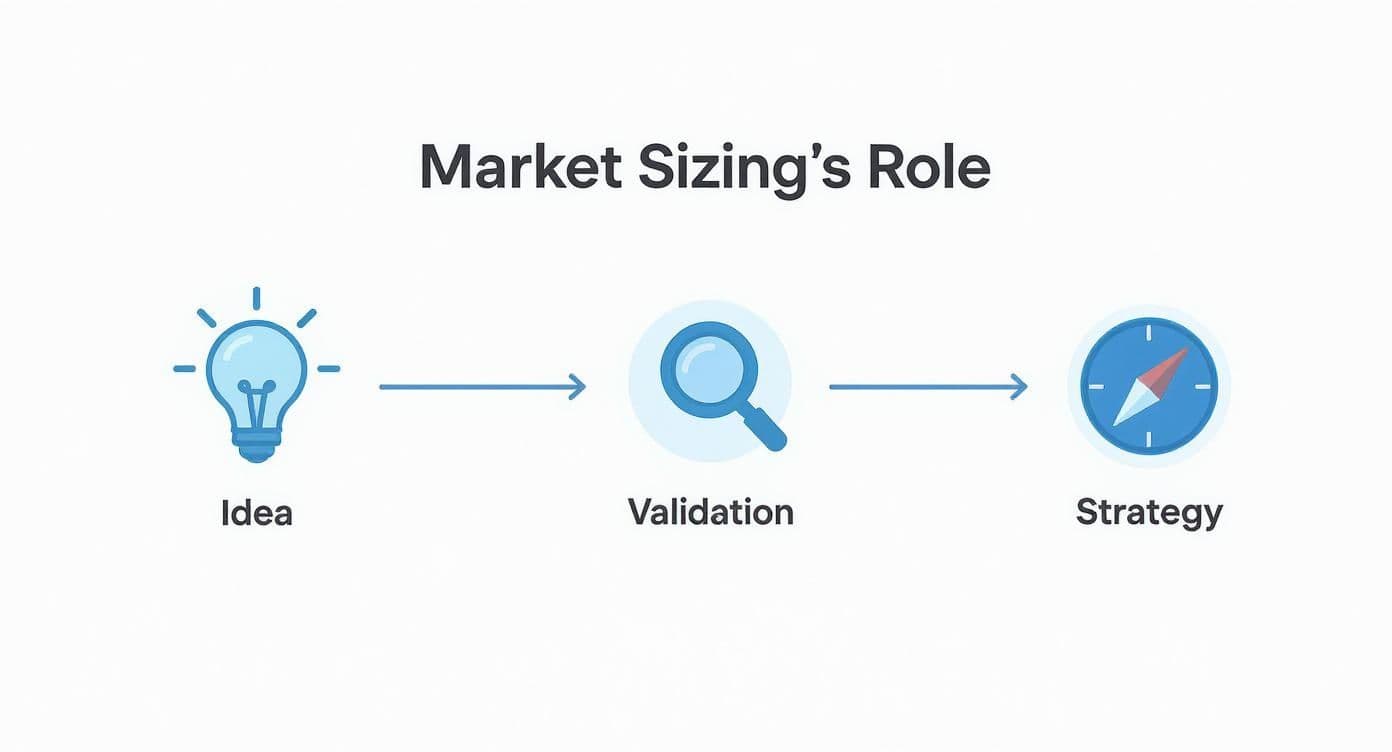
As you can see, market sizing isn't just an academic exercise. It’s the critical stress test that proves whether an idea has real-world potential.
The Top-Down Approach Explained
The top-down method starts with the biggest possible number you can find and systematically carves away the irrelevant parts. You begin with a massive, well-documented market figure and narrow it down using a series of logical assumptions. This is your go-to when you need a quick "back-of-the-envelope" calculation or when granular data is hard to come by.
Here’s how it works in practice:
- Start with the Macro View: Find a credible, high-level number for the total addressable market. This often comes from industry reports, government stats, or firms like Gartner or Forrester.
- Apply a Series of Filters: Layer on logical assumptions to trim that macro number down to your specific segment. These filters could be based on geography, customer demographics, or product-specific criteria.
- Arrive at Your Estimate: What's left after all the filtering is your top-down market size estimate.
A top-down approach is fast and effective, but remember: its accuracy lives and dies by your assumptions. A single bad assumption can throw the whole calculation off, so be prepared to defend the logic behind every percentage you use.
Let's size the market for premium coffee shops in Chicago.
- Total US Coffee Market: You find a report stating the total market is $48 billion.
- Filter for Chicago: Chicago has about 0.8% of the US population. We can reasonably assume its share of the coffee market is similar. That gives us $48 billion * 0.8% = $384 million.
- Filter for Premium Coffee: Based on industry trends, you estimate that the "premium" segment makes up roughly 30% of the market. So, $384 million * 30% = $115.2 million.
Our top-down estimate for Chicago's premium coffee shop market is around $115 million.
The Bottom-Up Approach Explained
The bottom-up approach is the inverse. Instead of starting big and going small, you start with individual components and build your way up. It’s generally seen as more reliable because it’s grounded in tangible data points, not broad assumptions. This method gives you a much more defensible and granular estimate.
Here's the process:
- Identify the Core Unit: What is the fundamental building block of this market? It could be a single customer, a single store, or a single transaction.
- Estimate the Value of that Unit: How much revenue or value does one unit generate? For example, what's the average annual revenue of one premium coffee shop?
- Scale It Up: Multiply the number of units in your target market by their average value. The result is your total market size.
Let’s tackle that same Chicago coffee shop problem from the ground up:
- Identify Core Unit: The base unit is a single premium coffee shop in Chicago. A quick search and some estimation suggest there are about 500 such shops.
- Estimate Unit Value: You estimate the average shop brings in $500,000 in annual revenue. You could back this up with logic (e.g., average customers per day × average ticket price × 365 days).
- Scale It Up: 500 shops × $500,000/shop = $250 million.
Using a bottom-up approach, we get an estimate of $250 million.
Wait, that's more than double our top-down number! This is actually a great outcome. The difference doesn't mean one is "wrong"—it highlights the sensitivity of your assumptions. In a real interview, you'd explore this gap and use it to present a more nuanced answer, perhaps by offering a plausible market size range.
To help you decide which approach to use, here's a quick comparison of the two methodologies.
Top-Down Vs Bottom-Up Market Sizing Compared
This table breaks down the key differences to help you choose the right methodology for a specific business problem or interview question.
| Attribute | Top-Down Approach | Bottom-Up Approach |
|---|---|---|
| Starting Point | Starts with a large, aggregate market figure (e.g., global industry size). | Starts with individual data points (e.g., revenue per store, number of users). |
| Data Sources | Relies on third-party market research reports, government statistics, and industry analyses. | Based on primary research, internal company data, or direct observation. |
| Primary Use Case | Best for quick, high-level estimates, especially when detailed data is unavailable. | Ideal for creating a detailed, defensible, and granular market forecast. |
| Accuracy | Accuracy depends heavily on the validity of the assumptions and filters applied. | Generally more accurate and reliable as it's built on tangible, verifiable data. |
| Effort & Time | Faster and less resource-intensive. | More time-consuming and requires significant data gathering and analysis. |
| Key Risk | Overestimation is common if the filters aren't conservative enough. | Underestimation can occur if not all potential segments or units are accounted for. |
Ultimately, the strongest analyses often use both. A top-down estimate provides a useful sanity check for your bottom-up calculation, and vice versa. Being able to articulate both shows a level of analytical maturity that will impress any interviewer.
Applying TAM, SAM, and SOM to Your Analysis

Alright, you've picked your approach—either top-down or bottom-up. Now what? The next step is to give your estimate some much-needed structure and credibility. This is where the TAM, SAM, and SOM framework becomes your best friend.
These aren't just fancy acronyms to throw around in a meeting. They represent the essential layers of any logical, defensible market sizing estimate. Think of it as a funnel. You start with the biggest possible number at the top, and with each step, you apply smart filters to zero in on a realistic target. This structured thinking is exactly what interviewers are looking for.
Total Addressable Market (TAM)
First up is the Total Addressable Market (TAM). This is the top of the funnel—the absolute total demand for a product or service across the globe. It's the "pie in the sky" number, the theoretical ceiling if you could magically capture 100% of the market without any competition. TAM simply defines the outer limits of your opportunity.
Let's use an example: plant-based burgers. The TAM here would be the total global spending on all burgers—beef, chicken, veggie, you name it. It's a massive figure that represents the entire revenue pool you're playing in.
Serviceable Available Market (SAM)
While it's nice to dream big with TAM, no single company can serve the entire planet. This brings us to the Serviceable Available Market (SAM), which is the slice of the TAM your business can realistically reach with its specific products and sales channels. It's the part of the market that's actually a good fit for what you're selling.
Back to our burger example. The SAM would be the portion of the total burger market that is specifically looking for, or at least open to, plant-based options. You’d likely narrow this down further by geography—for instance, the plant-based burger market just within North America and Europe, where your company actually operates.
This step is all about moving from a huge, theoretical market to one you can actually compete in.
This framework isn't just an interview exercise; it's critical for high-level strategic decisions. For example, the global Information Services market was valued at roughly $179.73 billion and is projected to hit $327.94 billion. A company in this sector would use TAM to grasp the global potential, then slice it by region or industry (SAM) to tailor its services and allocate budgets effectively. You can learn more about how these insights drive growth by checking out the full information services market report.
Serviceable Obtainable Market (SOM)
Finally, we get down to the most practical and actionable layer: the Serviceable Obtainable Market (SOM). This is the piece of your SAM that you can realistically capture over the next few years, factoring in your competition, resources, and overall strategy.
For our plant-based burger company, the SOM is the market share it can win within its target regions. It directly answers the question: "Given our brand, our marketing budget, and the fact that we have to compete with Impossible Foods and Beyond Meat, what slice of the SAM can we actually take home?"
This is your target. It's the number that should inform your sales forecasts, hiring plans, and immediate business goals.
Putting It All Together
Using the TAM, SAM, SOM framework does more than just get you to an answer; it shows you have a sophisticated and structured way of thinking. It proves you can take a massive, abstract idea and break it down into a concrete, actionable business target.
Here’s a quick summary of the funnel for our plant-based burger business:
- TAM: The total global market for every kind of burger.
- SAM: The market for plant-based burgers in the specific countries you serve.
- SOM: The share of that regional plant-based market you can realistically win in the next 3-5 years.
In an interview, walking an assessor through these layers tells a compelling story about how you analyze opportunities. It's proof that you know how to break down a huge question, apply logical filters, and land on a conclusion you can stand behind—a core skill for any top-tier analyst or consultant.
Walking Through A Real-World Sizing Problem
Theory is great, but the real test comes when you have to put it into practice under the pressure of an interview. So, let’s get our hands dirty and tackle a classic case study question: Estimate the annual market for bicycles in France.
This is exactly the kind of open-ended problem you’ll face. Remember, the interviewer isn't looking for a single "right" answer—because one doesn't exist. They want to see how you think. Can you build a logical, structured argument that leads to a reasonable estimate? Let's walk through it together.
Setting The Stage And Clarifying Scope
Before you even think about numbers, your first move is to bring clarity to the question. A vague problem will lead to a messy, confusing answer. The best way to start is by asking smart, clarifying questions to narrow the scope.
"Bicycles," for instance, is far too broad. Are we talking about kids' bikes? High-end professional racing bikes? What about the booming e-bike market? Let's assume the interviewer confirms we should focus on new adult bicycles sold annually. Just like that, one simple question makes the entire problem much more manageable.
Next, we need to pick our strategy. A bottom-up approach, trying to add up sales from every bike shop in France, is a non-starter without data. A top-down approach, starting with the entire population, is a much more practical way forward.
Stating Your Assumptions Upfront
Any market sizing estimate lives and dies by its assumptions. The trick is to state them clearly and make sure they're sensible. In an interview, it's also smart to use round numbers that make mental math a breeze.
Here are the assumptions we'll build our estimate on:
- Population of France: Let's use 60 million. It's close enough to the actual ~65 million and much easier to work with.
- Average Household Size: We'll assume 2 people per household.
- Bike Ownership: A reasonable guess is that 50% of households own at least one bike.
- Replacement Cycle: Bikes last a while. Let's say the average person or family buys a new one every 10 years.
- Average Price: We'll set the average price of a new adult bike at €300.
By laying these out first, you're giving the interviewer a clear roadmap of your thinking. It shows you're organized and methodical.
Performing The Step-By-Step Calculation
Now for the fun part: the math. The key here is to talk through each step out loud so the interviewer can follow your train of thought.
-
Find the Total Number of Households:
- 60 million people / 2 people per household = 30 million households
-
Find the Number of Bike-Owning Households:
- 30 million households × 50% ownership rate = 15 million households that own a bike.
-
Calculate How Many New Bikes Are Sold Each Year:
- If a bike is replaced every 10 years, that means 10% of the total bike "stock" is purchased new each year.
- 15 million bikes × 10% replacement rate = 1.5 million new bikes sold annually.
-
Calculate the Total Market Value:
- 1.5 million bikes × €300 average price per bike = €450 million.
So, based on our logic, we can confidently estimate the annual market for new adult bicycles in France is around €450 million. This structured breakdown is a core skill you'll find in many consulting case study examples.
Performing The Sanity Check
You're not done yet! The final, crucial step is to quickly check if your answer makes sense in the real world. Does €450 million seem plausible?
A market of €450 million for 1.5 million bikes feels about right. It isn’t an astronomical number in the billions, nor is it so small that it seems trivial. You could even add a quick qualitative check: "This figure seems reasonable, as it would represent a small fraction of a much larger market, like the automotive industry in France."
Key Takeaway: The final number is the least important part of this exercise. What interviewers truly care about is your ability to structure the problem, state clear assumptions, communicate your logic, and gut-check your conclusion. This process gives you a repeatable framework to tackle any market sizing question with confidence.
Common Pitfalls and How to Sidestep Them
Even the most prepared candidates can get tripped up by a market sizing question in the heat of an interview. The secret isn't just memorizing frameworks; it's about gracefully sidestepping the common traps that lead to shaky logic and unconvincing answers. Think of this as your pre-flight checklist before you dive into any sizing problem.
Successfully navigating a market sizing case is as much about what not to do as it is about getting the math right. Most of the time, candidates stumble over a few key details that can completely derail an otherwise solid analysis. Knowing what these pitfalls are is the first step to delivering a smooth, confident solution.
Making Assumptions Out of Thin Air
This is, without a doubt, the number one mistake. If you pull a number out of thin air with no reasoning, you immediately lose credibility. Your assumptions don't have to be perfect, but they absolutely have to be defensible.
Instead of just saying, "Let's assume 20% of people buy coffee daily," build a logical bridge for your interviewer. Try something like this: "Okay, let's start with the assumption that about half the population drinks coffee. From there, maybe 40% of that group are daily drinkers who actually buy it, since many people will make it at home. That gets us to a more grounded figure of 20%." Anchoring your numbers in observable logic or relatable human behavior makes all the difference.
Getting Lost in the Weeds
Remember, the goal here is a logical structure, not pinpoint precision. Too many candidates get bogged down trying to calculate an exact figure, wasting time on tiny details that barely move the needle on the final number. This eats up the clock and, worse, makes your entire analysis a pain to follow.
Pro Tip: Always use round, easy-to-work-with numbers. It's much better to estimate the population of France as 60 million than the exact 65.3 million. It simplifies your mental math and keeps the focus where it should be: on your thought process. That’s what the interviewer really wants to see.
Skipping the Sanity Check
Once you've arrived at your final number, you have to take a breath, step back, and ask yourself: "Does this number actually make sense?" Forgetting this final step is a huge red flag for interviewers because it signals a lack of real-world business sense.
To avoid this, just do a quick gut check. If you've calculated the market for dental floss in a small country to be $5 billion, something has gone horribly wrong. A quick cross-reference, like comparing your number to the annual revenue of a well-known consumer goods company, can help you spot the error. It shows the interviewer you can catch your own mistakes and self-correct.
Best Practices for a Flawless Analysis
To stick the landing every time, weave these habits into your practice routine until they become second nature:
- Think Out Loud: Your interviewer isn't a mind reader. Walk them through every single step of your thinking, from the clarifying questions at the start to your final sanity check. This lets them follow your logic and even nudge you back on track if you start to stray.
- Structure First, Numbers Second: Before a single calculation, lay out your roadmap. "First, I'm going to estimate the number of households. Second, I'll segment them by income to find the target group. Third, I’ll figure out the replacement cycle to get to annual sales." This kind of structured thinking is exactly what consulting firms look for.
- Acknowledge What You Don't Know: It's completely fine to not know a specific data point. Just call it out and make a reasonable, stated assumption. For instance, "I'm not sure of the exact number of airports in Canada, but for this model, I'll assume there's one major hub for each of the large provinces, so let's say 10 to start." It shows you're confident and can adapt on the fly.
Answering Your Top Market Sizing Questions
As you start putting these concepts into practice, a few key questions almost always pop up. Let's tackle some of the most common ones you'll face, especially when you're in the hot seat during an interview.
How Accurate Does My Final Number Need to Be?
Here’s a secret that trips up a lot of candidates: in an interview, your final number is the least important part of the answer. What the interviewer really cares about is your thinking. Can you take a big, messy problem and break it down into logical, manageable steps? Can you make smart assumptions and defend them?
A well-structured estimate that's a bit off the mark is infinitely better than a lucky guess you can't explain. The goal is to walk the interviewer through your thought process, explaining why you're making each calculation and doing a quick "does this make sense?" check at the end. That’s what shows you can think like a consultant.
What If I Don’t Know a Key Piece of Data?
Don't panic—this happens all the time, and it's practically part of the test. Your first move should be to simply ask the interviewer. They might just give you the number.
If they push back and tell you to estimate it, you need to state a clear, logical assumption. For instance, you could say, "I don't know the exact population of Canada off the top of my head, but I know it's a little more than California's, so I'll start with an estimate of 38 million." This shows you can think on your feet, not that you've failed a trivia question.
The trick is to flag the missing piece of information, state a reasonable assumption to fill the gap, and then move forward with confidence. That’s how you handle ambiguity in the real world.
To see how this plays out in different scenarios, take a look at these common market sizing interview questions.
Should I Use Both a Top-Down and Bottom-Up Approach?
Given how tight time is in an interview, you almost never need to do a full-blown analysis using both methods. Your best bet is to pick the one that feels most natural for the problem and the data you can reasonably assume.
However, a great pro-level move is to use the second method as a quick gut check. After you finish your primary calculation, you could add something like, "My bottom-up analysis lands us at X. Just as a quick sanity check, a top-down approach looking at the total industry size would likely put us in a similar ballpark." It’s a simple way to show you have a much deeper command of the concept.
Ready to stop just reading about market sizing and actually master it? Soreno gives you an AI-powered platform to practice with. You get hundreds of case studies, guided drills, and instant feedback from an MBB-trained AI interviewer. Start your free trial at https://soreno.ai and build the skills to ace your next interview.