
A Guide to the Market Entry Framework
Master the market entry framework with this step-by-step guide. Learn core concepts, how to choose an entry mode, and see real-world case study examples.

When a business looks to expand into a new market, it needs a plan. That's what a market entry framework is: a structured, methodical way to figure out if an expansion makes sense and, if so, how to pull it off. It’s all about making sure decisions are driven by solid data, not just a gut feeling.
Deconstructing the Market Entry Framework
Staring at a new market opportunity can be pretty intimidating. There are so many unknowns. Think of the market entry framework as your strategic compass for navigating this uncertainty, especially in a high-stakes case interview.
It’s less of a rigid checklist and more like a master recipe from a seasoned chef. It gives you the core ingredients and a proven method, but the real art lies in adapting that recipe to the unique "cuisine" of the market you're exploring.

This guide will walk you through each component, showing you how to move from theory to confident application. We'll use practical steps and real-world examples to help you structure your thinking and deliver a winning recommendation.
The Purpose of a Structured Approach
So, why not just jump in and see what happens? Because that's how companies waste enormous amounts of time and money on a flawed strategy. A structured approach forces you to spot the deal-breakers early on.
It’s a systematic way to evaluate the competitive landscape, identify potential pitfalls, and make sure the new venture actually lines up with the company's bigger goals. This kind of structured thinking is exactly what interviewers want to see in a case study.
Key Questions the Framework Answers
At its heart, a market entry framework is designed to provide clear, data-backed answers to a few fundamental questions. It pushes you beyond surface-level assumptions and makes you dig into the details that truly determine success or failure.
Before making a move, any smart company needs to know:
- Is This Market Worth Entering? This is all about the numbers: market size, growth potential, and how much profit is realistically on the table.
- Can Our Company Win Here? This calls for an honest look in the mirror. Are our products a good fit? Is our brand strong enough? Do we have the operational chops to compete?
- How Should We Enter? This is the final piece of the puzzle. You need to choose the right entry mode, which could be anything from exporting goods to acquiring a local company outright.
A well-defined market entry framework allows companies to identify potential pitfalls, understand the competitive landscape, and align their strategy with their objectives, ultimately maximizing their chances of success.
We’re going to break down each of these areas, turning this abstract concept into a powerful, practical tool for your case interview toolkit.
Deconstructing the Core Components
To really nail a market entry case, you have to break it down into its three core pillars. Think of them like the legs of a stool—if one is wobbly or missing, the whole strategy topples over. These pillars are The Market, The Company, and The Entry Strategy.
For each pillar, you'll need to ask a series of sharp, probing questions. This process takes you from a fuzzy idea to a solid, defensible plan. By working through them one by one, you get the full picture and make sure no big risks are left hiding in the weeds. Let’s dig into what each of these really means.
Analyzing The Market Opportunity
First things first: look outside your own company. Before you even think about your own capabilities, you have to figure out if the market is actually a good place to play. This is more than a simple "yes" or "no"—it’s a deep, objective look at the entire field.
A classic mistake is getting star-struck by a huge market size without digging into its real dynamics. A solid market entry plan is built on rigorous market analysis and a clear definition of who your customers are. In fact, a 2022 study showed that a staggering 56% of businesses blamed poor market research for their failed international expansions, according to The Glocal Partners.
To avoid that trap, your analysis needs to answer some fundamental questions:
- Size and Growth: What's the total addressable market (TAM)? Is it growing, shrinking, or just sitting there? A massive but dying market is often a worse bet than a smaller one that's booming.
- Customer Needs: Who are you actually selling to? What are their pain points? Are existing companies doing a bad job of solving them?
- Competitive Landscape: Who are the big dogs in this space? What's their market share? What are they good at, and where are their weak spots? How will they react when a new player shows up on their turf?
Getting the numbers right here is critical. If you want to sharpen your quantitative skills, check out our guide on tackling market sizing interview questions for structured ways to make solid estimations.
Evaluating The Company's Capabilities
Once you’ve got a handle on the market, it’s time to turn the spotlight inward for an honest self-assessment. A golden market opportunity is completely useless if your company doesn’t have the right skills, resources, or strategic fit to actually go after it.
This pillar is all about lining up your company's unique strengths with what the market actually needs. It’s about asking, "Are we the right ones to win here, and why?"
Here's what you need to evaluate:
- Product-Market Fit: Does our product actually solve a real problem for customers in this new market? Or will we need to change it, maybe even completely overhaul it, to fit local tastes?
- Financial Resources: Do we have the cash to fund this move and keep the lights on until we're profitable? What’s our appetite for risk on an investment of this scale?
- Core Competencies: What are we genuinely better at than anyone else? Do our existing strengths—like our technology, brand name, or super-efficient operations—give us an edge in this new arena?
Defining The Entry Strategy
Okay, you've confirmed the market is attractive and your company is a good fit. The final pillar is deciding how you're going to make your move. This is where the strategic brainstorming meets the hard numbers. It’s not just about picking a mode of entry; it’s about mapping out the financials and understanding the risks involved.
A well-defined entry strategy is the bridge between analysis and action. It lays out the exact path forward, quantifies the prize, and prepares you for the bumps in the road.
This last piece is where you pull everything together. You'll synthesize all your findings from the first two pillars into a coherent plan, complete with financial projections and a logistical roadmap. This is what turns a market entry framework from an academic exercise into a real-world recommendation.
To help you keep these pillars straight during a high-pressure interview, here’s a quick-reference table that summarizes the key questions for each.
Pillars of the Market Entry Framework
| Framework Pillar | Key Objective | Critical Questions to Ask |
|---|---|---|
| The Market | Determine if the external environment is attractive. | Is the market large and growing? Who are the customers and what do they need? Who are the competitors and how will they react? |
| The Company | Assess internal readiness and strategic alignment. | Do we have the right product? Can we afford this? Do our core strengths give us an edge here? |
| The Entry Strategy | Define the specific plan of action and its financial implications. | How will we enter (e.g., build, buy, partner)? What are the projected costs, revenues, and risks? What's the timeline? |
Think of this table as your cheat sheet. When the interviewer asks, "How should Company X enter Market Y?" you can mentally walk through these questions to build a structured, comprehensive, and impressive response.
Choosing Your Path: Selecting the Right Entry Mode
How a company decides to step into a new market is a huge decision. It's not just about logistics; it’s a strategic choice that dictates the level of risk, control, and potential reward for years to come.
Think of it like this: are you dipping a toe in the water, or are you diving in headfirst? The four main paths—exporting, licensing, joint ventures, and direct investment—each represent a different level of commitment. Let's break down how they stack up.
Comparison of Market Entry Modes
To really get a handle on these options, it helps to see them side-by-side. Each mode comes with a unique set of trade-offs between risk, control, and the capital you need to put on the table.
| Entry Mode | Risk Level | Control Level | Investment Cost | Best For... |
|---|---|---|---|---|
| Exporting | Low | Low | $ | Companies testing the waters or with limited resources. |
| Licensing | Low | Low-Medium | $ | Brands looking for rapid, low-cost expansion using a partner's assets. |
| Joint Venture | Medium | Medium | $$ | Firms needing local market expertise and willing to share control. |
| Direct Investment | High | High | $$$ | Businesses committed to a market long-term and seeking full control. |
As you can see, there's no single "best" answer. The right choice is all about aligning the company's goals and resources with the realities of the new market. For a deeper dive into how these choices impact financial outcomes, check out these market entry framework findings.
The Four Key Decision Factors
When you're in a case interview, your recommendation needs to be grounded in a solid rationale. You can build that by weighing these four core factors:
- Risk Tolerance: How much financial and operational uncertainty is the company prepared to handle?
- Need for Control: Is it critical to manage every aspect of the brand, operations, and customer experience?
- Investment Capacity: What's the realistic budget for this expansion?
- Speed of Entry: How quickly does the company need to establish a presence to beat competitors or seize an opportunity?
These aren't just bullet points; they're the pillars of your decision-making matrix.
When Is Exporting the Smart Play?
Exporting is the go-to strategy for companies that want to test a market's appetite without a massive upfront commitment. It’s the lowest-risk way to get your product in front of new customers.
Imagine a small, high-end furniture maker. They could start by shipping a few pieces to a distributor overseas to see if there's real demand before ever thinking about setting up a local workshop. This approach keeps costs down and neatly sidesteps the headache of navigating complex local regulations right away.
"Exporting lets you dip your toes in a new market before diving in."
When Do Licensing and Joint Ventures Make Sense?
Sometimes, you have a great brand but lack the local know-how or capital to go it alone. That’s where partnerships come in.
Licensing is a fantastic low-risk option. You essentially rent out your brand or intellectual property to a local company in exchange for royalty payments. You trade a degree of control for speed and minimal investment.
A joint venture, on the other hand, is more of a true partnership. You and a local company create a new entity together, pooling your resources and expertise. This is a brilliant move when you're facing significant regulatory hurdles or deep-seated cultural barriers that an insider can help you navigate.
This infographic does a great job of visualizing how you might arrive at one of these decisions.
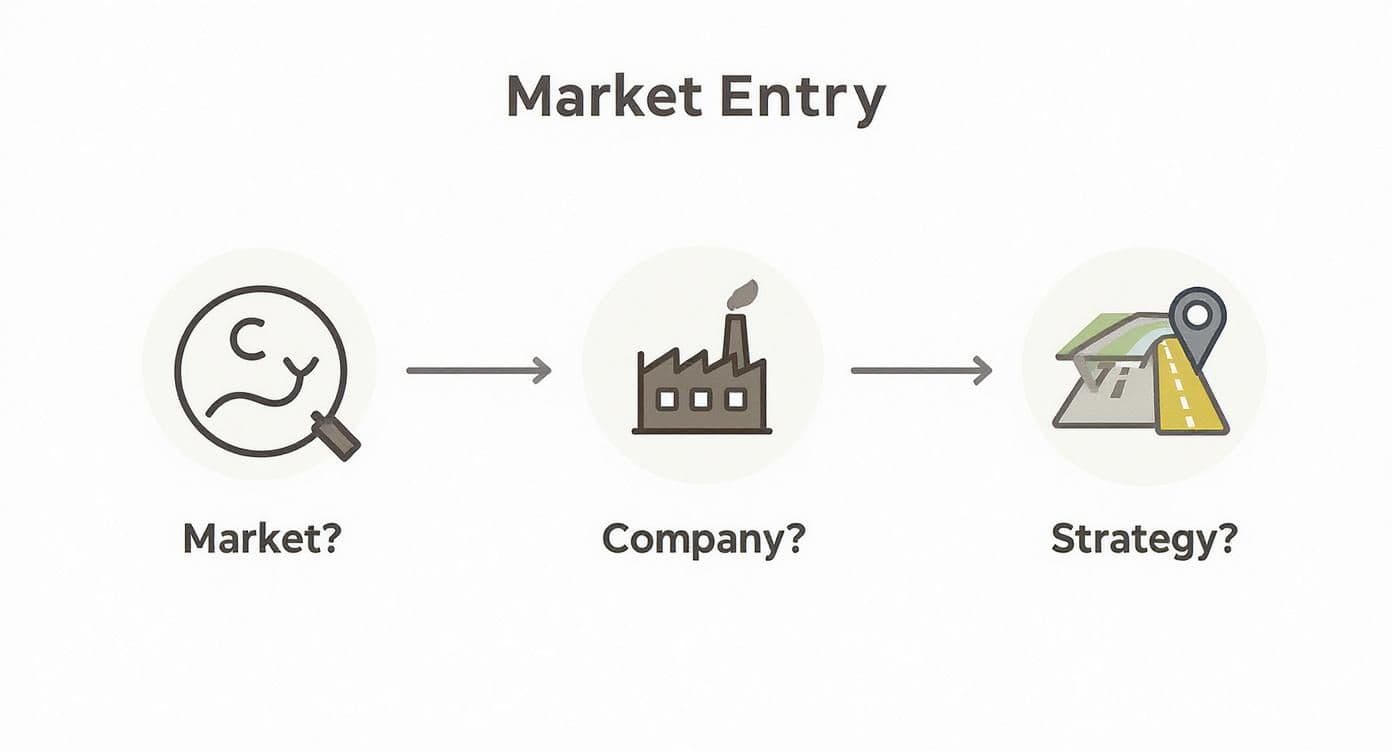
As the diagram shows, the best strategy flows from a clear-eyed assessment of both the market's potential and your company's own capabilities.
When Should You Go All-In With Direct Investment?
Direct investment—either by building from the ground up (a "greenfield" project) or acquiring a local company—is the ultimate power move. It’s for businesses that are fully committed and want maximum control over their destiny in a new market.
This path isn’t for the faint of heart. It requires a huge injection of capital and a deep understanding of the local landscape. The potential for high rewards is matched only by the risk of significant losses if things go south. Strong financial modeling and a rock-solid risk mitigation plan are non-negotiable.
Real-World Examples in Action
Let's look at a couple of classic examples:
-
A Joint Venture Success: Back in the 1990s, Starbucks wanted to crack the Indian market. Instead of going solo, they formed a joint venture with Tata, a local powerhouse. Starbucks brought the coffee expertise and brand recognition; Tata brought its immense distribution network and deep understanding of India. The result? A successful, rapid expansion that neither could have achieved as effectively alone.
-
A Game-Changing Acquisition: Facebook's $1 billion purchase of Instagram in 2012 is a textbook case of direct investment. Instead of building its own competitor, Facebook bought the fastest-growing player in the photo-sharing space, giving it total control and securing market dominance for years to come.
These stories show how the theoretical frameworks play out with real stakes and real money.
Putting It All Together for Your Interview
In a case interview setting, your job is to connect the dots. Start by analyzing the market and the company's strengths and weaknesses. Then, use the decision factors we discussed to systematically evaluate which entry modes are viable.
Don't just pick one. Defend your choice. Explain why it's the best fit based on the company's risk appetite, budget, and strategic goals. A structured, evidence-based approach will make your recommendation shine.
Best Practices for a Bulletproof Recommendation
To really impress your interviewer, go beyond the basics. A truly great recommendation is practical and anticipates challenges.
- Test Before You Invest: Suggest a pilot program in a specific city or region to validate your assumptions before a full-scale rollout.
- Vet Your Partners: If you recommend a partnership, emphasize the need to scrutinize the potential partner’s finances, reputation, and cultural fit.
- Stress-Test the Numbers: Show that you’ve thought about worst-case scenarios for costs and revenue projections.
- Plan Your Exit: What happens if things don't work out? A smart recommendation includes clear governance rules and exit clauses from the start.
Common Pitfalls to Avoid
Just as important as knowing what to do is knowing what not to do. Be sure to avoid these common traps in your analysis:
- Ignoring Hidden Costs: Don't forget about tariffs, shipping, and other logistical costs that can eat into the margins of an exporting strategy.
- The Illusion of Control: In a licensing deal, you can't just assume your partner will maintain your brand's quality standards. How will you enforce them?
- Underestimating Culture Clash: Joint ventures often fail because of integration challenges. Acknowledge this risk.
- Forgetting the Long Game: A direct investment might look good now, but does it offer the scalability the company will need in five or ten years?
Steering clear of these mistakes will make your analysis far more credible and robust.
Key Takeaways
At the end of the day, choosing a market entry mode is a balancing act between risk, control, cost, and speed.
- Exporting and licensing are your go-to options for low-cost market tests.
- Joint ventures are perfect for sharing risk and tapping into crucial local knowledge.
- Direct investment is the high-stakes, high-reward path for full market control.
In your interview, demonstrate that you grasp the trade-offs of each option. Your ability to speak confidently about both the strategic vision and the financial implications of market entry will show that you’re ready to tackle real-world business challenges.
Applying the Framework in a Case Interview
Knowing the theory is one thing, but executing it flawlessly under pressure is what really counts. When an interviewer slides a case prompt across the table and asks you to figure out if their client should enter a new market, your ability to systematically apply a market entry framework is what separates a good answer from a great one. This isn't about just reciting steps you memorized; it’s about leading a structured, logical investigation.
Think of yourself as a detective arriving at a crime scene. You wouldn't just start poking around for clues at random. You'd secure the perimeter, gather the initial facts, analyze the evidence piece by piece, and then build your conclusion. A market entry case follows that same methodical, four-step process.

Having this playbook in your back pocket turns an intimidating, abstract problem into a solvable puzzle, giving you the confidence and control you need to shine.
Step 1: Clarify the Objective
Before you even think about market size or competitors, you have to nail down the "why." A classic rookie mistake is to jump headfirst into the numbers without truly understanding the client's goal. Never assume you know what success looks like to them.
Is the main objective to hit a specific revenue target in three years? Or maybe it's to establish a strategic beachhead in a new region to fend off a competitor? It could even be a simpler goal, like achieving profitability within a certain timeframe. The client's specific objective is the North Star for your entire analysis.
Start by asking a few smart, clarifying questions:
- "What's the primary driver for entering this market? Are we focused on revenue, market share, or something else entirely?"
- "Could you help me understand what a successful outcome looks like in year one, year three, and year five?"
- "Are there any major budget constraints or specific risk tolerances I should keep in mind?"
Getting this first step right ensures your whole framework is perfectly aligned with what the client actually wants to achieve.
Step 2: Conduct a Structured Analysis
With a clear objective in hand, you can start building the core of your case. This is where you conduct a structured analysis of both the market and the company, digging into the foundational pillars we talked about earlier. You have to systematically investigate the external opportunity and the company’s internal ability to actually capture it.
First, look outward at the market. Quantify the opportunity by estimating the market size and its growth rate. Then, paint a clear picture of the competitive landscape—who are the big players, and how might they react to a new entrant? Finally, you need to understand the customers. What are their needs? Where are the gaps?
Next, turn your focus inward. Take a hard look at the client's company. What's their financial situation? Do they have a product that fits this new market? What are their unique capabilities or secret weapons? This dual analysis is crucial; it stops you from recommending a fantastic market that the company is completely unprepared to tackle.
Your analysis here must be MECE (Mutually Exclusive, Collectively Exhaustive). This principle is gospel in consulting. It means you cover all the critical bases without any confusing overlap, proving you have the kind of structured thinking firms are desperate to find.
Step 3: Evaluate Entry Modes and Recommend
Alright, now it’s time to connect your analysis to a concrete plan. Based on everything you've uncovered about the market and the company, you can start evaluating the most realistic ways to get in. This could range from simply exporting goods or licensing a brand to forming a joint venture or going all-in with a direct investment.
For each potential entry mode, you need to weigh the pros and cons against four key factors: risk, control, cost, and speed.
Let's say your analysis showed the company has limited cash but a powerful brand (the "Company" pillar), and the target market has a ton of regulatory red tape (the "Market" pillar). In that scenario, a joint venture with a well-connected local partner might be the most logical recommendation.
Form a preliminary recommendation and be ready to defend it. State your choice clearly and back it up with the top two or three reasons drawn directly from your analysis. This shows the interviewer you can not only break down a problem but also synthesize your findings into a sound strategic judgment.
Step 4: Quantify and Outline Risks
A recommendation without numbers is really just an opinion. Your final step is to attach some financial projections to your strategy. You don't need to build a complex financial model on the whiteboard, but you should be able to do a quick, back-of-the-envelope calculation of potential revenues, costs, and, ultimately, profitability. It’s a gut check that proves you have a solid business sense.
Just as important is being honest about the potential downsides. No business plan is bulletproof. You need to identify the top two or three risks that come with your recommendation. This could be anything from a fierce price war sparked by a competitor to unexpected regulatory hurdles.
But don't just stop at listing the risks—propose a mitigation strategy for each one. This final layer of detail shows real foresight and a practical, boots-on-the-ground mindset. To round out your preparation, our guide on how to prepare for consulting interviews offers more insights that tie in perfectly with these steps.
Market Entry Framework in Action
Theory is one thing, but seeing a framework in the wild is where the real learning happens. To make these concepts click, let's walk through how a market entry framework actually works in practice. We'll look at two very different scenarios to see how the same systematic process adapts to unique challenges.
First, we'll follow a B2B SaaS company as it eyes expansion into a developed European market like Germany. Then, we'll switch gears and look at a consumer beverage brand trying to crack an emerging Southeast Asian market like Vietnam. By putting ourselves in the consultant's shoes for both, you’ll see how the framework bends without breaking.

Thinking through these stories is the best way to make the framework second nature. It’s exactly the kind of thinking you’ll need for an interview. If you want to see more of these breakdowns, digging into various consulting case study examples is a great way to prep for different industries and problems.
Case One: SaaS Expansion into Germany
Picture this: "InnovateHR," a successful American SaaS company with a great HR management platform, wants to expand. Their target? The German market, specifically the robust Mittelstand (the thousands of small and medium-sized businesses that form the backbone of the economy).
Step 1: The Market Analysis
First, we have to size up the opportunity. Germany is one of Europe’s economic powerhouses, and its Mittelstand includes over 99% of all companies—a massive potential customer base. Tech adoption is high, but so are the walls to entry.
- Competition: The market is already crowded. You have deeply entrenched local players and other international giants who got there first. Brand loyalty is a real factor.
- Regulation: Germany operates under GDPR, one of the world's most stringent data privacy laws. This isn't just a checkbox; it’s a deal-breaker. Compliance requires serious investment in data security and localization.
- Customer Needs: German businesses are famously meticulous. They demand top-notch data security, reliability, and excellent customer support in German. A one-size-fits-all American product just won't cut it.
The verdict? The prize is big, but the barriers are high. Intense competition and tough regulations mean this won't be a walk in the park.
Step 2: The Company Evaluation
Next, we look inward at InnovateHR. They've got a fantastic, feature-rich product and the cash to fund an expansion. But how do their strengths and weaknesses stack up against the German market's demands?
- Strengths: Their technology is genuinely superior, and they have a proven playbook from their success in the US.
- Weaknesses: They have zero brand recognition in Europe, no German-speaking support team, and their current data infrastructure is a GDPR lawsuit waiting to happen.
This honest self-assessment shows a clear gap. What works in America isn’t enough to win in Germany.
Step 3: Selecting the Entry Mode
With the market and company analyses in hand, we can now weigh the options.
- Direct Exporting (Selling Remotely): A non-starter. This approach completely ignores the need for local customer support and GDPR compliance.
- Acquisition: This is the fast-track option, but it's expensive. Buying a local competitor gets you immediate market access and a compliant setup, but merging two company cultures is often a nightmare.
- Joint Venture: A very strong contender. Partnering with a respected local tech firm would grant instant credibility, a built-in sales network, and regulatory know-how, all while sharing the financial risk.
- Greenfield (Building from Scratch): This offers the most control but is painfully slow and costly. It means setting up a German subsidiary, hiring a full team, and building a local data center from the ground up.
Given the sky-high regulatory hurdles and the deep-seated need for local trust, a joint venture stands out as the smartest play. It elegantly sidesteps the biggest risks while tapping into local expertise for a faster, more effective launch.
Case Two: Beverage Brand in Vietnam
Now, let's pivot to a completely different challenge. "Oasis Drinks" is a hip American brand of fruit-infused sparkling water. They want to tap into the booming beverage market in Vietnam, targeting young, health-conscious city dwellers.
Step 1: The Market Analysis
Vietnam is a fantastic growth story. Its beverage market is exploding, fueled by a young population—over 70% are under 35—and rising incomes. There's a clear trend toward healthier, less sugary drinks.
- Competition: The market is dominated by huge local companies and global giants selling traditional sodas and teas. However, the niche for healthy, flavored sparkling water is wide open.
- Distribution: This is the tricky part. The retail scene is a chaotic mix of modern supermarkets and a vast network of tiny, family-owned shops. If you can't get your product into those small stores, you can't win.
- Consumer Tastes: While health consciousness is on the rise, local palates are key. Flavors like passionfruit, lychee, and kumquat will likely sell far better than a standard lemon-lime.
The takeaway here is that the market is incredibly attractive, with a clear gap waiting to be filled. The biggest hurdle isn't regulation; it's logistics.
Step 2: The Company Evaluation
Oasis Drinks has a cool brand and a great product. The problem? Their entire world has been North America.
- Strengths: They have a modern brand image that will appeal to young consumers and real expertise in making high-quality sparkling water.
- Weaknesses: They have zero experience in Southeast Asia, a supply chain built for US logistics, and a flavor lineup that might seem boring or strange to Vietnamese consumers.
The core challenge for Oasis is operational. They need to localize their product and figure out how to navigate a completely unfamiliar distribution network.
Step 3: Selecting the Entry Mode
With this context, let's evaluate their entry options.
- Exporting: A great way to dip a toe in the water. Finding a local distributor would let Oasis get its drinks on shelves in major cities like Ho Chi Minh City and Hanoi without a massive upfront investment. It’s a low-risk way to test the market.
- Licensing: An option, but a risky one. Licensing their formula to a local producer would mean giving up control over quality—a core part of their brand's promise.
- Joint Venture: This is the powerhouse move for scaling up. A JV with an established local beverage company would provide instant access to factories and, most importantly, their massive distribution network.
The best recommendation is a phased approach. Start with exporting through a trusted local distributor to confirm product-market fit and start building some brand buzz. If the pilot phase proves successful, the next step would be to form a joint venture to truly scale production and distribution across the entire country. This strategy carefully manages risk while positioning them for long-term success.
Common Mistakes That Can Derail Your Analysis
Knowing the market entry framework is one thing, but using it effectively under the pressure of an interview is another beast entirely. It’s where the best candidates really shine. I’ve seen countless sharp, well-prepared individuals stumble into the same few traps that can weaken an otherwise solid case.
These mistakes usually pop up when you take a mental shortcut or just miss a crucial piece of the puzzle. For example, you might correctly spot that a market is huge, but if you don't put a number on it—actually quantify the opportunity—your whole argument rests on a vague feeling instead of concrete data.
Forgetting That Competitors Fight Back
This is a big one. It's so easy to analyze the market as a static picture, a perfect snapshot in time. But the moment your client enters, that picture gets shaken up. Competitors aren't just going to sit back and watch you eat their lunch.
Ignoring this is a fatal flaw in any market entry plan. You absolutely have to think through how the big players will respond. Are they going to slash prices and start a price war? Will they double their marketing budget overnight? Maybe they'll rush a copycat product to market. Building these reactions into your analysis is the only way to create a plan that's grounded in reality.
Think of it like this: entering a market isn't just taking a picture; it's stepping into a boxing ring. If you only plan your first punch without thinking about your opponent's counterpunch, you're going to get knocked out.
Building Your Case on Shaky Assumptions
Another classic pitfall is making a big assumption and then just running with it, without ever saying it out loud or suggesting how you'd check it. For instance, jumping straight to a recommendation like building a factory assumes your client has millions in capital, a stomach for high risk, and the know-how to run an international operation.
Don't say this: "They should just acquire a local company to get in fast."
Instead, say this: "Assuming our client has the capital for an acquisition—which we'd need to verify—that could be a quick way in. But we also need to weigh the serious risks, like the nightmare of integrating two different company cultures."
See the difference? The second approach shows you're aware of the assumptions you're making and the risks that come with them. Always flag your assumptions and briefly explain how you'd test them. It proves you have a structured, honest way of thinking, which is exactly what interviewers are looking for.
Common Sticking Points & How to Handle Them
Even with a great framework in your back pocket, the pressure of a live case interview can throw you a curveball. Let’s walk through some of the most common questions and tricky situations that come up when you’re tackling a market entry problem.
Think of this as the part of the coaching session where we go beyond the basics. We're digging into the nuances that can make the difference between a good answer and a great one, so you’re ready for anything the interviewer might ask.
How Do You Estimate Market Size with No Data?
This is a classic. The interviewer will sometimes intentionally give you a case with no hard numbers for market size. Don't panic—this is your chance to shine by building a logical estimate from scratch. You can approach this from the top down or the bottom up.
Let's say you need to estimate the market for electric scooters in a specific city. Here's how a quick top-down estimation might look:
- Start with a known number: The city's total population (e.g., 2 million people).
- Narrow it down: Segment that population by the most likely users. Let's assume the prime demographic is people aged 18-40, which might be 40% of the city.
- Make a reasonable assumption about adoption: Of this group, maybe 20% are likely to actually use e-scooters.
- Calculate the user base and spending: Now you have a potential number of users. Multiply that by how much they might spend per year.
The key here isn't to get the exact number. The interviewer is testing your ability to think logically and state your assumptions clearly. Walk them through your thought process, step-by-step.
Strategic Alliance vs. Joint Venture: What’s the Difference?
These two get mixed up all the time, but in a case interview, the distinction matters.
A strategic alliance is a bit like a partnership on a specific project. Two companies agree to work together toward a common goal, but they stay completely separate legal entities. It’s a lower-risk, lower-commitment way to test the waters.
A joint venture (JV) is a much bigger deal. The two parent companies actually create a brand new, separate company that they co-own and operate. This involves more risk, capital, and integration, but it’s often the right move for a serious, long-term play in a new market. Your recommendation will depend entirely on how much risk, control, and capital your client is willing to commit.
Ready to master the frameworks and ace your interviews? Soreno provides an AI-powered platform with over 500 cases and guided drills to sharpen your skills. Practice with an MBB-trained AI interviewer and get instant, detailed feedback to turn your weaknesses into strengths. Start your 7-day free trial.