
How to Improve Mental Math for Consulting Interviews
A practical guide on how to improve mental math for high-stakes interviews. Learn the techniques and drills used by top consulting and finance candidates.

Improving your mental math isn't about becoming a human calculator overnight. It’s a straightforward process: first, you master the core shortcuts like rounding and breaking down big numbers. Then, you build a solid habit with short, daily drills. Finally, you start applying those skills to the kinds of problems you'll actually face in an interview.
This approach turns a common source of anxiety into a powerful tool that shows you can think on your feet.
Why Mental Math Is Your Secret Weapon in High-Stakes Interviews

Let's get one thing straight. When an interviewer asks you to estimate the market size for electric scooters in Seattle, they aren't really testing your multiplication. They're running a live diagnostic on how you perform under pressure. Fast, accurate mental math is a stand-in for several key traits that top consulting and finance firms prize.
What Interviewers Truly Evaluate
In a high-stakes interview, your calculations are a window into your mind. They reveal far more than just whether you got the right answer.
An interviewer is watching for your:
- Composure: Can you stay calm and think logically when put on the spot? A cleanly articulated calculation signals you won’t crumble when a client is watching.
- Logical Structuring: Do you break the problem down into clear, manageable steps before jumping into the numbers? This is exactly how you'd tackle a complex business case.
- Problem-Solving Agility: How do you react when a number is awkward or tricky? Using smart estimations or shortcuts shows practical intelligence, not just rote memorization.
A candidate who can smoothly calculate a 15% tip on a $78 bill in their head comes across as more decisive and reliable than someone who freezes up. That perception of competence is built through consistent practice, not genius-level talent.
Here's a quick look at the core skills interviewers are looking for and what they signal.
Key Mental Math Skills for Interviews
| Core Skill | What It Demonstrates | Example Interview Application |
|---|---|---|
| Estimation & Rounding | Practicality and focus on the big picture. You know when precision isn't necessary. | Quickly sizing a market by rounding population figures and average spending. |
| Percentage Calculations | Business fluency. You can quickly grasp growth rates, margins, and discounts. | Calculating a 20% year-over-year revenue increase or a 30% gross margin. |
| Break-Even Analysis | Commercial acumen. You understand the relationship between costs, price, and volume. | Determining how many units a company must sell to cover its fixed costs. |
| Large Number Arithmetic | Comfort with scale. You aren't intimidated by millions or billions in a business case. | Adding up total costs across multiple multi-million dollar business units. |
Mastering these skills allows your strategic thinking to take center stage, rather than getting bogged down by the numbers.
The Power of Deliberate Practice
The gap between a confident candidate and an anxious one almost always comes down to one thing: preparation. Mental math is a trainable skill, not an innate gift. Think about it—the PISA 2022 results showed Singapore leading with 575 math points, while the OECD average was 472. That gap isn't magic; it's the result of rigorous, consistent practice. You can find more details on global math education on smartick.com.
This same principle applies directly to interview prep. Daily mental training has been shown to significantly boost cognitive functions, which is exactly what you need to overcome the math anxiety that cripples 35% of adults.
Ultimately, learning how to improve mental math is about turning a potential weakness into a clear advantage. With sharpened skills, your strategic insights and business sense can shine, unhindered by any fumbles with the numbers.
Nail the Numbers: Core Techniques for Fast, Accurate Mental Math
When you’re in an interview, mental math isn't about being a human calculator. It’s about demonstrating clear thinking under pressure. Forget trying to perfectly multiply massive numbers in your head. The real goal is to get to a solid, logical answer quickly, showing the interviewer you're comfortable with numbers.
The secret is to unlearn the rigid, formal methods from school. When you see a problem like 35 x 12, your mind shouldn't default to a pen-and-paper process. Instead, you should instantly see it as (35 x 10) + (35 x 2). This instinct to break down complex problems into bite-sized pieces is the cornerstone of both speed and accuracy.
Deconstruct and Conquer Large Numbers
Big, intimidating numbers instantly become manageable when you break them apart. Your best friend here is the distributive property: a(b + c) = ab + ac. This simple rule lets you swap one difficult calculation for several easy ones.
Imagine the interviewer hits you with this: "Our client sells 45,000 units at $14 each. What's the total revenue?"
Don't try to tackle 45,000 x 14 head-on. That's a recipe for a mental traffic jam. Instead, deconstruct it on the fly:
- First, handle the easy part:
45,000 x 10is a straightforward $450,000. - Next, calculate
45,000 x 4. Just double 45,000 twice: once to 90,000, then again to $180,000. - Finally, add your two pieces together:
$450,000 + $180,000 = $630,000.
This approach is not just easier to do in your head; it’s also much clearer when you explain your logic out loud—a critical skill they are absolutely evaluating. Your ability to stay sharp in these moments often comes down to cognitive control. In fact, a dedicated effort toward improving focus and concentration through proven methods can make a huge difference here.
Embrace Estimation for Rapid Insights
In a case interview, the direction of your answer is often far more important than its exact precision. The interviewer needs to know if you can quickly tell whether a market is worth billions or just millions. This is where rounding and estimation become your superpowers.
Let's say you're asked to find 19% of a $497 million market. The precise calculation is a complete waste of time and mental energy.
Instead, get to a "good enough" answer in seconds by rounding the numbers:
- Round 19% up to a much friendlier 20%.
- Round $497 million up to an even $500 million.
Now your problem is a breeze: 20% of $500 million. Just find 10% ($50M) and double it to get $100 million. This ballpark figure is more than enough to drive the conversation forward. You can even voice your process: "To get a quick estimate, I'll round that to 20% of $500 million, which is roughly $100 million." This shows both numerical agility and sharp, strategic thinking.
Handle Percentages with Simple Building Blocks
Percentages are everywhere in business cases—growth rates, profit margins, market share. You need to be fluent. The fastest way to handle them is by breaking any percentage down into 10% and 1% blocks. With these two values, you can build almost any other percentage with ease.
Let's say you need to calculate 35% of $800.
- Start with 10%:
10% of $800is $80. Simple. - Build the main part: You need 30%, which is just
3 x 10%. So,3 x $80 = $240. - Get the smaller piece: You still need 5%. Since you know 10% is $80, 5% is simply half of that, which is $40.
- Add them up:
$240 + $40 = $280.
This method turns a potentially messy calculation into a simple sequence of addition and division. It's a reliable system that works for any percentage and reinforces the valuable habit of breaking problems down.
Mastering these core techniques—deconstruction, estimation, and percentage blocks—will give you a rock-solid foundation for any interview. These aren't just parlor tricks; they are structured thinking methods that signal to your interviewer that you are a clear, logical, and confident thinker.
As you keep practicing, you'll see these skills are also crucial for formal assessments. To dig deeper, check out our guide on how to ace a https://soreno.ai/articles/numerical-reasoning-test.
Building Your Mental Muscle with Structured Drills
Knowing the shortcuts is just the first step. To actually use them under pressure, you need to turn those techniques into reflexes. This isn’t about cramming for hours; it's about building a powerful habit in just 10-15 minutes a day.
Consistency is the real secret here. A short, focused drill every day does more to build long-term memory than a single, grueling session on the weekend. The goal is to make these calculations so automatic that they feel less like a stressful task and more like a background process.
Start with Foundational Drills
Before you can tackle a complex business case, you have to be rock-solid on the fundamentals. Think of it as strength training—you need to build the core muscles before you can perform more complex movements. Your first focus should be pure speed and accuracy with basic arithmetic.
Your daily routine should kick off with a rapid-fire mix of these:
- Addition and Subtraction: Work with two and three-digit numbers. Think
85 + 47or320 - 145. - Multiplication Tables: Don't stop at 12x12. The real advantage comes when you can instantly recall tables up to 20x20. This is a massive unlock for speed.
- Division and Remainders: Practice simple division that leaves a remainder, like
100 / 7. This is far more common in real-world scenarios than clean, perfect division.
This work lays the groundwork. If you want to really cement this knowledge, look into the Spaced Repetition Study Method. It’s a game-changer for moving information from short-term to long-term memory.
Introducing The Daily 20 Drill
Once the basics feel sharp, it’s time to add some complexity. "The Daily 20" is my go-to framework for a quick session that hits all the key areas you'll face in an interview.
The objective is simple: get through 20 mixed problems, aiming for both speed and precision.
Here’s a sample set you can start with and adapt:
- 5x Multiplication/Division:
35 x 14,450 / 1.5,18 x 60,7,200 / 90,125 x 8 - 5x Percentages:
15% of 300,4% of $1.2M,Increase 80 by 25%,What is 12 as a % of 60?,35 is 5% of what? - 5x Fractions & Decimals:
3/8 of 160,140 x 0.25,45 / 0.5,Convert 7/20 to %,1/6 of 540 - 5x Mixed Operations:
(40 x 12) + 350,1,000 - (15 x 30),(360 / 9) x 2.5,(20% of 500) - 45,80 x (1 - 0.15)
This mix forces you to constantly switch gears, which is exactly the kind of mental agility you need in a dynamic case interview.
Track Your Progress Relentlessly
You can't improve what you don't measure. "Feeling" faster isn't good enough; you need hard data. If you’re serious about improving your mental math, tracking your performance on drills like The Daily 20 is non-negotiable.
Use a simple notebook or a spreadsheet to log two key metrics after every session:
- Time to Completion: How long did it take you to get through all 20 problems?
- Accuracy Score: What percentage of your answers were spot-on?
There's nothing more motivating than seeing your completion time drop from 15 minutes to 10 while your accuracy climbs from 80% to 95%. It also instantly shows you where your weak spots are so you can target them in the next drill.
The flowchart below shows the exact mental process you’re training: from a quick estimate to breaking the problem down and simplifying.
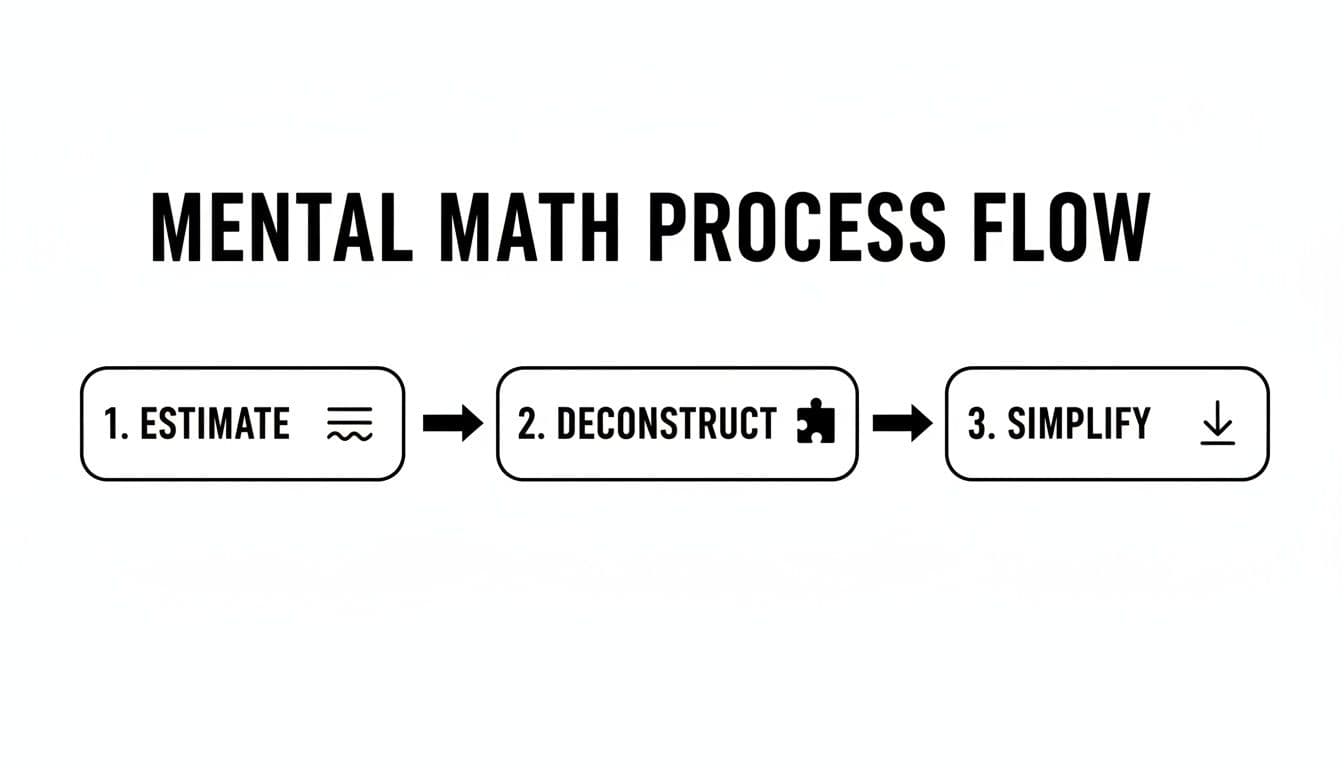
This structured approach is what separates amateurs from professionals. World-class mental calculators don't just have a natural "knack" for numbers; they are products of highly deliberate and consistent training. Whether it's for M&A valuations or a back-of-the-envelope market sizing, this skill is critical. To see how these calculations apply directly to a core interview concept, check out our guide on https://soreno.ai/articles/what-is-market-size.
Your Weekly Mental Math Practice Plan

Knowing the techniques is a great start, but making them second nature is what separates good from great in an interview. The only way to get there is by turning theory into a repeatable habit. This practical weekly schedule takes the guesswork out of your prep, helping you build skills systematically.
Forget about marathon study sessions. The key here is consistency over intensity. A focused 20-25 minutes each day is far more powerful than cramming for three hours on a Sunday. Think of this plan as your road map to building both speed and confidence.
Days 1-2: Nail Down the Fundamentals
Kick off the week by sharpening your core tools. These first two days are all about the raw mechanics of multiplication, division, and percentages. Don't worry about business context yet—just focus on speed and pure accuracy.
- Day 1: Multiplication Mastery. Zero in on two-digit by one-digit (e.g., 47 x 8) and two-digit by two-digit (e.g., 25 x 16) problems. Lean heavily on the deconstruction method, breaking problems into easy chunks like
(47 x 10) - (47 x 2). - Day 2: Percentage Precision. This is all about breaking down percentages into 10% and 1% blocks. Drill yourself on finding values like 15%, 45%, and 2.5% of different numbers until finding 10% (just move the decimal) is an instant reflex.
This kind of foundational practice is non-negotiable. It’s no secret that math proficiency is a challenge globally—the recent 15-point drop in OECD PISA 2022 math scores is a stark reminder. This data shows why the consistent, structured training common in top-performing nations like South Korea is so effective. For you, this means a focused plan is crucial for building the numeracy that can account for 20-30% of a typical case interview score. You can learn more about the importance of this skill on the OECD's official page.
Days 3-4: Start Applying to Mini-Scenarios
With the basics sharpened, it's time to connect them to realistic business situations. The math is the same, but the way it's framed makes all the difference. This is a crucial step in conditioning yourself for the pressure of an interview.
Your drills should now feel like bite-sized case problems:
- Day 3: Break-Even and Cost Analysis. Practice calculations tied to fixed and variable costs. For example: "Fixed costs are $50,000. Each unit has a profit contribution of $2.50. How many units do we need to sell to break even?"
- Day 4: Growth and Market Share. Get comfortable working with year-over-year growth and market sizing. A typical drill might be: "A $400M market grew by 15% last year. What is its current size?"
This is where real confidence is built. You're no longer just doing math problems; you're starting to think like an analyst or consultant, applying numerical fluency to solve a business challenge.
Days 5-7: Synthesize and Simulate
The end of the week is all about integration. You'll bring multiple skills together to tackle more complex, multi-step problems that look and feel like what you’ll face in a real interview. These final days are designed to test your mental agility under pressure.
- Day 5: Multi-Step Profitability. Tackle problems that require several calculations in a sequence. For example: "A company has $2M in revenue. Costs, originally $1.5M, increase by 10%. At the same time, units sold decline by 5%. What’s the new profit margin?"
- Day 6: Back-of-the-Envelope Sizing. Practice making quick market estimations using rounded numbers and logical assumptions. Try to estimate something like the annual revenue of a busy local coffee shop.
- Day 7: Review and Repeat. Use today to look over your notes from the week. What was your weakest area? Run another 20-minute drill focused solely on that skill. Then, take a well-deserved break.
A structured plan like this provides a clear, repeatable cycle for improvement. To give you a bird's-eye view, here's how it all comes together in a simple schedule.
Sample 7-Day Mental Math Training Schedule
This table outlines a practical weekly plan to structure your practice sessions, blending technique focus with real-world application drills.
| Day | Focus Area | Drill Example (15 mins) | Application (10 mins) |
|---|---|---|---|
| Day 1 | Multiplication & Subtraction | 2-digit by 1-digit multiplication (e.g., 68 x 7) | Calculate total revenue from multiple product lines. |
| Day 2 | Percentages (10%, 1%, 5%) | Find 15% of 250, 45% of 800 | Apply percent discounts to prices or calculate commission on sales. |
| Day 3 | Break-Even Analysis | Fixed costs of $100k, variable of $5/unit, price of $15/unit. | Scenario: "How many customers does a subscription business need to break even?" |
| Day 4 | Growth Rates & Market Sizing | Calculate 12% YoY growth on a $250M market. | Estimate the size of the local market for electric scooters. |
| Day 5 | Multi-Step Profitability | Combine cost increases and revenue drops into a single problem. | Analyze a profit & loss statement with multiple changing variables. |
| Day 6 | Back-of-the-Envelope Estimation | How many golf balls fit in a school bus? | Quick-estimate a company's annual revenue based on store count and average sales. |
| Day 7 | Review & Weakness Drill | Re-do the toughest drill type from Days 1-6. | Identify the one calculation type that feels slowest and dedicate the full session to it. |
Stick with this schedule for a few weeks. What once felt like a source of anxiety will slowly but surely transform into one of your biggest assets in any interview.
Putting Your Mental Math to the Test in Real Case Scenarios
All those drills? This is the moment they were for. This is where your new skills stop being an abstract exercise and start having a real, tangible impact. In a case interview, the numbers are never just numbers—they're the language of business strategy.
Being able to fluently apply mental math to frameworks like market sizing, profitability, or M&A valuations is what separates a good candidate from a great one. It proves you can think quantitatively on your feet and, more importantly, translate raw data into strategic insight. Let's walk through how this plays out in the most common situations you'll face.
Tackling Market Sizing Questions
Market sizing is a classic case interview prompt. It's designed to test your logical thinking and your ability to handle ambiguity. The interviewer doesn't actually care about the exact answer; they want to see a clear, defensible thought process that breaks a huge, intimidating question into small, manageable estimations.
Sample Prompt: "Estimate the annual market size, in dollars, for coffee shops in Chicago."
Your first instinct shouldn't be to panic. It should be to build a logical funnel, starting from a number you can reasonably estimate—the population.
Here’s a practical way to break it down:
- Start with the Population: Let's use a nice round number for Chicago's population: 3 million people.
- Segment Your Base: Not everyone drinks coffee, so let's narrow it down. Assume 80% of the population are adults who might be potential customers. That gives us
3M * 0.8 = 2.4Mpeople. - Estimate Frequency: Now, how often do these folks buy coffee? You could get lost in complex segments (frequent buyers, occasional, etc.), but that's a trap. Simplify! Let's just assume the average coffee drinker buys 2 coffees per week from a shop.
- Calculate Total Coffees per Year: First, find the weekly total:
2.4M people * 2 coffees/week = 4.8M coffees/week. To get the annual number, multiply by 52 weeks. Let's round that to 50 to keep the math clean.4.8M * 50is the same as(4.8M * 100) / 2, which is480M / 2 = 240Mcoffees per year. - Estimate Average Price: A reasonable average price for a coffee in Chicago might be $5.
- Calculate the Final Market Size: Now, just multiply them together:
240M coffees * $5/coffee = $1.2 billion.
See what happened? By breaking the problem down and rounding strategically, a massive question became a series of simple multiplications. You can get more practice by learning how to prepare for case study interviews to really nail this technique.
Navigating Profitability Analysis
Profitability cases are all about digging into the core drivers of a business. An interviewer will give you a scenario—usually declining profits—and expect you to quickly diagnose the cause by analyzing revenue and cost changes. This is where being quick with percentage changes really shines.
Sample Prompt: "A company's revenue was $50 million last year with a 20% profit margin. This year, revenue grew by 10%, but costs increased by $7 million. What is the new profit margin?"
Don't jump straight to a formula. Walk through it piece by piece, talking your interviewer through your logic.
- Find Last Year's Profit: This is straightforward. 20% of $50M is $10M.
- Find Last Year's Costs: If Revenue was $50M and Profit was $10M, then Costs must have been $40M.
- Find This Year's Revenue: A 10% growth on $50M is an extra $5M, bringing the new revenue to $55M.
- Find This Year's Costs: Last year's costs were $40M. Add the $7M increase, and you get $47M.
- Find This Year's Profit:
New Revenue - New Costs = $55M - $47M = $8M. - Calculate the New Profit Margin: Now for the trickiest part:
($8M / $55M) * 100. Instead of getting stuck dividing 8 by 55, approximate! It’s very close to 8/56, which simplifies to 1/7. You should know that 1/7 is roughly 14.3%.
Your ability to confidently state, "The new profit margin is approximately 14-15%," is far more impressive than fumbling with a calculator for an exact decimal. It shows you prioritize the business insight over pointless precision.
Handling M&A and Valuation Math
In interviews for finance or corporate strategy roles, you'll almost certainly run into M&A or valuation questions. These problems test your ability to work with big numbers, growth projections, and simple multiples.
Sample Prompt: "A private equity firm is considering buying a company with $40 million in EBITDA. Similar companies in the industry are trading at an 8x EBITDA multiple. The firm believes it can increase EBITDA by 25% in three years. What is the potential exit valuation?"
This might sound like a lot, but it's just a couple of simple steps.
- Calculate the Current Valuation: This is your baseline. Just multiply EBITDA by the multiple:
$40M * 8 = $320 million. - Calculate the Future EBITDA: The firm projects a 25% increase. The quickest way is
$40M * 1.25, but you can also do it as$40M + (25% of $40M) = $40M + $10M = $50 million. - Calculate the Potential Exit Valuation: Now, apply that same multiple to the projected EBITDA:
$50M * 8 = $400 million.
The key here is just being comfortable with numbers in the millions and applying a percentage increase without stumbling. In every one of these scenarios, the underlying math is simple arithmetic. The real skill is structuring your thoughts, applying the math in a business context, and communicating your process with confidence.
Your Top Mental Math Questions, Answered
As you dive into a practice routine, you're bound to have questions. Everyone does. Getting straight answers to these common hurdles can keep you on track and make your prep time count. Let's tackle what's usually on people's minds.
How Long Until I Actually Get Faster?
You'll likely feel a real difference in your speed and confidence in about 2-3 weeks, but only if you're consistent. This isn't about cramming; it's about building a daily habit. Just 15-20 minutes a day is far more effective than a multi-hour session once a week.
The first wins come pretty quickly as you get the hang of basic shortcuts like rounding and breaking down numbers. The real, lasting skill, though, is making those techniques feel like second nature. Progress is never a straight line—some days you'll feel sharp, and others you'll hit a wall. That’s totally normal. Just keep tracking your times and accuracy, and you'll see the trend is heading in the right direction.
The Most Common Math Mistakes I See in Interviews
It's rarely the complex math that gets candidates into trouble. It's usually how they handle the pressure of doing it live. I’ve seen three classic mistakes sink otherwise great candidates, so make sure you avoid them.
- Going Silent. This is the number one killer. You have to walk the interviewer through your logic, step by step. If your thought process is clear, they can still give you credit even if you botch the final number.
- Jumping In Too Fast. Never start punching numbers without first outlining your plan. It can be as simple as, "Okay, to figure this out, I'm going to first calculate the total costs, and then I'll use that to find the profit." This signals that you're a structured thinker, not just a human calculator.
- Freaking Out Over a Mistake. Look, everyone slips up. The best candidates are the ones who catch their own error, say something like, "Hold on, let me re-check that," and calmly fix it. They're testing your composure just as much as your arithmetic.
How you react to a mistake tells the interviewer more than the mistake itself. A calm correction shows you’re resilient and have a good eye for detail. Panicking just shows you can't handle a little heat.
What Numbers and Formulas Do I Really Need to Memorize?
Your goal should be fluency, not just memorization. Trying to cram a long list of formulas you don't really understand is a recipe for disaster—it all falls apart under pressure. Instead, focus on internalizing the basics until they're instinct.
Here’s the absolute must-know list:
- Multiplication Tables: Get these down cold, at least up to 15x15. The less brainpower you spend on basic multiplication, the more you have for solving the actual business problem.
- Fraction-to-Percentage Conversions: You need to know the common ones without thinking. Things like 1/8 = 12.5% or 1/6 = ~16.7% should be automatic.
- Core Business Formulas: Don't just memorize these; understand them deeply.
Profit = Revenue - CostsRevenue = Price x Quantity- The logic behind a
Break-Even Point(Fixed Costs / Contribution Margin per Unit)
Truly understanding these concepts is infinitely more valuable than having a dozen niche formulas rattling around in your head. Getting good at interview math is about knowing the why behind the numbers, not just the what.
Ready to stop practicing in theory and start simulating real-world interview pressure? Soreno is an AI-powered platform that puts you in a mock interview with an MBB-trained AI that asks follow-up questions, manages time, and provides instant, rubric-based feedback on your structure, numeracy, and communication. Start your 7-day free trial and get unlimited reps on demand.