
Elite Case Interview Prep: how to prepare for case study interviews
Learn how to prepare for case study interviews with a proven system: master frameworks, mental math, and crisp storytelling to land consulting or finance roles.
Preparing for a case study interview is less about memorizing frameworks and more about building a repeatable, bulletproof problem-solving method. What you're really doing is systematically training your brain to structure ambiguous problems, run quick analytical calculations, and communicate your thought process clearly, even when you’re under the gun.
Your Foundation for Case Interview Success
Case study interviews can feel like a black box, but they’re designed to test a specific set of skills you can absolutely build from the ground up. Interviewers at firms like McKinsey, Bain, or BCG aren't looking for a "gotcha" moment or one single right answer. They’re evaluating your structured thinking, your business intuition, and your ability to stay composed when the pressure is on.
This guide is your roadmap to demystifying the whole process. If you’re brand new to this world, getting a handle on what a case study interview is is the perfect place to start.

Success doesn’t come from cramming answers. It comes from developing a reliable methodology that you can lean on for any problem they throw at you. We'll show you how to move from feeling overwhelmed and anxious to feeling confident in your own problem-solving toolkit.
The Four Pillars of Preparation
The best way to tackle this is to break your preparation into four distinct pillars. Mastering each one ensures you have no weak spots when you walk into that interview room. Think of it as breaking down a huge, intimidating task into smaller, more manageable training blocks.
- Frameworks and Structuring: This is your foundation. It's all about taking a messy, ambiguous business problem and breaking it down into logical, clean pieces. You'll learn to apply core principles like MECE (Mutually Exclusive, Collectively Exhaustive) to build custom issue trees that go way beyond just rattling off Porter's Five Forces.
- Analytical Fluency: Next up is your quantitative muscle. This pillar is about mastering mental math and pulling insights from data under pressure. It covers everything from market sizing and profitability deep dives to quickly making sense of a complex chart or exhibit.
- Structured Communication: Getting the right answer is only half the battle. Seriously. You have to be able to articulate your thought process and recommendations in a clear, persuasive way. It’s about telling a compelling story with the data you've uncovered.
- Performance Simulation: Finally, you have to bring it all together and replicate real interview conditions. This means doing timed mock interviews, getting tough feedback, and learning to adapt when the interviewer throws you a curveball.
To really build a robust foundation, it helps to have a solid grasp of core business principles from the start. These pillars are all connected—your slick analytical skills are useless without clear communication, and a brilliant structure falls flat if you can’t find the numbers to back it up.
The goal isn't to find the 'one right answer'—because it often doesn't exist. Instead, the interviewer wants to see how you think. They are renting your brain for 30 minutes to see if they'd want to rent it for a full-time job.
To see how this all fits together, here’s a quick breakdown of how each pillar contributes to a well-rounded preparation strategy.
The Four Pillars of Case Interview Preparation
| Pillar | Focus Area | Key Skills Developed |
|---|---|---|
| Frameworks and Structuring | Breaking down ambiguous problems into logical parts. | MECE principle, hypothesis-driven thinking, issue trees. |
| Analytical Fluency | Mastering mental math and interpreting data under pressure. | Market sizing, profitability analysis, chart reading, numeracy. |
| Structured Communication | Articulating your thought process and recommendations clearly. | Synthesis, storytelling with data, top-down communication. |
| Performance Simulation | Replicating real interview conditions to build confidence. | Time management, poise, adapting to follow-up questions. |
By focusing your efforts across these four areas, you're not just preparing for an interview; you're developing the fundamental skills of a top-tier strategist.
Building Your Problem-Solving Toolkit
Alright, let's move from theory into the real world. This is where the rubber meets the road. A classic rookie mistake is learning a few standard frameworks—like Porter’s Five Forces or the 4 Ps—and then trying to shoehorn every single problem into one of them. Believe me, interviewers can spot a "framework dropper" from a mile away. They're far more impressed by someone who can think on their feet and build a solution from the ground up.
The goal isn't to have a memorized script for every business problem. It's to build a flexible, custom approach that works for any case, whether it’s a classic profitability question or something completely out of left field. Think of it as developing a true problem-solving toolkit, not just carrying a single, rusty wrench.
From First Principles to Issue Trees
The foundation of this custom approach is what we call "first-principles thinking," and its primary tool is the issue tree. An issue tree is just a way to visually break down a huge, messy problem into smaller, manageable pieces. It’s built on the MECE principle (Mutually Exclusive, Collectively Exhaustive), which is a fancy way of saying you cover all your bases without double-counting anything. It’s your roadmap.
Let's quickly run through a mini-case to see how this works in practice.
- The Prompt: “Our client is a national coffee chain. Profits have tanked by 15% over the last year. What should they do?”
A rigid thinker might immediately blurt out the profitability framework (Profit = Revenue - Costs). And while that’s not wrong, it’s incredibly generic. A first-principles thinker customizes. They’ll pause, form a hypothesis, and then build a bespoke issue tree to test it.
Crafting a Hypothesis and Structuring Your Analysis
Those first three minutes of a case are gold. This is your moment to absorb the prompt, ask a few smart clarifying questions, and—most importantly—lay out your plan of attack for the interviewer.
Your initial hypothesis doesn't need to be a perfect, clairvoyant prediction. It just needs to be logical. For our coffee chain, a solid start might sound something like this: "My initial thought is that the profit decline is mainly coming from decreasing revenue in our core urban stores. This is likely driven by a one-two punch of increased competition from boutique coffee shops and lower foot traffic since the pandemic shifted work patterns."
With that hypothesis in hand, you can build your issue tree to investigate it piece by piece.
An issue tree is your structured brainstorm. It’s a visual commitment to being logical and thorough, showing the interviewer exactly how you plan to navigate the problem's complexity.
Your structure, which you should talk your interviewer through, could look something like this:
- Pinpoint the Profit Leak: First, I need to figure out where the 15% drop is coming from.
- Revenue Streams: Is the issue with company-owned stores, franchises, or maybe our CPG sales (like bags of beans)? I’ll want to slice this by geography (urban vs. suburban) and product type (drinks vs. food).
- Cost Structure: On the other side of the ledger, have our major costs—like coffee beans, labor, or rent—spiked?
- Scan the Battlefield (External Factors): Next, I’ll look outside the company.
- Competition: Who are we up against? Other big chains? Local indie shops? Have they launched new pricing or aggressive marketing?
- Customer Behavior: Have people's habits changed? Are they brewing more at home or just visiting cafes less often?
- Look in the Mirror (Internal Operations): Finally, I’ll assess our own house.
- Customer Experience: Has service quality dropped? Are our stores looking tired?
- Product Offering: Is our menu still relevant? Are we keeping up with new trends?
This structure is tailored, MECE, and directly tackles the prompt. It shows you’re not just reciting from a textbook; you’re an active problem-solver building a custom plan. While knowing the popular frameworks for case interviews is a good starting point, the real magic lies in adapting them—or building your own from scratch. This is what separates the good candidates from the great ones.
Mastering the Quantitative and Analytical Core
Nothing separates candidates faster than the moment a chart is slapped on the table or a market sizing question is thrown your way. This is where your analytical horsepower gets put to the test. A calm, structured approach to numbers can make or break your performance.
So many candidates freeze up at the thought of "case math," but it's just a skill. And like any skill, you can build it systematically through focused drills, turning a major point of anxiety into an area where you can really shine.
The goal isn't to be a human calculator. It’s about being fluent and logical with numbers when the pressure is on. You need to confidently handle things like growth rates, breakeven points, and market sizing estimations without missing a beat. This fluency is what frees up your mental bandwidth to focus on the bigger picture—what the numbers actually mean for the business—instead of getting lost in the weeds of the calculation itself.
Sharpening Your Mental Math Skills
Before you can pull insights from data, you have to be comfortable playing with it. Start with daily drills that focus on both speed and accuracy.
- Practice with Big Numbers: Consultants deal in millions and billions. Get comfortable adding, subtracting, multiplying, and dividing huge figures. A great trick is to just drop the zeros, do the core calculation (like 15 x 25), and then add the zeros back on at the end.
- Master Percentages and Growth Rates: You will, without a doubt, be asked to calculate a percentage change or a compound annual growth rate (CAGR). Practice these until they’re second nature. If revenue grew from $200M to $250M, you should instantly know that’s a 25% jump.
- Sanity-Check Everything: This is huge. After every calculation, pause for a second and ask yourself, "Does this number even make sense?" If you estimate the U.S. market for electric scooters is $500 billion, that’s a massive red flag. This simple habit not only catches embarrassing errors but also shows your interviewer you have solid business judgment.
Developing this kind of numerical reasoning is a non-negotiable part of your prep. For a deeper dive, our guide on acing a numerical reasoning assessment has more structured exercises to help you build this muscle.
From Data to Insights: The Art of Chart Interpretation
These days, case interviews are less about raw calculation and more about your ability to look at a messy chart, synthesize the data, and communicate a clear insight. You'll often be handed a complex exhibit and asked, "So, what do you see here?"
The worst thing you can do is just read the data labels back to the interviewer. They already know what the chart says. They want to know what it means.
Your job is to find the "so what?"—the core business implication hidden in the numbers.
"The interviewer isn't testing your ability to read an axis. They're testing your ability to connect a data point to the client's core problem and use it to drive your analysis forward."
Let's say you're shown a bar chart comparing the market share of three competitors over the last five years. Here’s how you handle it:
- State the Obvious First: Start high-level. "Okay, this chart shows the market share for our client and its two main competitors from 2019 to 2023."
- Identify the Key Insight: Now, find the most important trend. "The most striking thing here is that while Competitor A's share has been flat and ours has dipped slightly, Competitor B has exploded from 5% to 25% market share, capturing nearly all the market growth in that time."
- Formulate a Hypothesis (The "So What?"): Connect it back to the problem. "This strongly suggests Competitor B has a real competitive advantage that's clicking with customers. My next step would be to figure out what they're doing differently—is it their product, pricing, or distribution?—to understand the drivers of their success."
This top-down communication shows you can turn raw data into a strategic next step. That’s exactly what top firms are looking for.
Building Fluency Through Repetition
At the end of the day, confidence with the quant core comes from one thing: structured, repeated practice. Modern cases test your numeracy, data interpretation, and clear communication under pressure—all skills that get better with disciplined drills.
As the experts at Management Consulted point out, candidates often try to cram stats right before interviews, but that’s not what’s being tested. The case format is designed to see how you interpret data, not if you memorized a formula. This is why top performers build habits through repeated, timed reps with immediate feedback on their pacing and clarity.
This is precisely why platforms like Soreno exist—to help you drill the most error-prone parts of the case, like live math and exhibit synthesis, with targeted exercises and automated feedback. Deliberate practice is what transforms quantitative challenges from obstacles into opportunities to shine.
The Power of High-Volume Structured Practice
Here's a secret that successful candidates in consulting and finance know well: the biggest difference-maker isn't a prestigious MBA or raw intellect. It's the sheer volume and quality of practice they put in. Getting comfortable with the ambiguity and pressure of a live case is a skill you build through deliberate, structured repetition.
And you'll need every advantage you can get. Between 2018 and 2023, the competition for roles at top firms became unbelievably fierce. McKinsey, BCG, and Bain now field over a million applications each year for just a few thousand spots, driving offer rates well below 5%. This reality has made systematic case prep a statistical necessity, not just a good idea.
Data from platforms like CaseCoach shows that candidates who actually land offers typically invest around 60 hours in structured prep, completing at least 25 live mock interviews. This isn't about memorizing frameworks; it's about building the muscle memory needed to tackle any case format thrown your way.
Designing an Effective Practice Plan
A solid practice plan isn’t random—it moves through distinct phases, with each one building on the last. The whole point is to progress from low-pressure solo work to high-fidelity simulations that feel just like the real thing.
Think of your journey in this logical sequence:
- Solo Drills: Start by yourself, working through cases on paper. Focus on the fundamentals: building solid issue trees, structuring your thoughts clearly, and getting your mental math up to speed. This is your time to internalize the core mechanics without an audience.
- Partner Practice: Once the basics feel solid, find a dedicated case partner. This is absolutely critical. You have to learn to articulate your thought process out loud, and the only way to get good at it is by actually doing it with another person.
- High-Fidelity Simulations: In the final stretch, you need to replicate the interview as closely as possible. This means timed sessions, often with partners you don't know well or by using specialized tools that simulate the experience of a real interviewer.
The Pitfalls of Unstructured Peer Practice
While practicing with peers is a must, it’s also full of common traps that can stall your progress or, even worse, cement bad habits.
- Inconsistent Feedback: Your MBA classmate might be brilliant, but that doesn't make them a trained interviewer. Feedback can be vague ("That felt pretty good") or focused on the wrong things, leaving you with nothing actionable to work on.
- Reinforcing Bad Habits: If your partner doesn't know how to spot a non-MECE structure or a flawed calculation, you might end up practicing the wrong way dozens of times. Unlearning those mistakes later is much harder than learning correctly the first time.
- Scheduling Nightmares: Let's be honest, finding a reliable partner who is as committed as you are and whose schedule aligns with yours can be a huge time sink.
The quality of your feedback dictates the speed of your improvement. Vague encouragement feels good, but it's the specific, critical feedback that helps you break through plateaus.
To sidestep these issues, you need a way to get consistent, high-quality reps paired with objective, data-driven feedback. This is exactly where technology is changing the game.
The diagram below breaks down the ideal process for developing case math fluency. High-volume practice is what solidifies each of these steps.
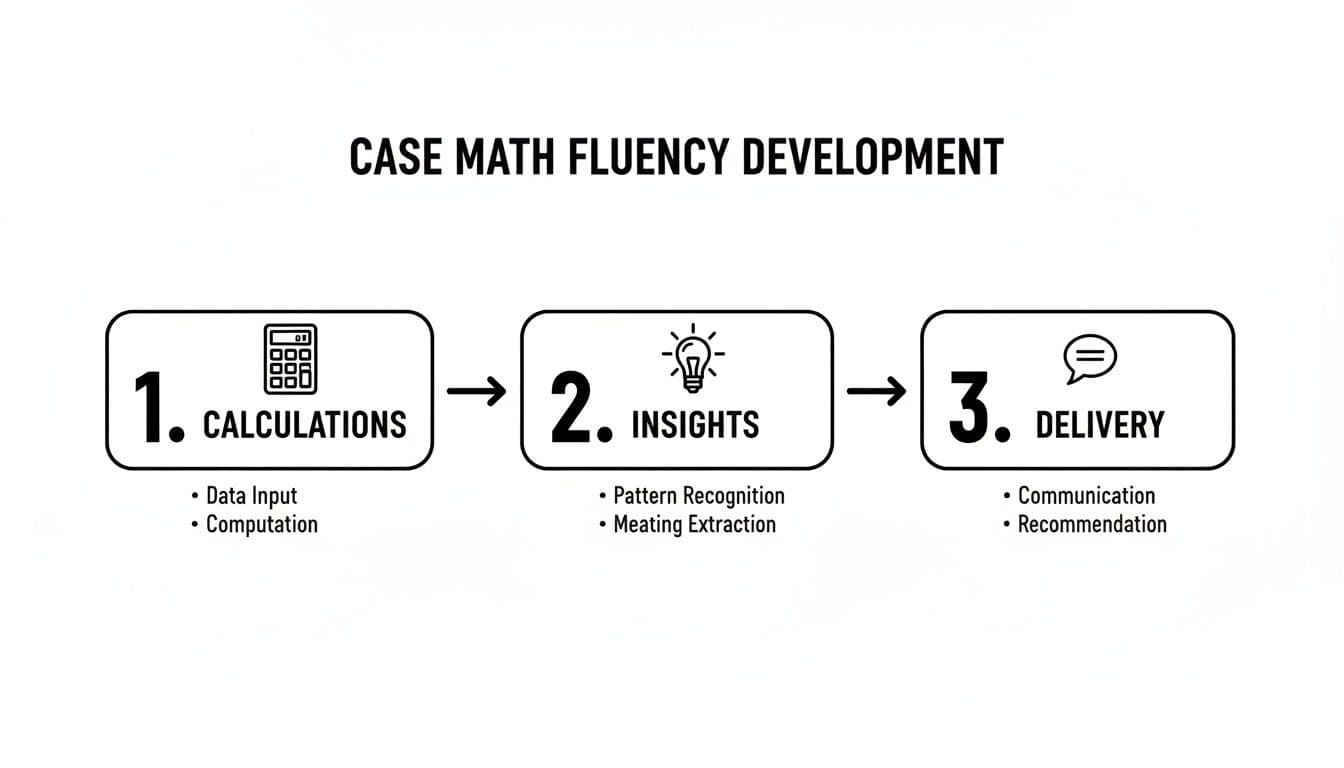
As you can see, raw calculation is just the starting line. True mastery comes from being able to pull meaningful insights from the numbers and deliver them effectively.
Accelerating Your Learning with AI
To compress that 60-hour workload and make every minute count, many candidates are now turning to AI-powered platforms. These tools are built specifically to solve the core problems of traditional peer practice.
Platforms like Soreno offer on-demand, judgment-free practice with an AI interviewer trained on MBB methodologies. This lets you squeeze in unlimited reps whenever you have a spare 30 minutes, without the hassle of scheduling.
But the real advantage is the feedback. Instead of someone's subjective opinion, you get instant, rubric-based feedback on everything from your case structure to your communication. The system can pinpoint filler words, analyze your pacing, and suggest targeted drills for your specific weak spots, whether that's market sizing or interpreting a tricky chart.
It's this immediate, targeted feedback loop that allows you to make rapid, tangible improvements and get interview-ready in a fraction of the time.
How Deliberate Practice Can Double Your Offer Rate
It's not just about how many hours you clock in; it’s about how you use that time. I've seen countless candidates grind through 50+ cases and still not get the offer. Why? Because they weren't practicing—they were just repeating.
The single biggest lever you can pull is shifting from unstructured practice to a deliberate, feedback-driven approach. The difference isn't small. It can statistically double your chances of landing a top-tier consulting job.
This isn’t just a hunch; it's backed by hard data. Specialized prep firms have tracked this for years, and the numbers are pretty stark. One analysis of 563 candidates gunning for McKinsey, BCG, and Bain found that 142 received offers. That's a success rate of 25.2%, or roughly 1 in 4.
Think about that. The firm that ran this analysis, CaseCoach.com, describes this as double the average success rate in those markets, which puts the baseline for most applicants somewhere around 12–13%.
The gap between a 12% and a 25% success rate is built entirely on targeted drills. It’s the difference between just "doing cases" and actively sharpening your structure, your MECE thinking, your mental math, and your chart interpretation with every single repetition. This is how you move from the middle of the pack to the top of the "must-hire" list.
You Need Brutally Honest Feedback Loops
The engine of deliberate practice is the feedback loop. Without high-quality feedback, you’re just practicing your mistakes until they become bad habits. Whether you're working with a friend or a dedicated coach, your goal is to get specific, actionable, and sometimes painfully honest advice after every single mock interview.
Vague feedback like "You did a good job" is completely useless. You need to dissect your performance.
- Structure and Logic: Was your initial framework actually tailored to the problem, or was it a generic copy-paste job? Did you cover the key drivers without overlap? Your practice partner should be able to point to the exact branch of your issue tree that was weak or confusing.
- Math and Quantitative Insight: Sure, you got the math right, but did you connect it back to the business problem? The feedback shouldn’t be "Your math was correct." It needs to be: "Your calculation was fine, but you completely missed the chance to explain why a 10% margin drop is a five-alarm fire in this specific industry."
- Storytelling and Communication: How well did you articulate your thought process? Did you just state facts, or did you weave them into a compelling narrative? Feedback should focus on your top-down communication and whether you delivered a clear, confident final recommendation.
A feedback loop is your diagnostic tool. It tells you precisely which part of your problem-solving engine is misfiring so you can fix it before the real interview. Without it, you’re just driving blind.
Using Technology to Get More Reps
For a long time, this kind of intensive, one-on-one coaching was only available to candidates who could afford it. It was expensive, hard to schedule, and didn’t scale. Luckily, technology has completely changed the game, making elite-level prep accessible to almost everyone.
AI-driven platforms are a perfect example. They're designed to replicate the experience of practicing with a seasoned MBB coach, providing the kind of data-driven feedback that used to be out of reach.
Here’s where these tools can give you a real edge:
- Rubric-Based Scoring: Instead of a subjective opinion, you get objective scores across core competencies like structure, business acumen, and communication. This lets you track your progress with actual data over time.
- Time-Stamped Notes: Good AI tools can give you specific, time-stamped feedback right on a video replay of your session. You can see the exact moment you went off-track or missed a key insight, making it much easier to correct for next time.
- Communication Analysis: The best systems can even analyze your speech patterns—counting filler words like "um" and "uh," measuring your speaking pace, and even giving you pointers on eye contact and body language.
By bringing these tools into your prep, you can implement the kind of intensive, feedback-rich practice that has been proven to make a massive difference in offer rates. Remember, how you prepare is just as important as how long you prepare. Focus on targeted, data-driven feedback, and you'll build the skills that actually get you the job.
Questions I Hear All the Time About Case Prep
As you get deeper into your prep, you're going to hit some snags. It’s inevitable. Mastering case interviews isn't just about learning frameworks; it's about navigating the very real roadblocks and anxieties that come up along the way. Let's tackle some of the most common questions I get from candidates, so you can keep your prep moving forward.
How Long Does This Actually Take?
Look, there's no magic number, but most candidates who get offers from top-tier firms put in about 60 hours of real work. This usually happens over four to eight weeks.
That timeframe gives you enough runway to really learn the core concepts, get a ton of practice interviews under your belt (aim for 20-30 mocks), and still have time to zero in on your weak spots. Spreading it out is far better than a frantic, last-minute cram session. Trying to jam it all into a week or two just leads to burnout, and you won't have time to actually absorb the feedback you're getting.
Here’s a simple way to plan it out:
- Start with your interview date and work backward.
- Create a realistic weekly schedule—maybe 3-4 mock interviews a week.
- On your "off" days, run solo drills for things like structuring and mental math.
What's the Single Biggest Mistake People Make?
Hands down, it's "framework slapping." This is when a candidate hears a problem and immediately forces a memorized framework onto it, like trying to fit a square peg in a round hole with Porter's Five Forces. Interviewers see this from a mile away and it screams "I can't think for myself."
A close second is the "data dump." This is painful to watch. A candidate gets a chart and just… reads the numbers out loud. Your job isn't to be a narrator; it's to be an analyst. You have to find the story in the data.
Every single time you see a number in a case, ask yourself: "So what?" What does this number actually mean for the client? What does it tell me about where I need to dig next?
I Can't Find a Good Case Partner—What Do I Do?
This is a huge one. Finding someone who is reliable, skilled, and available when you are can feel impossible. Worse, practicing with an inconsistent or unprepared partner can actually reinforce bad habits.
This is where technology has really changed the game. AI-powered platforms were built to solve this exact problem.
Think about it: an AI interviewer like Soreno can run you through hundreds of different cases, anytime you want. You get a realistic simulation without having to coordinate schedules. The feedback is instant and objective, breaking down your structure, math, and communication. It's the perfect way to get in high-quality reps whenever you have a spare 30 minutes, building that crucial muscle memory on your own schedule.
Structure vs. Recommendation: What Matters More?
Your structure. It's not even close.
Your final recommendation is just the logical endpoint of the path you've built. A recommendation that sounds brilliant but comes from a messy, unstructured analysis is worthless. It won't get you the job.
Interviewers are judging your thinking process, not just your final answer. A strong, MECE (Mutually Exclusive, Collectively Exhaustive) structure is your roadmap for the entire case. It creates a clear, logical journey that naturally leads to a defensible conclusion. If you mess up the structure at the beginning, it's almost impossible to recover and deliver a recommendation that makes any sense.
Ready to stop worrying about finding case partners and start getting high-quality, on-demand practice? Soreno provides an AI-powered platform with over 500 cases and instant, rubric-based feedback to accelerate your preparation. Start your free trial today at https://soreno.ai.