
How to Break Into Investment Banking A Proven Roadmap
Learn how to break into investment banking with our practical guide. Get actionable tips on networking, resume building, and acing the interview process.

Breaking into investment banking isn't just about good grades; it's a calculated campaign. It takes a potent mix of sharp technical skills, a network you've relentlessly built from the ground up, and a resume that tells a compelling story. This journey doesn't start when you fire off applications—it often begins years earlier with the right internships, setting the stage for the industry's notoriously tough interview gauntlet.
Understanding The Modern Investment Banking Landscape
Before you can even think about strategy, you need to understand the terrain. The world of investment banking is so much more than the blockbuster Mergers & Acquisitions (M&A) deals that grab headlines. It's a massive ecosystem filled with different roles, each demanding a very specific set of skills and offering a unique career trajectory. Getting this lay of the land is your absolute first step.
Too many aspiring bankers get tunnel vision, fixating only on M&A. That's a huge mistake. Banks are complex machines with tons of specialized groups that generate revenue and provide incredible, hands-on learning experiences.
Beyond The Marquee M&A Deals
To really figure out how to break in, you have to look past the obvious. While M&A is the classic, high-profile path, there are other core groups that serve as fantastic entry points and launchpads for incredible careers.
- Debt Capital Markets (DCM): These are the teams that help companies and governments raise money by issuing bonds. It's a fascinating blend of deep market analysis and client relationship management, perfect if you get a kick out of tracking macroeconomic trends.
- Leveraged Finance (LevFin): This is a high-stakes, fast-paced group. They structure and finance the massive buyouts you see private equity firms making, often using complex debt instruments. If you're even remotely interested in the buy-side, LevFin is your window into the world of PE.
- Restructuring: When a company is in trouble, this is the team that gets the call. They advise on bankruptcies, renegotiate debt, and orchestrate turnarounds. It’s an incredibly technical and intense field that actually gets busier when the economy slows down.
Knowing these different functions is a game-changer. It lets you tailor your story and your networking. Showing up to a coffee chat with a well-researched interest in DCM, backed by a real understanding of credit markets, is infinitely more impressive than another generic "I want to do M&A" pitch.
Let's break down the most common roles you'll be targeting. Understanding what each one actually does day-to-day is critical to figuring out where you fit.
Key Investment Banking Roles and Responsibilities
| Role | Primary Function | Core Responsibilities |
|---|---|---|
| Analyst | Valuation & Financial Modeling | Building financial models, creating pitch books, performing industry research, managing data rooms. |
| Associate | Project Management & Mentorship | Overseeing analyst work, managing deal execution timelines, communicating with clients, mentoring junior bankers. |
| Vice President (VP) | Deal Sourcing & Execution | Leading deal teams, managing client relationships, negotiating term sheets, ensuring flawless execution of transactions. |
These roles form the core of the deal team, and as a new entrant, your focus will be on mastering the Analyst responsibilities.
The Hiring Climate and What Banks Value Now
The recruiting game has changed. The industry is still growing, but the path to landing an analyst gig is more competitive and far more structured than it used to be. You need a deliberate, well-planned approach before you even think about hitting 'submit' on an application. The entire process boils down to a simple, powerful flow.
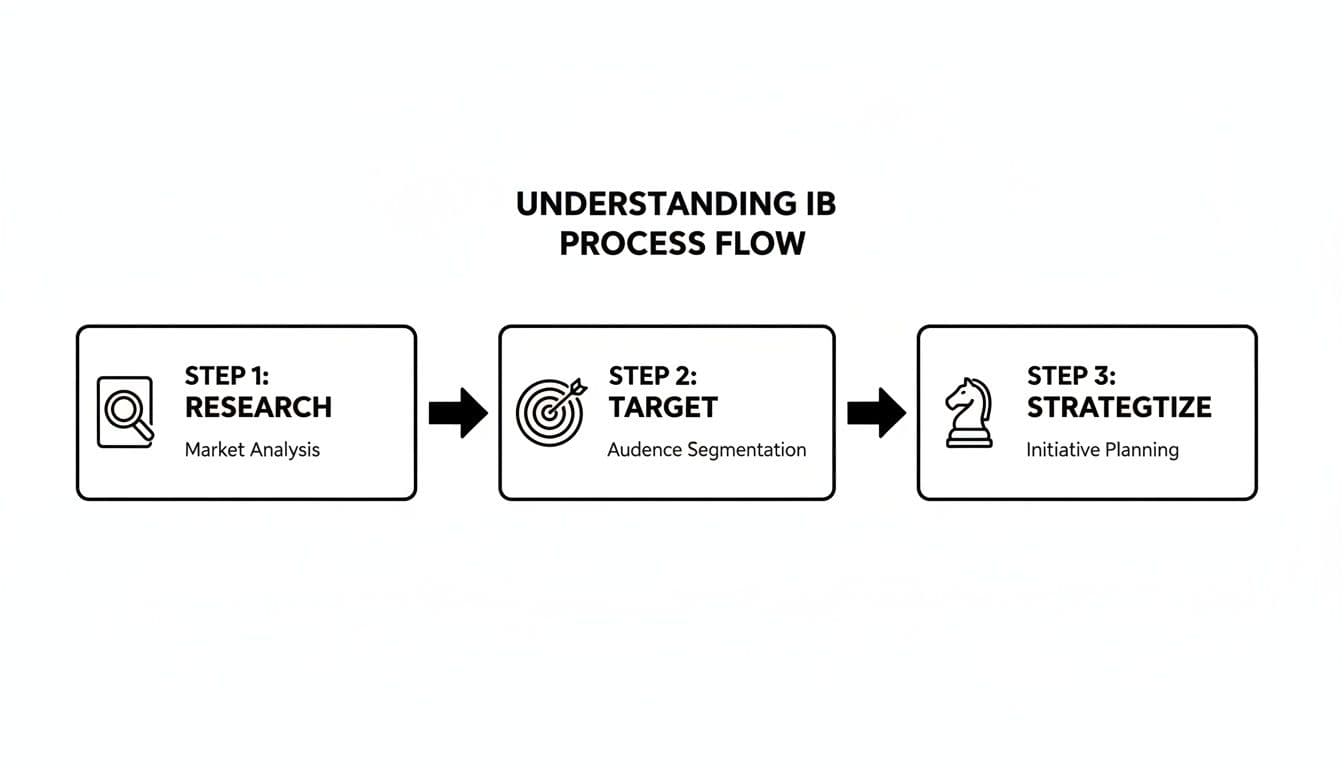
This Research, Target, and Strategize framework isn't just a suggestion; it's the foundation of a successful job search.
The investment banking sector in the United States has seen modest but steady growth. As of 2025, the industry employed over 381,000 people, growing at an average annual clip of 1.4% between 2020 and 2025. You can dig into more investment banking employment trends on IBISWorld. This shift toward lean efficiency has completely reshaped what banks expect from junior talent, making things like mock interviews and financial modeling practice non-negotiable.
Today's banks aren't just looking for a high GPA. They're screening for candidates who come to the table with a sophisticated, proactive understanding of the industry from day one. This means proving you’ve done your homework on their specific groups, recent deals, and current market trends.
Building Your Non-Negotiable Technical Skillset

Let's be blunt: networking might get you in the door, but technical skills are what keep you in the room. There’s absolutely no faking your way through this. The ability to build a model from scratch, tear apart a company’s financials, and speak the language of valuation is the price of admission.
Think of it this way—your resume earns you the interview, but your technical command lands you the offer. Banks hire junior talent to do specific, high-stakes analytical work from day one. They simply don’t have the time or patience to teach you the fundamentals; you’re expected to show up with a solid foundation already in place.
This means you need to go way beyond just knowing what a Discounted Cash Flow (DCF) model is. You need to have built several, wrestled with the key drivers, and be ready to defend your assumptions under the pressure of a technical grilling.
Mastering the Core Financial Modeling Trio
Your entire technical journey starts right here, with the three pillars of valuation. These aren't optional—they are the bedrock of every analyst's toolkit. Your goal is to achieve genuine fluency, not just rote memorization.
-
Discounted Cash Flow (DCF) Analysis: This is the cornerstone of valuation, period. You have to be able to project a company's free cash flows, determine an appropriate discount rate (WACC), and calculate a terminal value to arrive at an intrinsic valuation.
-
Comparable Company Analysis (Comps): Here, you're valuing a business by comparing it to similar publicly traded companies. This requires a sharp understanding of multiples like EV/EBITDA and P/E, and more importantly, the judgment to select a truly comparable peer group.
-
Precedent Transaction Analysis (Precedents): Similar to comps, this method values a company based on what buyers have actually paid for similar businesses in the past. It’s a reality check that tests your grasp of M&A dynamics and control premiums.
Of course, building these models is just the first step. For a more detailed walkthrough, you can find a solid primer if you check out our guide on how to build financial models. The real test, though, is being able to articulate the why behind your work during an interview.
An interviewer will inevitably ask something like, "Walk me through how a $10 increase in depreciation affects the three financial statements." Simply knowing the answer isn't enough. You have to explain it clearly, confidently, and without a second of hesitation. This is what separates the prepared candidates from everyone else.
The technical bar has been raised significantly over the years. Banks are looking for a more sophisticated candidate than ever before. With leaner analyst classes and a bigger push toward efficiency, your depth of skill is what will make you stand out.
Advancing Beyond the Basics
Once you've got a firm handle on the core valuation techniques, you need to layer on more specialized knowledge. Nailing these shows you've gone the extra mile.
An LBO (Leveraged Buyout) model is a must-know, especially if you have any interest in private equity down the line. It's a different beast entirely, combining elements of all three financial statements to determine the potential IRR a financial sponsor could generate by acquiring a company with a significant amount of debt.
Beyond the big models, your raw command of Excel needs to be second nature. This isn't about knowing a few formulas; it’s about pure speed and efficiency.
Essential Excel Skills for Banking
| Category | Must-Know Functions & Shortcuts | Why It Matters |
|---|---|---|
| Data Manipulation | VLOOKUP, INDEX/MATCH, SUMIFS, COUNTIFS | You will spend countless hours pulling and organizing data. These functions are your best friends for doing it quickly and accurately. |
| Navigation & Formatting | Ctrl + Arrow Keys, Alt + E, S, T, Ctrl + Shift + L | Speed is everything. Navigating massive spreadsheets without touching your mouse is the hallmark of a seasoned analyst. |
| Analysis Tools | Data Tables, Goal Seek, Scenarios | These are critical for sensitivity analysis. They let you see how changes in key assumptions ripple through your entire valuation. |
The expectation is that you can operate Excel at a high level before you even start. This isn’t a nice-to-have; it’s a core competency that interviewers will absolutely test, often through a timed modeling exercise. In this process, your ability to build, analyze, and present financial information is the single most important asset you have.
Crafting a Resume That Actually Gets You an Interview
Let's get one thing straight: your resume isn't a historical record of everything you've ever done. It’s a sales pitch, plain and simple. And you’ve got about six seconds to make your case before a recruiter moves on to the next one in the stack.
That means every single word—every verb, every number, every bullet point—has to earn its place. Your job is to tell a compelling story about your competence, drive, and potential. We need to move past just listing tasks and start framing your experiences to scream "investment banking." This means translating that school project or part-time gig into evidence of analytical skill, meticulous attention to detail, and an insane work ethic.
Structure for a Six-Second Scan
Before we even get to the content, let’s talk about formatting. It has to be perfect. Non-negotiable.
Stick to a clean, classic, one-page layout. The standard sections work for a reason: Education, Professional Experience, Leadership & Activities, and finally, Skills & Interests. Use a traditional font like Times New Roman or Garamond, around 10-11 pt.
The single biggest rookie mistake is cramming too much text onto the page. White space is your best friend. It gives the recruiter’s eyes a path to follow and makes your key achievements pop. You also have to consider the automated systems that see your resume first; it's worth understanding why resumes often fail Applicant Tracking Systems before you even start writing.
Your resume’s format is the first test. It should look like it belongs to a future investment banker: impeccably organized, typo-free, and able to communicate dense information with clarity. One small mistake signals a lack of attention to detail, which is a cardinal sin in this field.
Turn Your Experience into Evidence
The real meat of your resume is in the bullet points under each experience. This is where you stop telling and start showing. Every bullet needs to lead with a powerful action verb and, whenever possible, end with a hard number.
Get rid of passive phrases like "Responsible for..." or "Helped with..." Instead of saying you were responsible for analysis, show it: "Analyzed financial statements for 5+ portfolio companies to identify key performance drivers and model future growth." See the difference? One is a job duty; the other is an accomplishment.
Let’s look at a real-world example of how to punch up a common student experience:
- Before (The "Meh" Version): "Helped with a project for the university’s investment club."
- After (The "Hired" Version): "Constructed a DCF valuation model for a public tech company, projecting free cash flows over a 10-year period and presenting a final buy/sell recommendation to a 20-member investment committee."
That’s the transformation you’re aiming for. You're not just a club member; you're someone who performs the same kind of work a first-year analyst does.
Don't Sleep on the Cover Letter
Okay, so the resume is the main event, but a killer cover letter can absolutely be the tiebreaker that gets you the interview. It's your one chance to show some personality and connect the dots for the recruiter. This is where you explain why you want to work at their specific firm.
A good cover letter cuts the fluff. It tells a quick, sharp story:
- The Hook: Start by naming the role and showing you've done your homework. Mention a specific recent deal, a research report you found insightful, or a senior banker whose work you admire. Prove your interest is genuine.
- The Proof: This is the core. Pick one or two of your proudest achievements from your resume and elaborate on them. Explain how those skills directly translate to what an analyst needs to do from day one.
- The Close: Reiterate your strong interest and make it clear you're ready and eager to discuss your fit in an interview.
Think of it this way: your resume is the "what," and your cover letter is the "why." When you nail both, you create a narrative that makes a recruiter stop, put down their coffee, and say, "We need to talk to this person."
Networking That Actually Opens Doors

Everyone will tell you to "network" to break into investment banking, but that's probably the most generic advice you'll ever get. It's not about collecting contacts like trading cards or awkwardly asking strangers for a job. Real networking is about building genuine professional relationships, and it starts long before you actually need anything from anyone.
Let’s be clear: a strong referral can get your resume out of the digital black hole and onto the desk of a real person. Your goal isn’t just to meet people; it's to find champions inside the firms you're targeting.
Finding the Right People to Contact
Forget the shotgun approach of messaging every banker you can find on LinkedIn. Your outreach needs to be surgical. The best way to get a response is to find some common ground before you even hit send.
Think about your natural connections first:
- Your Alumni Network: This is gold. Use your university’s alumni database or the LinkedIn alumni tool. Bankers are almost always willing to talk to a student from their alma mater. It’s a built-in "in."
- Shared Connections: See who you know in common. A second-degree connection on LinkedIn might feel distant, but mentioning a mutual acquaintance is the perfect icebreaker.
- Similar Backgrounds: This is where you can get creative. Did you both play lacrosse? Are you from the same small town in Ohio? These personal hooks create an instant human connection that cuts through the noise.
And don’t just aim for Managing Directors. Analysts and Associates are your best bet. They were in your shoes just a few years ago, so they get it. They can give you the real, on-the-ground story and often become your most powerful allies.
The Art of the Informational Interview Request
Your first email is everything. It needs to be short, sharp, and respectful of their time. You have one goal: to get a quick 15-minute phone call to hear their story.
Here’s a simple structure that I’ve seen work time and time again:
- Clear Subject Line: Make it easy for them. Something like "University of [Your School] Student Seeking Advice" is a classic for a reason.
- The Quick Intro: Get straight to the point. "My name is [Your Name], and I'm a sophomore at [Your University]. I found your profile through the alumni network."
- Show You've Done Your Homework: Mention one specific thing about their career or firm. "I was really impressed by your team's recent work on the [Deal Name] transaction and would love to learn more."
- The Ask: Be direct but polite. "Would you have 15 minutes in the coming weeks for a brief call? I'd be grateful to hear about your experience in the TMT group at [Bank Name]."
- Make It Easy for Them: Attach your resume for context, but don't ask them to review it. You're asking for advice, not a job.
This approach flips the script. You’re not a job-seeker; you're a student seeking knowledge. It's a much more comfortable conversation for everyone involved. Remember, your communication skills are always on display, even in a simple email.
Turning Conversations into Referrals
The informational interview is your moment to shine. Don't waste it asking questions you could have Googled. Prepare smart, thoughtful questions about their career path, the group's culture, and the skills they find most critical for success.
The most crucial part of networking isn't the first call—it's the follow-up. A simple, personalized thank-you email sent within 24 hours is non-negotiable. This small gesture reinforces your professionalism and keeps the door open.
From there, your job is to keep the connection warm. Don't be a stranger. If you took their advice and finished a financial modeling course, send them a quick note to let them know. If their firm announces a big deal, drop them a line to say congratulations.
This is how you turn a single conversation into a real relationship. And when an internship or full-time role opens up, you’ll be the first person they think of. That's how networking really opens doors.
How to Dominate the Investment Banking Interview
Let's be clear: an investment banking interview isn't just a friendly chat. It’s a performance. It's meticulously designed to test three core things: your technical horsepower, your cultural fit, and your ability to keep your head on straight when the pressure is on. Think of this as your playbook for mastering all three.
Your prep needs to be a two-pronged attack. One side is the "fit" or behavioral interview, and the other is the technical gauntlet. Banks hire people, not just walking calculators. They need someone who can not only build a flawless model but can also grind through an all-nighter with a team and maintain a good attitude.
Nailing the Behavioral and Fit Questions
You can bet the house that every single banker you meet will ask some version of "Why investment banking?" and "Why our firm?" Don't mistake these for warm-up questions—they're critical filters to weed out anyone who isn't genuinely committed or a good fit for their team. Your answers need to be sharp, specific, and memorable.
The best way to structure your answers is by using the STAR method (Situation, Task, Action, Result). It’s a simple but incredibly effective framework that turns a vague claim about your skills into hard proof.
Let’s walk through a classic question: "Tell me about a time you worked on a team."
- Situation: "In my corporate finance class, my team of four was assigned to build a complete DCF valuation for a public retail company."
- Task: "We had to deliver a 30-page deck with our final recommendation. But just two days before the deadline, we found a huge error in our revenue projections that basically torched our entire model."
- Action: "I immediately took the lead. I volunteered to stay up all night and rebuild the revenue model from scratch, while delegating the slide updates and sensitivity analysis reruns to my teammates so we could work in parallel and not lose any more time."
- Result: "By splitting up the work, we fixed the model, updated the entire deck, and got it in on time. Our project ended up getting the highest grade in the class, and the professor even used our model as an example of exceptional work."
See the difference? This tells a story with a real outcome. It proves leadership, work ethic, and attention to detail far better than just saying, "I'm a great team player." You should have three to five of these stories polished and ready to go, covering themes like teamwork, leadership, failure, and how you handle stress.
For a deeper dive, our complete guide on investment banking interview preparation covers more strategies to perfect your stories.
Conquering the Technical Gauntlet
There is absolutely no hiding from the technical questions. This is where you prove you have the foundational knowledge to hit the ground running from day one. You can't just know this stuff; you need to be fluent.
You have to be systematic here. Start with accounting—it's the language of business. You need to be able to answer questions like, "Walk me through the three financial statements" or "How does a $10 increase in depreciation flow through the statements?" without even a hint of hesitation.
Once you have accounting down cold, you move on to the three main pillars of valuation. This is non-negotiable.
- DCF Analysis: Be ready to build a simple DCF on a piece of paper from memory. You'll need to defend every single assumption, from your weighted average cost of capital (WACC) to the terminal growth rate.
- Comparable Company Analysis: You need to understand what makes a good peer group and be able to clearly articulate the pros and cons of using different multiples, like EV/EBITDA versus P/E.
- Precedent Transactions: Know exactly why a control premium is paid in an acquisition and how that affects valuation multiples when compared to public comps.
The current market has really raised the stakes. As you can read in this analysis of the current investment banking recruiting inflection point on ProspectRockPartners.com, banks are laser-focused on candidates who have some kind of proven track record, even at the most junior levels. For students, this means relevant internship experience is more critical than ever.
Below is a quick summary of the technical topics you'll absolutely need to master.
Common Technical Interview Question Categories
| Category | Key Concepts | Example Question |
|---|---|---|
| Accounting | 3 Financial Statements, Depreciation, Working Capital, EBITDA, Equity Value vs. Enterprise Value | "Walk me through how a $10 increase in Depreciation flows through the Income Statement, Cash Flow Statement, and Balance Sheet." |
| Valuation | DCF, Comparable Company Analysis (Comps), Precedent Transaction Analysis (Precedents), LBO Analysis | "Of the three main valuation methodologies, which one typically results in the highest valuation and why?" |
| DCF Analysis | Free Cash Flow (FCF), WACC, Terminal Value, Net Present Value (NPV) | "How do you calculate Unlevered Free Cash Flow, and what's the logic behind using it in a DCF?" |
| M&A / LBO | Accretion/Dilution, Goodwill, Control Premiums, IRR, Sources & Uses, Debt Covenants | "Walk me through a basic accretion/dilution analysis for an all-stock M&A deal." |
Mastering these areas is your ticket to getting through the technical rounds.
The Superday is the final boss. It's a grueling marathon of back-to-back interviews, often with a timed modeling test designed to break you. The entire point is to see if your performance, and your personality, can hold up under fatigue. Stay hydrated, stay sharp, and make sure your answers are consistent from your first meeting to your last.
At the end of the day, success comes down to one thing: preparation. The candidates who land the offers are the ones who have put in hundreds of hours of practice. They've run through so many mock interviews that their stories are second nature and their technical answers are automatic. They don't walk into the interview hoping for the best—they walk in expecting to succeed.
Common Questions About Breaking Into Investment Banking

As you start down this path, you're bound to have a ton of questions. Let's be honest, it's a confusing process filled with mixed signals and common worries. Below, I’ve broken down the most frequent questions I hear, with straight-to-the-point answers to help you cut through the noise.
Can I Break Into Investment Banking From a Non-Target School?
Yes, you absolutely can. But you can't follow the same playbook as students from Wharton or Harvard. While they benefit from a steady stream of on-campus recruiting events, your success is going to come down to one thing: relentless, strategic networking.
You’ll need to become an expert at using LinkedIn and digging through your university's alumni database to forge connections from the ground up. Your resume has to be bulletproof, showing off a high GPA and hands-on finance experience that proves you've been putting in the extra work all along.
My advice? Focus your energy on boutique and middle-market banks first. At smaller firms, your application is far more likely to get a real look from a human being. Your entire goal is to build such a compelling case for yourself—and such a strong network of internal champions—that nobody cares where you went to school.
How Important Is My GPA for Investment Banking Applications?
It’s critical, especially early on. Think of your GPA as the first gatekeeper. The top bulge bracket and elite boutique banks are flooded with applications, so they use an unofficial cutoff—usually around a 3.5 GPA—just to make the pile manageable.
A high GPA is their initial shortcut to gauge your work ethic, intelligence, and attention to detail. It’s what gets your resume past the algorithm and into the hands of a real person.
If your GPA is below that threshold, it's not a dealbreaker, but you have to be exceptional everywhere else. That means landing killer internships, building a network of people who will vouch for you, and being absolutely flawless in your technical interviews. You have to prove that your capabilities aren't defined by your transcript.
Think of your application as a portfolio of evidence. A lower GPA is a weakness you must offset with overwhelming strength in your work experience and technical proficiency. It’s not an automatic disqualifier, but it makes the climb significantly steeper.
What Is the Typical Career Path After Two Years as an Analyst?
Finishing a two or three-year analyst stint is like graduating from a boot camp that opens doors everywhere. The skills you grind out are seen as a gold-standard launchpad for almost any career in high finance or corporate strategy.
The most sought-after move is to the "buy-side," where you're making investment decisions instead of just advising on them. The classic paths include:
- Private Equity (PE): Taking what you learned in banking to buy, manage, and eventually sell entire companies.
- Hedge Funds: Applying your deep analytical skills to invest in public markets.
- Venture Capital (VC): Finding and funding the next generation of startups.
Of course, many analysts decide they like the deal-making world and stay in banking, getting promoted to the Associate level. Others take their skills to corporate development roles at Fortune 500 companies, head to a top MBA program to pivot, or even launch their own business with the network and credibility they’ve built.
How Can I Prepare If I Am a Career Switcher With No Finance Background?
This is a tough jump, but it’s done all the time. The most well-trodden path for career switchers is through a top-tier MBA program. These programs are major recruiting pipelines for investment banking associate roles and provide the perfect environment to pivot.
Before you even think about business school, your mission is to nail the GMAT or GRE. You'll also need to build a powerful story in your application essays that explains why you want to move into finance and how your unique background has prepared you for the intensity.
Once you’re in a program, you have to hit the ground running. Join the finance club, network with every alum you can find, and start drilling technical concepts long before official recruiting kicks off. If an MBA isn't in the cards, the path is much harder. You'd likely be targeting smaller, regional firms where your specific industry experience might be seen as a unique advantage.
Ready to ace your interviews and land the offer? Soreno provides an AI-powered mock interview platform designed specifically for finance and consulting candidates. Practice with an MBB-trained AI, get instant, detailed feedback on your performance, and master the technical and behavioral skills you need to succeed. Start your free trial today.