
How to Answer Why This Company in Your Next Interview
Learn how to answer why this company with a proven framework. Get expert tips and sample answers for consulting and finance to land your dream job.

Answering "Why this company?" isn't about reciting their "About Us" page. It’s about weaving a story that connects your personal career path, your skills, and your values directly to their specific mission, culture, and recent wins. You have to show them you’ve done your homework and see a real, mutual fit.
This isn’t just about landing any job; it’s about proving you want this job.
Why This Question Determines Your Interview Success
Make no mistake, "Why this company?" isn't just a casual icebreaker. It’s a make-or-break moment where the entire interview can pivot. Interviewers throw this question out to test your real motivation, your research abilities, and whether you'll actually fit into their team.
They’re trying to see past generic compliments like "you're an industry leader." They want to know if you've done the real work. For a hiring manager, your answer is a powerful diagnostic tool that helps them figure out:
- Did you actually invest time to understand our business, or just skim the homepage?
- Can you draw a clear line from your personal ambitions to our company's goals?
- Do you get our culture and genuinely see yourself succeeding here?
- Are you truly excited about us, or are we just one of fifty applications you sent out this week?
A flimsy answer immediately signals a lack of preparation and authentic interest, which is often a deal-breaker. A thoughtful, specific response, on the other hand, shows you're committed and think strategically.
Decoding What Interviewers Really Want to Know
When an interviewer asks "Why us?", they're rarely just curious. There’s a whole set of underlying questions they are trying to answer about you as a candidate. Understanding this hidden agenda is the key to crafting an answer that truly connects.
| What They Ask | What They Really Mean | How to Signal a Strong Answer |
|---|---|---|
| "Why do you want to work here?" | "Do you understand what we actually do and what we value?" | Cite specific projects, company values, or recent news. |
| "What interests you about this role?" | "How does this specific job fit into your long-term career plan?" | Connect the role’s responsibilities to your personal growth goals. |
| "Why are you interested in our company?" | "Are you just looking for a paycheck, or are you invested in our mission?" | Show genuine enthusiasm for their mission or impact on the industry. |
| "What do you know about us?" | "Have you done your homework, or are you winging this?" | Mention a competitor, a market trend, or a recent achievement. |
Ultimately, they need to see that your professional story is on a collision course with their company's trajectory. A compelling answer shows you've thought deeply about how your skills can solve their problems and how their platform can help you grow.
Imagine you're in the hot seat for a final round at McKinsey, and the partner asks, 'Why this firm?' Nailing that answer is everything. In fact, data shows candidates who articulate a strong 'fit' story are 40% more likely to advance to the next round.
According to Insight Global's 2025 AI in Hiring Survey, a whopping 31% of candidates now use AI tools to prep for questions just like this one—a huge jump from just a few years ago. You can see more on these hiring trends in the full 2025 report.
This isn't about flattery; it's about fit. Your goal is to present a business case for yourself as a valuable, long-term investment who understands the company's unique position in the market.
Your response is a preview of how you approach important work: with diligence, insight, and a clear point of view. It’s a fundamental piece of the interview puzzle, and getting it right often starts before you even walk in the door, by mastering phone interview questions to secure that first-round success.
Polishing this answer is a direct reflection of your overall communication skills for interviews. This is your chance to stand out.
Building Your Answer with the Three Pillar Framework
Alright, let's move from theory to a practical, repeatable framework. A knockout answer to "Why this company?" isn't just one brilliant insight. It's a story you build, piece by piece, on three core pillars. This structure is your secret weapon for turning a pile of research notes into a narrative that’s both authentic and incredibly strategic.
Think of it like building a bridge. The company is on one shore, and you're on the other. Your answer needs to connect the two so perfectly that hiring you feels like the most obvious, logical next step they could possibly take.
This simple flow shows how your initial interest should fuel your research, which then becomes the evidence that proves you're a perfect fit.
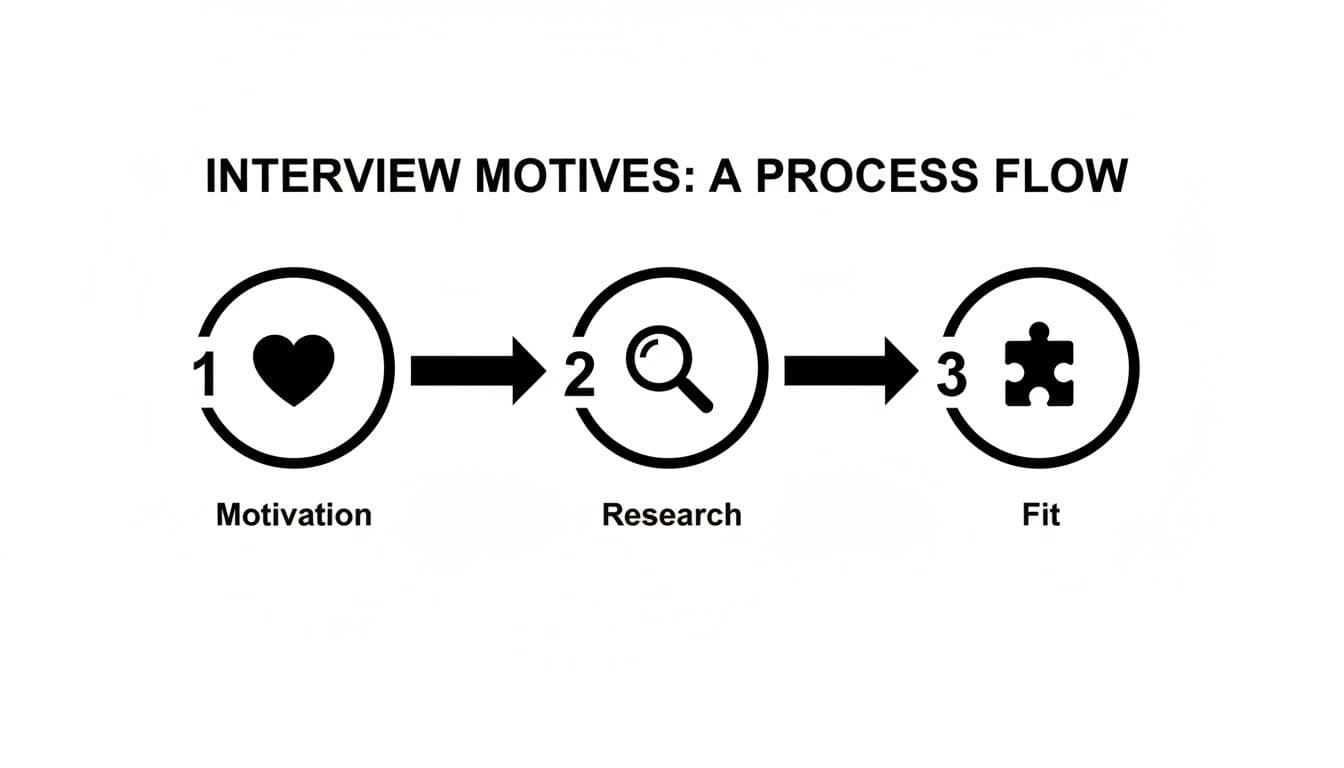
A great answer isn't just a gut feeling. It’s the result of a deliberate process—turning genuine curiosity into cold, hard proof.
Pillar One: The Firm
First up, it’s all about them. This is where you prove you’ve done your homework and didn’t just skim the “About Us” page five minutes before the call. Your mission is to show a deep, specific understanding of what makes this particular company tick.
Generic praise like "You have a great reputation" is the fastest way to lose an interviewer's interest.
You need to dig deeper for the concrete details that actually mean something to you.
- Values and Culture: Don't just say, “I love your collaborative culture.” Find a specific company value, like Amazon’s “Bias for Action,” and link it to a real story. Talk about a project where you took the initiative to solve a problem without waiting for permission.
- Recent Projects or Deals: Mention a recent product launch, a big M&A deal they just closed, or a whitepaper they published that you found insightful. Crucially, explain why it grabbed your attention and how it ties into your professional passions.
- Market Position: Show you get their place in the world. You could acknowledge a major competitor and then explain why you find this company's strategy more compelling or its niche more interesting.
This isn’t about reciting facts you memorized from their latest earnings call. It's about showing you can interpret those facts and connect them to what genuinely excites you.
Pillar Two: Your Story
The second pillar is the bridge itself. This is where you pivot from, "Here’s what I know about you," to "Here’s why that matters to me—and to you." It's your personal value proposition, tailored specifically for them.
You have to draw a direct, unmissable line between their needs and your unique skills and experiences. Don't just list your accomplishments; select specific pieces of evidence that prove you’re the solution to a problem they have.
Ask yourself these questions to build this pillar:
- Skills Alignment: Which of my core skills (financial modeling, client management, Python) directly maps to a need I’ve identified in this role or team?
- Experience Connection: What specific project from my past gave me a trial run for the exact challenges this company is facing right now?
- Career Trajectory: How is this role the logical next chapter in my career story, and why is this company the only place I want that chapter to unfold?
Your goal is to reframe your resume. It’s no longer a history of past duties; it’s a compelling argument for your future potential. You’re showing them how your entire background has been a training ground for this specific opportunity.
For example, instead of saying, "I have three years of project management experience," you make it sharp: "My experience leading the supply chain optimization project, where we cut warehousing costs by 15%, seems directly relevant to the operational efficiency challenges your consumer goods practice is focused on."
Pillar Three: The Future
The final pillar is your closing argument. It’s where you paint a picture of what you can accomplish together. You've shown you understand them (Pillar One) and how your past prepares you for this role (Pillar Two). Now, you need to show them the future.
This part of your answer proves you aren't just looking for any job; you're looking to make a real contribution and build a career here.
Your vision for the future should touch on two things:
- Your Contribution: Get specific about how you see yourself adding value, both immediately and down the road. Maybe you see a way to improve a process or want to contribute to a certain type of project. Name it.
- Your Growth: Show them you’ve thought about your own development within their company. This proves you’re in it for the long haul. You could mention a specific training program they offer or the chance to learn from a well-known expert on their team.
This is what seals the deal. It tells the interviewer you’re a forward-thinking candidate who is already invested in a shared future, which makes you a far more compelling hire than someone just looking for their next paycheck.
Tailoring Your Answer for Consulting and Finance Roles
Let's be blunt: a generic answer to "Why this company?" is an interview killer. This is especially true when you're gunning for a spot in the high-stakes worlds of consulting and finance.
In these fields, interviewers aren't just looking for another smart person. They're searching for a future partner or principal who thinks with razor-sharp precision and genuine commercial awareness. A canned, one-size-fits-all response immediately signals you lack both. When you’re sitting across from someone at a top-tier firm, your answer has to prove you’ve done the work and have a deep, nuanced understanding of their specific world. This means going far beyond surface-level compliments and weaving your personal story directly into the fabric of their business model, client work, and strategic priorities.
Cracking the Code for Consulting Interviews
For consulting roles at firms like McKinsey, Bain, BCG, or the Big 4, your answer needs to be a masterclass in structured thinking. These firms sell expertise and problem-solving, so your reasons for wanting to join them have to align perfectly with that core mission.
Simply saying you’re drawn to their "challenging work" is a classic mistake. It's vague and tells them nothing. You have to get specific and articulate which challenges you're interested in and why their particular approach to solving them resonates with you.
Here's how to sharpen your angle:
- Zero in on Practice Areas: Don't just praise the firm’s overall brand. Pinpoint a specific group—like their digital transformation practice, private equity due diligence team, or healthcare strategy unit—that genuinely aligns with your background. Then, explain why that group's work is so compelling to you.
- Reference Their Intellectual Capital: Top consulting firms are idea factories, constantly publishing research and thought leadership. Citing a specific report from the McKinsey Global Institute or an article from the BCG Henderson Institute shows you’re not just a passive applicant; you actively engage with their ideas.
- Connect to Their Problem-Solving Style: Every firm has its own flavor. Is it McKinsey's famous top-down, hypothesis-driven approach? Or Bain’s intense focus on "True North" and delivering measurable results? Acknowledge these nuances and explain why their methodology clicks with your own way of thinking. You might also want to prepare for the closely related "Why Consulting?" question to round out your story.
The data makes a strong case for this approach. In consulting interviews, a staggering 66% of offers go to candidates who tie their 'why this company' answer to tangible impact. For example, you could reference how a BCG digital initiative cut client project times by 25%. This demand for hyper-specific answers is fueling massive growth in the interview prep tool market, which is projected to jump from $1.2 billion in 2023 to $3.5 billion by 2032, largely driven by AI tools that help candidates practice making these exact connections. You can dig into the numbers yourself in Dataintelo's full report.
A powerful consulting answer is a mini-case study in itself. It presents a clear hypothesis (I am a great fit here), supports it with evidence (my skills plus your work), and concludes with the expected impact (I will deliver real value).
Think of it this way. Instead of a weak line like, "I'm interested in your tech practice," you deliver something with substance: "I was particularly drawn to your recent work in cloud strategy for financial services. My experience developing a data migration framework for a fintech startup gave me firsthand insight into the exact regulatory and operational hurdles your teams are helping clients navigate right now." See the difference?
Mastering the Narrative for Finance Roles
When you step into a finance interview—whether it's for investment banking (IB), private equity (PE), or venture capital (VC)—the entire language shifts. The conversation moves away from operational problems and centers on deals, investment theses, and market dynamics. Your "Why this company?" answer needs to sound like it belongs in a boardroom, not a classroom.
Interviewers are really testing your commercial instincts. They need to see that you get how their firm makes money and where it fits in the competitive landscape.
For Investment Banking
At a powerhouse like Goldman Sachs or J.P. Morgan, your answer must be grounded in their market position and deal flow.
- Talk About Specific Deals: Don’t be shy. Name a recent M&A advisory role or IPO they led that caught your eye. But don't just list it; have a point of view. Explain why you thought the deal was strategically brilliant or how it showcases the bank’s dominance in a particular sector.
- Highlight Their Industry Groups: Show you understand their internal structure. If you’re interviewing for their Technology, Media, and Telecom (TMT) group, your entire answer should be filtered through that TMT lens. Discuss trends in the space and why that specific bank is the ultimate platform for building a career there.
- Reference Analyst Commentary: Mentioning a senior analyst’s published take on a market trend is a sophisticated move. It proves you’re following their intellectual output and respect their market perspective.
For Private Equity and Venture Capital
On the buy-side, the focus is all on the investment strategy and the companies in their portfolio.
- Discuss Their Investment Thesis: Show them you get their unique playbook. Do they focus on distressed assets, growth equity in SaaS, or early-stage consumer tech? You need to clearly articulate why their specific investment philosophy resonates with your own analytical style.
- Analyze a Portfolio Company: This is a killer move. Pick a company in their portfolio and explain why you think it was a smart acquisition. You could say, "I've been following your investment in Company X. The way you’ve helped them scale their go-to-market strategy is a perfect example of the hands-on, value-add approach I want to be a part of."
- Acknowledge Firm Culture and Size: A mega-fund like Blackstone offers a completely different world than a smaller, sector-focused shop. Show you’ve thought about this. Maybe you prefer the broad deal exposure of a large firm, or perhaps you’re drawn to the deep operational involvement common at a smaller one. Just be ready to defend your preference.
By customizing your answer with this level of detail, you instantly elevate yourself. You stop being just another qualified applicant and start sounding like a future colleague who already speaks their language and gets what makes them win.
From Good to Great: Breaking Down Sample Answers
Seeing the theory in action is where it all clicks. Let's walk through a few high-quality sample answers for different roles to show you how this framework can transform a generic response into something truly memorable. The goal isn't to memorize a script—it's to internalize a structure that lets your authentic story and research shine through.
Think of it like editing a paper. The first draft might be okay, but the real magic happens when you know how to revise an essay from good to great. You sharpen your points, cut the fluff, and make a much stronger case. It's the same process here.

Good Answer vs Great Answer Teardown
Lots of candidates give "good" answers. They’re polite, positive, and hit the basic notes. The problem? They're completely forgettable. A "great" answer, on the other hand, is loaded with specific, research-backed details that weave a compelling narrative.
Let’s tear down the difference.
Good Answer vs Great Answer Teardown
Here's a side-by-side look at how a standard, generic answer gets elevated into something that grabs the interviewer's attention.
| Component | Generic (Good) Answer | Specific (Great) Answer |
|---|---|---|
| The Firm (Pillar 1) | "I'm interested in your firm because you have a strong reputation in the tech industry and work with impressive clients." | "I was drawn to your TMT practice, specifically your recent advisory work on the a large-cap semiconductor M&A deal. Your team's ability to navigate complex cross-border regulatory hurdles really stood out." |
| Your Story (Pillar 2) | "My background in project management and data analysis makes me a good fit for the challenges of this role." | "My experience leading a cloud migration project, where I managed a $2M budget and coordinated with three engineering teams, gave me direct exposure to the integration challenges your TMT clients are facing." |
| The Future (Pillar 3) | "I'm excited to learn from the best and contribute to your team's success." | "I believe my background in cloud infrastructure can add immediate value on post-merger integration projects, and I’m eager to deepen that expertise under the mentorship of a leader like Jane Doe in the SF office." |
See the difference? The great answer isn't just listing skills; it's connecting them directly to the firm's specific, recent work and even name-dropping a potential mentor. That’s what makes an impact.
Sample Answer for Management Consulting
Now let's look at a full-length response for a top consulting firm. Notice how it seamlessly weaves all three pillars into one cohesive story.
"There are three main reasons I'm so focused on joining this firm. First, your leadership in the digital transformation space is undeniable. I've been following your reports on AI's impact on supply chains, and the framework you published last quarter on leveraging predictive analytics is precisely the kind of forward-thinking I want to be part of."
Right away, they've established Pillar One (The Firm). It's specific, it references the firm's actual intellectual capital, and it proves they've done more than just a quick Google search.
"This connects directly to my own background. At my previous role, I led a project that used machine learning to optimize our warehouse inventory, ultimately cutting carrying costs by 18%. That experience showed me the power of data-driven strategy, but I realized I wanted to apply those skills to a broader range of complex, industry-defining problems—the kind your firm is known for solving."
This is a brilliant transition into Pillar Two (Your Story). They use a hard number to quantify their achievement and then clearly explain why they want to move into consulting. Their past work becomes the perfect training ground for this specific opportunity.
"Looking forward, I’m particularly excited by the opportunity to contribute to your Consumer Goods practice. Given the current pressures on CPG companies to digitize their operations, I believe my hands-on experience in supply chain analytics could bring a unique perspective to your client work from day one. I'm keen to build on that foundation here."
And that’s the closer. Pillar Three (The Future) shows they’ve thought about where they fit. By naming a practice area and explaining how they can add value immediately, they go from being just another applicant to a potential colleague.
Sample Answer for Investment Banking
When you're up for an investment banking role, the stakes are high. Your answer has to scream commercial awareness and a real feel for the market. Here, the emphasis shifts heavily toward deals and industry knowledge.
- Pillar 1 (The Firm): "I've been following your Healthcare group closely, and your role as the lead advisor on the recent biotech merger was particularly impressive. Your team's ability to structure a deal that satisfied both shareholder groups while navigating a tough regulatory environment highlights why you're a leader in the space."
- Pillar 2 (Your Story): "That deal resonates with my background in financial modeling for early-stage pharma companies. During my internship, I developed a valuation model for a company with a complex drug pipeline, which gave me a deep appreciation for the nuanced financial drivers in the biotech sector. I want to apply that analytical rigor to landmark deals like the ones your team executes."
- Pillar 3 (The Future): "Ultimately, I want to build a career advising innovative healthcare companies, and there's no better platform to do that than here. I’m confident my financial modeling skills can support your deal teams immediately, and I am eager to learn the art of deal execution from the best in the industry."
This answer works because it’s not about a vague "passion for finance." It's about a specific passion for this firm's work in a particular sector.
If you’re targeting a role in finance, our detailed guide on preparing for investment banking interviews dives even deeper into this. By breaking down your answer into these three pillars, you ensure you deliver a structured, compelling, and memorable response every single time.
Common Mistakes and How to Sidestep Them
Knowing what not to do is just as critical as knowing what to do. You can spend hours preparing a brilliant answer, only to have it completely derailed by a few common, easily avoidable mistakes. These slip-ups are major red flags for interviewers, often signaling a lack of genuine interest or real preparation.
Think of it this way: avoiding these pitfalls is the quality control for your answer. It’s what makes it polished and compelling, ensuring it doesn’t fall apart under a little pressure. Let’s walk through the most frequent blunders I’ve seen and, more importantly, how you can steer clear of them.

The Generic Culture Compliment
This one is probably the most common. A candidate says something like, "I was really drawn to your great company culture." It's an empty compliment because it's not backed by any proof. Honestly, you could say that about any company.
Why it’s a red flag: It screams that you haven’t done your homework to figure out what their culture actually is. Every company thinks it has a great culture; your job is to show you understand the specifics.
How to fix it:
- Get specific with their values. Reference one of their official company values. Instead of a general statement, try: "I was impressed by your commitment to 'Disagree and Commit,' because it shows a culture that values tough debate before everyone aligns to execute."
- Tie it to a personal story. Connect that value to your own experience. "In my last project, our team had to make a difficult call on a tight deadline, and embracing that same principle was the key to our success."
Focusing Only on Prestige or Pay
Another quick way to lose the interviewer is to make it all about what the company can do for you. Saying, "I want to work for the best," or "You're the top firm in the industry," comes across as self-serving and, frankly, a bit arrogant.
They already know they're a top firm. What they want to know is what you bring to the table. This is especially true in competitive fields where every single candidate is attracted to the brand name.
Your answer should be a business case for hiring you, not a wish list for your career. Focus on mutual benefit and shared goals, not just personal gain. The interviewer is assessing your potential contribution, not just your ambition.
Simply Reciting the "About Us" Page
This is an instant giveaway that your research was only skin-deep. If your answer sounds like you're reading a script pulled directly from their website or a recent press release, it shows a complete lack of original thought.
The expectation is that you go beyond the public relations copy.
Why it’s a red flag: It shows you can summarize, but you can’t synthesize. The best candidates connect the dots between the company’s public statements and their own unique perspective.
How to fix it:
- Find the "so what." For every fact you find (like "The company launched Product X"), you must ask yourself, "So what?" Why does that matter to you? How does it connect to your skills?
- Form an opinion. Don't just state facts; have a point of view. For instance, "When you launched Product X, it seemed like a brilliant strategic move into the mid-market segment, which is an area I’ve been focused on for the past two years."
- Lean on human sources. Nothing beats mentioning insights from conversations with current or former employees. It's the ultimate proof that you’ve gone the extra mile.
The hiring landscape is changing, and preparation is everything. As a case in point, recent industry polls show that 51% of firms were using AI in their hiring processes by mid-2025, a figure expected to jump to 68% by the end of the year. This shift really underscores the growing need for structured, data-driven preparation. You can find more details in the full analysis of the AI recruiting market.
Got More Questions? Let's Tackle Them.
Even with the best framework, you're bound to have some specific questions. Answering "Why this company?" isn't always straightforward, and real-world interviews can throw curveballs. Getting these details right is what separates a good answer from a great one.
Let's dig into some of the most common tricky situations I see candidates struggle with.
How Long Should My Answer Be?
Aim for the sweet spot: 90 seconds to two minutes.
That's just enough time to tell a compelling story covering your past, the firm's appeal, and your future together, without making the interviewer's eyes glaze over. It’s about being punchy and powerful, not long-winded.
The best way to get this right? Time yourself. Seriously. Run through your answer a few times with a stopwatch until it feels natural and lands right in that two-minute window.
What If I'm Interviewing With Multiple, Similar Firms?
This is the classic consultant's dilemma. You have interviews with McKinsey, Bain, and BCG all in the same week. What do you do?
Your personal story—the "You" part of the answer—can stay mostly the same. But the "Firm" and "Future" components have to be 100% unique.
For McKinsey, you might talk about their global scale and the cutting-edge research from the McKinsey Global Institute. When you walk into the BCG interview, your focus could shift to their reputation for creative, bespoke solutions and their work in digital ventures.
Key Takeaway: Never, ever recycle your answer. Interviewers can spot a generic, copy-paste response from a mile away. Do the homework to find what makes each firm distinct and weave those specific details into your story. It shows you’ve done more than just read the home page.
How Do I Answer for a Role I'm Not Truly Passionate About?
Let’s be honest, not every role is a lifelong dream. The key here is authenticity, not feigned excitement.
Don't pretend this is your ultimate passion if it isn't. Instead, find genuine points of connection. Focus on the professional value. What skills will you build? What unique experience will you gain? Is the company a leader in a specific niche you want to learn?
You can frame your answer with honesty and professional maturity. Something like: "While my long-term career goals are in a different space, I'm genuinely excited about this opportunity because your team is the best in the business at M&A analytics. For me, building that deep analytical foundation is the most important next step, and there's no better place to do it than here."
This approach works because it’s truthful and demonstrates that you're a strategic thinker who is serious about your career development.
Should I Mention People I've Spoken With at the Firm?
Yes, but do it with purpose. Name-dropping for the sake of it sounds hollow and can easily backfire.
Instead of just listing names, show how those conversations shaped your perspective. Weave what you learned from them into the fabric of your answer to give it more weight.
For example: "My interest was really solidified after speaking with Jane Doe in the TMT practice. She told me about the firm’s truly collaborative culture, especially on high-stakes projects, which is exactly the kind of environment where I do my best work."
This shows you took the initiative to connect, listened carefully, and used that insight to confirm your fit. It’s proof that you’ve done your due diligence and are making an informed decision, not just sending out résumés.
Ready to stop memorizing answers and start mastering them? Soreno provides an AI-powered platform with over 500 cases and 80 guided drills to help you perfect your story. Get instant, rubric-based feedback on everything from your structure to your filler words, and practice until your answer is unforgettable. Start your free 7-day trial today.