
Answering Interview Questions Why Consulting Your Winning Framework
Struggling with interview questions why consulting? Get our proven framework, real-world sample answers, and expert tips to land your dream consulting job.
Let's get one thing straight: when an interviewer asks, "Why consulting?" they aren't just ticking a box. They're stress-testing your motivation and your real-world understanding of the industry. They need to see a genuine connection between your personal goals and the unique, often grueling, demands of a consulting career. A generic answer about loving "problem-solving" won't cut it.
A truly powerful answer is always built on three core pillars: your drive for personal growth, your desire to create tangible professional impact, and why you see a firm-specific fit.
Decoding the "Why Consulting?" Question
When someone from McKinsey, BCG, or Bain poses this question, they're digging much deeper than your resume. What they're really after is your "why." They want to know your core motivations and whether you truly get what this job is all about—the good, the bad, and the 3 AM PowerPoint sessions. This isn't just about what you can do; it's about your commitment and self-awareness.
A compelling response proves you've done more than a quick Google search. It shows that you see consulting not as just another prestigious job, but as a deliberate and essential step in your career journey. The key is to artfully connect your past experiences to the future you want to build with their firm.
Understanding the Interviewer’s Goal
Think of this question as a filter. It's designed to weed out the candidates who are merely "consulting curious" from those who are genuinely committed. The interviewer is listening for a few specific things:
- Genuine Interest: Do you actually understand the day-to-day life of a consultant? This includes the intense hours and constant travel, not just the high-profile projects and prestige.
- Logical Reasoning: Can you tell a clear, structured story that links your skills and ambitions directly to the consulting role? Your answer itself should be a mini-case study in clear communication.
- Firm Alignment: Have you done your homework? Can you articulate exactly what makes their firm different from the one down the street? Why this firm, and why now?
The consulting industry continues to be a magnet for top talent, and for good reason. With the global market projected to hit a staggering US$1.32 trillion by 2029, firms are more discerning than ever. They can afford to be picky, and they’re looking for candidates who are all in.
A great response is a story, not a list. It should weave together your ambition for accelerated learning, your desire to create tangible client impact, and your specific reasons for choosing that firm.
Before we dive deeper, it's helpful to see how these components work together.
The Three Pillars of a Strong 'Why Consulting' Answer
This table breaks down the essential elements that every strong answer should contain. Think of it as your framework for building a response that is both authentic and strategic.
| Pillar | What It Demonstrates | Example Talking Point |
|---|---|---|
| Personal Growth | Ambition for rapid learning, skill development, and exposure to diverse challenges. | "I'm drawn to the steep learning curve and the opportunity to develop a general manager's toolkit by working across various industries early in my career." |
| Professional Impact | A drive to solve complex problems and deliver measurable, real-world results for clients. | "I want to move beyond theoretical analysis and be on the ground, working with teams to implement changes that directly improve a company's performance." |
| Firm-Specific Fit | A clear, well-researched understanding of the firm's culture, values, and unique strengths. | "I was particularly impressed by your firm's focus on digital transformation in the retail sector, which aligns perfectly with my background in e-commerce analytics." |
By hitting all three pillars, you show the interviewer that you've thought deeply about your career and see their firm as the ideal place to make it happen.
While we’re focusing on this crucial question, don’t forget that it’s part of a much larger conversation. It’s always a good idea to have a few other tough questions prepped. You can find some excellent tips for tackling other challenging interview questions to make sure you're ready for anything. And for a complete roadmap, check out our full guide on how to break into consulting.
How to Build Your "Why Consulting?" Answer Framework
A generic answer to "Why consulting?" will get you a generic rejection. It's one of the most common interview questions, and you have to nail it. The best answers aren't just a list of reasons; they're personal stories. To get there, you need a simple framework to turn your raw experiences into a narrative that sticks. I like to think of it in three parts: your Spark, your Evidence, and your Future.
Your Spark is your origin story. What was the specific moment, project, or conversation that first got you genuinely interested in consulting? This isn't about some childhood dream. It's about a real turning point that made you think, "Wow, that's what I want to do."
Maybe you were neck-deep in a case study for a strategy class and loved the process of untangling a complex business problem. Or perhaps you saw a mentor at an internship solve a massive operational bottleneck, and it just clicked. Pinpointing that moment makes your motivation feel real and memorable to the interviewer.
Gather Your Evidence
Once you've found your Spark, you need to back it up with Evidence. This is where you connect the dots between your past experiences—from jobs, school, or even side projects—and the skills a consultant actually needs. Your job is to show them you have the raw materials, not just tell them.
Start by making a quick inventory of your biggest achievements. Then, map them to core consulting skills.
- Analytical Rigor: When did you have to make sense of a messy dataset to find a crucial insight? How did you approach the problem and make sure your conclusion was solid?
- Client Communication: Think about a time you had to explain something complicated to people who weren't experts. How did you get the message across clearly without dumbing it down?
- Team Collaboration: What's a good example of working on a diverse team to hit a goal, especially if you ran into disagreements along the way?
This isn't just resume-building; these are the specific stories you'll pull from during the interview to prove your points. This kind of structured thinking reflects the very things that make consulting attractive in the first place: accelerated growth, real impact, and alignment with your personal goals.
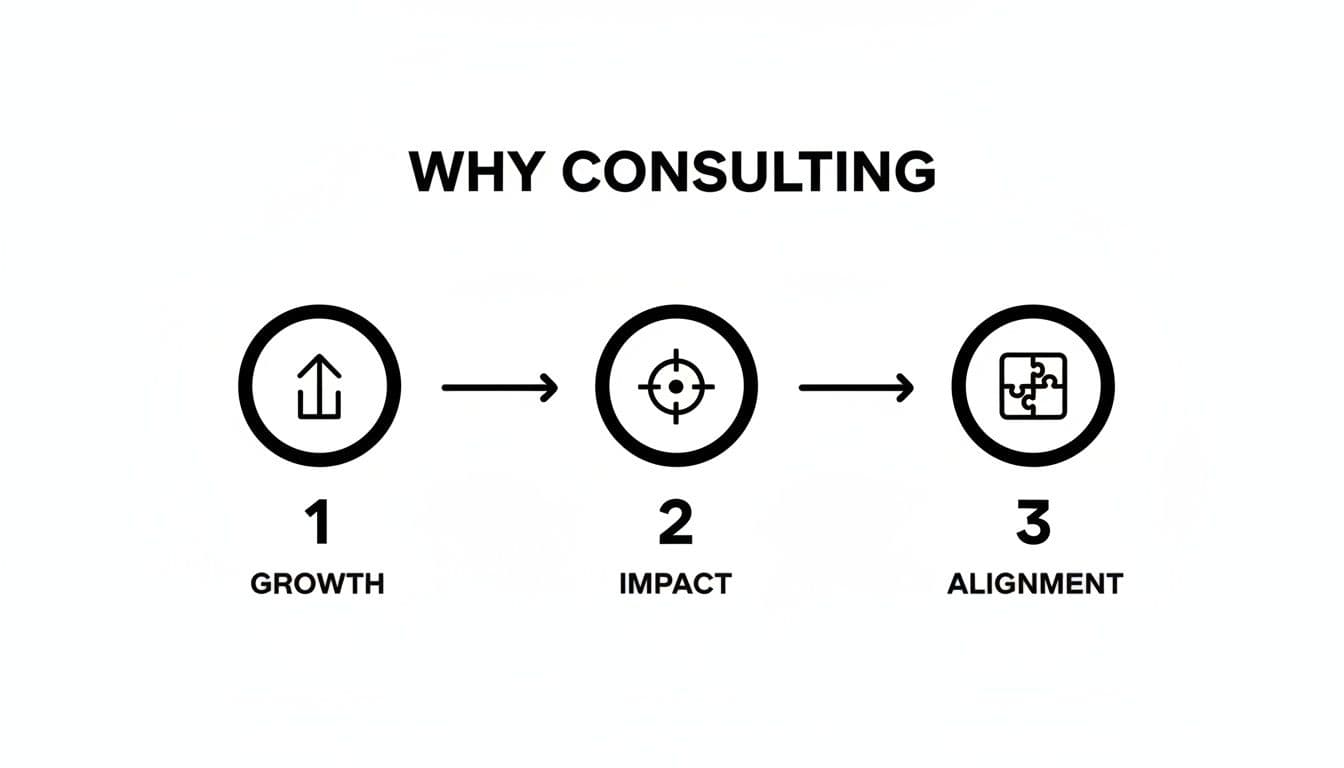
These pillars—growth, impact, and alignment—are the benefits you're seeking. Your answer should show the interviewer how your journey naturally leads to them.
Map Out Your Future
Finally, you have to talk about your Future. This is what ties everything together. You need to explain why getting a job at this specific firm is the obvious and necessary next step for you. It can't just be a two-year stop on the way to something else. Saying you want to "learn a lot" is a classic non-answer that won't get you far.
Your answer needs to position consulting as the catalyst for your career. It's the bridge from where you've been to where you're going, and you have to convince the interviewer you've actually thought about the journey.
Show them you've done your homework on what this experience will lead to. For example, you might explain how working on supply chain projects at their firm will give you the direct experience you need to eventually lead operations at a major CPG company. This turns a simple statement of interest into a powerful story about your ambition.
This knack for storytelling is a core consulting skill, and it's tested constantly. For more on this, check out our guide on the top 10 consulting behavioral interview questions.
Tailoring Your Answer to Top Consulting Firms

A one-size-fits-all answer to “Why consulting?” is the fastest way to get lost in the crowd. Top firms aren't just looking for someone who wants to be a consultant; they’re trying to find out why you want to be a consultant at their firm. If you can't articulate that, you've missed the entire point of the question.
This is where you show them you’ve done your homework. Every firm, from the MBB giants to the niche boutiques, has its own flavor—a unique culture, industry focus, and way of working. Simply saying you admire their "prestige" or "smart people" is a classic rookie mistake. They’ve heard it a thousand times.
Deconstruct the Firm's DNA
To craft a standout answer, you have to get under the hood of the company. A great response connects your personal journey and aspirations directly to the firm’s unique identity. This means digging much deeper than their homepage.
Focus your research on these key areas:
- Signature Work and Industry Spikes: Is the firm a powerhouse in a particular sector, like Bain in private equity or Oliver Wyman in financial services? Are they famous for massive public sector projects or for their cutting-edge digital strategy work? Pinpoint what they're known for.
- Culture and Vibe: What’s it actually like to work there? Is it a deeply collaborative, "one-firm" culture like McKinsey, or is it more entrepreneurial and office-centric? You can find clues in alumni stories, podcasts, and how they describe their own people.
- Intellectual Capital: What are they thinking and writing about? Reading a recent report from the McKinsey Global Institute or the BCG Henderson Institute gives you a direct line into their current intellectual agenda. Mentioning a specific article you found compelling is an incredibly powerful move.
For example, if you're interviewing with McKinsey, your story should probably connect to their focus on driving huge, CEO-level impact. They want to see that you think big and are drawn to that scale. It's also smart to get familiar with their interview style; understanding common McKinsey PEI questions reveals their deep focus on personal impact and leadership.
Firm-Specific Answer Customization
The way you angle your answer should shift depending on the firm's profile. A story that resonates at a large strategy house might fall flat at a boutique specialist. The table below breaks down how to tailor your narrative for different types of consulting firms.
| Firm Type | Key Focus | Example Answer Angle |
|---|---|---|
| MBB (McKinsey, BCG, Bain) | Breadth, CEO-level strategy, massive impact, thought leadership. | "I'm drawn to the sheer scale of the challenges you solve. The chance to work on problems that define industries, alongside experts from your global institutes, is an unparalleled learning opportunity." |
| Big 4 (Deloitte, PwC, EY, KPMG) | Implementation, operational excellence, digital transformation, deep industry verticals. | "Beyond strategy, I'm passionate about making things happen. Your firm's reputation for end-to-end implementation and digital execution is what excites me most—turning plans into real-world results." |
| Boutique/Specialist Firm | Deep expertise in a specific niche (e.g., pricing, healthcare, retail). | "While I've enjoyed my broad exposure to X, I've realized my true passion is [Firm's Specialty]. The opportunity to become a deep expert and learn from the recognized leaders in this specific field is exactly what I'm looking for." |
Ultimately, your goal is to show the interviewer that you see what makes their firm unique and that you specifically chose them for those reasons.
Weave It All into Your Story
Once you’ve gathered your intel, the final step is to weave it seamlessly into your personal narrative. It can’t sound like you're just reciting a company brochure back to them.
Don't just compliment the firm—connect with it. Show how their specific work, values, or culture is the ideal environment for your skills and ambitions to flourish. This transforms a generic answer into a compelling pitch for mutual fit.
For instance, instead of saying, "I'm impressed by your work in sustainability," get specific.
Try something like this: "I was fascinated by your recent whitepaper on circular supply chains. My project reducing packaging waste for a local retailer gave me a small taste of that challenge, and the chance to tackle those issues at the scale you do is exactly why I'm so excited about this specific opportunity."
This level of detail proves you aren’t just looking for any consulting job. You’re looking for this one.
Sample Answers for Different Candidate Profiles

So, how does this all look in practice? The best "Why consulting?" answers are never one-size-fits-all. They're deeply personal and reflect your unique journey. While the core ingredients—personal growth, professional impact, and firm fit—stay the same, the evidence you bring to the table will look completely different depending on where you're coming from.
Think of these examples as blueprints, not scripts. Pay close attention to how each one weaves a specific past experience (the "spark") into the day-to-day realities of consulting and the specific culture of the firm they're talking to. Use them as inspiration to find and shape your own authentic story.
The University Student
If you're still in university, your job is to show that your academic and extracurricular life has been a training ground for business. You don't have years of corporate wins to point to, and that's okay. Your proof points will come from challenging projects, leadership roles, and internships where you demonstrated raw consulting potential.
Example Answer for a University Student:
"My interest in consulting really sparked during a final-year strategy project. My team was tasked with helping a local retail chain figure out why foot traffic was tanking. We spent weeks buried in their financials and market data, but the real breakthrough happened when we got out of the classroom and just started talking to their customers. It turned out their marketing message and the actual in-store experience were worlds apart.
Presenting our final recommendation—a revamped loyalty program tied into local community events—and seeing the management team's reaction was a huge moment for me. I loved that whole process: the deep analysis, the human element of understanding the customer, and then creating a practical solution.
That’s what pulls me toward consulting. I want to be on the steepest learning curve possible, moving from academic case studies to making a real-world impact across different industries. I'm especially excited by [Firm Name]'s reputation in the consumer goods space. I’ve been following your work on post-pandemic retail strategy, and the chance to contribute to that kind of work right out of school is exactly what I'm looking for."
Why This Works:
- It tells a story: The retail project is a concrete and relatable "spark."
- It shows, not just tells: The story naturally highlights skills like analysis, problem-solving, and communication.
- It's specific to the firm: Mentioning their retail practice shows they've done their homework beyond a quick glance at the website.
The Career Changer
When you're changing careers, your industry expertise is your superpower. The goal isn't to pretend your past doesn't exist; it's to reframe it. You need to show how your unique background gives you a perspective that a traditional candidate just won't have. You're not starting over—you're building on a specialized foundation to solve bigger, more strategic problems.
Example Answer for a Career Changer (from Marketing):
"After five years in digital marketing, I found that my favorite part of the job wasn't just running campaigns, but figuring out why they weren't performing. At my last company, we were facing a 15% drop in customer retention. While everyone else was focused on tweaking ad spend, I dove into our CRM data and pinpointed the drop-off to the moments right after a customer's second purchase.
I pulled together a small team from sales and product to completely overhaul our customer onboarding, which ended up lifting retention by 10% within six months. That was my 'aha' moment. I loved getting out of my marketing silo to tackle a systemic business problem.
I want to pivot into consulting to do exactly that, but on a bigger scale. I want to apply that same diagnostic, cross-functional approach to a wider set of business challenges. I'm particularly drawn to [Firm Name] because of your well-known focus on customer strategy. The opportunity to merge my hands-on marketing experience with your firm's strategic toolkit feels like the perfect next step for me."
The Advanced Degree Candidate (PhD/MD)
If you're coming from a PhD or MD program, you bring incredible analytical horsepower. Your challenge is to bridge the gap between deep academic research and the fast-paced, results-driven world of consulting. You need to frame your years of research not as a narrow specialization, but as an elite training program in structured, hypothesis-driven problem-solving.
Example Answer for a PhD Candidate (in Biology):
"My PhD was a four-year crash course in managing ambiguity. I was developing a novel protein sequencing technique, and the real challenge wasn't just the science—it was managing a complex project with a shoestring budget, constantly shifting hypotheses, and messy data. I had to learn how to break down an enormous, unstructured problem into testable steps, pivot quickly when an experiment failed, and explain highly technical results to a non-specialist review board.
That process of imposing structure on uncertainty is what drew me to consulting. I want to apply that same rigorous, hypothesis-driven mindset to business problems that affect entire industries.
I'm especially interested in [Firm Name]'s life sciences practice. I've read a few of your white papers on R&D productivity in pharma, and I think my hands-on lab experience gives me a ground-level perspective on the very operational challenges you help clients solve. I’m excited by the chance to help bridge that gap between the lab and the boardroom."
The Experienced Hire
For an experienced hire, the conversation shifts from potential to proven impact. Your story needs to be about more than just solving a problem. It has to demonstrate leadership, an ability to manage complex stakeholder relationships, and a track record of driving real, lasting change within an organization.
Example Answer for an Experienced Hire (from Operations):
"In my role as an operations manager, I led a project to reduce waste in our manufacturing process. We hit our initial 5% reduction target pretty quickly, but I had a gut feeling we were leaving a lot on the table. So, I spent a month on the factory floor, working side-by-side with the line crews. It became clear that our bonus system was actually punishing people for being more efficient.
By redesigning the incentive structure based on their feedback and implementing a few of their workflow ideas, we cut waste by another 12% and saw a huge boost in team morale. That experience was a turning point. It showed me that I thrive on not just finding the right analytical answer, but on managing the human side of change to make sure a solution actually works in the real world.
I want to move into consulting to bring that leadership and implementation experience to a bigger stage. [Firm Name]'s deep expertise in operational excellence and change management is a perfect match. I'm confident that my background in driving tangible results from the ground up would let me deliver value for your clients from day one."
Common Mistakes and How to Avoid Them
Knowing what to say is only half the battle. Knowing what not to say is often what separates a candidate who gets an offer from one who gets a polite rejection email.
Even the most polished candidate can stumble by making a few common mistakes. You've worked hard to craft your story, so let's make sure you don't accidentally undermine it by falling into these traps.
Sounding Generic or Uninspired
This is, by far, the most common mistake. Interviewers have heard "I love problem-solving" and "I want to work with smart people" thousands of times. These phrases are basically empty calories; they sound good but offer no real substance and tell the interviewer nothing unique about you.
A vague answer is a huge red flag. It suggests you haven't really thought through why you want this specific career or why you're sitting in front of them at this particular firm.
- What they usually hear: "I'm drawn to consulting because I enjoy solving complex problems and I'm looking for a fast-paced environment where I can learn a lot."
- What they want to hear: "My experience optimizing a supply chain process for a local non-profit showed me how much I enjoy untangling complex operational issues. The opportunity to apply that analytical process to challenges at the scale your firm tackles is what truly excites me."
See the difference? The second example is grounded in a real, tangible experience. It's credible, memorable, and proves your interest instead of just stating it.
Vague compliments about "impact" or "learning" are interview-speak for "I haven't done my research." Root your answer in a personal story to demonstrate genuine interest, not just ambition.
Focusing on Exit Opportunities
This is another killer mistake. Never, ever frame consulting as a stepping stone to your "real" career. Yes, everyone knows consulting opens a lot of doors, but the person interviewing you is hiring for their team. They want people who are genuinely committed to the job, not someone who's already planning their exit.
Avoid any language that makes it sound like you view the firm as a two-year MBA alternative before you go launch a startup or jump to private equity. It comes off as transactional and shows a lack of respect for the immense investment the firm is about to make in you.
- Don't say this: "Consulting seems like the best way to build a strong business toolkit before I eventually move into a leadership role in the tech industry."
- Try this instead: "I see consulting as the ideal environment to deepen my expertise in tech strategy. I'm excited by the chance to advise multiple industry leaders on their biggest challenges, which I believe is the most effective way to build the skills needed for a long-term career focused on technological innovation."
It’s a subtle but crucial shift. The better answer focuses on the work itself and frames your long-term goals as a natural extension of the value you'll both gain and provide at the firm. Your answer to "Why consulting?" must show commitment, plain and simple.
Navigating Follow-Up Questions
Your first answer to "Why consulting?" is just the opening act. The real test often comes next.
A sharp interviewer won't just nod and move on; they'll probe. They want to see if your story has substance or if it's just a well-rehearsed script. Nailing these follow-ups is what separates a good candidate from a great one.
Expect to be challenged. They might question your assumptions, dig into the details of an experience you mentioned, or ask you about the less-than-glamorous realities of the job. This is where you prove your answer is authentic and that you can think on your feet.
How Long Should My Answer Be?
You're aiming for the sweet spot: between 90 seconds and two minutes. That’s enough time to hit your key points without losing the interviewer's attention. Anything longer and you risk rambling.
Think of it as a mini-story with a beginning (what sparked your interest), a middle (the experiences that back it up), and an end (why this firm is the next logical step). Time yourself when you practice. The goal is to sound natural and confident, not like you're racing against a clock.
What If I Lack Direct Business Experience?
Don't panic. Consulting firms are hunting for transferable skills, not just a specific resume. They crave sharp analytical minds, structured problem-solvers, and excellent communicators.
If you come from academia, the arts, or another non-traditional field, your job is to connect the dots for them. Talk about that complex dataset you analyzed for your thesis or how you presented nuanced findings to a tough audience. Frame your past through a business lens.
Your goal is to translate your unique background into the language of consulting. An academic research project becomes a deep-dive analysis; leading a volunteer group becomes a lesson in stakeholder management.
Remember, acing this one question is part of a bigger picture. Success also depends on skillfully navigating the broader interview process.
Should I Mention Specific People or Projects?
Absolutely, but be strategic about it. Dropping the name of a project or a piece of the firm's thought leadership shows you’ve done your homework. The trick is to make it relevant to you.
Don't just name-drop. Connect it to your own story. For instance, you could say, "I was particularly drawn to your work on [Project Name] because it directly relates to my passion for supply chain optimization in the renewable energy sector." This shows genuine curiosity and builds a much stronger case for why you belong at their firm.
Ready to stop memorizing frameworks and start mastering the interview? Soreno provides an AI-powered mock interviewer trained by MBB experts to give you unlimited, on-demand practice. Get instant, rubric-based feedback on everything from your structure to your filler words and ace your next interview. Try it free at https://soreno.ai.