
What Is Strategic Analysis (what is strategic analysis): A Clear Guide
Discover what is strategic analysis with practical frameworks, real-world examples, and actionable tips to sharpen decision-making and strategy.
At its core, strategic analysis is the disciplined process of figuring out where a company stands in the world. It’s about taking a hard, honest look at the business itself—its strengths and weaknesses—and then turning an equally critical eye to the outside world to spot opportunities and threats.
This isn't about guesswork or going with your gut. It’s the foundational homework that lets leaders make smart, calculated decisions about the future.

What Is Strategic Analysis, Really?
Imagine you're the captain of a ship about to set sail on a long journey. You wouldn't just point the bow toward the horizon and hope for the best, right? Of course not.
First, you'd inspect your own vessel from top to bottom—the engine's health, the hull's integrity, the crew's skill level. That's your internal analysis. It’s about knowing exactly what you’re working with, good and bad.
Then, you’d scan the external environment. You'd study the weather forecasts, ocean currents, and any potential dangers like storm systems or rival trade routes. This is your external analysis, where you identify helpful currents (opportunities) and potential disasters (threats).
Only by combining both perspectives can you plot the best course. Strategic analysis is that exact process for a business. It’s a cornerstone discipline within the broader business subject area.
For anyone preparing for consulting or finance interviews, boiling down this concept into its core questions is key. Here’s a quick way to frame it.
Strategic Analysis At a Glance
| The Question | What It Means in Strategic Analysis |
|---|---|
| Where are we now? | Assessing the company's current performance, market share, and competitive position. |
| What's happening around us? | Analyzing market trends, competitor actions, and the macroeconomic environment. |
| What are we good at (and not so good at)? | Identifying the organization's core competencies, unique assets, and internal weaknesses. |
| Where could we go? | Pinpointing potential opportunities for growth, new markets, or strategic pivots. |
| What could stop us? | Recognizing external threats, from new competitors to regulatory changes. |
Thinking through these five questions provides a solid, 360-degree view that forms the bedrock of any solid strategy.
The Core Purpose of Strategic Analysis
Ultimately, the goal is to get a crystal-clear, objective picture of a business today so you can chart a winning path for tomorrow. This process is essential for a few big reasons:
- Drives Informed Decisions: It swaps gut feelings for hard evidence, ensuring resources like time and money are spent where they’ll have the most impact.
- Creates Competitive Advantage: It uncovers how a company can use its unique strengths to outmaneuver the competition.
- Enables Proactive Planning: It helps a business get ahead of market changes and prepare for what’s next, rather than just reacting to crises.
- Builds Stakeholder Alignment: It creates a shared, fact-based understanding of the company's situation, getting everyone from the C-suite to the front lines pulling in the same direction.
Strategic analysis isn't just about coming up with a plan; it's about doing the diagnostic work to make sure the plan is the right one. It's the diagnosis before the prescription.
This kind of rigorous thinking has become absolutely vital in business. The proof is in the numbers. The corporate strategy market is projected to hit USD 27.14 billion in 2026, growing at a compound annual growth rate of 9.8%. That's a clear signal that organizations see sharp strategic analysis as essential for survival and growth.
Analyzing From the Inside Out and Outside In
A winning strategy is built on a clear, brutally honest understanding of two distinct worlds: what’s happening inside your company and what’s happening outside of it. Think about it. A phenomenal product launched into a dying market is just as doomed as a weak product in a booming one. This is why any solid strategic analysis has to look through a dual lens, both inward and outward.
This process is really a two-part diagnosis. Internal analysis is like a mechanic getting under the hood. It’s a deep dive into your organization’s resources, unique skills, company culture, and how well things actually run day-to-day. You’re asking the tough questions: What are we genuinely better at than anyone else? Where are the hidden weaknesses that are secretly holding us back?
At the same time, external analysis is like a ship’s captain scanning the horizon for storms and clear skies. This means methodically tracking everything outside your walls—market trends, what competitors are up to, new technology, and the overall economic forecast. By bringing these two viewpoints together, you can spot the massive blind spots that can sink an otherwise successful company.
Looking Under the Hood with Internal Analysis
Internal analysis is all about taking inventory of your company’s specific strengths and weaknesses. The goal is to get a realistic picture of the assets you have to work with and the liabilities you need to shore up. Ultimately, you're hunting for what gives you a real, lasting edge over the competition.
When you're doing an internal review, you'll want to zoom in on a few key areas:
- Financial Resources: How healthy is your cash flow? What are your profit margins? How easily can you get your hands on capital if you need it?
- Physical Assets: Take stock of your factories, equipment, and real estate. Are they a competitive advantage or an anchor?
- Human Capital: Look at the skills, experience, and motivation of your team. This is often a company's most valuable—and overlooked—asset.
- Brand and Reputation: How strong is your brand? Are your customers fiercely loyal? What do people say about you when you're not in the room?
- Processes and Systems: How efficient are your supply chain, sales process, and internal workflows? This is where small leaks can sink big ships.
A classic mistake is confusing a feature with a strength. A true strength is something your company excels at that customers value and that competitors can't easily copy.
For example, a software company might have a team of world-class AI engineers—a clear human capital strength. This lets them create predictive features that their rivals simply can't build, giving them a durable competitive advantage. It’s not just about listing what you have; it’s about understanding what makes you powerful in the market.
Scanning the Horizon with External Analysis
While looking inward is about what you can control, external analysis is about making sense of the chaotic world you can’t control. It’s the art of spotting the opportunities and threats brewing in your market and beyond. Being good at this means you can anticipate change instead of just reacting to it.
A thorough external analysis should give you critical intel on several fronts:
- Market Dynamics: This covers the market's size, its growth rate, and new customer behaviors. Are people’s tastes shifting away from what you sell?
- Competitive Landscape: This means identifying your main rivals, dissecting their strategies, and tracking their market share. Who are the new players that could disrupt everything?
- Technological Shifts: Are there new inventions on the horizon that could make your business model obsolete—or create massive new opportunities?
- Regulatory and Economic Factors: You have to keep an eye on changing laws, trade policies, and economic cycles that could seriously impact your business.
Imagine a luxury car company. They have a powerful brand and incredible engineering (internal strengths), but they completely ignore the massive consumer and regulatory push toward electric vehicles (an external threat). No matter how perfect their gasoline-powered cars are, that failure to adapt to the outside world will eventually catch up to them. By linking the view from under the hood with the view from the crow's nest, strategic analysis gives you the complete map you need to navigate the future.
Building Your Strategic Analysis Toolkit
So, you understand the difference between looking inside a company and looking at the world around it. That's the first step. Now, it's time to load up your toolkit with the exact frameworks that consultants and strategists use to crack complex business problems.
These aren't just abstract theories from a textbook; they are the practical instruments you'll use to structure your thinking, especially when the clock is ticking in a case interview.
Think of it like being a mechanic. You wouldn't use a sledgehammer to fix a delicate sensor, and you wouldn't use a tiny screwdriver to change a tire. Every tool has a specific job. The real trick is knowing which one to grab and when—that’s what separates the pros from the amateurs.
This is the fundamental map for your toolkit, breaking down analysis into the two core perspectives you'll always need to consider.
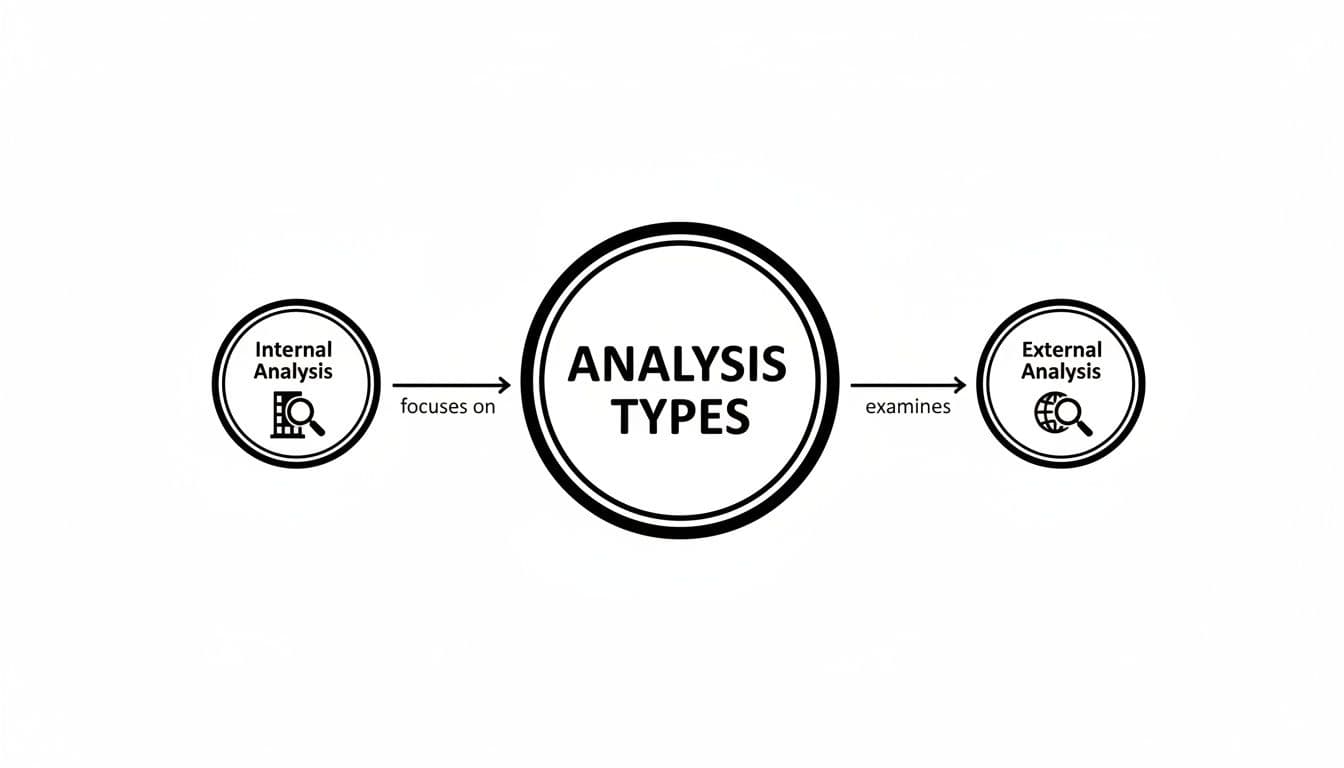
As the diagram shows, a truly comprehensive strategy demands that you look both inward at the company's own operations and outward at the market it competes in.
The Essential Frameworks for Any Analyst
Let's break down the powerhouse tools you absolutely need to master. Each one gives you a unique lens for viewing a business challenge, providing a structured path to form a hypothesis and build a rock-solid argument.
-
SWOT Analysis: This is your go-to for a fast, high-level snapshot of a company’s situation. It cleanly organizes your thoughts into four buckets: Strengths (internal, good), Weaknesses (internal, bad), Opportunities (external, good), and Threats (external, bad). It’s perfect for structuring your initial thoughts in a case. For a deeper dive, our guide on how to perform a SWOT analysis is a great resource.
-
Porter's Five Forces: When the goal is to figure out how tough an industry is and how profitable it can be, this is the framework you pull out. It guides you in sizing up the competitive pressure by looking at five key forces: the threat of new companies entering, the negotiating power of customers, the leverage of suppliers, the risk of substitute products, and the intensity of the rivalry among current players. It's a must-use for market entry or investment decisions.
-
PESTLE Analysis: This tool makes you zoom way out to see the big picture. It prompts you to analyze the macro-environmental factors that could sideswipe a business, standing for Political, Economic, Social, Technological, Legal, and Environmental. Use this when you're assessing a new market's potential or trying to spot long-term risks that aren't immediately obvious.
The real skill isn't just memorizing the frameworks. It's about instinctively choosing the right one for the question at hand and then blending insights from multiple tools to create one cohesive, compelling recommendation.
This kind of analytical thinking is what the top consulting firms are built on. The value of this work is massive; the US strategic consulting industry alone is projected to grow at a CAGR of 6.8% from 2025 to 2033. This growth is driven by firms like McKinsey & Company and Boston Consulting Group, who serve clients where razor-sharp strategic analysis is the difference between winning and losing.
Choosing the Right Tool for the Job
In a high-pressure interview, you don't have time to run every analysis under the sun. You need to diagnose the problem quickly and pick the most relevant framework. The table below is designed to be a quick reference guide to help you make that split-second decision.
Choosing the Right Strategic Analysis Framework
When you're handed a case study, your first move is to identify the core question. Is it about internal capabilities, industry competition, or the broader market? This table will help you map the problem to the perfect framework.
| Framework | Primary Use Case | Focus Area (Internal/External) | Best For Analyzing... |
|---|---|---|---|
| SWOT | Quick situational assessment | Internal & External | A company's overall strategic position at a single point in time. |
| Porter's Five Forces | Industry profitability and attractiveness | External | The competitive dynamics of an industry before entering or investing. |
| PESTLE | Macro-environmental scanning | External | Long-term market trends, risks, and opportunities on a national or global scale. |
| VRIO | Internal resource evaluation | Internal | Whether a company's resources can provide a sustainable competitive advantage. |
This table makes it clear: if the case is about a company's unique assets, VRIO is your best bet. If it's about whether to enter the airline industry, Porter's Five Forces is the obvious choice.
The VRIO framework, by the way, is a powerful tool for looking inward. It helps you inspect a company’s resources and capabilities to see if they are truly a source of lasting advantage by asking if they are Valuable, Rare, costly to Imitate, and if the company is Organized to capture their value.
As you build your expertise, remember that modern analysis doesn't stop with these classics. To get a real edge, you can integrate advanced tools that give you deeper insights. For example, understanding AI-powered sales intelligence can show you how technology is pushing the boundaries of strategic analysis.
By mastering these frameworks, you're not just learning to answer questions—you're learning to think like a seasoned strategist.
A 5-Step Process for Flawless Analysis
Knowing the frameworks is one thing. Actually executing a structured analysis under pressure is a completely different ballgame. Top-tier consultants and strategists don’t just wing it; they lean on a repeatable, logical process to break down any business problem they face.
This five-step methodology is more than just a checklist. It's a proven roadmap that turns those abstract analytical tools into an engine for generating clear, defensible recommendations. This is the exact kind of thinking you’ll need to show in a high-stakes case interview—it's not just about finding the right answer, but showing how you think.
Step 1: Define the Core Problem
First things first, you have to know exactly what problem you're trying to solve. This is the most critical step. A vague goal like "increase profits" is a recipe for a messy, unfocused analysis.
You need to dig deeper. Ask clarifying questions to narrow the scope and set a clear, measurable goal. Is the problem coming from falling revenues or runaway costs? Is a specific product line tanking, or is a certain geographic region underperforming?
Think of a well-defined problem as your North Star for the entire project. In a case interview, this is your moment to take control. Spend the first few minutes asking pointed questions to lock down the objective, scope, and any constraints. It shows you know how to cut through the noise and focus on what really matters.
Step 2: Gather the Right Data
Once you have a clear objective, it's time to gather your evidence. After all, your analysis is only as strong as the data you build it on. This means pulling information from two key areas:
- Internal Data: This is your inside look—think financial statements, sales reports, operational KPIs, and even feedback from employees. It gives you a baseline for the company's performance and capabilities.
- External Data: This is the view from the outside. You'll look at market research reports, competitor deep dives, industry trends, and customer surveys to understand the world the business is playing in.
You can't just look at one or the other. This dual approach ensures you get a 360-degree view, combining hard performance numbers with the realities of the market.
Step 3: Synthesize Insights Using Frameworks
Here's where the magic happens. Raw data is just noise; frameworks like SWOT, Porter’s Five Forces, or PESTLE are the tools you use to organize that data into meaningful insights. Don't treat them like a checklist. Use them as a lens to spot patterns, connect the dots, and find the root causes of the problem.
For example, after researching a new market, you might run a Porter’s Five Forces analysis and realize that high supplier power and intense rivalry make it a brutal place to compete. The framework didn't just give you the answer—it gave you the structure to find it hiding in the data.
The goal here is synthesis, not summary. You’re connecting internal weaknesses to external threats, or internal strengths to market opportunities, to build a cohesive story.
Step 4: Develop Strategic Options
With your insights in hand, you can start brainstorming potential solutions. The key here is to come up with a range of options that are both creative and practical. Don't just latch onto the first idea that pops into your head. A sharp analyst will always present several distinct paths the company could take.
For each option, you need to map out the potential upsides, risks, and what it would take to pull it off. This proves you’ve thought through the consequences. For a struggling retailer, your options might look something like this:
- Invest heavily in E-commerce: Big growth potential, but it's going to require a huge capital investment.
- Optimize the store footprint: This is a lower-risk move that could boost short-term profits, but it might just be a band-aid on a bigger problem.
- Launch a private label brand: A great way to improve margins, but it comes with significant brand and execution risk.
Step 5: Deliver an Actionable Recommendation
Finally, you have to make a call. Pick the most compelling strategic option and build a powerful, evidence-based case for it. Don't just say, "We should do option one." You have to defend it. Explain why it's better than the other choices, pulling in key data points and insights from your analysis.
Your final recommendation needs to be specific, measurable, and actionable. Wrap it up with a clear summary of what to do, the impact you expect it to have, and what the very next steps should be. In an interview, delivering this final piece with confidence and clarity is what seals the deal and truly showcases your strategic horsepower.
Applying Strategic Analysis in the Real World
Frameworks are great on paper, but their real value shines when you’re facing a high-stakes, real-world business problem. When you move from the classroom to the boardroom, strategic analysis is the engine that actually drives billion-dollar decisions in consulting and finance.
To really get what strategic analysis is, you have to see it in action. So, let’s walk through two detailed scenarios that are a dead ringer for the challenges you’d face in these fields. These examples will connect the dots between the frameworks and the structured thinking needed to deliver a winning recommendation.
Consulting Case: A Legacy Retailer at a Crossroads
Picture this: you’re a consultant hired by "Brick & Mortar Co.," a department store chain that’s been around for a century. For decades, they were unstoppable. Now, they're bleeding market share to slick e-commerce players. Profits are tanking, and the board is panicking.
The problem is staring them in the face: how can the company adapt to the digital age to survive and grow?
Your first move is to look at the problem from two different angles.
- Looking Inward (SWOT/VRIO): You quickly find that Brick & Mortar Co. has some serious assets. Their brand name is trusted, they own prime real estate in major cities, and they have a loyal, older customer base. But the weaknesses are just as stark: their supply chain is ancient, the website is a clunky mess, and the company culture fights change at every turn.
- Looking Outward (PESTLE/Porter's Five Forces): The world outside is not friendly. The biggest threat is the unstoppable shift to online shopping, driven by consumers who demand convenience. New, niche e-commerce sites pop up constantly, making the rivalry intense. But there’s a silver lining—a growing desire for unique, in-person "experiences" that online stores just can't offer.
When you put it all together, a clear path starts to form. Trying to out-Amazon Amazon is a losing battle. They're just not equipped for it.
The better move? Pivot. The recommendation is to transform their stores from boring retail spaces into immersive brand experience centers. At the same time, they need to overhaul their e-commerce operation, but specifically to serve their existing loyal customers better, not to compete with the giants.
Finance Case: Evaluating a Private Equity Acquisition
Now, switch hats. You're an associate at a private equity firm, and you’re looking at acquiring "SaaS-ify," a mid-sized software company. The firm smells potential, but before they write a nine-figure check, they need to know if it’s a smart bet.
The core question is: does SaaS-ify have a real, sustainable competitive advantage and enough room to grow to deliver the returns we need?
Once again, you need a structured analysis to build the case.
- Looking Inward (VRIO): You dig into SaaS-ify’s assets. Their proprietary code is definitely Valuable and Rare. But after a closer look, you realize it wouldn't be that hard for a well-funded competitor to Imitate. The company is Organized to make money, sure, but its competitive moat isn't as deep as it first appeared.
- Looking Outward (Porter’s Five Forces): The market itself is attractive. Suppliers don't have much power, and there aren't many real substitutes for what they do. However, the threat of new entrants is high because it’s a relatively easy market to get into, and rivalry is heating up as bigger tech companies start sniffing around.
This analysis paints a much more complicated picture. SaaS-ify is a decent company, but it doesn't have the knockout, durable competitive advantage that would justify a sky-high price.
The final recommendation to the investment committee? Pass on the deal—at least at this price. Keep an eye on them, and maybe circle back if the valuation becomes more reasonable. For anyone looking to get better at this type of analysis, exploring a detailed market entry strategy framework is a great next step.
As you can see, strategic analysis isn't just some academic exercise. It’s a practical, repeatable process for making sense of chaos and finding a clear path forward.
It’s a skill that companies are willing to pay top dollar for. The strategic consulting market, which is built entirely on this expertise, hit USD 77.53 billion globally in 2026 and is expected to climb to USD 95.49 billion by 2031. That number alone tells you how much value the business world places on this skill. You can read the full research on the strategic consulting market to see just how fast it's growing.
How to Sharpen Your Strategic Thinking for Interviews
Knowing the frameworks is one thing, but actually using them to nail a high-pressure interview? That’s a completely different ballgame. The good news is that strategic thinking is a muscle. Like any muscle, you can strengthen it with the right training.
Think of the following habits as your personal workout plan. This isn't about cramming the night before; it's about building a new way of seeing the business world so that when the pressure is on, your analysis is sharp, clear, and instinctive.
Adopt an Analyst Mindset
First things first: change how you consume business news. Don’t just be a passive reader. You need to start actively deconstructing what you see.
When a major company makes a big move—say, acquiring a smaller startup or launching an entirely new product—don't just stop at the headline. Push yourself to ask the same questions a consultant would:
- Why this move? What’s the real driver here? Are they playing offense by using an internal strength, or defense against a market threat?
- What's next? How will this ripple through the industry? What will competitors do? How will customers react?
- What could go wrong? What are the top three risks they’re taking on with this decision?
A fantastic way to get inside the heads of top executives is to read the annual shareholder letters from companies you admire. These documents are an absolute masterclass in strategic communication, laying out the "why" behind the numbers and painting a picture of the company's long-term vision.
Deconstruct a Sample Case Prompt
Okay, let's put this analyst mindset into practice with a classic case prompt. This is where you connect the dots between theory and a structured, compelling answer.
Case Prompt: A major airline has seen growth stall in its highly profitable business travel segment. What are their strategic options?
You can use the five-step process we covered to organize your thoughts in real-time. You’d kick things off by clearly defining the problem (stagnating revenue in a core segment). Next, you’d probe for more information, asking smart questions about customer trends, what competitors are up to, and any recent market shifts.
From there, you’d lean on your frameworks to pull your insights together and brainstorm a few solid options—maybe launching a new premium loyalty tier, forging direct partnerships with large corporations, or totally revamping the in-flight business class experience. Your final recommendation would be a single, confident choice, backed up by the facts you’ve gathered. For more real-world examples, check out our deep dive into strategic thinking interview questions.
Ultimately, it’s not enough to just know what strategic analysis is. You have to show an interviewer you can do it. They want to see how you think, not just hear what you know.
This is where dedicated practice platforms can make a huge difference, helping you get those reps in.
An environment like the one above lets you tackle countless cases with an AI interviewer. It's a space where you can practice without fear of judgment, refining your approach until your analytical skills are sharp enough to land you the job.
Got Questions About Strategic Analysis? Let's Dig In.
Even after you've got the basics down, a few common questions always seem to pop up, especially when you're gearing up for a high-stakes interview. Let’s tackle some of the most frequent ones to clear up any confusion and get you ready for the real thing.
These aren't just academic questions; they get to the heart of what separates a good analyst from a great one and how to prove your strategic chops when it matters most.
Strategic Analysis vs. Strategic Planning: What's the Real Difference?
It’s easy to get these two mixed up, but the distinction is critical. Think of it like a doctor's visit.
Strategic analysis is the diagnosis. It’s all about figuring out what’s going on right now. You’re using tools like SWOT or Porter’s Five Forces to take a hard look at the company and its surroundings, answering the question, "Where are we, and how did we get here?"
Strategic planning, on the other hand, is the treatment plan. It takes everything you learned from the diagnosis and builds a concrete roadmap for the future. This is where you answer, "Okay, now where are we going, and what specific steps will get us there?"
A solid strategic analysis is the bedrock of any good plan. You can't write a prescription without a diagnosis, and you can't build a winning strategy on guesswork.
How Do I Show I'm a Strategic Thinker in a Behavioral Interview?
This is a big one. The trick is to elevate your answers beyond just listing your accomplishments. The STAR method (Situation, Task, Action, Result) is your starting point, but you need to add a layer of strategic thinking on top.
Don't just say what you did. Explain why you did it and how it connected to the bigger picture.
For example, instead of, "I built a new sales forecast," try framing it strategically: "The team's goal was to find our most profitable new market. My task was to figure out which direction to point them. I built a forecast that modeled three different customer segments, and my analysis showed one segment had a 30% higher lifetime value. That insight convinced leadership to shift our entire marketing budget, and it paid off." See the difference? You connected your action to a major business outcome.
What Are the Big Trends in Strategic Analysis Right Now?
The field is always evolving, but two major shifts are impossible to ignore.
First, the game has been changed by big data and predictive analytics. We've moved beyond just looking at what happened last quarter. Now, companies can analyze massive datasets to spot market shifts and predict customer behavior before they even happen. It’s about being proactive, not just reactive.
Second, ESG (Environmental, Social, and Governance) factors are no longer a footnote—they're a headline. A modern analysis that ignores a company's sustainability, social impact, and governance practices is simply incomplete. These issues now directly affect brand value, investor decisions, and long-term survival, making them essential risks and opportunities to dissect.
Ready to stop just reading and start doing? Soreno gives you an AI-powered platform with over 500 case studies and 80 guided drills to build real-world analytical muscle. Practice against an MBB-trained AI interviewer, get immediate, actionable feedback, and see your skills improve in real-time. Start your free trial at https://soreno.ai.