
The Investor's Playbook for venture capital due diligence
Master venture capital due diligence with a practical investor guide: checklists, red flags, and proven steps to secure better deals.

Venture capital due diligence is the exhaustive, often grueling, investigation a firm undertakes before cutting a check to a startup. It's how investors move beyond a slick pitch deck to get to the truth of the business. The entire point is to verify the founders' claims, dig into the risks, and build real conviction around the company's potential to deliver massive returns.
Building Your Due Diligence Framework
Before you even think about opening a data room, you have to get your head in the right space. Due diligence isn't a checklist. It's an investigation. Your job is to systematically de-risk the investment and pressure-test every single assumption the founders have made about their vision.
Think of yourself as a detective, piecing together a puzzle from financial models, customer interviews, and late-night reference calls. It’s about asking the tough questions—the ones founders might not even be asking themselves. Mastering this analytical mindset is the first, and most important, step. If you want to sharpen these skills, our guide on structured problem-solving techniques is a great place to start.
The Key Stages of Investigation
The diligence process isn't a single event; it's a funnel that gets narrower and deeper at each stage. It often takes more than 20 hours of intense work for a single deal. It kicks off with a quick initial screen to weed out companies that are a clear mismatch for the fund's thesis. If a startup makes it through, it moves into a full-blown business deep-dive, and finally, a meticulous legal and financial review before any papers are signed. You can explore a great breakdown of venture capital due diligence best practices on Affinity.co.
This flowchart gives you a bird's-eye view of how the process unfolds, from that first look to the final legal checks.
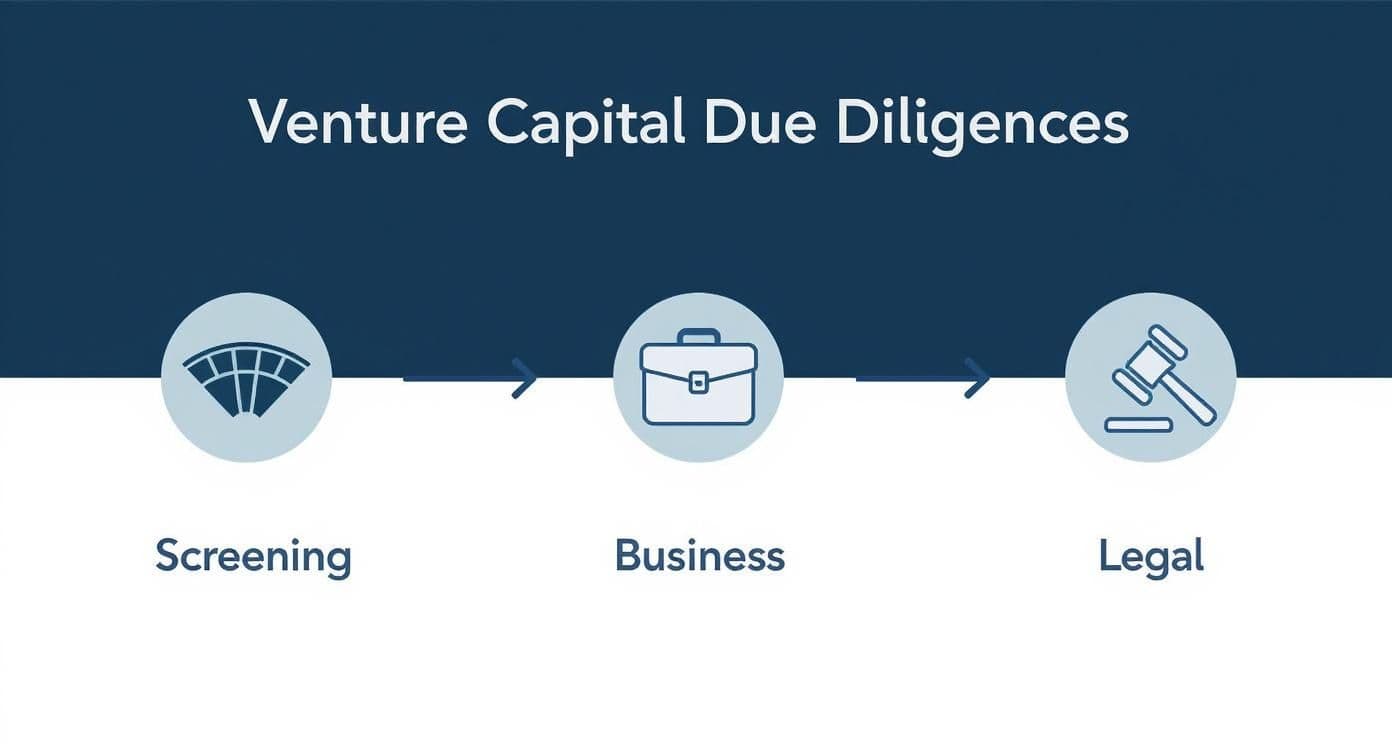
As you can see, it's all about efficiency. The goal is to allocate your most precious resource—time—to the opportunities with the highest potential.
At its heart, due diligence is the bridge between a compelling story and a credible investment. It's where the narrative of a pitch deck meets the reality of the business.
Establishing the Foundational Pillars
To tackle this complexity without getting lost, you need a solid framework. I find it most effective to anchor the analysis around five core pillars. Think of this as your strategic map for the entire investigation, ensuring you cover every critical angle of risk and opportunity.
Here's a simple table that breaks down the five pillars of our due diligence framework. Each pillar represents a core area of the business you'll need to scrutinize, along with the fundamental question you're trying to answer.
The Five Pillars of VC Due Diligence
| Pillar | Primary Question to Answer |
|---|---|
| Team | Do the founders have the resilience, vision, and skills to win? |
| Market | Is this market big enough, and can the company build a moat? |
| Product | Does this product solve a real pain point that customers will pay for? |
| Financials | Are the unit economics sound and is the business model scalable? |
| Legal | Is the company's corporate structure clean and defensible? |
By methodically working your way through each of these areas, you create a repeatable system for spotting red flags and, just as importantly, uncovering hidden strengths. This structured approach is what turns a potentially overwhelming task into a manageable process that builds the conviction needed to invest.
Understanding the Market and the Moat
A brilliant team with a game-changing product can still crash and burn if the market simply isn’t there. That's why a huge part of any real due diligence process is looking past the flashy Total Addressable Market (TAM) slides in the pitch deck to get to the truth of the opportunity. Your job is to independently figure out how big this market really is, what's making it grow, and what, if anything, makes this startup truly defensible.

Founders almost always present a top-down market analysis. You've seen it before: "The global SaaS market is worth $200 billion, and if we just capture 1%, we’ll be a unicorn." It's a nice thought, but for serious diligence, it’s far too simplistic. It's on you to build a credible, bottom-up model from scratch.
A classic investor mistake is confusing a cool feature for a massive market opportunity. Getting the market sizing right is how you tell the difference between a small pond and a vast ocean.
Building from the bottom-up means getting specific. You need to identify the exact number of potential customers and multiply that by a realistic annual contract value (ACV). For instance, if a startup is selling compliance software to mid-sized American banks, your math would look something like this: (Number of US banks with 500-2,000 employees) x (Estimated annual price per bank). This approach gives you a much more concrete and defensible market size.
Sizing Up the Market Opportunity
To build a solid bottom-up analysis, you have to hunt for specific data points that either prove or disprove the startup's claims. This isn't just a numbers game; it’s about grasping the fundamental forces at play. I find it’s best to frame this as a series of sharp questions.
Key Questions for Market Sizing
- Who is the ideal customer? Be precise. How many of them actually exist? You can find this out using industry reports, government data, and even tools like LinkedIn Sales Navigator to get a reliable headcount.
- What's a realistic price? See what competitors charge for something that delivers similar value. Is the startup trying to be the premium choice or the budget-friendly option? This directly impacts your ACV assumption.
- What's pushing the market forward? Is there a regulatory tailwind, like new data privacy laws, forcing companies to buy a solution? Or maybe a tech shift, like the migration to cloud infrastructure, is opening up new doors.
- What could slow things down? Don't forget the headwinds. Think about things like market saturation, industry consolidation, or even changing behaviors that make the problem less painful for customers.
Answering these helps you construct a financial model that’s grounded in reality, not just wishful thinking. For a deeper look at this, our guide on choosing the right market entry framework offers more tools for structuring this kind of analysis.
Identifying the Competitive Moat
Once you're confident you have a handle on the market size, the next crucial step is to map out the competitive landscape. A company can be in a massive market and still get crushed if it has no real, defensible advantage. This advantage—the "moat"—is what will protect its market share and profits down the line.
It's absolutely critical to look beyond the direct competitors listed in the pitch deck. More often than not, the biggest threats are indirect. For a project management tool, the direct competitors are obviously folks like Asana or Trello. But the indirect competition? That could be spreadsheets, email, or even a custom-built internal tool at a big company.
Mapping out this entire ecosystem helps you pinpoint the startup's unique value. Why would a customer choose this product over every other option, including the powerful option of doing nothing at all? A strong moat can come from a few different places.
Here are the most common types of moats we look for in venture:
- Network Effects: The product gets more valuable as more people use it. Think of marketplaces like Airbnb or professional networks like LinkedIn. A new player can't just show up and replicate that massive, interconnected user base overnight.
- High Switching Costs: It’s a huge pain for customers to leave. This is common in enterprise software where a company has built its entire workflow around a tool. Ripping it out would be a massive, expensive headache.
- Intellectual Property (IP): This is your classic defensibility—patents, proprietary algorithms, or unique datasets that are incredibly hard for anyone else to replicate. This is the bread and butter for many deep tech and biotech startups.
- Brand: A powerful brand builds trust and loyalty, making it the default choice. While potent, a strong brand is usually a result of success, not a cause of it, and it's less defensible in the very early days.
Ultimately, your goal here is to decide if the startup's moat is wide and deep enough to generate and sustain venture-scale returns. Without a truly defensible position, even a promising company in a great market will have a tough time fending off the competition long enough to win.
Putting the Product and Technology to the Test
Alright, once you’ve got a handle on the market size, it’s time to zoom in on what the company is actually building. This is where the rubber meets the road. You’re moving past the pitch deck and the flashy marketing claims to find out if this product is the real deal.
We're looking for tangible proof that people genuinely love this thing. Forget vanity metrics like total downloads or sign-ups—those are easy to fake and often meaningless. The real story is in the product's stickiness. Do people keep coming back? Is it becoming part of their daily routine? High churn is a massive red flag, telling you the product is more of a "nice-to-have" than a "must-have."
Get on the Phone with Customers
Data will only get you so far. The most powerful insights—the ones that build true conviction—come from talking to the people who use the product every single day. Customer reference calls are absolutely non-negotiable.
Your mission here is to get brutally honest feedback. Don't just ask them what they like; you need to dig for the frustrations. It’s a bit counterintuitive, but when a customer cares enough to passionately complain about a missing feature, it's often a sign they're deeply invested and can't imagine their workflow without it.
Here are a few questions I’ve found that cut through the fluff:
- "If this product vanished tomorrow, what would you do?" This reveals if it's a mission-critical tool or just a minor convenience they could easily replace.
- "What’s the one thing that drives you crazy about it?" This uncovers unmet needs and often points directly to gaps in the product roadmap.
- "Have you looked at [Competitor X]? What made you stick with this?" This is a direct gut-check on the product's competitive moat from a user’s perspective.
- "How would you feel if the price doubled next year?" A blunt question, for sure, but it’s the fastest way to gauge how much value they’re really getting.
These conversations add the qualitative color that spreadsheets and charts will never give you. They help you understand the why behind the numbers.
A Look Under the Hood at the Tech Stack
A product that users love is fantastic, but it needs to be built on a foundation that can actually handle massive growth. Now it's time to peek under the hood at the technology. You don't have to be a coder, but you need to know enough to ask smart questions about scalability, security, and technical debt.
Is the architecture modern and built to scale, or is it a tangled mess of legacy code that will buckle under pressure? A startup saddled with significant technical debt—the shortcuts and quick fixes that will eventually need to be reworked—is a huge risk. They might be forced into a costly and time-consuming rewrite right when they should be hitting their growth stride, and that can kill a company.
For a VC, a product that delights users but can’t scale is a ticking time bomb. The technology must be as robust as the value proposition it delivers.
The intensity of this technical review has really ramped up over the past few years. By 2025, diligence processes have become way more rigorous, especially as sectors like deep tech and AI now account for over 20% of VC interest. This means investors are doing much deeper dives into a company's IP portfolio, its ability to scale complex technology, and even the resilience of its supply chain. For more on this, check out these evolving VC due diligence trends on Kruze Consulting. In today’s world, especially with these kinds of companies, scrutinizing the core patents and IP is no longer optional.
Ultimately, you’re trying to answer two fundamental questions. First, does this product solve a real, burning problem for its customers today? And second, is the technology built to handle the rocket-ship growth you’re hoping for? A clear "yes" to both is a very powerful signal.
Unpacking the Financials and Business Model
A visionary founder and a massive market are great starting points, but the numbers have to tell a story of sustainable growth. Financial due diligence is where you get your hands dirty, moving past the big-picture narrative to dissect the startup's economic engine. We're trying to see if this thing is actually built for the kind of returns VCs need.
This isn't just about checking for profitability. For an early-stage company, that's often a long way off. It's about understanding the core mechanics of how the business makes—and keeps—money.

Sure, the income statement, balance sheet, and cash flow statement give you the historical view. But the real gold for a startup is hidden in the unit economics. This is how you find out if the fundamental business model is sound before the company pours millions into scaling it.
Cracking the Code of Unit Economics
Unit economics boil the entire business down to its simplest components: one customer, one transaction, one product. The goal is to answer a single, brutal question: does the company make more money from a customer than it costs to get them in the door?
The two metrics that matter most here are Customer Acquisition Cost (CAC) and Lifetime Value (LTV).
- Customer Acquisition Cost (CAC): This is your total sales and marketing spend for a period, divided by the number of new customers you landed. It’s the price tag for acquiring a single customer. Simple as that.
- Lifetime Value (LTV): This is a projection of the total revenue you can expect from a single customer over the entire time they stay with you. It’s the reward you get for that initial acquisition cost.
A healthy LTV-to-CAC ratio is the heartbeat of a scalable business. In the SaaS world, a ratio of 3:1 or better is the gold standard. It’s a clear signal that for every dollar you spend getting a customer, you're getting at least three dollars back over time.
A fantastic product with a broken business model is just a charity. Strong unit economics are the non-negotiable proof that the company has a viable path to profitability and scale.
For SaaS companies, VCs zero in on a specific set of metrics to gauge the health and scalability of the business model. Understanding these is key to any financial analysis.
Key Financial Metrics for SaaS Startups
| Metric | What It Measures | Healthy Benchmark |
|---|---|---|
| LTV/CAC Ratio | The relationship between customer lifetime value and the cost to acquire them. | 3x or higher. Less than 3x suggests an unsustainable model. |
| CAC Payback Period | The number of months it takes to earn back the cost of acquiring a customer. | Under 12 months. A shorter payback period means faster, more efficient growth. |
| Monthly Recurring Revenue (MRR) | The predictable revenue a company can expect to receive every month. | Strong, consistent month-over-month growth (10-20%+) is a key indicator. |
| Net Revenue Retention (NRR) | Measures revenue from existing customers, including upsells, downgrades, and churn. | Over 100%. This means the company is growing even without adding new customers. |
| Gross Margin | The percentage of revenue left after accounting for the cost of goods sold (COGS). | 75-80% or higher for software companies, indicating high scalability. |
These benchmarks aren't absolute rules, but they provide a powerful framework for evaluating whether a SaaS company's financial engine is firing on all cylinders.
Stress-Testing the Financial Projections
Every founder's pitch deck features the classic "hockey stick" growth chart. It’s practically mandatory. Your job is to treat those projections with a healthy dose of professional skepticism. You need to pull the forecast apart and really pressure-test the assumptions holding it up.
Don't just look at the final revenue number; dig into the drivers. Is that growth coming from hiring more salespeople? Ramping up marketing spend? Expanding into Europe? Each of those assumptions has its own risks and costs.
For example, if their model assumes 20% month-over-month growth in new customers, you need to ask how. Which marketing channel is supposed to deliver that? Is the projected CAC for that channel realistic, or is it based on early, best-case-scenario data?
A great exercise is to build your own quick-and-dirty model using more conservative inputs. What happens to the company's cash runway if CAC is 30% higher than they think? What if churn doubles from 1% to 2%? This kind of sensitivity analysis quickly reveals how fragile the plan is and which variables will make or break the company.
Demystifying the Capitalization Table
The capitalization table, or cap table, is the official scorecard of ownership. It’s a spreadsheet that lists every security the company has ever issued—common stock, preferred stock, options, warrants—and exactly who owns what.
A clean, well-organized cap table shows discipline. A messy one is a huge red flag.
When you're reviewing a cap table, you're looking for a few specific things:
- Founder Equity: Do the founders still own a meaningful chunk of the company? If they've been diluted down to a tiny percentage, their motivation can take a serious hit.
- Dead Equity: This is equity held by former employees or co-founders who are no longer contributing. Too much dead equity can be a drag on the company and a headache for future investors.
- Option Pool: Is there a big enough unallocated option pool to attract the A-players they'll need to hire? A tiny pool signals the founders aren't thinking ahead about how to build a world-class team.
Getting deep into the financials, unit economics, and cap table gives you a clear, data-driven picture of the company's true health. It's how you confirm that the compelling story you heard in the pitch is actually backed by a business that can deliver.
Evaluating the Founders and Team Dynamics
While market sizing and financial models give you the hard numbers, the most critical part of due diligence, especially for early-stage deals, is all about the people. You're not just buying into a product; you’re backing a specific group of individuals to steer the ship through years of uncertainty, stress, and brutal competition.
I've seen it time and again: an A+ team can pivot a mediocre idea into a home run, while a B-level team can drive a brilliant concept straight into the ground.
This is where the process becomes less about spreadsheets and more about psychology. Your job is to get a real read on the founders' resilience, their coachability, and their raw hunger. It’s time to look past the polished pitch deck and see how they actually operate when things get tough.
Assessing Founder-Market Fit
The first thing I look for is strong founder-market fit. It boils down to one simple question: Why is this specific person the one to solve this particular problem?
The best founders often have a deep, personal connection to the pain point they're addressing. Maybe they lived it themselves. For instance, a founder who spent a decade as a logistics manager and is now building supply chain software has an earned insight that no outsider could replicate. They know the industry jargon, the hidden frustrations, and who the real players are. That firsthand experience is a massive, almost unfair, advantage.
In early-stage venture, you're betting on the jockey, not just the horse. A team's ability to execute, learn, and persevere is the single greatest predictor of long-term success.
Getting to the heart of this requires digging deep in your conversations. Ask them for their origin story—not the rehearsed version from their pitch, but the real, nitty-gritty frustrations that sparked the whole idea. You’re searching for a genuine, almost obsessive connection to the problem. It’s also incredibly valuable to analyze their leadership strengths and weaknesses to see how their personal style will hold up against the startup's coming challenges.
Conducting Meaningful Reference Checks
Reference checks are one of the most powerful tools in your diligence toolkit, but most people do them wrong. Never, ever rely solely on the list of names the founder gives you. Of course, you should call those people, but the real insights come from "back-channel" references.
These are the former colleagues, managers, or even co-founders you find on your own through LinkedIn or mutual connections. People are always more candid when they haven’t been prepped by the founder beforehand.
Once you get someone on the phone, don’t waste time with generic questions. You need to ask questions that pull out specific stories and examples.
Try these:
- "Can you tell me about a time you saw them handle a major setback? What was their process?" This gets right at their resilience and problem-solving skills under fire.
- "What's one piece of tough feedback you gave them, and how did they take it?" This is a direct test of their coachability and ego.
- "In what kind of environment have you seen them do their absolute best work?" This helps you figure out if their strengths match the chaotic reality of a startup.
- "Who on your team would be most—and least—excited to work with them again? Why?" This is a fantastic way to uncover potential red flags around their working style or interpersonal skills.
These off-list calls give you an unfiltered look at a founder’s character, work ethic, and leadership ability. A glowing review from a hand-picked reference is table stakes. Candid, nuanced feedback from a former colleague you found yourself? That’s pure gold.
Navigating the Legal and Regulatory Maze
Legal due diligence is your final, critical backstop before any capital is committed. While your firm's lawyers will dive into the nitty-gritty, your role as an investor is to grasp the core legal risks and spot potential deal-breakers long before the final documents are drawn up. This is where you confirm the company's corporate hygiene is in order, that they actually own their intellectual property, and that no regulatory boogeyman is hiding in the closet.
Think of it as checking the foundation of a house. If there are cracks in the corporate structure or ownership, everything else you've gotten excited about—the product, the team, the market—is built on shaky ground. A messy cap table, for instance, isn't just a spreadsheet error; it often points to founder disputes or broken promises that can explode into lawsuits down the line.
Core Areas of Legal Review
The legal review really zeroes in on a few critical areas. These are the places where you'll either get a clean bill of health or uncover a fatal flaw that kills the deal. You're hunting for anything that could jeopardize the company's assets or, by extension, your investment.
Here's what that typically involves:
- Corporate Formation and Governance: Are the company’s incorporation documents, bylaws, and board minutes all buttoned up? You'd be surprised how many startups have sloppy paperwork that requires a major cleanup.
- Capitalization Table: Get a magnifying glass out for the cap table. Look for accuracy, unvested shares from founders who have already left ("dead equity"), or weird, non-standard terms from previous financing rounds.
- Intellectual Property (IP): This is a big one. You need to confirm that every piece of IP developed by founders and employees has been formally and legally assigned to the company. Missing IP assignment agreements are a common and very serious red flag.
- Key Contracts: Go through the major customer agreements, supplier contracts, and leases. You're specifically looking for change-of-control clauses or other unfavorable terms that could hamstring growth after you invest.
- Employment and Contractor Agreements: Make sure every single employee and contractor has signed the right agreements, especially those containing confidentiality and IP assignment clauses.
Legal diligence isn't just about avoiding lawsuits. It's about making sure the asset you're buying is exactly what you think it is—clean, unencumbered, and owned lock, stock, and barrel by the company.
The Growing Importance of Regulatory Scrutiny
In hot sectors like fintech, health tech, and AI, regulatory compliance has moved from a boring afterthought to a primary business risk. A startup’s very existence can hinge on its ability to navigate a maze of rules around data privacy (like GDPR or CCPA), financial regulations, or FDA approvals.
Getting this wrong can be catastrophic. Imagine a fintech startup with a brilliant product that completely ignores anti-money laundering (AML) laws. That's not a small mistake; it's an existential threat. As an investor, a key part of your venture capital due diligence is pressure-testing the team’s understanding of these rules. Do they get it, or are they flying blind?
Interestingly, the rigor of this diligence isn't always constant. Research from the National Bureau of Economic Research shows that in "hotter" markets or when investors are slammed, the depth of diligence tends to drop. This rush often leads to higher volatility in investment performance because hidden risks get overlooked. You can check out the full study about how diligence intensity impacts VC deals on nber.org.
This is a powerful reminder to stay disciplined, even when a deal feels urgent. A thorough legal and regulatory check is what protects you from completely preventable disasters.
Answering Your Due Diligence Questions
When you're honing your venture capital due diligence skills, the same questions tend to pop up. Having straight answers from people who've been in the trenches can make a huge difference in building your own process. Let's dig into a few of the most common ones I hear.
How Long Does This Whole Process Take?
The honest answer? It depends. I’ve seen deals close in a frantic week and others stretch out for months.
Generally, the pace is set by the stage and the competition. An early-stage deal with multiple term sheets on the table will move at lightning speed. A later-stage investment, on the other hand, requires a much deeper, more methodical dive into years of financial history and complex legal paperwork.
As a general benchmark, plan for 3-6 weeks for a standard seed or Series A round.
The biggest red flag I ever see isn't a wonky financial model or a scary competitor—it's a founder who isn't transparent. If a team is cagey, disorganized, or evasive during diligence, that tells you exactly how they'll act when real problems arise down the road.
How Is Technology Changing the Game?
Technology is making diligence faster and smarter, but it hasn't replaced the human element. We're now using sophisticated tools to handle the heavy lifting.
AI platforms can scan hundreds of legal documents in minutes, flagging non-standard clauses that would have taken a junior lawyer days to find. Other tools can scrape the web to analyze customer sentiment or help automate financial modeling. This frees up crucial time for what really matters: talking to customers, doing deep reference checks on the founders, and thinking strategically about the market.