
Guide: profitability framework case interview Masterclass
Master the profitability framework case interview with practical steps, real-world examples, and expert tips to ace your consulting interviews.
The profitability framework is your bread and butter for case interviews. It’s the go-to structure for tackling one of the most common questions you'll face: "Our company's profits are down. Why, and what should we do?"
At its core, this framework helps you dissect a company’s financial health by breaking profit down into its two fundamental parts: Revenue and Costs. This simple but powerful approach is the first and most critical tool you need to master.
Why Profitability Cases Are a Consulting Interview Staple
Profitability problems aren't just an interview gimmick; they're a direct reflection of what consultants do every day. When a client brings in a firm like McKinsey, BCG, or Bain, it’s often because something is wrong with their bottom line. They need a sharp, structured thinker to figure out what’s broken and how to fix it. This is why the profitability case is the ultimate test of your business sense.
The entire analysis hinges on one basic equation: Profit = Revenue – Costs. But don't be fooled by its simplicity. The real skill is using this equation as a roadmap to systematically investigate a business. Your job isn’t to just recite the formula but to use it to ask the right questions and dig into the right areas.
The Consultant's Mindset
Think of yourself as a doctor. A client saying, "Our profits are down," is like a patient complaining, "I don't feel well." A good doctor doesn't just guess or hand out random medicine. They ask a series of targeted questions to diagnose the underlying cause. Is it a sudden fever (a revenue problem)? Or a chronic cough (a cost problem)? The framework is your diagnostic toolkit.
A typical case breakdown using this framework looks something like this:
- Structure the Problem: Start by laying out your plan. Break profit into revenue and costs, creating a MECE (Mutually Exclusive, Collectively Exhaustive) tree to guide your analysis.
- Drill into Revenue: This is where you investigate things like price per unit, the number of units sold, shifts in customer segments, changes in the product mix, or performance across different regions.
- Analyze the Costs: Next, you turn to the other side of the equation. You'll examine both fixed costs (like rent, salaries, and overhead) and variable costs (like raw materials, labor, and shipping).
- Synthesize and Recommend: Once you've isolated the root cause—say, a spike in raw material costs—you need to pull it all together and propose a clear, actionable solution backed by your analysis.
A Cornerstone of Consulting Interviews
There's a reason this framework is so heavily emphasized. It’s the foundational tool in a consultant’s arsenal, with an adoption rate of over 90% at top firms. In fact, internal training data shows that roughly 35-40% of all first-round case questions are, at their heart, profitability problems. Knowing this framework isn't optional; it's essential for getting an offer.
The ability to quickly structure a profitability problem demonstrates more than just analytical skill; it shows an interviewer that you can think like a consultant—logically, efficiently, and under pressure. It's about turning a vague business problem into a solvable equation.
For anyone looking at roles like a Business Value Consultant, this kind of structured financial diagnosis is the core of the job.
Ultimately, every case is a test run for the real thing. You can learn more about the mechanics in our guide on what is a case interview. Nailing the profitability framework proves you’re ready for the complex business challenges you'll face from day one.
To help you get a clearer picture, here is a quick overview of how the profitability framework breaks down.
Profitability Framework at a Glance
This table summarizes the main components of the framework and the kinds of questions you should be asking at each stage of your analysis.
| Component | Key Objective | Sample Questions to Ask |
|---|---|---|
| Revenue | Identify what has changed with the company's income streams. | "Have our prices changed recently?" "Are we selling fewer units?" "Has our product mix or customer segment mix shifted?" |
| Costs | Pinpoint any increases or unusual changes in the company's expenses. | "Have our fixed costs, like rent or salaries, gone up?" "What about our variable costs per unit, like raw materials?" |
| Synthesis | Combine findings from both sides to form a cohesive recommendation. | "Based on the drop in volume and steady costs, what external market factors could be at play?" |
Think of this table not as a script, but as a mental checklist to ensure you’re covering all your bases before you jump to a conclusion.
Building a MECE Structure Under Pressure
The first two minutes of your case interview can make or break you. This is where you lay the groundwork for your entire analysis. A strong, logical structure signals to your interviewer that you're a clear, methodical thinker who can handle complexity. The goal here is to build a Mutually Exclusive, Collectively Exhaustive (MECE) framework that becomes your roadmap, ensuring you cover every possibility without getting lost in the weeds.
A common mistake is to just state the obvious: Profit = Revenue - Costs. While technically correct, it’s just the starting line. Top candidates immediately add layers of depth, showing they understand the actual levers a business can pull. Your job isn't to recite a formula but to tailor it to the specific company and problem staring you in the face.
This diagram gives a great high-level view of how a profitability analysis flows, from that initial structuring all the way to your final recommendation.
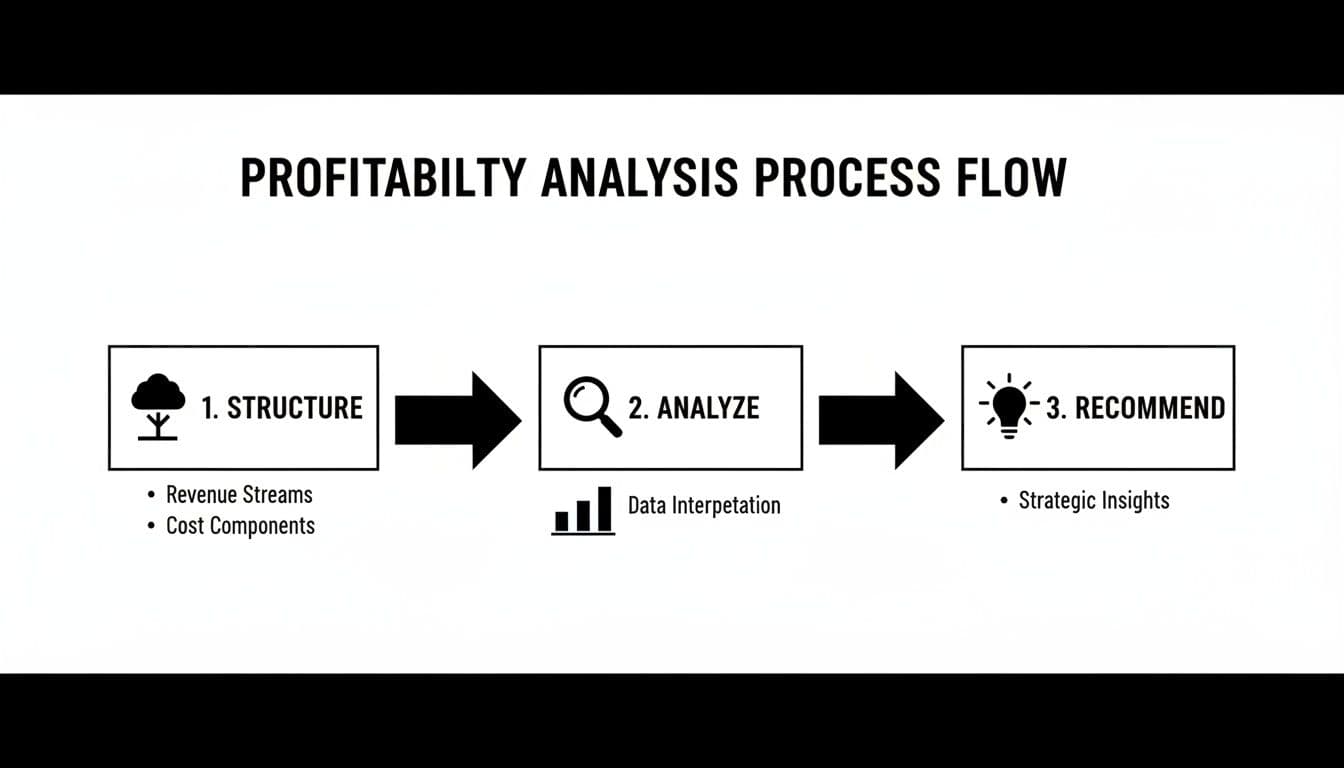
As you can see, a solid structure is the non-negotiable first step. It guides not just your analysis, but how you synthesize everything at the end.
Deconstructing the Revenue Side
Just saying "revenue" isn't going to cut it. You need to break it down into its core drivers. The classic first move is Price x Volume (Number of Units Sold). But don't stop there. You need to add more nuance based on the case details.
Think about slicing the revenue pie in different ways:
- By Product Line: Does the company sell a few different things? A revenue drop could be hiding in just one underperforming product category.
- By Customer Segment: Are they selling to big enterprises and small businesses? New customers versus repeat buyers? Profitability can look wildly different across these groups.
- By Geographic Region: Is the problem in North America, or is the European division dragging everything down?
- By Distribution Channel: Are sales coming from their website, physical stores, or partners? Each channel has its own dynamics.
For example, if you're looking at a software-as-a-service (SaaS) company, a much sharper way to frame revenue is (Number of Subscribers x Subscription Price) + Upsell Revenue. That’s far more actionable than just "revenue."
Breaking Down the Cost Structure
The cost side of the profit equation needs the same detailed thinking. The standard first split is between Fixed Costs and Variable Costs.
- Fixed Costs: These are the expenses that stick around no matter how much you sell. Think rent for the office, full-time employee salaries, and insurance.
- Variable Costs: These costs go up and down directly with production or sales. This includes things like raw materials, shipping fees, and sales commissions.
Again, the industry context is everything. For a manufacturing client, the variable cost of raw materials could be the single biggest factor. But for a consulting firm? The biggest cost bucket is almost always fixed: the salaries of its highly-paid consultants.
A well-structured framework does more than just organize your thoughts; it communicates your business acumen to the interviewer. It shows you can tailor your approach and aren't just reciting a memorized template.
Presenting Your Framework with Confidence
Once you've sketched out your structure on paper, you have to present it clearly and confidently. This is where your communication skills come into play. It's not just about what you think, but how well you can explain your thinking. For anyone looking to sharpen this skill, looking into effective communication skills training can be a huge help.
Here’s a natural way to walk your interviewer through your plan:
- Start High-Level: "To get to the root of this profitability decline, I’d like to break the problem into its two main drivers: Revenue and Costs."
- Drill Down on the First Branch: "Looking at the Revenue side first, I want to investigate the core components—specifically, price per unit and the total volume sold. I'd then segment volume by key product lines and maybe even geographic regions to see if the issue is isolated somewhere."
- Transition to the Second Branch: "Then, for the Cost side, I'll separate the analysis into Fixed Costs, like G&A and salaries, and Variable Costs, like raw materials and distribution. This will tell us if we have an operational efficiency problem or if our overhead structure is too bloated."
- Ask for Direction: "That’s my initial roadmap for tackling this. Does starting with the revenue side sound good to you, or do you think the cost structure is a more urgent area to dig into?"
This approach shows you're a structured thinker, you understand what drives a business, and you’re collaborative. To get more comfortable with different scenarios, I highly recommend exploring various frameworks for case interviews to build up your mental toolkit. The more you practice, the more naturally you'll be able to build a MECE structure that holds up under pressure.
The Art of Hypothesis-Driven Questioning
Okay, so you’ve laid out your MECE framework. That’s the opening move, but it’s just that—an opening. The real magic in a profitability framework case interview isn't just drawing the tree, but how you use it to find the root of the problem. This is where hypothesis-driven questioning comes in. Think of it as the engine that drives your analysis from a high-level map down to a specific, actionable insight.
Instead of vaguely asking, "So, what's happening with revenue?" you make an educated guess and then ask for the specific data that will prove or disprove it. This immediately shows the interviewer you’re thinking like a strategist, not just an analyst ticking boxes. You're not just exploring; you're actively solving the problem.

This simple shift turns your questioning from passive to active. You’re now in the driver's seat, guiding the conversation with purpose and showing off your business intuition with every question.
From Broad Buckets to Testable Hypotheses
Let's put this into practice. Imagine you're tackling a case for a coffee shop chain with sinking profits. Your framework has two main branches: Revenue and Costs. A generic approach would be to just ask for revenue data. A hypothesis-driven approach is much sharper.
You might start with a specific theory. Something like, "My initial hypothesis is that the revenue dip isn't from fewer customers, but from a drop in what each customer is spending. Maybe they're buying cheaper drinks or skipping the pastries. Do we have any data on the average ticket price over the last year?"
Look at what this single question accomplishes:
- It proves you're thinking beyond the basic "Price x Volume" formula.
- It paints a plausible, real-world business scenario.
- It asks for a very specific piece of data to test your theory.
Now, what if the interviewer says the average ticket size is actually up? Perfect. You pivot. "That's interesting, so my initial hypothesis is wrong. That means the issue must be on the volume side. My next hypothesis is that we're seeing less foot traffic, specifically at our urban locations, maybe due to new work-from-home trends. Can we segment customer volume by store type—urban versus suburban?"
This back-and-forth is the very heart of a great case interview. You state a hypothesis, you test it, and you use the answer to form your next, even sharper hypothesis.
The Anatomy of a Powerful Question
In a case interview, not all questions are created equal. Vague questions force the interviewer to do the thinking for you. Targeted, hypothesis-driven questions show you’ve got the analytical horsepower to do it yourself.
Let's look at the difference.
Weak vs. Strong Questioning
| Vague Question (Avoid) | Sharp, Hypothesis-Driven Question (Use) | Why It's Better |
|---|---|---|
| "Can you tell me about the costs?" | "My hypothesis is that the cost increase is from variable costs, specifically raw materials. Has the price of coffee beans or milk gone up recently?" | Pinpoints a specific cost driver and makes a testable assertion. |
| "What are competitors doing?" | "I suspect a new competitor is running an aggressive pricing promotion, hitting our sales volume in the breakfast rush. Do we have any competitive intelligence on this?" | Frames competitor analysis around a specific, measurable market threat. |
| "Is revenue down?" | "Given the stable economy, my first thought is that a revenue drop is likely due to something internal. Have we changed our product mix or pricing strategy in the last six months?" | Connects the problem to a broader context and seeks specific internal data. |
The goal is to make it easy for the interviewer to give you a specific data point. Asking "Do we know the variable cost per unit this year versus last year?" is much more effective than "Have costs gone up?" It requests a clean, comparable number they can just give you.
Common Pitfalls in Questioning
Even with a solid hypothesis, it's easy to misstep. One of the most common traps is "boiling the ocean"—asking for way too much data at once. Never ask for "all the revenue data broken down by product, region, and channel." It’s overwhelming and signals you don't know how to prioritize. Instead, ask for one slice at a time based on your most likely hypothesis.
Another classic mistake is confirmation bias. This is when you only ask questions that support your pet theory. A great consultant is just as happy to disprove a hypothesis as to prove one. Every time you disprove a theory, you’ve made progress. You've eliminated a path and can now focus your energy elsewhere.
Ultimately, mastering hypothesis-driven questioning is what brings your profitability framework to life. It’s the difference between a candidate who can draw a tree and one who can actually solve the case.
Real-World Scenarios and Practical Solutions
Knowing the profitability framework is one thing; applying it under pressure in a case interview is another. This is where theory meets reality. Let's walk through a couple of classic scenarios to see how you can move from a basic formula to a killer diagnosis.
Scenario One: Declining Profits at a Consumer Goods Company
Picture this: your client is "FreshBites," a company that sells packaged salads. The partner tells you profits have dropped by 15% over the last year. Your job is to figure out why and what they should do about it.
Right away, you anchor yourself with the core equation: Profit = Revenue - Costs. A good starting hypothesis might be that rising ingredient costs are eating into their margins. It’s a common problem, so it's a logical place to begin.
You decide to tackle the cost side first. You ask for a breakdown of FreshBites’ costs, splitting them between fixed costs (like factory rent) and variable costs (lettuce, chicken, packaging, etc.). The interviewer shares that fixed costs haven't changed, but variable costs per salad have shot up by 20%. Okay, your initial hunch was on the right track, but a top-tier consultant always digs deeper. The "why" is everything. You can learn more about how to do this by checking out our guide on how to find variable cost.
So, you start segmenting those variable costs. Is it the lettuce? The packaging? The dressing? The interviewer reveals that a regional drought has caused the price of lettuce to spike. Boom. You've just identified a major root cause.
But don't stop there. A complete analysis means looking at the other side of the equation. You pivot to revenue, asking if it has changed. You break it down into Price x Volume. The interviewer notes that prices have been stable, but sales volume has dipped by 5%, mostly in their premium salad line. Now you have the second piece of the puzzle.
By structuring the problem, you've uncovered two completely separate issues: a supply chain crisis (the cost of lettuce) and what looks like a market demand problem (people are buying fewer premium salads). A less structured approach might have just stopped at "costs are up," but your method paints a much clearer picture, setting you up for a powerful recommendation.
Scenario Two: Profit Improvement for a Tech Company
Let's switch gears. Now your client is "CloudServe," a B2B SaaS company. Their profits are flat, and the board is demanding 20% growth next year. This isn't about fixing something that's broken; it's about proactively finding new growth levers.
You still start with Profit = Revenue - Costs, but your mindset here is all about opportunity.
On the revenue side, you’re hunting for ways to boost income. Instead of a simple Price x Volume, you adapt the framework to a SaaS business model: (Number of Customers x Average Revenue Per Customer).
This structure immediately sparks some clear lines of questioning:
- Pricing Tiers: "Could we introduce a new 'Enterprise' tier with advanced features? It could lift our average revenue per customer."
- Customer Segments: "Are we really winning in the small-to-medium business (SMB) market, or is there a huge untapped opportunity to grow our customer base there?"
- Product Upselling: "What portion of our clients are on the basic plan? Maybe we could run a campaign to upsell them on our premium analytics module."
Then you turn your attention to the cost side, searching for efficiencies. You might analyze the customer acquisition cost (CAC) or the cost to serve different types of clients. A strong hypothesis could sound like this: "I have a hunch that our high-touch support for smaller clients isn't profitable. Do we have data on support costs broken down by customer size?"
If the data shows that 80% of your support tickets come from the lowest-paying 20% of customers, you've struck gold. Your recommendation could be to build out a self-service knowledge base for those smaller clients, which would free up your support team to deliver amazing service to high-value enterprise accounts.
Key Takeaway: The profitability framework isn’t a rigid script. It’s a flexible tool that you must adapt to the specific business model and problem at hand. Your real value comes from segmenting the core components to uncover the story hidden in the numbers.
Navigating Common Traps and Advanced Techniques

Knowing the profitability framework is one thing; executing it under pressure is another challenge entirely. Even sharp candidates who've done their homework can stumble into a few well-worn traps. Learning to spot these pitfalls and sidestep them is what really separates a decent performance from a truly impressive one.
And you will need to be impressive. Major consulting firms report that profitability cases make up roughly 25-30% of all case interviews. Digging deeper, between 65-75% of MBA candidates will get hit with at least one profitability case. It's not a framework you can afford to be shaky on. You can get more context on why this is a core skill in any good consulting interview preparation.
The Peril of Surface-Level Segmentation
One of the most common mistakes I see is when a candidate stops digging too soon. They might correctly identify that revenue is down, but they treat that as the answer. It's not. It's just the beginning of the real investigation.
Simply stating, "It looks like sales volume has decreased," is an observation, not an insight. A star candidate immediately starts slicing the data to find the real story. They'll ask questions like:
- By Customer: "Is this volume drop coming from our loyal, repeat buyers, or are we failing to attract new customers?"
- By Product: "Are all our product lines feeling the pain, or is the decline isolated to our high-margin premium offering?"
- By Region: "Is this a nationwide problem, or is it concentrated in the Northeast, where a new competitor just launched?"
Rescue Strategy: Always push one layer deeper. The moment you find a problem (like rising costs), your next move should be to suggest ways to segment it. You're hunting for the driver of the problem, not just staring at the symptom.
Getting Lost in the Math
Another classic trap is getting so tangled up in the calculations that you lose sight of the big picture. The math in a case interview is just a tool. It's there to help you test a hypothesis and pull out an insight.
If you find yourself calculating a company's total fixed costs down to the last penny but can't explain what that number actually means for the business, you've gone off track. The interviewer isn't testing your arithmetic skills; they're testing your business acumen.
Quick Tip: After every single calculation, take a breath and state the "so what." For instance, once you calculate that variable costs are up by 12%, immediately follow up with something like, "This 12% jump in variable costs is a major issue. It's eroded our gross margin by 4 percentage points, which looks to be the primary cause of our overall profit decline."
The Trap of Generic Solutions
The final major pitfall is wrapping up your brilliant analysis with a dull, generic recommendation. Telling a company to "reduce costs" or "increase marketing" is useless. Your solutions have to be specific, actionable, and tied directly to the root cause you unearthed.
Think about the difference:
- Generic: "They should find ways to lower their costs."
- Specific: "Our analysis points to the cost of raw material X as the single biggest driver of our margin decline. My recommendation is to immediately explore renegotiating contracts with our top three suppliers. As a parallel path, we should investigate alternative, lower-cost materials that won't compromise our product quality."
Advanced Technique: Value Chain Analysis
If you really want to impress, you can move beyond the basic Revenue and Cost buckets by applying a value chain lens to the problem. This means looking for opportunities to boost profitability at every single step of the business, from sourcing raw materials to providing customer service.
Break the business down and probe each stage:
- Inbound Logistics: Can we source or receive materials more cheaply?
- Operations: Are there inefficiencies in our manufacturing process we can fix?
- Outbound Logistics: Are our distribution channels truly optimized for cost and speed?
- Marketing & Sales: Is our customer acquisition cost sustainable? Where is the waste?
- Service: Could we monetize our customer support or make it more efficient?
This kind of thinking uncovers hidden opportunities that a simple Profit = Revenue - Costs formula would completely miss. It signals to the interviewer that you can think holistically about how a business actually works—the hallmark of a great consultant. By sidestepping these common traps and applying more advanced analytical tools, you'll be well-positioned to ace any profitability framework case interview.
Answering Your Top Profitability Case Questions
Once you’ve got the basic structure down and have run through the math a few times, a few tricky "what if" scenarios can still get in your head. Let's tackle those common hang-ups directly. Getting these cleared up is essential for walking into your interview feeling prepared and confident, not just hoping you get it right.
What If My Initial Framework Is Wrong?
This is probably the number one fear I see in candidates, but it comes from a basic misunderstanding of the game. Your interviewer isn't looking for a psychic who can guess the perfect answer from the get-go. They're testing your ability to think on your feet and adapt as new information comes in.
Think of your initial framework not as a rigid answer, but as a starting hypothesis. If the data proves it wrong, that's not a mistake—it's progress. Pivoting gracefully based on new evidence is far more impressive than getting lucky with your first guess.
"That's interesting. The data shows that revenues are actually stable, which disproves my initial hypothesis that the issue was on the top line. This new information suggests the problem must be on the cost side. I'd like to redirect my focus there and begin by breaking down variable versus fixed costs."
A response like this shows you're flexible, logical, and thinking like a consultant. Remember, it’s a collaborative problem-solving exercise, not a test with a hidden answer key.
How Detailed Should My Structure Be?
This is all about finding the sweet spot. A framework that's too broad (just "Revenue" and "Costs") looks lazy. But one that's too granular (listing ten sub-drivers for every category) is a mess and wastes precious time. The trick is to build your structure in layers.
Start with a clean, MECE first level, then check in with your interviewer before diving deeper.
- Initial Structure: "To get to the root of the profit decline, I want to look at both the Revenue and Cost sides of the equation. On the Revenue side, I'll start by breaking it down into Price and Volume. For Costs, I’ll split them into Fixed and Variable."
- Collaborative Next Step: "That's my initial map of the problem. Given we’re talking about a manufacturing client, does it make more sense to you that we start on the revenue side or dig into the cost structure first?"
This approach shows you can create a solid plan without getting lost in the weeds. It also brings the interviewer into the conversation, which is a great way to avoid spending ten minutes analyzing a branch they already know is a dead end.
What Is the Best Way to Practice Profitability Cases?
Endless, unfocused practice isn't the answer. You need to practice smarter. Just reading articles or watching videos is fine for getting the basics, but the real improvement comes from active, targeted practice.
Here’s a much better way to approach it:
- Component Drills: Don't jump straight into full, 30-minute cases. Isolate the skills first. Spend time just drilling revenue breakdowns for five different industries. Do a few timed drills just on calculating cost-per-unit or contribution margin. Nail the building blocks before you try to build the house.
- Full Mock Interviews: Once you feel solid on the mechanics, it’s time to simulate the real thing. Grab a partner or use an AI-powered tool to get reps under pressure. This is where you connect the pieces: the structure, the math, the communication, and the synthesis.
- Feedback and Iteration: This is the most important step, and the one most people skip. After every single mock, you have to analyze what went well and what didn't. Identify one or two specific things to improve next time. Without this loop, you’re just reinforcing bad habits.
This methodical approach builds a strong foundation and ensures you’re actually getting better with every case you do. It turns a massive, intimidating task into a series of manageable steps.
Ready to stop practicing with bad habits and start getting targeted, data-driven feedback? Soreno provides an AI-powered platform with an extensive library of cases and drills designed to sharpen your skills. Get instant, rubric-based scores on your structure, communication, and business insights after every mock interview. Start your free trial at https://soreno.ai and turn practice into perfection.