
What Is a Case Interview and How Do You Ace It
Discover what is a case interview with this complete guide. Learn the formats, frameworks, and proven prep strategies to ace your consulting interview.

So, what exactly is a case interview?
Think of it less like a traditional Q&A and more like a live-action business puzzle. You’re presented with a real-world scenario a company is facing—maybe profits are plummeting, or they're thinking about launching a new product. Your task is to act like a consultant on the spot. You'll need to think out loud, ask smart questions, analyze the data you're given, and ultimately, recommend a course of action.
It’s a dynamic, interactive session where how you think is far more important than getting the "right" answer.
Why Do Top Firms Swear By Case Interviews?
Firms like McKinsey, Bain, and BCG didn't just stumble upon this interview style. It's a carefully designed simulation of the actual job. They want to see, in real-time, if you have the raw skills to tackle the ambiguous, high-stakes problems they solve for clients every day. Can you take a messy, complex situation and bring structure and clarity to it?
This method has been the gold standard for decades, first popularized by firms like McKinsey & Company back in the 1950s. By the 1980s, it became the main hurdle for anyone trying to join the top tier of consulting. It's an incredibly effective filter—so much so that firms often weed out up to 80% of applicants before they even get a chance at a case. This history is well-documented on platforms like PrepLounge.com.
What Are They Really Looking For?
At its heart, the case interview isn't a test of obscure industry trivia. It's a performance. The interviewer is assessing a handful of core skills that are non-negotiable for anyone in a strategy role.
Before we dive into the skills, it's helpful to see them in context. This table breaks down what's being tested and what that looks like from the interviewer's perspective.
| Skill Tested | What Interviewers Are Looking For |
|---|---|
| Problem-Solving | Can you break down a big, vague problem into smaller, logical pieces? |
| Quantitative Acumen | Are you comfortable with numbers? Can you do quick, back-of-the-envelope math? |
| Business Intuition | Do you have a good gut-level understanding of how businesses make money and operate? |
| Communication & Poise | Can you clearly explain your thought process and stay confident under pressure? |
These skills form the foundation of the work. Let's look a little closer at what each one means in a case setting.
- Analytical Horsepower: This is about your ability to think on your feet. Can you process new information quickly, spot what's important, and run the numbers to back up your ideas?
- Structured Thinking: Can you create a logical plan of attack? Interviewers want to see you build a framework to guide your analysis, not just jump randomly from one idea to the next.
- Business Acumen: You don’t need to be a CEO, but you do need a solid grasp of business fundamentals. Think revenues, costs, market dynamics, and competition.
- Poise and Communication: This is huge. The entire interview is a conversation. They're judging your ability to articulate your logic, defend your recommendations, and maintain a collaborative, confident attitude.
The single biggest mistake candidates make is chasing a "correct" answer that doesn't exist. The best candidates show up ready to demonstrate a structured, logical, and hypothesis-driven way of thinking.
Ultimately, the case interview is the gateway. If you can prove you can think like a consultant for 30 minutes, you're showing them you have what it takes to become one. For anyone serious about breaking into these elite firms, mastering this unique challenge is the price of admission.
The Anatomy of a Case Interview: From Prompt to Recommendation
Think of a case interview not as a random Q&A session, but as a structured, 30 to 45-minute journey. It’s a predictable conversation with distinct phases. Once you understand the flow, you stop feeling like you’re being interrogated and start feeling like you’re leading a problem-solving discussion.
The whole thing unfolds like a four-act play. Each part builds on the last, guiding you from an ambiguous problem to a powerful, data-backed conclusion. Getting the transitions right is just as important as acing each individual section.
The core of it all is testing three things: can you solve the problem, is your thinking process logical, and can you keep your cool under pressure?
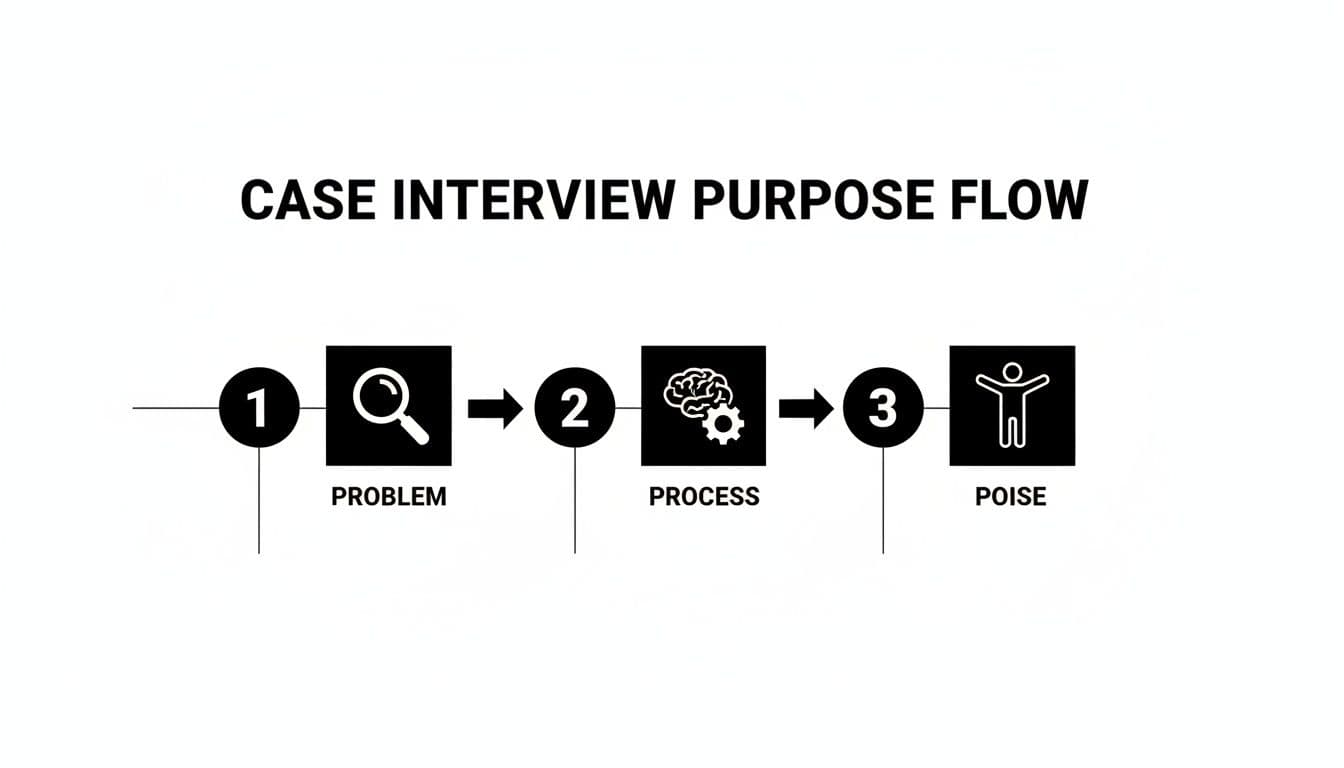
As the visual shows, your final answer is just one piece of the puzzle. How you get there—and the professional poise you show along the way—is what really counts.
Phase 1: Understand the Prompt and Ask Questions
The interview starts the second the interviewer stops talking. Your first move? Don't jump into an answer. Pause. Breathe. Then, start asking smart questions to make sure you fully grasp the client's goal and any hidden constraints.
These aren't just any questions; they should be sharp and insightful. They show you’re methodical. For instance:
- "The goal is to boost profits by 15%. Is there a specific time frame for that, say, within one year or over the next three?"
- "Just to confirm, should we focus on a specific geographic market, or is this a global problem?"
- "Is there any context I should know about, like recent moves by competitors or shifts in customer behavior?"
This opening dialogue isn't just for you. It signals to the interviewer that you’re a structured thinker who doesn't rush into things, setting a collaborative tone right from the start.
Phase 2: Build and Explain Your Framework
Once you’re clear on the problem, it’s time to ask for a moment to structure your approach. This is where you create your framework—essentially, your game plan for cracking the case. A good framework is just a way of breaking a huge, messy problem down into smaller, manageable chunks.
If you're new to this, exploring different frameworks for case interviews can give you a great starting point.
But here’s a common trap: never just name-drop a generic framework. Don’t just say, "I'm going to use the Profitability Framework." You have to tailor it to the case at hand.
Instead of a generic, "I'll look at revenues and costs," try something like this: "To figure out why profits are down at this coffee chain, I want to start by digging into revenues. I'll look at the number of stores and the average revenue each store brings in. After that, I’ll tackle the cost side, breaking it down into big fixed costs like rent and variable costs like coffee beans and labor."
See the difference? It's specific and custom-built for the problem.
Phase 3: Drive the Analysis with Data
With your roadmap laid out, you dive into the heart of the case. This is all about you taking charge. You’ll use your framework to guide your questions, ask for specific data, and make sense of any charts or tables the interviewer gives you.
You might say, "You mentioned revenue per store is down. Do we have any data that splits that out into customer traffic versus the average amount each customer spends?"
When you get a chart, follow a simple three-step process:
- State the Takeaway: "Okay, this chart shows that while our average ticket size is flat, our foot traffic has dropped by 20%."
- Synthesize: "That tells me the problem isn't our pricing, it’s about getting people in the door."
- Propose Next Steps: "So, I’d like to explore why traffic is down. Can we look into customer satisfaction scores or what competitors have been up to recently?"
Phase 4: Deliver a Final Recommendation
You’ve done the work, you’ve followed the data, and now it's time to bring it all home. Your final recommendation shouldn't be a dry summary of facts; it should be a compelling, confident conclusion.
A great final recommendation has three key ingredients:
- The Recommendation: Start with a direct, clear answer to the original question. No beating around the bush.
- Supporting Reasons: Back it up with the 2-3 most critical insights you uncovered during your analysis. This is your "why."
- Risks and Next Steps: Show you're thinking ahead. Acknowledge any potential risks with your plan and suggest the immediate next steps the client should take.
Nailing this final part leaves the interviewer with a powerful lasting impression of your analytical mind and clear, structured thinking.
The Most Common Case Interview Types You'll Face

While no two cases are identical, most fall into a handful of classic categories. Think of these not as rigid templates but as different "game modes" you'll encounter. Getting a feel for the underlying pattern of each type is a huge advantage. It lets you instantly recognize the core problem and choose the right tools for the job, right from the start.
It's all about pattern recognition. A seasoned chef immediately knows whether a cut of meat is best for braising or grilling. In the same way, you’ll learn to spot the business challenge and apply the right analytical lens. The goal isn't to force-fit a memorized framework but to have a reliable starting point you can build on.
This adaptability is more important than ever. The modern case interview process is a marathon, often involving 4-6 sessions per candidate at top firms, with each lasting 45-60 minutes. While the classic oral case is still king, online formats are gaining ground. Data shows that 50% of interviewees fail the first round on chart interpretation alone, and 45% of candidates are flagged for pacing issues. For certain roles, like product management, the cases shift; about 60% are operations-focused.
Profitability Cases
This is the quintessential case interview. Your client’s profits are down, flat, or just not where they should be. Your mission? Figure out why and what to do about it. This is the bread and butter of management consulting.
The first move is always to break down the profit equation: Profits = Revenue - Costs. It's a simple formula, but the magic is in digging into what drives each side. You can't just look at one in isolation.
- Revenue Side: What's happening with price per unit? Volume sold? Is the product mix changing? Are certain customer segments buying less?
- Cost Side: Are fixed costs like rent and salaries creeping up? Or are variable costs, like raw materials and commissions, the real problem?
A great candidate starts by asking smart, clarifying questions to narrow the field. Is this an industry-wide slump, or is it just our client? Did revenues fall off a cliff, or did costs suddenly spike? That initial diagnosis sets the stage for everything that follows.
Market Sizing and Estimation Cases
Often called a "guesstimate," this type of case is a test of your logical thinking and comfort with back-of-the-envelope math. You might be asked to estimate something that seems impossible, like the number of golf balls sold in the US each year or the market size for electric scooters in Paris.
The interviewer doesn't care about the exact answer; there isn't one. What they really want to see is your thought process. Can you make reasonable assumptions, structure a clear calculation, and do the math without a calculator?
The most common approach is to build a top-down or bottom-up calculation. For sizing the coffee market, for instance, you could start with the total population, slice it by likely coffee drinkers, estimate how often they buy coffee, and multiply that by an average price.
Market Entry Cases
In this scenario, a client is thinking about expanding into a new geography or launching a new product. Your job is to advise them: is this a good idea? And if so, how should they go about it? This type of case is a great mix of big-picture strategic thinking and hard financial analysis.
Many of these cases, especially when they involve a new product, will hinge on your understanding of a strong Go To Market (GTM) strategy.
Your analysis will almost always need to cover a few core areas:
- The Market Itself: How big is this opportunity? Is it growing or shrinking? Who are the customers?
- The Competition: Who are the major players? How much market share do they hold? Is it tough for a new company to break in?
- The Client's Chops: Does our client actually have the money, brand power, and operational know-how to win here?
- The "How": Should they build from scratch, buy a competitor, or partner with a local player?
Mergers and Acquisitions (M&A) Cases
Here, one company is considering buying another. You need to play the role of an advisor, evaluating if the deal makes sense from both a strategic and financial perspective. It’s a lot like a market entry case, but with a specific target already in your sights. The big question is always: will this deal create value?
You'll need to look at the target company's health, identify potential synergies (like cost savings or new revenue opportunities from the merger), and assess the overall market. A huge piece of the puzzle is the price—is it right, and will shareholders get a good return on their investment?
To get a better feel for these, check out our library of sample cases for case interviews, which includes several M&A scenarios.
To help you keep these straight, here's a quick cheat sheet for recognizing the different case types and knowing what to ask first.
Case Type Cheat Sheet: Key Questions and Focus Areas
| Case Type | Core Objective | Key Questions to Ask First |
|---|---|---|
| Profitability | Diagnose the root cause of declining profits and recommend a solution. | "Is this an industry-wide problem or client-specific? Have profits declined recently or over a long period?" |
| Market Sizing | Estimate a market size or quantity using a logical, structured approach. | "To clarify, are we looking for the market in terms of revenue or units sold? Over what time frame (e.g., annually)?" |
| Market Entry | Advise a client on whether to enter a new market and how to do it. | "What is the client's primary motivation for entering this market (e.g., revenue growth, diversification)?" |
| M&A | Evaluate the viability of an acquisition and recommend for or against the deal. | "What are the potential synergies the client hopes to achieve with this acquisition (cost, revenue)?" |
This table is a great starting point. As you practice, you'll find that many real-world cases are hybrids, blending elements from two or more of these types. That’s where the real fun begins.
Building the Mental Toolkit for Case Success
You can't win a case interview by memorizing a stack of frameworks. The real goal is to build the mental habits of a top-tier consultant—to develop a flexible, logical problem-solving engine that can tear down any business challenge you encounter. Frameworks are just the tools; your thinking is the real asset.
Think of it like learning to cook. Following a recipe (a framework) is a great way to start, and you'll probably make a decent dish. But a true chef understands the fundamentals—how heat works, how flavors balance, why certain ingredients pair well together. They can walk into a strange kitchen with unfamiliar ingredients and still create something amazing.
This section is all about developing that chef's intuition for business problems.
Adopting a MECE Mindset
One of the most powerful habits to build is thinking in a MECE (Mutually Exclusive, Collectively Exhaustive) way. It might sound like consultant-speak, but the concept is surprisingly simple: break down any problem into pieces that don't overlap (Mutually Exclusive) and, when added together, cover all the possibilities (Collectively Exhaustive).
Imagine you were asked to organize a library. You wouldn't create sections for "Fiction," "Novels," and "Mysteries." Why? Because a mystery novel could fit into all three categories, creating overlap and confusion.
A MECE approach would be to start with high-level categories like "Fiction" and "Non-Fiction." Then, within Fiction, you could create distinct sub-categories like "Mystery," "Sci-Fi," and "Romance." Every single book has one clear, logical home, and no book is left without a shelf.
By structuring problems this way, you ensure there are no gaps in your logic and you aren’t double-counting parts of your analysis. It’s the absolute bedrock of a strong case performance.
A flimsy structure is a fast track to failing the interview. In a review of over 300 Bain interviews, 80% of low scorers couldn't build a MECE framework. On top of that, weak math skills trip up 40% of candidates on basic calculations. You have to be comfortable with both the structure and the numbers, whether it's sizing a market (the US airline industry saw nearly 1 billion passengers per year pre-COVID) or analyzing profitability (airline margins cratered to -5% in 2020 before recovering). For a deeper dive into these skills, you can find great analytics on RocketBlocks.me.
Using a Hypothesis-Driven Approach
Once you have a solid, MECE structure, don't just wander through it randomly. Top candidates are far more deliberate; they use a hypothesis-driven approach. This is basically the scientific method applied to business. You make an educated guess about the root cause of the problem and then hunt for data to prove or disprove it.
Let's say a company's profits are falling. Your initial hypothesis might be: "I believe profits are down because our main competitor launched an aggressive price cut last quarter, which is stealing our market share."
This simple statement instantly gives your analysis a sharp focus. Instead of vaguely asking for "all the data on revenue," you can make targeted, intelligent requests:
- To Test: "Do we have data on our market share versus our top competitor's over the last two quarters?"
- To Validate: "Can we see our pricing and our competitor's pricing over that same period?"
- To Confirm: "What has happened to our sales volume in the regions where this competitor is strongest?"
What if the data shows your market share held steady? Great! Your hypothesis was wrong, but you haven't failed—you've made progress. You can now confidently rule out that possibility and form a new hypothesis, like: "Okay, if it's not a market share issue, I now believe the problem is on the cost side, possibly driven by a recent spike in raw material prices."
This method is efficient and focused. It shows the interviewer you’re thinking like a strategist who solves problems, not an analyst who just gathers data.
Your Action Plan for Case Interview Prep

Knowing what a case interview is and actually being good at them are two very different things. The real secret isn't just knowing the theory; it's having a disciplined, structured way to practice that builds real confidence and muscle memory. This is your roadmap for turning that knowledge into a stellar performance.
Think of it like training for a marathon. You wouldn't just read a book about running and then show up on race day expecting to win. You’d follow a plan—foundational conditioning, targeted speed drills, and full-length practice runs. Case prep works the exact same way.
Step 1: Master the Foundational Concepts
Before you even think about tackling a full case, you have to get the basics down cold. This first phase is all about building your toolkit. When the clock is ticking and the pressure is on, you need to have these core business principles at your fingertips.
Start by getting comfortable with concepts like revenue streams, cost structures (fixed vs. variable), market dynamics, and competitive strategy. You don’t need an MBA, but you do need to speak the language of business fluently. This is the groundwork that keeps you from trying to solve a complex problem with an empty toolbox.
Step 2: Sharpen Your Core Skills with Drills
Once you’ve got the fundamentals, it's time to isolate and sharpen the specific skills you’ll use in every single case. Targeted drills are perfect for this. They let you perfect the individual components before you have to juggle them all at once.
Zero in on these two high-impact areas:
- Mental Math: You have to get fast and accurate with calculations involving big numbers, percentages, and estimations—all without a calculator. Your speed here is what keeps the case moving forward.
- Chart Interpretation: Go online and find business charts. Give yourself just 30-60 seconds to look at one, then say out loud what the key takeaway is, what it implies, and what questions it makes you want to ask.
This kind of focused practice builds the speed and precision you'll desperately need when you're in the hot seat. For more ideas on how to structure your studies, explore our detailed case interview prep guide.
Step 3: Simulate the Real Thing with Mock Interviews
This is where it all comes together. Mock interviews are the single best way to simulate the pressure, time constraints, and give-and-take of a real case. The goal here is to move from just knowing things to actually doing them.
But here’s the catch: quality over quantity. Grinding through dozens of mocks without stopping to reflect is a complete waste of time. The real value comes from what you learn and improve on after each session.
A single, well-analyzed mock interview where you identify specific weaknesses and create a plan to fix them is more valuable than five rushed sessions where you repeat the same mistakes.
After every mock, make time to deconstruct your performance. Go over your notes. Where was your structure weak? Did you make a calculation error? When did you lose your train of thought? This review is arguably the most important part of the entire process.
Step 4: Close the Gaps with a Feedback Loop
The final, crucial step is to create a cycle of feedback and improvement. This is what separates candidates who get better from those who just spin their wheels. Look at your mock interview analysis, find your 1-2 biggest weaknesses, and circle back to Step 2 to drill those specific areas.
- Struggled with profitability? Go do five profitability drills.
- Math slowed you down? Dedicate a couple of hours to mental math exercises.
- Framework felt clunky? Practice structuring three different case prompts from scratch.
By systematically finding your weak spots and hitting them with targeted practice, you create a powerful cycle of improvement. This iterative approach ensures you’re not just practicing—you’re getting noticeably better, day by day.
Accelerate Your Prep with AI Tools
Knowing what to do is only half the battle. The real challenge is putting in the reps, and the old way of doing things—scrambling to find practice partners, aligning schedules, and then hoping their feedback is actually useful—is full of friction. It's often slow, unreliable, and frankly, a bit of a grind.
This is where prep has fundamentally changed. You can now practice smarter, not just harder. Imagine having an expert interviewer on call 24/7, ready whenever you have a spare 20 minutes for a market sizing drill or an hour for a full M&A case. That’s the power of practicing with AI.
Fixing the Biggest Prep Headaches
For most people, the two biggest roadblocks are finding good practice partners and getting feedback they can actually trust. Trying to sync up with other busy students or professionals is a logistical nightmare, and the quality of practice you get can be a total coin flip. An AI partner sidesteps those problems completely.
Every session is consistent and designed to feel like the real deal. The AI asks sharp follow-up questions, keeps the interview on pace, and adjusts to how you’re performing. This lets you build the kind of muscle memory that only comes from focused, repeated practice.
The goal is to walk into your real interview feeling like it's just another practice run. AI tools give you the unlimited, zero-judgment reps you need to get there.
This frees you up to focus entirely on improving your skills without the scheduling drama or the performance anxiety that can creep in when practicing with different people.
Feedback That Actually Helps You Improve
Here’s where AI really shines: the feedback is incredibly detailed and specific. Gone are the days of getting vague advice like, "Your structure could be better." Instead, you get an immediate, data-backed breakdown of your performance against a clear scoring rubric.
These platforms are built to find your blind spots and help you fix them. It's like having a dedicated coach analyzing your every move and giving you a concrete action plan. If you're curious about how this works, you can check out the Parakeet AI homepage.
Here’s a taste of what that looks like:
- Scoring You Can Trust: Get instant scores on everything—from how MECE your framework was to the persuasiveness of your final synthesis.
- Communication Breakdown: The platform analyzes your speech to pinpoint your exact filler words ("uh," "like," "you know"), tracks your speaking pace, and can even evaluate your non-verbal cues.
- Drills for Your Weaknesses: AI identifies the skills you need to work on and points you to specific drills to turn those weaknesses into strengths.
When you combine endless practice with instant, granular feedback, you create a powerful improvement loop. You practice a case, get a detailed report, drill your weak points, and repeat. It’s the fastest way to go from feeling overwhelmed to feeling confident and ready.
Frequently Asked Questions About Case Interviews
Even with a solid grasp of what a case interview is, a few practical questions almost always pop up. Let's walk through some of the most common worries candidates have before they step into that room and give you some clear, actionable advice.
How Much Math Is in a Case Interview?
You'll definitely need to be comfortable with numbers, but think "business math," not advanced calculus. The focus is on being able to handle calculations with large numbers—percentages, multiplication, division—without a calculator and without breaking a sweat.
What interviewers are really looking for is how you set up your calculations and articulate your assumptions. It's less about hitting the exact number and more about what that number means for the business problem. Honestly, one of the best things you can do to prepare is to run mental math drills until it becomes second nature. It's all about building the speed and confidence to keep the conversation flowing.
What if I Don’t Know the Industry in the Case?
Don't worry, this happens all the time. In fact, it's expected. The interviewer is testing your problem-solving skills, not your encyclopedic knowledge of niche industries. No one walks in knowing the ins and outs of the German agricultural equipment market.
It's completely fine—and actually a good idea—to say something like, "I'm not too familiar with this particular industry, so I'll probably ask a few basic questions to get my bearings." Use those first few moments to ask about the business model, how they make money, and who the major players are.
A logical structure and clear thinking are far more valuable than pre-existing expertise. Your ability to learn quickly and adapt your problem-solving approach is what's truly being evaluated.
How Do I Handle a Mistake During the Case?
First thing: breathe. The mistake itself is rarely the problem; it's how you react to it that matters. A small error is actually a great chance to show you can stay cool under pressure and have good self-awareness—two things every consulting firm values.
If you catch a math error, just say, "Hang on, let me quickly double-check that number." If you realize your initial framework isn't quite right, you can pivot by saying, "You know, on second thought, I think a better way to break this down would be X, because it gets closer to the core issue." Owning the mistake and correcting it confidently shows poise and a commitment to getting the right answer.
Ready to stop worrying about mistakes and start building the confidence to ace any case? Soreno provides an AI-powered platform with unlimited, on-demand mock interviews. Get instant, rubric-based feedback on your structure, communication, and quantitative skills to systematically eliminate weaknesses and walk into your interview fully prepared. Start your free trial today at https://soreno.ai.