
Your Guide to Product Manager Interview Prep
Master your product manager interview prep with this actionable guide. Learn key frameworks, common questions, and insider tips to land your dream PM job.
Landing a product manager role is tough, and the interview process can feel like a gauntlet. Your success hinges on how well you prepare across four crucial areas: Product Sense, Execution, Technical Acumen, and Behavioral Fit. The goal isn't to have canned answers ready, but to build a flexible, problem-solving toolkit that lets you tackle any question with confidence.
Why Your PM Interview Prep Matters More Than Ever

Let's be real: the competition for product manager roles is fierce. Gone are the days when you could just walk in with a solid resume and wing it. Companies now expect candidates to demonstrate structured thinking, genuine user empathy, and a sharp understanding of business impact—all while under pressure. This is where a smart preparation strategy makes all the difference.
The demand for great PMs is definitely not slowing down. The job outlook for global product managers points to a 10% growth spurt between 2018 and 2028. That's a huge number, translating to about 33,700 new PM jobs opening up around the world. You can read more about these product manager job trends to see just how essential this role is becoming.
But here’s the catch: more opportunity means more competition. With a bigger talent pool to choose from, companies are raising the bar. The interview is where they separate the good from the great, and your performance is everything. Thorough prep is the only way to prove you belong in that top tier.
The Roadmap to Interview Success
So, what does great preparation actually look like? It's more than just reading a few books or watching YouTube videos. You need a hands-on, systematic approach that builds real muscle memory for the types of challenges you'll face. Instead of trying to boil the ocean, focus your energy on the core pillars that every PM interview is built on.
This guide will give you a clear roadmap based on these essentials:
- Understanding Core Competencies: We'll break down what interviewers are actually testing when they ask a "product sense" or "execution" question.
- Applying Frameworks Intelligently: Learn to use frameworks like CIRCLES or STAR as thinking guides, not as rigid scripts you recite from memory.
- Practicing with Purpose: I'll show you how to turn mock interviews from awkward role-playing sessions into genuinely powerful learning opportunities.
- Tailoring Your Narrative: Discover how to shift your stories and examples for different companies, whether it's a fast-moving startup or a tech giant like Google.
Great prep is about building a mental toolkit. It’s about having the right framework for any problem, the right story for any behavioral question, and the confidence to think on your feet when something unexpected comes up.
At the end of the day, how you prepare for the interview is a direct reflection of how you'd perform as a PM. A candidate who shows up with a plan, thinks in a structured way, and is committed to doing the work—that’s who gets the job. Investing this time upfront isn't just about passing an interview; it's about proving you have what it takes to be a great product manager from day one.
To get started, it helps to have a clear picture of what you'll be working on. I've broken down the key preparation areas into a simple table to guide your focus.
Core Pillars of PM Interview Prep
This table summarizes the essential areas you need to master. Think of it as your high-level checklist for the journey ahead.
| Pillar | What It Covers | Why It Matters |
|---|---|---|
| Product Sense & Design | User empathy, product ideation, feature prioritization, and market analysis. | Shows you can identify real user problems and envision creative, impactful solutions. This is the heart of product thinking. |
| Execution & Metrics | Defining success, setting goals (OKRs/KPIs), handling trade-offs, and launching products. | Proves you can translate a vision into a concrete plan and measure its success. Interviewers need to know you can ship. |
| Technical Acumen | Understanding system design, APIs, data models, and a platform's technical constraints. | You don't need to be an engineer, but you must be able to have credible conversations with them and understand what's possible. |
| Behavioral & Leadership | Conflict resolution, stakeholder management, influencing without authority, and past experiences. | Demonstrates your soft skills and cultural fit. Can you lead a team, navigate ambiguity, and be a great colleague? |
With these pillars in mind, you have a solid foundation. Now, let’s dive into how to tackle each one.
Deconstructing the Four Pillars of the PM Interview
Think of the product manager interview less as a random quiz and more as a series of targeted stress tests. Each one is designed to probe a core competency. While the questions can feel unpredictable, they almost always tie back to four foundational pillars. If you can master these, you're well on your way to a compelling performance.
Seeing the interview through this lens demystifies the whole process. Instead of trying to memorize answers to hundreds of potential questions, you can focus on building real-world skills in these four domains. This gives you a versatile problem-solving toolkit you can adapt to whatever an interviewer throws at you.
Let's be clear: the competition for these roles is brutal. At top-tier tech companies, especially in the FAANG circle, rejection rates can soar as high as 97%. This intense filtering is built around these four pillars: product sense, technical skills, behavioral aptitude, and execution. They'll push you on everything from system architecture and A/B testing to your fundamental grasp of product metrics. You can get more insights from successful candidates on how they structure their PM interview prep.
Unpacking Product Sense
Product sense is easily the most critical—and often the most ambiguous—pillar of the interview. At its heart, it’s about your gut instinct for what makes a great product. It's your ability to deeply understand users and then translate that empathy into a clear, compelling vision.
Interviewers are looking for more than just cool feature ideas. They want to see how you think.
- Start with the 'Who' and 'Why': Always ground yourself by clarifying the goal and the user. Who are we actually building this for? What specific problem is this solving for them?
- Dig into the Pain: Go deep on the user's journey. What are their biggest frustrations? Where do they get stuck? This is where the real opportunities hide.
- Brainstorm Widely, Then Cut Ruthlessly: Generate a broad list of potential solutions first. Only then should you start narrowing them down based on things like user impact and technical feasibility.
One of the most common mistakes I see is candidates jumping straight to a solution. The strongest contenders spend the majority of their time really living in the problem space, making sure their foundation is rock-solid before they even think about building on it.
Mastering Execution and Metrics
If product sense is the "what" and "why," then execution is all about the "how." This is where you prove you can turn a brilliant idea into a real, successful product. Interviewers need to trust that you can drive a project, make difficult trade-offs, and measure what actually matters.
Execution questions often come disguised as prompts about prioritization, metrics, or strategy. You might get hit with something like, "How would you measure the success of Instagram Reels?" or "You have limited engineering resources. How do you decide between building Feature A and Feature B?"
Your answer needs to reveal a clear, logical framework for making decisions. It’s less about finding one "right" answer and more about showing you can rationally weigh competing priorities against core business goals and user needs.
To nail this, you need to be fluent in key performance indicators (KPIs) and feel comfortable with frameworks like AARM (Acquisition, Activation, Retention, Monetization). Show them you think like a business owner who is ultimately on the hook for the product's success or failure.
Navigating Technical Acumen
The technical round can be intimidating, especially for PMs who don't come from a computer science background. But here's the secret: you don't have to be a coder. You just need to be technically literate enough to have a productive, intelligent conversation with an engineer.
The goal is to demonstrate that you understand technical constraints and can be an effective partner to your engineering team. This usually means being able to talk about system design at a high level.
For instance, if you're asked to design a product like a ride-sharing app, you should be able to sketch out:
- The Core Components: Talk about the essential building blocks, like user profiles, mapping/GPS services, a payment gateway, and a matching algorithm.
- APIs: Explain how you’d use external APIs (from services like Google Maps or Stripe) to build faster and avoid reinventing the wheel.
- Scalability: Briefly touch on what it would take for the system to grow from one thousand users to one million.
This shows that you grasp a product's architecture and can make informed trade-offs—a huge part of the day-to-day PM job.
Demonstrating Behavioral Fit
Finally, behavioral questions are all about assessing your soft skills: your leadership style, how you collaborate, and how you communicate. Companies want to hire people who can influence without direct authority, navigate tricky team dynamics, and rally people around a shared goal.
This is where your personal stories become your superpower. Prepare 5-7 detailed examples from your career that bring your skills to life. Don't just claim you're a good collaborator. Tell a specific story about that time you mediated a conflict between design and engineering to get a critical feature shipped on schedule.
The STAR method (Situation, Task, Action, Result) is your best friend here. It’s a simple framework that forces your stories to be concise, compelling, and focused on your actual impact. This is your chance to show the interviewer who you are as a leader and what you’d be like to work with.
Adopting Frameworks Without Sounding Robotic
Frameworks are the guardrails of PM interview prep. They're essential for structuring your thoughts, but there's a huge pitfall here: sounding like you're reading from a script.
Methods like CIRCLES for product design or AARM for growth questions are fantastic tools. But the single biggest mistake I see candidates make is reciting the steps out loud.
Interviewers have heard "Okay, first I'll start with 'C' for 'Comprehend the Situation'" a thousand times. They don't care about the acronym. What they really want to see is if you can think systematically. Do you clarify goals? Do you actually care about the user? The framework is there to organize your thoughts, not to be the star of the show.
From Memorization to Internalization
The trick is to move from simply memorizing acronyms to deeply internalizing the thinking behind them. At its core, any good product framework is just a logical sequence of questions you should be asking anyway.
For almost any product design prompt, that natural flow looks something like this:
- Clarify the Goal: First things first, why are we even building this? What does a "win" look like?
- Identify the User: Who is this for? What are their real-world struggles and needs?
- Brainstorm Solutions: Okay, now let's get creative. What are all the different ways we could solve this problem?
- Prioritize: We can't build everything. Which idea gives us the most bang for our buck?
- Define Success: How will we know if we were right? What metrics will we track?
Once you get this flow down, you can ditch the rigid formula. It becomes less of a presentation and more of an authentic conversation. The interviewer will see you thinking like a PM, not just following a pre-packaged recipe.
This infographic breaks down the core areas your thinking needs to cover—the very things these frameworks are designed to test.
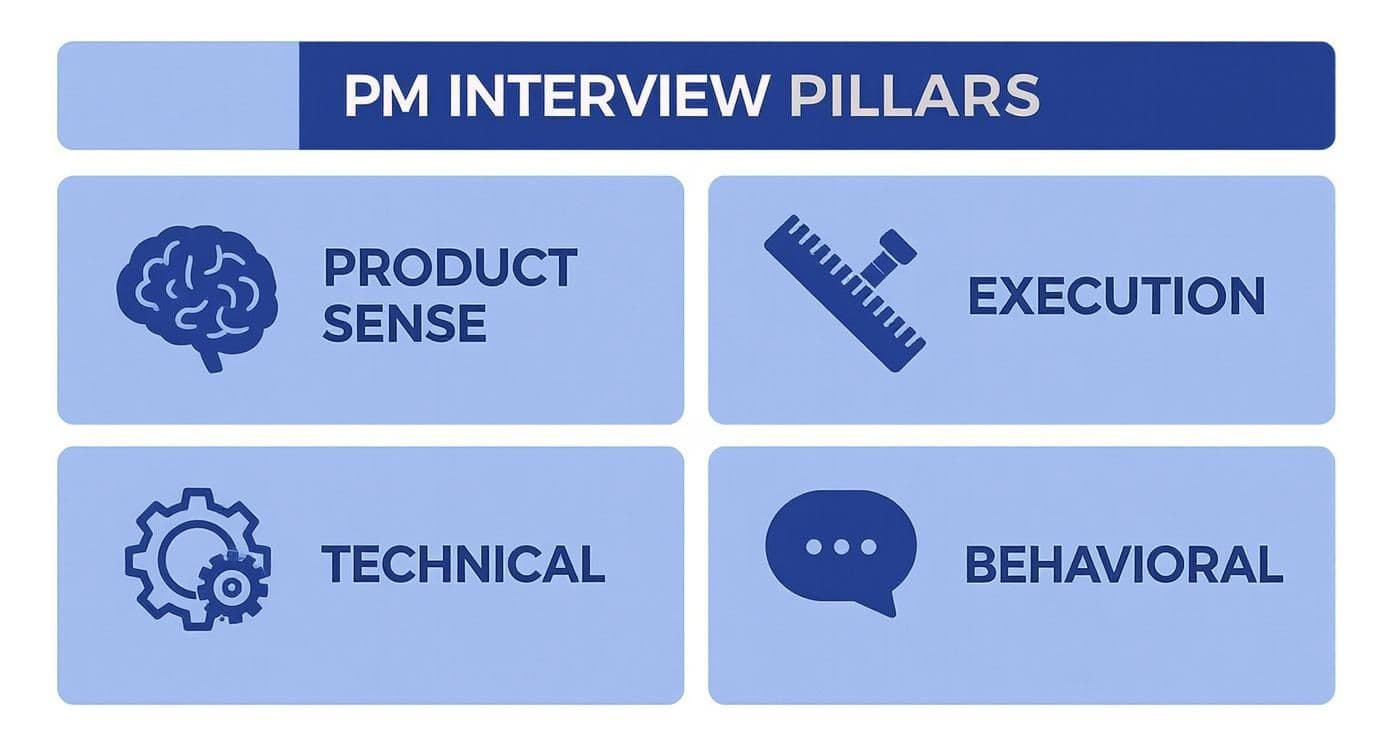
Your ability to apply a framework flexibly is what proves you have a command over all four of these essential pillars.
A Flexible Framework in Action
Let’s take a classic prompt: "Design a better airport experience." A rookie candidate will mechanically walk through the CIRCLES method. A strong candidate, on the other hand, internalizes the logic and starts a natural conversation.
Weak Approach (Robotic): "Okay, first, C - Clarify. The users are travelers. Let's say business travelers. Next, I - Identify Needs. They need to get through security faster..."
Strong Approach (Conversational): "That's a great, broad question. Before I dive in, I'd want to understand what 'better' really means here. Are we trying to increase revenue for the airport, boost passenger satisfaction, or maybe cut operational costs? Let's assume for now our main goal is to make passengers happier."
See the difference? The second approach immediately shows strategic thinking. You're not just a cog in a machine following steps; you're defining the problem space and aligning on a goal, which is 90% of what a real PM does every day.
The best answers feel less like a presentation and more like a whiteboarding session with a future colleague. Your goal is to showcase your thought process, not your ability to memorize an acronym.
From that jumping-off point, you can explore user segments. Instead of just picking one, you could briefly compare the needs of a business traveler versus a family trying to wrangle two toddlers. This demonstrates nuance and empathy.
When you get to solutions, you can tie them directly back to the specific pain points you uncovered. This creates a cohesive story that proves your product sense. For more complex strategic decisions, like launching a new product line, you can explore a detailed market entry framework to see how this structured thinking applies to high-stakes business choices.
Essential PM Interview Frameworks at a Glance
Navigating the sea of PM frameworks can be overwhelming. To help, here’s a quick-reference table breaking down some of the most common ones, what they’re used for, and their core components.
| Framework | Best For | Key Components |
|---|---|---|
| CIRCLES | Product Design & Improvement Questions | Comprehend Situation, Identify Users, Report Needs, Cut Through Prioritization, List Solutions, Evaluate, Summarize |
| AARM | Metrics & Growth Questions ("Increase X") | Acquisition, Activation, Retention, Monetization |
| STAR | Behavioral Questions ("Tell me about a time...") | Situation, Task, Action, Result |
| 5Es | User Journey Questions | Entice, Enter, Engage, Exit, Extend |
| SPADE | Prioritization & Decision-Making Questions | Setting, People, Alternatives, Decide, Explain |
Remember, this table is a starting point. The goal isn't to master every single one, but to understand the logic they represent so you can adapt your approach to any question that comes your way.
Demonstrating True Product Thinking
Ultimately, interviewers at top companies are looking for first-principles thinking. They want to see that you can take a messy, ambiguous problem, break it down into its fundamental pieces, and build a logical case for a solution from the ground up.
Here are a few practical tips to make sure your framework usage highlights your thinking rather than hiding it:
- Use Signposting: Ditch the framework jargon and use natural transitions. Try something like, "Before we jump into solutions, I think it's crucial to get on the same page about who we're actually building for and what their biggest frustrations are."
- Acknowledge Trade-Offs: Great PMs are constantly making tough calls. When you propose a solution, mention what you're choosing not to do and why. For example: "We could build a feature for ordering food directly to the gate, but I'd prioritize a real-time security wait time feature first, since that addresses a more universal and acute pain point."
- Synthesize and Summarize: Always wrap up your response with a quick, confident recap. "So, to summarize: by focusing on families with young kids and solving their core problem of navigating the airport, we can significantly improve their satisfaction with a simple app feature. We'd measure success by tracking app adoption and a reduction in missed flights for this segment."
By taking this flexible, conversational approach, you'll stand out from the sea of candidates who all sound the same. You'll prove you're not just ready for the interview—you're ready for the job.
Making Your Mock Interviews Count

Knowing your frameworks is one thing. Actually using them to think on your feet while an interviewer stares you down is a completely different ballgame. That's where mock interviews become your secret weapon. They’re the bridge between theory and performance, turning abstract knowledge into a confident, persuasive delivery when it really matters.
But just going through the motions is a waste of time. To get real value, you have to treat every single mock session like a dress rehearsal for the main event. This means finding the right people to practice with, setting up your sessions for serious learning, and building a system for honest feedback.
Finding High-Quality Practice Partners
The quality of your prep is a direct reflection of your practice partners. You're not looking for a cheerleader; you need someone who will give you blunt, actionable feedback. The goal is to get as close to the real thing as possible, and that requires partners who will challenge your thinking.
Here are a few of the best places to look:
- Peer Platforms: Websites like Exponent are full of aspiring PMs who are just as deep in interview prep as you are. The big plus here is that everyone is motivated and speaks the same language.
- Professional Coaches: If you need more targeted, expert feedback, a seasoned PM coach can be a game-changer. They’ve seen it all, run hundreds of interviews, and know exactly what top-tier companies are looking for behind the scenes.
- Alumni Networks: Don't sleep on your university or MBA alumni network. A quick message to a fellow alum now working in product can lead to some of the most insightful practice sessions you'll have.
It’s completely normal to feel clunky and nervous at first. But the more you practice, the more comfortable you'll get with the rhythm of the interview. That frees up precious brainpower to focus on what really matters: solving the problem in front of you.
Structuring Your Sessions for Real Growth
A good mock interview is more than just answering a question—it’s a full-on learning experience. To squeeze every ounce of value out of your time, you need a clear structure that puts feedback front and center.
Here's how I recommend breaking down a 60-minute session:
- The Interview (30-35 minutes): One person plays the interviewer, the other is the candidate. Be ruthless with the clock to mimic real-world pressure. The interviewer shouldn't just listen; they need to probe, ask for clarification, and push back just like a real one would.
- Verbal Feedback (15-20 minutes): As soon as the timer goes off, the "interviewer" gives direct, constructive feedback. This is the gold. Focus on the what (structure, clarity, insights) and the how (confidence, communication style).
- Role Swap: Now, switch places and do it all again. This is crucial. Playing the interviewer forces you to see answers from the other side of the table, which instantly sharpens your own thinking.
The point of a mock interview isn't to nail the "right" answer. It’s to get better at the process of answering—how you structure your thoughts, communicate clearly, and showcase your product sense on the fly.
Creating a Powerful Feedback Loop
Feedback is what fuels improvement. Without a system to capture and act on it, you’ll just keep making the same mistakes. You have to take a few minutes after every single mock for a personal debrief.
This self-review is where you internalize what you heard and start spotting your weak spots. If you're struggling with how to build a compelling narrative, reviewing some detailed product management case studies can show you what a great answer looks and sounds like.
Run through this simple checklist after each session to grade yourself honestly:
- Structure: Did I kick things off by clarifying the goal and defining the user? Was my logic easy to follow?
- Clarity: Did I use signposting to guide the interviewer? Were my points crisp and to the point?
- User Empathy: Were my solutions actually grounded in real user problems?
- Creativity: Did I brainstorm broadly before jumping to a single solution?
- Business Acumen: Did I talk about trade-offs, monetization, or how this fits into the company's goals?
- Confidence: How was my pacing and tone? Did I project leadership?
By consistently running this playbook, you'll transform each mock from a simple practice run into a powerful learning opportunity. You’ll find and fix your weaknesses, polish your delivery, and build the muscle memory to walk into the real interview feeling prepared and confident.
Tailoring Your Approach for Different Companies
One of the biggest mistakes I see candidates make is walking into every interview with the same script. Showing up to a scrappy B2B startup with the same game plan you’d bring to Google just doesn't work. While the core skills are consistent, the company’s size, stage, and market completely change the rules of the game.
To stand out, you have to prove you’re not just a good PM, but the right PM for them.
This starts with doing your homework—and I mean really doing it. Go way beyond the mission statement on their "About Us" page. Listen to their latest earnings calls. Find interviews with their Head of Product. What are they celebrating? What challenges are they hinting at? This level of research signals genuine interest and helps you speak their language from the first handshake.
This targeted approach is more critical than ever. The product management job market is bouncing back in a big way. Analysis from early 2025 showed a huge jump in open roles, with over 6,000 product manager positions available at leading tech firms. That's a 53.6% increase from the lows of 2023. You can dig into more of the numbers in this report on the state of the product job market. The opportunities are there, but so is the competition.
Decoding the FAANG Interview
Big tech companies like Google and Meta run their interviews like well-oiled machines. They're designed to evaluate thousands of candidates at scale, which means the process is highly structured, predictable, and leans heavily on standardized frameworks.
- Google: It's all about analytical rigor here. Expect big, abstract, hypothetical questions designed to test how you think from the ground up. Prompts like "Design a product for truck drivers" or "How would you improve YouTube?" are common. They care less about the "right" answer and more about how you structure your thinking.
- Meta: This is the land of execution, metrics, and data. Their interviews zero in on goal setting, prioritization, and how you measure success. Get ready for questions like, "How would you measure the success of Instagram Stories?" or "Engagement for Facebook Groups is down 10%. What do you do?"
For these interviews, frameworks are your best friend. They want to see you take a huge, ambiguous problem and methodically break it down.
Navigating the Startup Interview
Startups are a different beast entirely. They aren't looking for a cog in a machine; they're looking for builders who can thrive in chaos and take ownership. The interview process is often less about formal frameworks and more about your attitude and grit.
They want to see evidence of:
- A "Get-It-Done" Attitude: Tell them about the time you shipped a product with duct tape and sheer will because resources were tight.
- True Ownership: Can you take a vague idea and just run with it, figuring things out as you go without needing constant hand-holding?
- Passion for Their Mission: You have to genuinely care about the problem they're solving. They'll spot a lack of enthusiasm a mile away.
Your stories should focus on times you rolled up your sleeves and did whatever it took, not just how you managed a perfectly staffed, cross-functional team.
The key difference is scope. In a big tech interview, you're a specialist solving a piece of a massive puzzle. At a startup, you need to prove you can build the whole puzzle, even if you have to cut the pieces yourself.
Customizing for B2B vs. B2C Roles
Finally, think about who the customer is. The day-to-day reality of building a social media app for millions of consumers is worlds apart from building a complex enterprise SaaS platform.
B2B (Business-to-Business) Interviews These interviews are all about understanding complex customer workflows, long sales cycles, and technical integrations. Your interviewer will want to know if you can:
- Juggle the competing needs of multiple stakeholders at a single client.
- Make tough prioritization calls based on revenue impact and strategic deals.
- Explain complex technical ideas to non-technical buyers.
B2C (Business-to-Consumer) Interviews Here, the conversation shifts to user empathy, growth loops, and analyzing data at a massive scale. You'll need to show you're an expert in:
- Getting inside the head of the user and understanding their behavior.
- Designing intuitive and delightful experiences.
- Using A/B tests and analytics to drive decisions for a huge user base.
No matter the company, the best preparation is to become a user yourself. Sign up for a trial, click every button, read their help docs, and scour user reviews. This hands-on research gives you the specific insights needed to ask sharp questions and prove you’re the PM they’ve been looking for.
Common Questions About PM Interview Prep
As you start getting into the nitty-gritty of your prep, you're bound to run into some specific questions and a bit of anxiety. That's totally normal. Let's walk through some of the most common questions I hear from candidates so you can walk into your interview with total confidence.
How Long Should I Prepare for a PM Interview?
There’s no one-size-fits-all answer, but a structured 4-8 week plan seems to be the sweet spot for most people. This gives you enough time to really absorb the material without hitting total burnout.
The key is consistency, not cramming. An hour of focused work every day beats a frantic 10-hour weekend session right before the interview.
I recommend breaking it down like this:
- Weeks 1-2: Just focus on the fundamentals. Get your core concepts and frameworks down cold.
- Weeks 3-5: This is where the real work begins. Start doing mock interviews relentlessly to see how you perform under pressure.
- Weeks 6-8: Time to get specific. Do a deep dive on the companies you're interviewing with and fine-tune your personal stories to match what they're looking for.
This layered approach builds a strong base and then adds the polish, so you're at your best on game day.
What Are the Biggest Mistakes to Avoid?
Honestly, the most common mistakes are also the easiest to fix with a little bit of self-awareness. The biggest one? Jumping straight into a solution.
Great PMs—and great candidates—spend the bulk of their time exploring the problem. They ask clarifying questions. They get obsessed with the user and the goal before ever whispering the word "feature."
Another trap is treating frameworks like a checklist. They're guardrails, not a script. If you sound like you're reading from a textbook, it's an immediate red flag. On a similar note, you absolutely must prepare your behavioral stories. Have 5-7 solid examples in your back pocket that you know inside and out.
The goal isn't just to give a correct answer. It's to show the interviewer how you think. They want to see your curiosity, how you weigh trade-offs, and that you always tie your logic back to user needs and business goals.
How Do I Handle Technical Questions Without an Engineering Background?
First, take a breath. You don't need to be a former software engineer to pass this part. The goal is to prove you can hold a smart conversation with engineers, understand the reality of technical constraints, and make good decisions based on that information.
Whatever you do, don't fake it. They'll see right through it.
Instead, get comfortable with high-level system design concepts. Practice explaining how a product like Instagram or DoorDash might work. You should be able to talk about the roles of APIs, databases, and client-server models without needing to write a single line of code. Strong communication is key; you have to explain complex topics simply. Our guide on communication skills for interviews has some great tips on this.
The interviewer just wants to see that you'll be a credible, effective partner for the engineering team. That's it. Show them you get the basics, and you'll be just fine.
Ready to stop practicing and start performing? Soreno gives you the unlimited, on-demand mock interviews you need to build real confidence. Our MBB-trained AI interviewer provides instant, rubric-based feedback on everything from your structure to your communication style, helping you pinpoint weaknesses and improve faster. Start your free trial at https://soreno.ai and walk into your next interview fully prepared.