
Master Communication Skills for Interviews to Stand Out
Learn essential communication skills for interviews. Boost your confidence and impress hiring managers to land your dream job!
In today's competitive job market, your resume gets you in the door, but your communication skills secure the offer. It's not just about what you say, but how you say it. Strong communication is the invisible thread connecting your experience to the company's needs, powerfully demonstrating your competence, confidence, and cultural fit. Many candidates with impeccable qualifications falter because they fail to articulate their value effectively under pressure. An interview is more than a Q&A session; it's a performance where your ability to convey ideas clearly and persuasively is constantly being evaluated.
This guide moves beyond generic advice to provide a tactical breakdown of the most impactful communication skills for interviews. We will dissect the exact techniques that distinguish top-tier candidates, from structuring compelling stories with the STAR method to mastering the nuances of a professional virtual presence. You will learn how to listen actively, ask strategic questions that reveal your insight, and project confidence through both verbal and non-verbal cues. This article provides the actionable tools needed to transform any interview into a memorable conversation that showcases your true potential and leaves a lasting, positive impression on your future employer.
1. Active Listening and Reflective Responses
Active listening is more than just hearing words; it's a strategic communication skill for interviews that involves fully concentrating on what the interviewer is asking, understanding the complete message, and thoughtfully formulating a response. This technique, popularized by figures like Stephen Covey and Carl Rogers, signals high emotional intelligence and ensures your answers are precisely targeted to the question asked.

When an interviewer asks a multi-layered behavioral or technical question, it's easy to miss a key component. Active listening prevents this by encouraging a moment of processing, which reduces misunderstandings and helps you structure a more comprehensive and impressive answer.
Why This Skill is Crucial
In high-stakes interviews for consulting, finance, or tech, a misunderstanding can be costly. Active listening demonstrates respect for the interviewer and confidence in your own ability to process complex information. It turns a simple Q&A into a collaborative dialogue, allowing you to showcase your analytical abilities before you even begin your answer. A candidate who asks a clarifying question or paraphrases a complex prompt is often viewed as more thoughtful and detail-oriented than one who jumps into a hasty response.
Actionable Tips for Implementation
- Practice the 3-Second Pause: After the interviewer finishes speaking, take a deliberate three-second pause to think. This prevents impulsive answers and shows you are considering the question carefully.
- Jot Down Keywords: For multi-part questions, quickly write down key phrases on a notepad. This ensures you address every single component of the prompt in your final answer.
- Use Reflective Phrases: Confirm your understanding before diving in. Use openers like, "So, if I'm hearing you correctly, you're asking for an example of a time I managed a conflicting stakeholder priority and its P&L impact?"
- Maintain Engaged Body Language: Aim for natural, steady eye contact while listening. Nod occasionally to show you are following along, but avoid overdoing it to the point of distraction.
2. STAR Method for Structured Storytelling
The STAR method (Situation, Task, Action, Result) is a powerful framework for structuring answers to behavioral interview questions. It guides you to tell a concise, compelling story about a past experience, transforming a general claim into concrete evidence. Widely used by employers that run structured behavioral interviews, such as Amazon, this technique is a cornerstone of effective interview communication skills, ensuring your responses are logical, memorable, and persuasive.
Instead of a vague answer like "I'm a good team player," the STAR method forces you to provide a specific narrative that proves it. This structured storytelling prevents rambling and helps you deliver a targeted, impactful response that directly addresses the competency the interviewer is assessing.
Why This Skill is Crucial
In competitive interviews, especially for roles in tech and consulting, interviewers are trained to probe for evidence of past performance. Companies like Amazon famously build their entire interview process around Leadership Principles, requiring candidates to provide detailed STAR-based examples. This method moves your answer from the theoretical to the practical, demonstrating not just what you know, but what you have done. A well-delivered STAR story is tangible proof of your abilities, making your candidacy far more compelling than that of someone who speaks only in generalities.
Actionable Tips for Implementation
- Prepare 8-10 Stories: Before your interview, develop a portfolio of STAR stories covering key competencies like leadership, teamwork, conflict resolution, and problem-solving.
- Focus on the 'Action': Dedicate roughly 50% of your story to the 'Action' section. This is where you detail your specific contributions and thought process, which is what the interviewer cares about most.
- Quantify Your Results: Make the 'Result' as impactful as possible by using metrics. Instead of "improved efficiency," say "reduced project delivery time by 30%, saving an estimated $50,000 in operational costs."
- Keep it Concise: Aim to deliver each story in 2-3 minutes. Practice telling them out loud to ensure they are smooth, engaging, and to the point.
The following graphic illustrates the recommended time allocation for a STAR response, emphasizing where to focus your narrative for maximum impact.
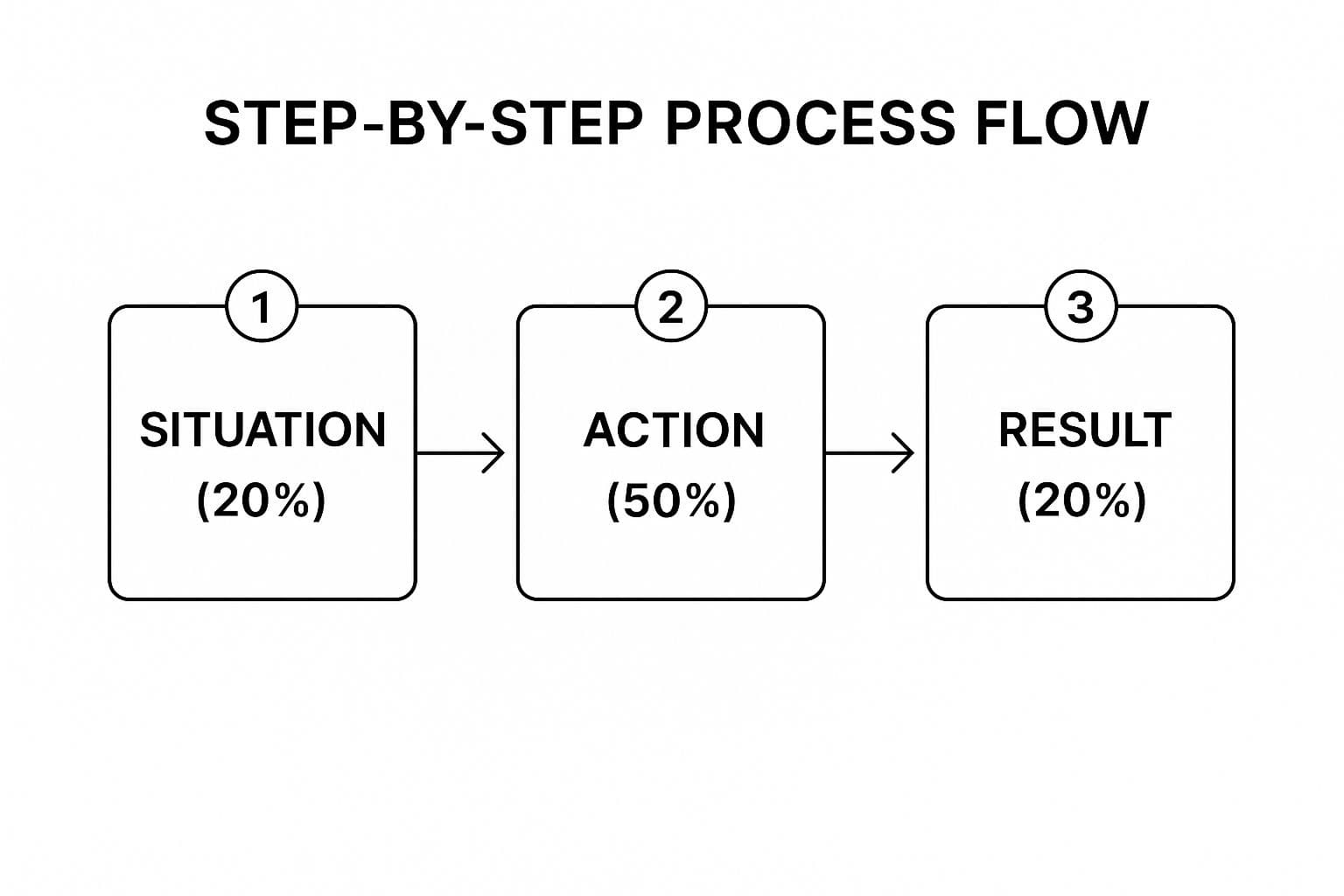
This visual breakdown highlights that the bulk of your answer should detail the specific actions you took, as this is the best indicator of your individual skills and contributions.
3. Strategic Question Asking
Strategic question asking transforms the end of an interview from a formality into a powerful communication opportunity. It involves moving beyond generic inquiries to pose thoughtful, research-based questions that reveal your genuine interest, critical thinking, and strategic mindset. This skill, championed by career experts like Richard Bolles and Laszlo Bock, demonstrates that you view the interview as a two-way evaluation, not just a test.
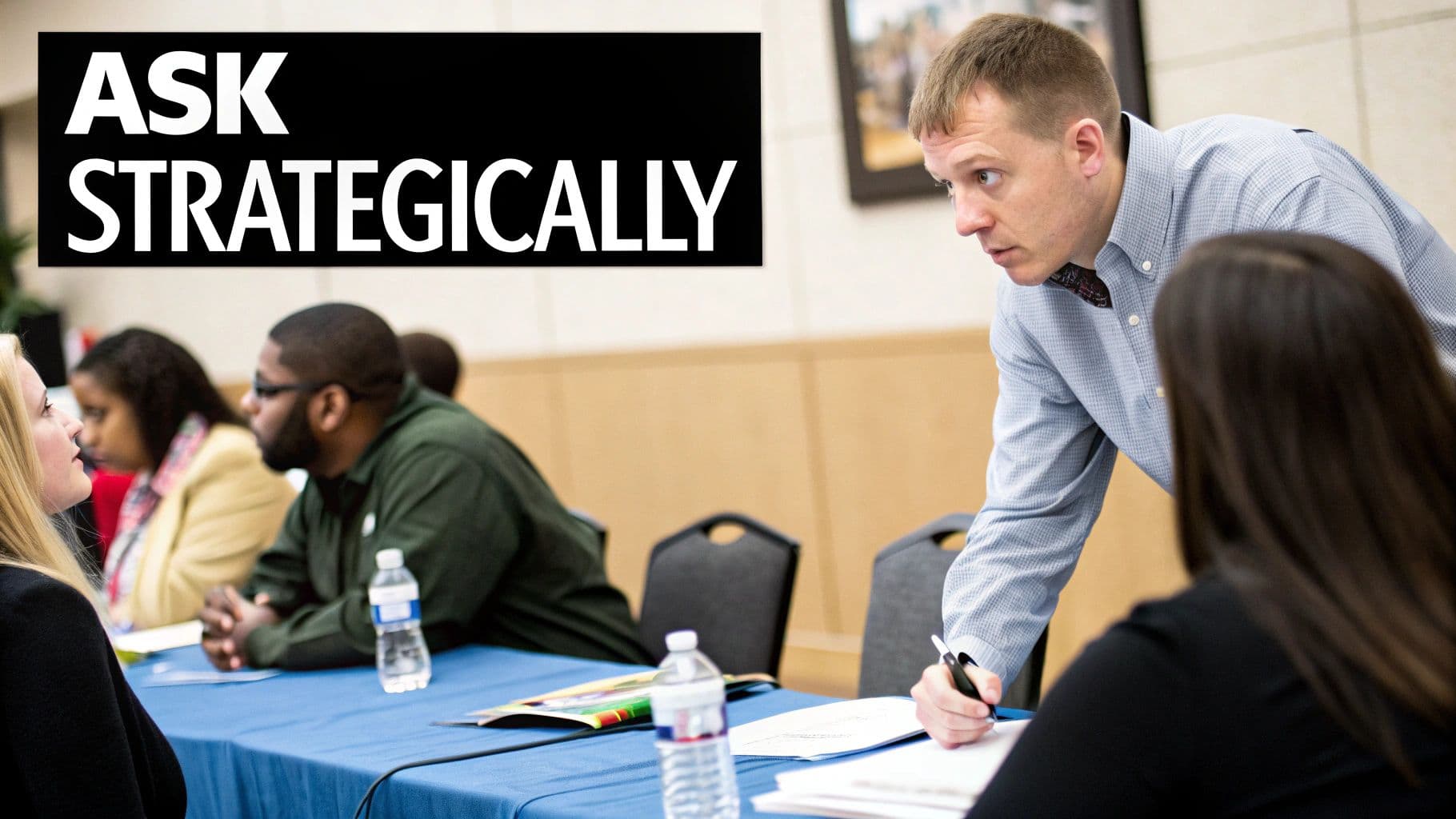
When a candidate asks insightful questions, it signals a deeper level of engagement and preparation. For example, imagine a marketing applicant who researched a recent campaign and then asked about its specific ROI metrics and customer segmentation shows analytical prowess, a quality highly valued in top-tier roles. This approach elevates your candidacy from someone who just wants a job to someone who wants this job.
Why This Skill is Crucial
In competitive interviews for roles in consulting, finance, or tech, the questions you ask can be as important as the answers you give. Asking well-researched questions differentiates you from other qualified candidates and proves you are assessing the role for a long-term fit. It's a chance to display your industry knowledge and see how the company approaches challenges. An engineering candidate, for instance, might ask how the team prioritizes technical debt against new features, showcasing both technical depth and a forward-thinking perspective. For more guidance on this topic, see how to prepare for a consulting interview.
Actionable Tips for Implementation
- Prepare and Prioritize: Develop 5-7 questions based on your research but prioritize them. You will likely only have time for two or three, so lead with your most impactful ones.
- Frame for Success: Instead of asking about duties, frame questions around performance. Ask, "What does success look like in this role six months from now, and what are the key performance indicators?"
- Reference Specifics: Show you've done your homework. Mention a recent company initiative, product launch, or news article in your question, like "I read about your recent expansion into Southeast Asia; what are the biggest challenges the team is currently facing with that initiative?"
- Ask About Their Experience: Make it personal and build rapport. A great question is, "What has been the most surprising or rewarding aspect of your experience working here?"
4. Confident Body Language and Non-Verbal Communication
Non-verbal communication is one of the most powerful yet subtle communication skills for interviews. It encompasses your posture, hand gestures, facial expressions, and eye contact, which collectively signal confidence, engagement, and professionalism. Popularized by experts like Amy Cuddy and Joe Navarro, the principle is that how you present yourself can be just as impactful as what you say.
In an interview, your body language reinforces your verbal messages, making you appear more credible and trustworthy. For example, Amy Cuddy's well-known "power pose" research suggested that standing in an expansive posture for two minutes can make people feel more confident. Be aware that the original hormone and risk-taking findings did not replicate and a co-author has withdrawn support for them, so treat it as a way to feel more at ease, not a proven performance boost.
Why This Skill is Crucial
In competitive interviews for finance or consulting, interviewers are assessing leadership potential and presence from the moment you walk in. Confident non-verbal cues can create a powerful first impression, helping you establish authority and build rapport before you answer a single question. Interviewers form impressions quickly, and purposeful, visible hand gestures tend to read as engaged and confident, so body language can support the message you deliver in words.
Actionable Tips for Implementation
- Try an Expansive Posture: Before your interview, spend two minutes standing tall with your shoulders back. It may help you feel more confident, though the evidence is for how you feel, not for how you are rated.
- Sit to Engage: Sit upright and lean slightly forward in your chair to non-verbally communicate interest and engagement in the conversation.
- Use Purposeful Hand Gestures: Keep your hands visible (not hidden under the table) and use them to emphasize key points in your answers. Avoid fidgeting or nervous habits.
- Master the Video Interview Frame: For virtual interviews, ensure your camera is at eye level. Look directly into the camera lens when speaking to simulate direct eye contact with the interviewer.
5. Concise and Impactful Communication
Concise communication is a critical skill for interviews that involves delivering complete, meaningful answers without unnecessary elaboration. It’s about distilling complex ideas into their most potent form, using clear language and eliminating filler words. This technique, championed by experts like Barbara Minto through her Pyramid Principle, signals respect for the interviewer's time and demonstrates clarity of thought.
Interviewers often conduct back-to-back sessions and value candidates who can provide substantive, powerful answers efficiently. By keeping responses to around 90 seconds, you prove you can synthesize information and focus on what truly matters, a highly sought-after trait in any fast-paced professional environment.
Why This Skill is Crucial
In competitive interviews for roles in consulting, tech, or finance, rambling is a red flag. It can suggest a lack of preparation, disorganized thinking, or an inability to identify core issues. Concise communication, on the other hand, projects confidence and expertise. When a software engineer condenses a complex system design explanation into a crisp 90-second overview using analogies, they demonstrate both technical mastery and superb communication skills. This ability to be both brief and brilliant leaves a lasting, positive impression.
Actionable Tips for Implementation
- Adopt the "Headline First" Approach: State your main point or conclusion in the first sentence. Then, use the rest of your time to provide the essential supporting details.
- Use the Traffic Light Rule: Mentally time your answers. Aim for green (under 60 seconds), be cautious in yellow (60-120 seconds), and stop before you hit red (over 2 minutes).
- Practice with a Timer: Record yourself answering common interview questions like "Tell me about a time you led a project." Play it back to identify and cut filler words and repetitive phrases.
- Create a Mental Outline: Before speaking, structure your answer: an opening statement, two to three key supporting points, and a concluding sentence. This prevents meandering.
6. Authentic Enthusiasm and Cultural Fit Demonstration
Authentic enthusiasm is a powerful communication skill for interviews that involves genuinely conveying your excitement for the role, company, and its mission. This goes far beyond saying "I'm passionate about this industry"; it requires demonstrating a deep connection through specific, well-researched examples. This approach, championed by leaders like the late Tony Hsieh of Zappos, shows that your personal values align with the company's culture.
When an interviewer is choosing between several highly qualified candidates, cultural fit often becomes the deciding factor. Demonstrating that you not only have the skills but also share the company's core principles makes you a more memorable and desirable candidate. Your genuine excitement is contagious and leaves a lasting positive impression that can set you apart.
Why This Skill is Crucial
In competitive fields like finance and consulting, technical skills are a baseline expectation. Authentic enthusiasm signals a deeper level of commitment and suggests you are more likely to thrive in the company's environment and contribute positively to the team. A candidate who can articulate a personal connection to the company’s mission, like referencing Salesforce’s 1-1-1 philanthropic model and sharing relevant volunteer experience, creates an immediate and powerful bond that a resume alone cannot achieve. It shows you aren't just looking for a job; you're looking for a place to belong.
Actionable Tips for Implementation
- Research Beyond the Surface: Go deeper than the "About Us" page. Find the company’s mission statement and core values, then prepare 2-3 brief, personal stories that demonstrate your alignment with them.
- Share Your "Why": Connect your personal story to the company's purpose. For example, if interviewing at Patagonia, share a genuine story about your connection to environmental conservation.
- Reference Recent Achievements: Mention a recent company milestone, product launch, or news article that impressed you. Say why it resonated with you, connecting it back to the role or company values.
- Use Vocal Energy: Let your excitement show in your voice. Vary your pitch and tone when you say phrases like, "I was particularly excited to learn about..." This vocal energy is a key part of your communication skills for interviews.
- Reinforce in Your Follow-Up: Use your thank-you note to reiterate your enthusiasm, referencing a specific point from the conversation that resonated with you. For roles in competitive sectors like venture capital, demonstrating this alignment is non-negotiable. You can read more about how to prepare for a venture capital interview on soreno.ai.
7. Confident Handling of Difficult Questions
Confident handling of difficult questions involves maintaining composure and providing thoughtful, strategic responses when faced with challenging inquiries. This essential communication skill for interviews is about addressing topics like weaknesses, employment gaps, or failures with honesty and a positive frame. The approach, influenced by the work of figures like Brené Brown on authenticity and Carol Dweck on growth mindsets, turns potential red flags into opportunities to demonstrate resilience and self-awareness.
Interviewers don't ask these questions to trap you; they use them to assess your emotional intelligence, problem-solving skills, and ability to handle pressure. A panicked or defensive answer can undermine an otherwise strong performance, while a poised response can significantly elevate your candidacy.
Why This Skill is Crucial
In competitive interviews, every answer matters. Your ability to navigate tough questions about a past failure or a professional weakness reveals more about your character than a straightforward question about your strengths. For instance, a candidate asked about a weakness might discuss a past struggle with delegation and detail the specific management training they completed to improve. This reframes the weakness into a story of growth and proactive development, showcasing a key leadership trait. This skill is critical for answering many common behavioral interview questions for consulting.
Actionable Tips for Implementation
- Use the Acknowledge-Reframe-Evidence Technique: First, acknowledge the challenge (e.g., an employment gap). Then, reframe it as a period of growth ("I used that time for professional development"). Finally, provide evidence ("I earned my PMP certification").
- Frame Weaknesses Around Growth: Choose a real but non-critical weakness. Structure your answer using a "situation-improvement-result" framework, focusing most of your time on the steps you took to improve.
- Focus on the Future: When asked why you left a previous job, avoid criticizing your former employer. Instead, focus on what you are moving toward in this new role, such as new challenges, growth opportunities, or alignment with the company's mission.
- Prepare a Salary Range: For salary questions, state a well-researched range rather than a single number. Qualify it by saying, "...depending on the full compensation package," to maintain flexibility.
8. Professional Virtual Communication Presence
Professional virtual communication presence involves mastering the technical and interpersonal skills specific to video interviews. It encompasses everything from camera positioning and lighting to digital body language and managing the unique challenges of remote communication. With the rise of platforms like Zoom and Microsoft Teams, this skill ensures you project confidence and professionalism, even through a screen.
As remote-first companies like GitLab conduct entire hiring processes remotely, and many others run at least some rounds over video, a candidate's ability to navigate the virtual landscape is a direct reflection of their adaptability and tech-savviness. A polished virtual presence proves you can thrive in a modern, often remote, work environment and represents a critical component of your overall communication skills for interviews.
Why This Skill is Crucial
In a virtual setting, technical glitches or a poor setup can distract from your qualifications and create a negative first impression. Mastering virtual communication demonstrates foresight, attention to detail, and respect for the interviewer's time. It shows you understand the nuances of modern professional etiquette and can represent the company effectively in a remote or hybrid context. A candidate who proactively manages their digital environment is seen as more reliable and prepared than one who is fumbling with technology.
Actionable Tips for Implementation
- Optimize Your Technical Setup: Test your camera, microphone, and internet connection at least 30 minutes prior. Use a wired connection if possible for stability and close all non-essential applications to maximize bandwidth.
- Master Your Framing and Lighting: Position your camera at eye level by placing your laptop on a stack of books or a stand. Ensure you are well-lit from the front, using a ring light or facing a window, to avoid shadows.
- Simulate In-Person Engagement: Look directly into the camera lens when speaking to create a sense of direct eye contact. Use gestures naturally within the frame and nod to show you are engaged while the interviewer is talking.
- Prepare for Contingencies: Have a backup plan. Keep your phone nearby, fully charged, in case your primary device fails. Also, have the interviewer's contact information readily accessible to quickly communicate any technical issues.
Thinking on Your Feet: The PREP Structure
STAR works for stories about your past. For questions that ask for an opinion or a quick answer on the spot, such as "What would you do first?" or "Do you agree with this approach?", use PREP, a four-part structure that stops you from rambling:
- Point: lead with your answer.
- Reason: say why you think so.
- Example: give one specific piece of evidence or an example.
- Point: restate your answer to close.
For example, asked whether a company should switch to new project software: "I think the switch is the right move. The main reason is that it connects directly to our sales platform, which ends the manual data entry that slows the team down. Last week, the marketing team spent hours reconciling campaign data between the two systems, and this would automate it. So based on that efficiency gain, I would switch." That takes about 30 seconds and every sentence does a job.
Two short drills build the habit. In the 60-second explainer, pick any object in the room and pitch it for one minute as if it were a great invention, which trains you to find the key benefits and tell a small story under time pressure. In the random-word drill, pick two unrelated words and build a logical bridge between them in a minute, which trains you to make connections quickly.
Calming Nerves and Controlling Your Pace
Nerves show up as fast speech, filler words and a shaky voice. Three habits help.
- Box breathing before you start. Breathe in through your nose for four seconds, hold for four, breathe out slowly for four and hold for four. Repeat for about two minutes. Slow breathing with a steady rhythm is widely used to calm the body's stress response, and nobody can see you doing it in the waiting room or before a video call.
- Use the pause. Speaking too fast is one of the most common signs of nervousness. A short pause before a key point gives the point more weight and gives you a moment to think. To practice, record yourself for a minute and listen for where you rush, then record again with a two-second pause at commas and a three-second pause at the end of sentences.
- Replace fillers with silence. Words like "um," "like" and "you know" dilute your message. Do not just try to stop. Notice the urge, stop, and take a silent breath instead. It will feel long to you, but to the listener a pause sounds confident.
Communication Skills Comparison Matrix for Interviews
| Skill / Method | Implementation Complexity 🔄 | Resource Requirements ⚡ | Expected Outcomes 📊 | Ideal Use Cases 💡 | Key Advantages ⭐ |
|---|---|---|---|---|---|
| Active Listening and Reflective Responses | Medium (requires focus, practice) | Low (mental energy, note-taking) | Higher interpersonal ratings, fewer misunderstandings | Behavioral & technical interviews needing clarity and rapport | Demonstrates emotional intelligence; reduces misunderstandings |
| STAR Method for Structured Storytelling | Medium-high (requires prep, practice) | Medium (time to prepare stories) | Clear, impactful examples with measurable results | Behavioral questions, competency demonstration | Prevents rambling; highlights accountability and results |
| Strategic Question Asking | Medium (needs research, planning) | Low-medium (research time) | Differentiates candidate; provides decision-making info | Two-way interviews assessing cultural/role fit | Shows preparation, strategic thinking, genuine interest |
| Confident Body Language and Non-Verbal Communication | Medium (practice and awareness needed) | Low (self-awareness, rehearsal) | Positive first impressions; increased credibility | All interview types, especially in-person or video | Enhances confidence and rapport; reinforces verbal messages |
| Concise and Impactful Communication | Medium (practice to refine skill) | Low (self-review, timing practice) | Clear, engaging answers respecting time constraints | Fast-paced or multiple interviews; technical & behavioral questions | Keeps interviewer engaged; reduces filler words and rambling |
| Authentic Enthusiasm and Cultural Fit Demonstration | Medium (requires self-reflection, prep) | Low-medium (research and personal stories) | Emotional connection; perceived cultural fit | Early-stage interviews, culture-focused roles | Differentiates candidate; signals motivation and alignment |
| Confident Handling of Difficult Questions | High (preparation & emotional control needed) | Medium (practicing scenarios) | Builds trust; shows resilience & honesty | Questions about weaknesses, gaps, sensitive topics | Demonstrates emotional intelligence; reframes challenges positively |
| Professional Virtual Communication Presence | Medium (tech setup + behavior adjustment) | Medium-high (equipment, environment) | Smooth remote interviews; professional virtual presence | Remote or hybrid interviews; virtual networking | Minimizes tech issues; improves rapport despite distance |
From Practice to Performance: Mastering Your Interview Communication
We have explored the essential communication skills for interviews that can elevate your candidacy from promising to undeniable. Moving beyond a simple checklist, we've seen how these eight pillars work in concert to build a compelling and authentic professional narrative. This isn't just about saying the right things; it's about creating a powerful, lasting impression that showcases your true potential.
The journey from understanding these concepts to executing them flawlessly under pressure is bridged by one crucial activity: deliberate practice. Mastering the STAR method isn’t about memorizing a script, but about internalizing a structure that makes your stories resonate. Projecting confident body language isn't an act; it's the natural result of feeling prepared and at ease. Each skill, from active listening and strategic questioning to demonstrating authentic enthusiasm, contributes to a holistic and persuasive performance.
Weaving the Skills into a Cohesive Narrative
Think of these skills not as isolated techniques but as interconnected threads.
- Active listening allows you to gather the insights needed to ask strategic questions.
- The STAR method provides the framework for concise and impactful communication.
- Confident body language and a strong virtual presence amplify the authentic enthusiasm you convey.
When you can confidently handle difficult questions and articulate your value with clarity, you demonstrate more than just competence; you signal to the interviewer that you are a poised, thoughtful, and high-caliber professional ready for the challenges of the role. The ultimate goal is to make these advanced communication skills for interviews feel like second nature, so you can focus on the conversation itself, not on the mechanics of your delivery.
Your Actionable Path Forward
Transforming this knowledge into a competitive advantage requires a commitment to application. Don't wait until the week before your big interview to start. Begin integrating these techniques into your daily professional interactions, networking calls, and informational interviews.
Record yourself answering common behavioral questions. Pay close attention to your pacing, your use of filler words, and the clarity of your message. Ask a trusted mentor or peer for feedback, specifically on the non-verbal cues you are sending. This consistent, focused effort is what separates a good candidate from a great one. By investing time in honing these skills now, you are not just preparing for an interview; you are building a foundational toolkit for your entire career, ensuring you can articulate your value and influence outcomes in any professional setting. The confidence you build is your greatest asset.
Ready to turn theory into performance? Soreno provides an AI-powered platform to practice your interview skills with an MBB-trained virtual interviewer, giving you instant, actionable feedback on everything from your word choice to your delivery. Refine your communication in a risk-free environment and walk into your next interview with unshakable confidence by visiting Soreno to start your preparation today.