
How to Improve Presentation Skills and Present with Confidence
Learn how to improve presentation skills with our guide on storytelling, confident delivery, and visual design, tailored for high-stakes interviews.

Before you can start improving your presentation skills, you first have to figure out where you stand. It's a bit like a doctor diagnosing a patient—you can't prescribe the right treatment without knowing the symptoms. So, we're going to start with an honest, clear-eyed look at your current abilities.
This isn't about guessing or just going with a gut feeling that you "need to be more confident." We're going to get concrete data on your delivery, structure, and visual clarity. This diagnostic approach turns a vague goal like "get better at presenting" into a focused, actionable plan.
Pinpoint Your Strengths and Weaknesses

To build elite presentation skills, you need an honest starting point. Vague feelings won't cut it. The path to real improvement starts by pinpointing exactly what's working and what isn't.
Think of it this way: you wouldn’t try to fix a car engine without looking under the hood first. Same principle applies here. We need to move from subjective feelings to objective analysis. A big piece of this is understanding the difference between soft skills and hard skills, since presenting is one of the most critical soft skills you can develop.
Create Your Diagnostic Baseline
The single most effective way to get an unbiased look at your skills is to record yourself. Seriously. Set up your phone or webcam and give a short, 5-minute presentation on a topic you know well. Don't aim for perfection—the goal is to capture a realistic snapshot of your current habits.
Now for the tough part: watch it back. But don't just watch it; analyze it with a critical eye. Use a simple framework to score yourself, focusing on three core areas:
- Structure & Clarity: Was your main point obvious from the get-go? Did your arguments flow logically, or did you jump around? Was it easy to follow your train of thought?
- Delivery & Presence: How was your pacing? Most people speak way too fast when they're nervous. Did you lean on filler words like "um," "ah," or "like"? How was your eye contact with the camera (your audience)?
- Visuals (if you used them): Were your slides clean and easy to read in a few seconds? Did they actually support what you were saying, or were they a distraction? Way too much text is a classic mistake.
This exercise can be a bit humbling, but the data you get is invaluable. You might realize you're speaking at 180 words per minute, when a more conversational and confident pace is closer to 150. Or maybe you'll discover that you say "basically" every other sentence. These are the specific, fixable issues you can start targeting immediately.
The point of self-assessment isn't to be self-critical; it's to be self-aware. Objective data is the foundation of any real improvement plan. It turns abstract anxieties into concrete goals.
Leverage Technology for Deeper Insights
While watching yourself is a huge step, AI-powered tools can give you a level of data-driven analysis that's nearly impossible to do on your own. Platforms like Soreno, for instance, can give you a quantitative breakdown of your performance, creating a personalized roadmap from your very first practice run.
These tools can analyze your recordings and deliver precise metrics on things like:
- Pacing and Pauses: Pinpointing moments where you rushed or, just as importantly, where you missed an opportunity to use a pause for dramatic effect.
- Filler Word Frequency: Literally counting every "um" and "ah" to show you just how often you rely on these verbal tics.
- Eye Contact Duration: Measuring how consistently you engage the camera, which is a great proxy for audience engagement in a real-world setting.
This kind of data-backed feedback removes all the guesswork. Knowing you have a fear of public speaking is one thing, but knowing you use filler words 12 times per minute gives you a specific, measurable target to work on. For a deeper dive into tackling presentation anxiety, our guide on https://soreno.ai/articles/overcoming-fear-of-public-speaking can help.
By combining your own honest self-reflection with this kind of objective data, you'll have a crystal-clear, actionable list of exactly what you need to improve.
Structure Your Story Like a Top Consultant

A powerful presentation isn't just a collection of facts; it’s a story built to persuade. In the fast-paced worlds of consulting and finance, your audience simply doesn't have time for rambling explanations. They need your core message upfront, followed by the logical proof that backs it up.
This is where you need to start thinking like a top-tier consultant. It means abandoning the old habit of building your case chronologically and saving the big reveal for the end. You have to lead with your conclusion. This isn't just about style—it's a strategic communication technique that shows you respect your audience's time and intelligence.
The Pyramid Principle in Action
The secret weapon for elite consulting communication is the Pyramid Principle. This framework, made famous by firms like McKinsey & Company, completely flips traditional storytelling. You start with the answer, then lay out your supporting arguments, and finally, present the hard data that makes your case undeniable.
Think about it in the context of a case interview. Instead of walking the interviewer through every single piece of analysis you performed, you open with the final recommendation. For example: "My recommendation is that the company should enter the South American market by acquiring a local distributor."
That single sentence immediately focuses the entire room. Everyone knows exactly what you're trying to prove. From that point on, every chart you show and every point you make serves to directly support that opening statement, creating a logical, easy-to-follow flow. It’s the best way to show you can think clearly under pressure.
Building Your Narrative Arc
Once you’ve stated your core recommendation, your next job is to build a compelling story around it. Your supporting arguments need to be grouped into logical themes. Think of these as the main chapters of your story, with each one proving a critical piece of your overall conclusion.
A solid narrative structure often looks like this:
- Main Conclusion: The definitive answer you're recommending.
- Supporting Argument 1: The first key pillar (e.g., The Market Opportunity is Massive).
- Supporting Argument 2: The second key pillar (e.g., The Competitive Landscape is Favorable).
- Supporting Argument 3: The third key pillar (e.g., The Acquisition is Financially Viable).
Of course, each of these arguments must be backed by hard data and specific analysis. This layered approach doesn't just make you more persuasive; it proves you can synthesize a mountain of complex information into a clear, compelling story.
"A great presenter doesn't just share data; they guide the audience on a logical journey. The structure is the roadmap that ensures no one gets lost along the way."
For instance, under "The Market Opportunity is Massive," you would show the data on total addressable market size, growth rates, and key customer segments. This turns your argument from a simple opinion into a data-driven conclusion.
Ensuring Your Logic Is Airtight
To make your structure truly bulletproof, every point must be MECE—that’s Mutually Exclusive, Collectively Exhaustive. This principle is another cornerstone of consulting logic. It’s a fancy way of saying your arguments should cover all the important bases without stepping on each other's toes.
-
Mutually Exclusive means each of your supporting points is distinct. You wouldn't have one argument about "Market Size" and another about "Revenue Potential"—they’re too similar and create a muddled, redundant message.
-
Collectively Exhaustive means you haven’t left any giant holes in your argument. If you're recommending an acquisition, you need to cover the market, the competition, the target's own strengths, and the financial reality. If you skip one, an experienced interviewer will find that hole in your logic immediately.
Mastering these frameworks will fundamentally change how you present. You’ll stop listing facts and start building a persuasive, logical case that guides your audience from problem to solution with clarity and confidence.
Design Visuals That Clarify, Not Complicate

In a high-stakes consulting or finance interview, your slides are your evidence, not your script. They’re there to back up your story, not to be the story. Think of it this way: effective visuals prove you can distill complex data into crisp, executive-ready insights—a non-negotiable skill at any top firm.
This is exactly where so many candidates drop the ball. They pack their slides with dense text, convoluted charts, and distracting graphics. The real goal is to create slides that an interviewer can grasp in a single glance, keeping their focus squarely on you and the narrative you’re weaving.
Adopt a "Less is More" Design Philosophy
Nothing says "I know my stuff" like simplicity. When it comes to slide design, a clean, uncluttered layout shows you have a rock-solid command of your material and aren't hiding behind a wall of text.
Try to stick to the Rule of Three. Our brains are wired to digest information in small groups, and three is a magic number. This can be three bullet points, three key takeaways, or three columns in a chart. Learning to resist the urge to add "just one more thing" is a critical discipline.
A few core principles to live by:
- Embrace white space. Don't be scared of empty areas on your slide. This negative space is your friend—it gives your content room to breathe and pulls the viewer's eye to what truly matters.
- Keep branding consistent. Settle on a simple color palette, one or two professional fonts, and a consistent logo placement. It creates a polished, cohesive look that screams professionalism.
- Prioritize high-contrast text. Make sure your words are easy to read from a distance. You can't go wrong with the classic dark text on a light background.
Make Every Slide Title a Headline
The most valuable real estate on your slide is the title. Don’t waste it with a lazy, generic label like "Market Analysis" or "Financial Data." You need to turn every title into an action-oriented headline that spells out the slide's main point.
This simple trick immediately answers the "so what?" question for your audience. Before they even scan your chart or bullets, they know exactly what conclusion you want them to reach.
Look at the difference this makes:
| Weak Title (Passive) | Strong Title (Action-Oriented) |
|---|---|
| Revenue by Region | Aggressive Growth in APAC Region Presents Key Expansion Opportunity |
| Competitor Analysis | Competitor B's Weak Supply Chain Creates an Opening for Market Entry |
| Financial Projections | Projected 15% EBITDA Margin Achievable Within Three Years |
This small adjustment transforms your deck from a passive data dump into a series of persuasive, confident statements.
Your slide title should be a complete sentence that communicates the single most important message of that slide. If your audience only read your titles, they should still understand the core of your argument.
Choose the Right Chart for the Job
This is a classic rookie mistake. Picking the wrong chart type can completely muddy your message and leave your audience scratching their heads. Every chart is designed for a specific purpose; your job is to pick the one that tells your data’s story most clearly.
Here’s a quick guide for your toolkit:
- Bar Charts are your go-to for comparing distinct categories. Use them to show which product line is most profitable or how your company’s revenue stacks up against competitors.
- Line Charts are perfect for showing trends over time. They are the best choice for illustrating revenue growth, stock performance, or shifts in customer acquisition costs.
- Waterfall Charts are a consultant’s secret weapon. They are incredibly powerful for showing how a starting value is affected by a series of positive and negative changes, like explaining a shift in profit from one year to the next.
- Pie Charts should be used with extreme caution. They only work when showing parts of a whole with very few categories—ideally no more than three or four. Any more than that, and it becomes a meaningless blob of color.
Once you’ve picked the right chart, keep it clean. Get rid of distracting gridlines, redundant labels, and any 3D effects. Use color strategically to highlight the one data point you really want them to see. Mastering these visual fundamentals is a huge step in learning how to improve presentation skills for a tough professional audience.
Refine Your Delivery and On-Screen Presence
You can have the most brilliant, data-backed argument in the world, but if the delivery falls flat, so does the message. It's a hard truth. I've seen countless candidates with great ideas lose their audience because of a monotone voice, nervous energy, or a total lack of connection.
Polishing your delivery isn't about being fake; it's about mastering the mechanics of confidence. It's about turning those nervous habits we all have into a style that's both polished and genuinely credible, whether you're in a boardroom or presenting from your home office.
Find Your Voice (and Use It)
Your voice is your most powerful tool for keeping people engaged. A flat, monotonous delivery is an express train to a tuned-out audience. The key is vocal variety—learning to play with your pacing, tone, and volume to keep your listeners leaning in.
Think of it like music. A song with no change in tempo or dynamics is just noise. Your voice works the same way.
- Pacing: When nerves kick in, we all tend to speed up. The first step is to consciously slow down to a conversational pace, somewhere around 140-160 words per minute. But the real art is using pace strategically. Speed up a bit when you're building excitement, then slow right down to land a critical point. That contrast is what makes people listen.
- Tone and Pitch: Your tone should reflect your content. A lower pitch can signal authority, while a higher one can bring energy and enthusiasm. The one thing to watch out for is "uptalk," where you end statements on a rising inflection. It makes you sound like you're asking a question and can really undermine your credibility.
- Volume: Use volume to create contrast and draw people in. You can speak a bit more softly to make an audience listen closely, then return to a normal volume for your main points. A sudden (but not shouting!) increase in volume can really punctuate a key takeaway. Just use it sparingly.
The Power of the Pause
Filler words—the "ums," "ahs," "likes," and "you knows"—are dead giveaways of nerves or a lack of preparation. They clutter your message and slowly chip away at your authority.
The antidote? The strategic pause.
It feels counterintuitive, but when you feel an "um" about to slip out, just stop. Take a breath. Be silent for a second or two. This isn't awkward; it's powerful. A well-placed pause gives your audience a moment to digest what you just said and builds anticipation for what comes next. It shows you're in complete control.
A pause is not dead air. It is a moment for your audience to think and for you to command attention. It shows you are in control of your message, not just rushing to fill the silence.
Here’s a simple drill: record yourself talking for 60 seconds about anything. Play it back and count every single filler word. Now do it again, aiming to cut that number down. You're consciously replacing those fillers with silence, building the muscle memory you need for a cleaner, more impactful delivery.
Commanding the Screen
In our hybrid world, mastering your on-screen presence isn't optional anymore. With 25.34% of UK workers relying on video calls in 2023, your ability to project confidence through a camera is a core skill.
Here are the non-negotiables for a strong virtual presence:
- Look at the Camera, Not the Screen: This is the golden rule. It's tempting to look at your own image or the faces on the screen, but you have to train yourself to look directly into the camera lens. This is what creates the feeling of direct eye contact for everyone watching, and it's a massive trust-builder. For a deeper dive, check out our guide on how to improve eye contact.
- Use Purposeful Gestures: Your body language still matters, even in a small window. Use controlled hand gestures within the frame to add emphasis. The key is to avoid fidgeting and instead use open, deliberate movements that make you appear more dynamic and confident.
- Mind Your Posture and Framing: Sit up straight or, even better, stand. Good posture instantly projects more energy. You’ll want to frame yourself from the chest up, giving your audience a clear view of your facial expressions and upper-body gestures. Some people even find that striking a few power poses before a big presentation helps them feel more grounded.
This is an area where practice tools like Soreno really shine. An AI-powered mock interview platform can give you objective, data-driven feedback on these exact metrics—from your eye contact percentage to how often you use filler words. It’s a way to practice in a realistic setting and get the targeted feedback you need to turn nervous habits into a truly polished delivery.
Handle Tough Questions with Poise and Structure
Let's be honest: the Q&A session is where the real interview begins. It's the moment you step away from the safety of your prepared slides and show them how you really think. This isn't an epilogue; it's the main event where they test your composure, critical thinking, and executive presence under fire.
Too many candidates just cross their fingers and hope for softballs. That’s a mistake. The best candidates I've seen treat the Q&A as their final, most convincing opportunity to drive home their core message and prove they’ve considered every angle. The goal isn't just to answer questions—it's to command the room with structured, confident responses that build even more credibility.
Anticipate Challenges Before They Happen
The secret to acing a tough Q&A is simple: there should be no surprises. Before you even think about presenting, you need to put on your most skeptical "Partner" hat and tear your own arguments apart. Brainstorm every possible objection, weakness, and worst-case scenario.
Think through the likely lines of attack:
- Financial Risks: What if your revenue forecast is wildly optimistic? Which three assumptions in your model are most likely to be wrong?
- Operational Hurdles: What’s the single biggest roadblock to implementation? Does the client actually have the talent to pull this off?
- Competitive Reactions: What happens when your top competitor responds? Are you prepared for a price war?
Walking in with pre-vetted answers to these hard-hitting questions is a game-changer. It shows you've done the deep thinking required and prevents you from getting flustered when the pressure is on.
The PREP Method for Clear Answers
When a tough question hits, the natural instinct is to start talking and hope you find an answer along the way. Resist that urge. For a crisp, powerful response, lean on a simple framework I teach all my clients: the PREP method.
- Point: Give a direct, one-sentence answer right away. No waffling.
- Reason: Briefly explain the "why" behind your point. What’s your logic?
- Example: Back it up with a specific data point, a quick anecdote, or a concrete example from your analysis. Make it real.
- Point: Circle back and restate your main point to wrap it up neatly.
This structure is your best friend under pressure. It keeps you from rambling and demonstrates clear, logical thinking. It’s a core component of being able to how to think on your feet in high-stakes situations.
A structured answer is a confident answer. The PREP method gives you a reliable mental model to fall back on when the pressure is on, ensuring your responses are as polished as your presentation.
Gracefully Handling the Unknown
Sooner or later, you'll get a question you truly don't know the answer to. This isn't a failure—it's a test of your professional maturity. The absolute worst thing you can do is try to fake it. You’ll lose all credibility in an instant, and that’s far more damaging than admitting a gap in your knowledge.
Instead, handle it with poise. Acknowledge it’s a great question, then pivot to what you do know. Try something like, "That's a sharp question. While I don't have the specific market share data for that sub-segment, our analysis of the broader market trends suggests..."
This approach accomplishes two things: it shows you're honest, and it proves you can stay calm and collected. Offering to follow up with the precise information afterward also scores major points for diligence. Mastering the Q&A transforms a potential minefield into your moment to shine.
Your 30-Day Plan to Presentation Mastery
Real improvement doesn't happen overnight. It’s built through smart, consistent practice. I've designed this 30-day schedule specifically for busy candidates who need a clear roadmap without the guesswork.
Each week builds on the last, so you’re layering skills methodically. This isn't about just "practicing"; it's about deliberate practice—honing specific skills, getting honest feedback, and making targeted adjustments. This is your path to walking into that high-stakes interview with genuine confidence.
Week 1: Laying the Foundation
The first week is all about diagnosis and structure. You can't fix what you don't know is broken, so we start with an honest look at your current baseline. From there, we'll dive into the logical frameworks that every great consulting or finance presentation is built on.
- Days 1-3 (Diagnosis): Find a quiet room and record yourself giving a 5-minute practice presentation on any business topic. Watch it back and be ruthless. Note every "um," awkward pause, and moment of rambling. For a more objective take, use a tool like Soreno to get a data-driven breakdown of your delivery.
- Days 4-7 (Structure Drills): Time to master the Pyramid Principle. Take three different business problems (e.g., declining profits, market entry, new product launch) and outline a response. Start with your core recommendation first, then map out three MECE (Mutually Exclusive, Collectively Exhaustive) arguments to back it up.
Week 2: Visuals and Delivery Mechanics
Now that you have your structure down, we shift to how you actually show and tell your story. This week is all about crafting clean, impactful slides and honing the verbal delivery that projects confidence and clarity.
A great presentation feels more like a compelling conversation than a stiff performance. Your real goal is to connect, and that starts with a delivery that feels natural and engaging.
- Days 8-10 (Slide Design): Dig up an old, text-heavy presentation. Pick three slides and completely redesign them. Your mission is to write an action-oriented headline for each and choose the single best chart or visual to make the data’s story pop off the screen.
- Days 11-14 (Delivery Drills): Grab a one-page article from a source like the Wall Street Journal. Read it aloud, aiming for a steady, conversational pace of about 150 words per minute. Record yourself. The goal here is to consciously replace filler words like "uh" or "like" with a powerful, intentional pause.
Week 3: Q&A and Full-Length Practice
This is where the rubber meets the road. Week three is dedicated to handling the toughest part of any presentation—the Q&A session. You'll also start putting all the pieces together in full-length mock presentations to build your stamina and simulate real interview pressure.
When it comes to answering tough questions on the spot, the PREP method is your best friend. It provides a simple, reliable framework for delivering a clear and concise answer every time.
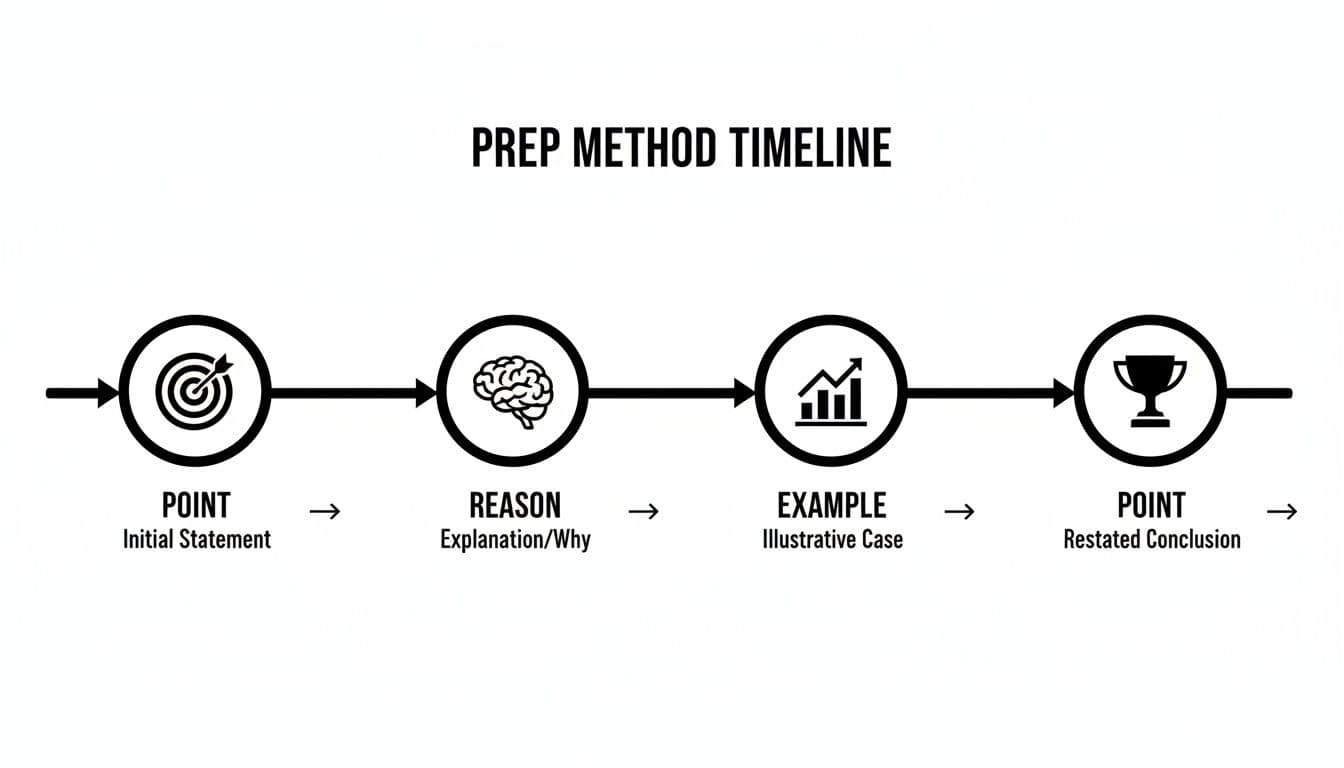
This simple flow—Point, Reason, Example, Point—ensures your answers are direct, well-supported, and don't trail off, even when you're under pressure.
Week 4: Refinement and Final Polish
The final week is all about high-intensity refinement. It’s time to run multiple full-length mock interviews under pressure. The focus now is on receiving sharp, critical feedback and immediately implementing it.
The goal is to make your delivery feel so second-nature that you can dedicate 100% of your mental energy to the content and your audience. By the end of this month, you won’t just be better at presenting—you’ll have a completely new, more confident approach.
Here's how it all breaks down in a simple, actionable plan.
30-Day Presentation Skills Improvement Plan
This structured weekly plan is your blueprint for systematically improving your presentation skills. By focusing on specific areas each week and using targeted drills, you'll see measurable progress.
| Week | Weekly Focus | Key Activities & Drills | Measurement of Success |
|---|---|---|---|
| 1 | Diagnosis & Structure | Record a baseline presentation. Practice the Pyramid Principle with 3 case prompts. | Identified 2-3 key weaknesses. Can structure a recommendation logically. |
| 2 | Visuals & Delivery | Redesign 3 text-heavy slides. Practice pacing drills and filler word reduction. | Slides are visual and have action-oriented headlines. Filler words reduced by 50%. |
| 3 | Q&A & Integration | Practice the PREP method for 5 common questions. Complete a full-length mock presentation. | Can answer unexpected questions clearly. Completed a full mock without major stumbles. |
| 4 | Refinement & Polish | Conduct 2-3 high-pressure mock interviews with a peer or coach. Focus on implementing feedback. | Delivery feels natural and confident. Receive positive feedback on poise and clarity. |
By following this plan, you're not just hoping to get better; you're building a repeatable system for excellence. Stick with it, and the results will speak for themselves.
A Few Common Questions I Get
Even with a detailed roadmap, you're bound to run into specific hurdles. Let's tackle some of the most frequent questions I hear from candidates in the thick of their presentation prep.
How Do I Stop Feeling So Anxious Before a Big Presentation?
Look, a little bit of nervous energy is actually a good thing. It keeps you sharp. The real problem is when that anxiety takes over, and the single best way to beat that is to be completely, unshakeably prepared.
Confidence isn't something you just have; it's what you earn by knowing your material cold. The more you've drilled your content and thought through every possible question, the more you'll feel in command.
Just before you're about to start, take a few slow, deep breaths. Seriously, it works. It's a simple physical trick to calm your nervous system. Try to reframe that fluttery feeling not as fear, but as excitement to share what you've put together.
What's the One Skill That Really Matters for a Consulting Presentation?
If I had to pick just one, it's clarity of thought. Interviewers don't care about flashy animations. They want to see if you can take a messy, complex problem, structure it into a logical argument, and deliver a clear recommendation backed by facts.
Essentially, they're testing if you can think like a consultant.
This is where frameworks like the Pyramid Principle become your best friend. Start with your answer first, then support it with clear, distinct arguments (the whole MECE thing—mutually exclusive, collectively exhaustive). It proves you can cut through the clutter and get straight to the point.
In a consulting interview, a well-structured argument is worth more than a thousand beautiful slides. It's the clearest possible sign that you can do the job.
Realistically, How Long Should I Prepare for a 30-Minute Case Presentation?
There's no single right answer, but a solid benchmark is to set aside 8 to 10 hours of real, focused work. And don't try to cram it all into one night. The key is to spread it out.
Here’s how that time should break down:
- Mapping out your story: This is just you, a whiteboard, and your core argument. What's the narrative? What are the key supporting points?
- Building your slides: Design visuals that support your story, not replace it. Keep them clean and easy to grasp.
- Doing full-on practice runs: Rehearse the entire presentation from start to finish. Record yourself. Do it in front of a friend. This is where you find the awkward phrasing and rough transitions.
Spreading this work over a few days lets the material really settle in your mind. You'll end up delivering a smooth, natural presentation, not just reciting a script you memorized the night before.
Ready to turn theory into practice? Soreno gives you the mock interview reps and data-backed feedback you need to build real presentation muscle. Start your free trial today and walk into your next interview feeling completely prepared.