
How to Build a Business Case That Gets Approved Every Time
Learn how to build a business case with our actionable guide. We cover problem definition, financial analysis, and risk mitigation to get your project funded.

Building a business case is all about creating a structured, persuasive argument to get a project or a major purchase signed off. It's where you define a real business problem, weigh your options, and make a rock-solid recommendation that lines up with the company's bigger goals—and, crucially, shows how it's going to pay off.
Why a Great Idea Is Not Enough
Every big project starts with a good idea. But to get that idea off the whiteboard and into the budget, you need more than just enthusiasm; you need a story backed by hard numbers. A well-constructed business case is the single most important tool you have for turning a concept into an actionable, fundable plan.
It fundamentally changes the conversation. You're no longer making a subjective 'ask.' Instead, you're presenting an objective, data-driven proposal in the language executives understand: risk, reward, and return. Without this structured justification, even the most brilliant ideas get sidelined by other priorities or written off as too risky. The business case gives decision-makers the logical framework they need to commit resources confidently.
The Bridge from Concept to Commitment
Think of your business case as the bridge connecting your vision to the company's strategic goals. It’s more than just a document; it’s a rigorous thinking exercise. It forces you to pressure-test your assumptions, poke holes in your own logic, and plan for roadblocks before a single dollar is spent.
For example, just pitching an "AI-powered analytics platform" because it’s new and exciting won't get you very far. Building a proper business case forces you to get specific and quantify the actual value.
- Will it reduce operational costs by automating 500 hours of manual data entry each month?
- Can it increase revenue by flagging customer churn risks 25% faster than the old system?
- Does it improve decision-making by delivering real-time insights that could capture an extra 5% of market share?
A business case transforms a good idea into a sound investment. It provides the evidence, rigor, and strategic alignment necessary for executives to say "yes" without hesitation.
This methodical approach is often the deciding factor that unlocks resources and keeps your project from dying on the vine.
Before we dive into the "how," let's outline the key components that make a business case work. This table breaks down the core elements that consistently win approval. Use it as a quick reference for the sections we'll be building throughout this guide.
The Anatomy of a Compelling Business Case
| Component | What It Does | The Core Question It Answers for Executives |
|---|---|---|
| Executive Summary | Provides a high-level overview of the entire case on a single page. | "What's the bottom line? Why should I care?" |
| Problem Statement | Clearly defines the business pain point or opportunity. | "What specific problem are we trying to solve here?" |
| Objectives & Goals | Sets measurable success criteria (e.g., reduce costs by 15%). | "What does success look like, and how will we measure it?" |
| Options Analysis | Evaluates several potential solutions, including the "do nothing" option. | "What are all our options, and what are the pros and cons of each?" |
| Financial Model | Quantifies the costs, benefits, ROI, NPV, and break-even point. | "What's the financial impact? When will we see a return?" |
| Risk Assessment | Identifies potential risks and outlines clear mitigation strategies. | "What could go wrong, and what's our plan to handle it?" |
| Implementation Plan | Lays out the timeline, key milestones, and resource requirements. | "How and when will this get done, and who is responsible?" |
Having these pieces in place gives decision-makers everything they need to make an informed, confident choice.
The journey from a simple idea to an approved project is a structured one, as shown below.
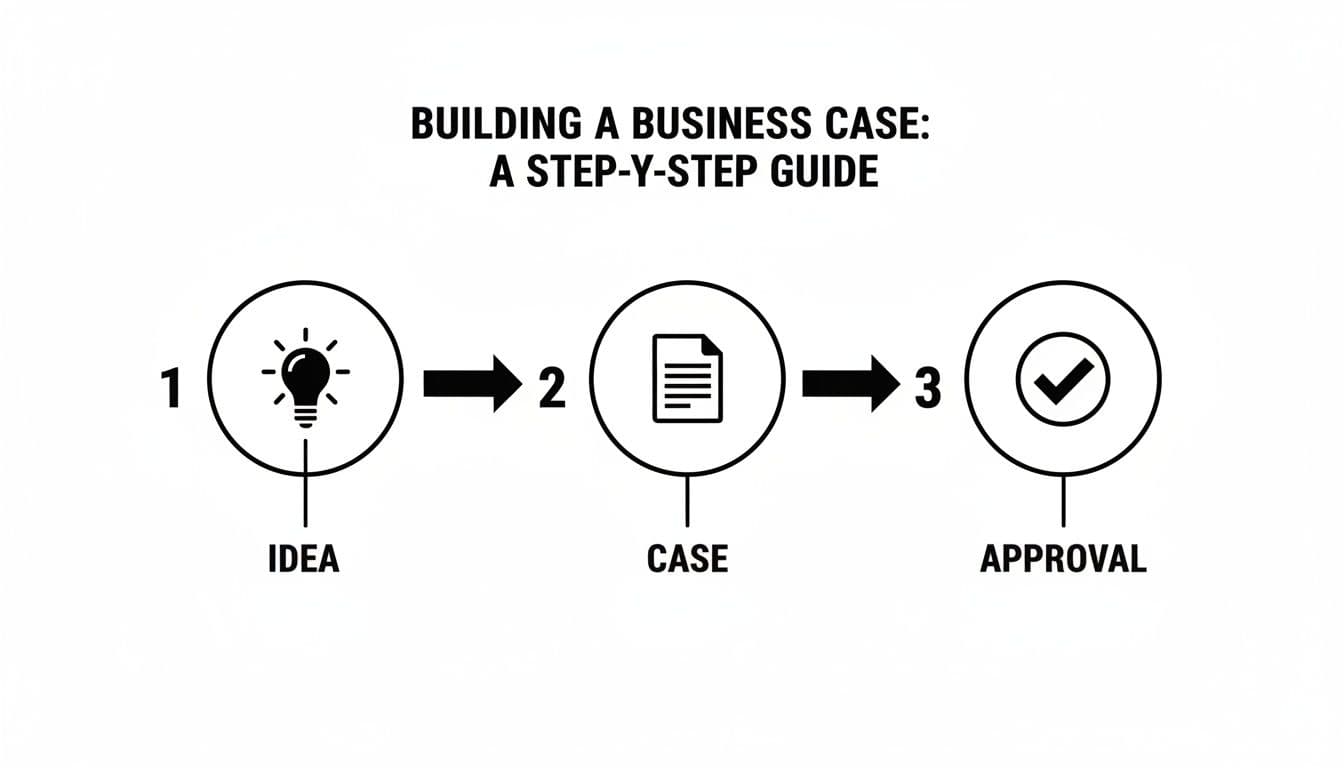
This flow highlights a critical truth: an idea only creates value for the organization once it's formalized into a case and gets the green light. The data backs this up. Industry analyses show that projects launched without a solid business case fail at rates exceeding 70%. On the flip side, projects with detailed cases tied directly to company strategy see 3x higher approval rates and deliver far better results. For more on this, check out this great resource on crafting a winning business case for project success.
Framing the Problem and Defining Success
Before you even think about crunching numbers in a spreadsheet, you have to nail the answer to one simple question: what problem are we actually trying to solve? Nothing gets a proposal shot down faster than a solution looking for a problem. Your first job is to lay out the core business pain point so clearly that everyone in the room immediately understands why a change is necessary.
This isn't the time for fuzzy statements like "our systems are outdated." That doesn't move anyone to action. You need to frame the issue in the language of the business: money, time, and missed opportunities. Show them the real, tangible impact of doing nothing.
Quantifying the Pain
To make the problem stick, you have to put a number on it. This is where you transform a vague complaint into a concrete liability that demands attention. Your goal here is to calculate the cost of inaction.
Think about it in these terms:
-
The Problem: Our customer support team is a revolving door.
- The Quantified Impact: "Our support team's 35% annual turnover rate is a $250,000 hole in our budget each year. That's what we're spending on recruitment fees, onboarding, and lost productivity while new hires get up to speed."
-
The Problem: We're buried in manual data entry.
- The Quantified Impact: "The sales ops team is burning a combined 120 hours every week on manual data entry. That's the equivalent of over $150,000 in annual salary costs dedicated to tasks that don't generate a dime of revenue."
See the difference? When you can prove a problem is a six-figure drag on the bottom line, you have their undivided attention. This approach immediately creates urgency and sets the baseline for measuring the value of any solution you propose. If your case is about growth, not just fixing a problem, you might want to learn how to estimate market size to quantify the potential upside.
Setting Clear and Measurable Objectives
Once the problem is crystal clear, you need to define what winning looks like. Vague goals like "improve customer satisfaction" are useless because you can't measure them. This is where you need to get specific by setting SMART objectives.
SMART is just a framework to make sure your goals are solid and trackable:
- Specific: What, exactly, are we going to do?
- Measurable: How will we know we've succeeded? What's the metric?
- Achievable: Is this actually possible with our time and resources?
- Relevant: Does this goal support the company's bigger strategic priorities?
- Time-bound: When will we get this done?
Let’s apply this to our earlier examples.
Problem 1: High Support Team Turnover
SMART Objective: Reduce customer support team turnover from 35% to 20% within 12 months of launching the new employee engagement program. We'll track this with quarterly HR reports, and hitting this target will save an estimated $100,000 annually.
Problem 2: Inefficient Data Entry
SMART Objective: Roll out a new CRM automation tool that cuts manual data entry time by 80%, taking the sales ops team from 120 hours down to 24 hours per week. This needs to be achieved within six months of go-live, and we'll measure it with time-tracking software.
These objectives are powerful because there’s no room for interpretation. They create a clear finish line and a built-in report card for your project. This airtight logic—connecting a quantified problem directly to a measurable solution—is the bedrock of a compelling business case. It keeps the project focused and ensures everyone is aligned from the get-go.
Exploring Alternatives to Prove Your Point
A business case with only one proposed solution isn't really a business case—it's an ultimatum. When you present a single path forward, it signals that you haven't considered the full picture, which can instantly sink your credibility with decision-makers. The most persuasive proposals I've seen always demonstrate rigorous thinking by exploring several viable alternatives, including the most critical one of all: doing nothing.
This analysis shows stakeholders you've done your homework. It proves your final recommendation wasn't just the first idea that popped into your head, but the best one after a balanced and objective evaluation. By comparing different options, you build a much stronger, more defensible argument for why your chosen path delivers the most value.

Honestly, this step is fundamental to building a case that can withstand any scrutiny. You're not just selling an idea; you're guiding leaders through the same logical process you followed to arrive at your conclusion.
The Power of the Status Quo Baseline
Every analysis has to start with the status quo, or the "do nothing" option. This isn't just a placeholder; it's the anchor for your entire comparison. It represents the ongoing costs, risks, and missed opportunities of just letting things continue as they are.
By first putting a number on the pain of the status quo (like we discussed when framing the problem), you create a benchmark. Every other alternative is then measured against it, making the value of any proposed change immediately obvious.
Identifying Viable Alternative Solutions
Beyond doing nothing, try to identify two to four other realistic alternatives. Too few options looks narrow-minded, but too many can lead to analysis paralysis. The goal is to cover the most logical paths forward.
For example, your options could include things like:
- Outsourcing the function to a specialized third-party vendor.
- Upgrading an existing system instead of a full-blown replacement.
- Hiring additional staff to handle the workload manually.
- Implementing a new software solution (which is likely your preferred option).
The strength of your business case is directly proportional to the thoroughness of your alternatives analysis. It shifts the discussion from "Should we do this?" to "Which of these sound options is best?"
Let's say your problem is an overwhelmed customer support team. Your options might be hiring more agents, outsourcing to a call center, or investing in an AI-powered chatbot. Each has completely different costs, benefits, and risks. This exploration is about survival. Think of the startup graveyard where 90% of ventures fail in their first year, often because they never validated their core approach against other possibilities. A rigorous business case dissects these alternatives to ensure the chosen path has the highest chance of success, a point underscored by recent analyses of startup survival rates.
Creating a Balanced Comparison Framework
Once you have your alternatives lined up, you need a consistent way to evaluate them. This is how you avoid a biased comparison and help stakeholders see the trade-offs clearly. I always recommend using a decision matrix or a simple table to score each option against the same critical criteria.
Key criteria I typically use include:
- Strategic Alignment: How well does this option support our company's broader goals?
- Financial Impact: What are the estimated costs, benefits, and potential ROI?
- Implementation Feasibility: How difficult, expensive, or time-consuming will this be to get off the ground?
- Associated Risks: What are the major operational, technical, or market risks?
Here’s a simplified example comparing options for improving customer support efficiency:
| Criteria | Status Quo (Do Nothing) | Hire More Agents | Outsource Support | Invest in AI Chatbot |
|---|---|---|---|---|
| Strategic Alignment | Low | Medium | Low | High |
| Cost to Implement | $0 | Medium (Recruiting) | Low (Setup Fee) | High (Software) |
| Annual Operating Cost | High (Inefficiency) | Very High (Salaries) | High (Fees) | Low (License) |
| Implementation Risk | Low | Medium (Training) | High (Quality) | Medium (Tech) |
| Overall Score | 2/10 | 5/10 | 4/10 | 8/10 |
This kind of structured comparison makes your final recommendation feel inevitable and data-driven. It shows exactly why the other paths are less attractive, building unshakable confidence in your proposed solution.
Building Your Financial Story With Confidence
This is where the rubber meets the road. You've defined the problem and laid out the options; now it's time to build the financial narrative that proves your idea is a smart investment, not just another expense. A lot of people freeze up at this stage, but don't. It’s simply about telling a clear story with numbers—a story of costs, benefits, and ultimately, value.
Your goal here is to translate your solution into the language of the C-suite: finance. They need to see a direct line from the initial investment to a positive return for the business. A solid financial model does just that, giving them the confidence they need to say "yes."
Nailing Down the Project Costs
Before you can even whisper the word "return," you have to get a firm grip on the costs. Nothing torpedoes credibility faster than underestimating the budget. A thorough cost analysis means breaking everything down into two distinct categories.
First up are the one-time costs. Think of these as the initial cash outlay required to get the project off the ground. These are usually the big, visible numbers that get the most scrutiny.
- Software Licensing or Purchase Fees: The sticker price for any new tech.
- Hardware and Infrastructure: New servers, laptops, or network gear.
- Implementation and Consulting Fees: Paying the experts to help set everything up correctly.
- Initial Employee Training: The cost of getting your team ready to use the new tools.
Then you have the ongoing costs—the recurring expenses that will live on long after the launch party. These are critical for understanding the project's long-term financial footprint.
- Annual Subscription or Maintenance Fees: Those pesky recurring charges for support and updates.
- Additional Staffing: Salaries for any new roles the project creates.
- Ongoing Training and Support: Budgeting for continuous learning as features evolve or new staff come on board.
Let's make this real. Say you're pitching a new CRM system. Your one-time costs might include a $50,000 software license and $20,000 for a consultant to handle the data migration. On the ongoing side, you're looking at a $15,000 annual subscription and maybe $5,000 a year for advanced user training. Getting this specific shows you've done your homework.
Quantifying the Upside: Tangible and Intangible Benefits
With the costs laid out, it's time for the exciting part: showing the value your project will create. Just like costs, benefits fall into two buckets.
Tangible benefits are the ones you can count—the hard numbers that directly impact the bottom line. This is the meat of your financial argument.
- Increased Revenue: "We project the new CRM’s lead scoring will lift our sales conversion rate by 5%, adding $200,000 in annual revenue."
- Reduced Costs: "Automating the weekly sales report will save the team 80 hours a month. At their blended rate, that’s $60,000 in recovered productivity costs each year."
Intangible benefits are trickier to measure but can be just as powerful. They're about the strategic value the project unlocks. Your job is to connect these qualitative wins to likely business outcomes.
- Improved Employee Morale: "Taking these mind-numbing manual tasks off our team's plate will almost certainly reduce burnout and turnover."
- Enhanced Customer Satisfaction: "Faster response times from the new system should give our Net Promoter Score (NPS) a healthy boost."
- Smarter Decision-Making: "Giving leadership access to real-time data will empower them to make better strategic calls, faster."
Pro Tip: While the tangible benefits are what drive your ROI calculation, the intangible benefits are what build the strategic argument. A killer business case weaves both together to paint a complete picture of why this project must happen.
Calculating the Key Financial Metrics
Alright, it's time to bring it all home. You'll take your cost and benefit estimates and distill them into the handful of metrics every executive immediately looks for. These calculations are what turn your narrative into a credible financial forecast. If you really want to sharpen your skills here, digging into some financial modeling best practices will give you a serious edge.
Here are the big three you absolutely need to include:
-
Return on Investment (ROI): This is the classic. It answers the question, "How much bang do we get for our buck?" The formula is simple: (Net Profit / Total Cost) x 100. An ROI of 150% means that for every dollar you put in, you get that dollar back plus another $1.50 in profit.
-
Payback Period: This one is all about speed. It tells you exactly how long it will take for the project to pay for itself. A shorter payback period is always more attractive because it means less risk and a faster return to positive cash flow.
-
Net Present Value (NPV): This is the most sophisticated of the three. NPV accounts for the time value of money—the fundamental idea that a dollar today is worth more than a dollar tomorrow. If your NPV is positive, it means the project is expected to generate more value than it costs, even after accounting for inflation and investment risk. It’s the gold standard for comparing long-term projects.
Presenting these three together gives your stakeholders a well-rounded, comprehensive view of the project's financial health.
Decoding Key Financial Metrics
This quick-glance table breaks down the financial metrics you need to know, explaining what they measure and why they're so crucial for your stakeholders.
| Metric | What It Tells You | Why Decision-Makers Care |
|---|---|---|
| Return on Investment (ROI) | The overall profitability of the project as a percentage. | It answers the simple, direct question: "Is this investment worth it?" |
| Payback Period | How quickly the investment will pay for itself. | It helps assess the project's risk and its impact on short-term cash flow. |
| Net Present Value (NPV) | The total value the project adds in today's dollars, accounting for time. | It provides the most accurate view of long-term value creation. |
By confidently building this financial story—from granular costs to clear benefits and industry-standard metrics—you aren't just asking for money. You're presenting a professional, credible argument that your project is a strategic investment poised to deliver a measurable return.
Identifying Risks and Planning for Reality
Every project has its pitfalls. Pretending they don't exist is the fastest way to tank your credibility with stakeholders. A truly solid business case doesn't shy away from risks; it tackles them head-on, turning potential weaknesses into a demonstration of foresight. This isn't about pessimism—it's about being prepared.
When you present a clear-eyed view of the road ahead, you show you've thought through the entire project lifecycle, not just the sunny, best-case scenario. This tells leaders you're ready to navigate the inevitable bumps and see the initiative through to the finish line.

A Simple Framework for Risk Assessment
You don't need a PhD in risk management to get started. A simple, straightforward approach is often the most effective. Just start by brainstorming what could go wrong across a few key areas.
I usually group them into buckets like these:
- Technical Risks: What if the new software is buggy or refuses to play nice with our existing systems? What if the vendor we pick goes belly-up?
- Operational Risks: Does our team actually have the skills to use this new tool or adopt this new process? What happens if a key team member quits mid-project?
- Financial Risks: What's the plan if we blow the budget? What if the amazing benefits we projected take way longer to show up?
Once you have a list, you need to size them up. A simple high-medium-low score for both likelihood (the chance of it happening) and impact (how bad it would be) is all it takes. This immediately helps you focus on the monsters in the closet. The process is a lot like what investors use, which you can see in our venture capital due diligence checklist.
From Threats to Manageable Challenges
Listing risks is easy. The real work is figuring out what you’re going to do about them. For every high-priority risk, you have to answer the question, "How do we stop this from happening, and what's our plan B if it does anyway?"
Your mitigation plan is what turns a vague threat into a manageable challenge. It shows you're not just a thinker but a planner, ready to steer the ship through the storm.
This proactive thinking is what separates projects that succeed from those that become cautionary tales. In the world of big digital projects, a staggering 70-95% of transformations fail to hit their goals without an airtight business case that includes robust risk planning. In fact, cases that actually address potential pitfalls see a 5.3x success multiplier. That’s a massive advantage. For more on this, check out these key statistics on data transformation challenges.
Crafting a High-Level Implementation Roadmap
With your risks and mitigation plans sorted, the final piece is a high-level implementation roadmap. This isn't a detailed, 500-line project plan. Think of it as a clear, simple map of the journey ahead for your stakeholders.
Your roadmap should outline:
- Key Milestones and Phases: Break the project into logical chunks. Think vendor selection, system setup, user training, and the final go-live.
- High-Level Timeline: Put realistic timeframes on each phase. This proves you've considered the actual effort involved and aren't just guessing.
- Resource Requirements: Briefly state who you need, what tools are required, and the budget for each major stage.
When you present this roadmap alongside your risk assessment, you're sending a powerful message. You've not only made a compelling case for why this needs to happen, but you've also laid out a credible plan for how you'll get it done—even when things don't go perfectly.
Weaving a Narrative That Wins Over the C-Suite
You've done the heavy lifting. The problem is defined, you've crunched the numbers, and your financial model is solid. But here's a hard truth I've learned from years of presenting these cases: logic and data only get you part of the way there.
To truly get that enthusiastic "yes" from leadership, you have to wrap your analysis in a compelling story. It’s about connecting the dots for them and making them feel the urgency and opportunity, not just understand it.
Speak Their Language
A generic, one-size-fits-all pitch is a recipe for failure. Every executive in that room is listening through the filter of their own world—their KPIs, their department's goals, and their biggest headaches. Your job is to tune your story to their specific frequency.
Think of it this way:
-
The CFO (Chief Financial Officer): Forget the fluff. Lead with the money. Talk ROI, Net Present Value (NPV), and the payback period. Frame everything in terms of profit, cost reduction, and balance sheet strength. How does this make the company more valuable?
-
The CTO (Chief Technical Officer): They're thinking about the guts of the operation. Will this new thing integrate with our current systems? Is it secure? Can it scale as we grow? You need to address the technical feasibility and long-term architectural fit.
-
The COO (Chief Operating Officer): Efficiency is the name of their game. Focus your story on smoother workflows, productivity boosts, and cutting operational risk. Show them a direct line from your project to a more streamlined, effective business.
The most successful business cases don't just present data; they translate it. When you frame the benefits in terms your audience cares about most, you're no longer just pitching a project—you're offering a direct solution to their problems.
Nail the Executive Summary
Let's be real: many executives will only read one page of your document. That page is the executive summary. It has to be powerful enough to stand on its own and convince them to either sign off or, at the very least, read on.
It’s your entire pitch, condensed into a few potent paragraphs. Make sure it hits these four key points, in this order:
- The Core Problem: What's the clear, urgent business pain we're facing?
- The Recommended Fix: State your proposed solution directly and without ambiguity.
- The Payoff: What are the headline benefits? Lead with your most impressive number, like a 250% ROI.
- The Ask: What, specifically, do you need? State the budget and key resources required.
This structure forces you to be sharp and persuasive, much like crafting a compelling investment thesis. Get this part right, and you've made it easy for them to say yes. Your hard work deserves to be seen and approved, and a killer summary is how you make that happen.
Common Questions on Building a Business Case

When you're putting together your first few business cases, a few questions always seem to pop up. Let's tackle them head-on so you can move forward with confidence.
How Long Should a Business Case Be?
Honestly, there’s no single right answer. The perfect length really depends on the scale of your project and what your company expects. A business case for a simple software update might only need a few pages, but a pitch for a brand-new factory could easily become a massive report.
The real goal is to be concise while still being thorough. Your executive summary must be a single, hard-hitting page that gives busy leaders everything they need. The rest of the document should have enough detail to stand up to tough questions but stay focused and easy to follow.
Rule of thumb: A good business case is long enough to cover all the bases but short enough that people will actually read it. Clarity and impact always trump page count.
How Should I Approach Intangible Benefits?
This is a classic challenge. How do you put a number on things like "better brand image" or "higher team morale"? While you can't just slap a dollar figure on them directly, you absolutely can link them to concrete business results.
For instance, you can tie improved employee morale to a potential 10% reduction in staff turnover—a metric with clear, calculable cost savings. You could frame a stronger brand reputation in terms of its potential to increase customer lifetime value or capture more market share. The trick is to translate these "soft" benefits into the language of financial impact.
If you want to make sure you're covering all the essential components, grabbing a practical business case template can be a great way to structure your work.
The very skills needed to build a compelling business case are exactly what consulting and finance firms test for in their interviews. At Soreno, our AI platform gives you unlimited practice with an AI interviewer trained on MBB standards. You get instant, detailed feedback on your structure, communication, and business sense. It's the perfect way to sharpen your analytical storytelling and land that dream offer. Try Soreno's 7-day free trial.