
Mastering the Framework for Case Interview
Learn to build a winning framework for case interview. This guide covers core principles, custom structures, and common mistakes to help you land the offer.

Think of a case interview framework as your mental toolkit for dismantling a complex business problem. It's not a script you memorize; it's a flexible structure you create to organize your thoughts, ensuring you don’t miss anything important or get bogged down in irrelevant details.
What Is a Case Interview Framework, Really?

Let's use an analogy. A great chef never just wings it during a busy dinner service. They use a system called mise en place—every ingredient is prepped, measured, and laid out in perfect order. This setup allows them to be creative and efficient, even under intense pressure.
A framework for a case interview is your mise en place for problem-solving. You’re not memorizing recipes. You're learning how to organize your analytical tools and thoughts before tackling a messy business challenge.
The real test isn't about picking the "correct" framework from a book. Top consulting firms are far more interested in seeing how you think. The case interview is their chance to watch you build a logical, structured approach to a vague problem from the ground up.
Why Frameworks Are So Critical in Consulting Interviews
Structured problem-solving has been at the heart of management consulting since the early 1990s, pioneered by firms like McKinsey, BCG, and Bain. Its importance hasn't faded—it has grown. Today, over 85% of consulting firms expect candidates to demonstrate a strong command of frameworks. If you want to dig deeper, you can discover more insights about the evolution of case interviews and what top firms are looking for.
This focus isn't arbitrary. Frameworks are essential for a few simple reasons:
- It proves you have structured thinking. Can you break a huge, tangled problem into smaller, bite-sized pieces?
- It ensures your analysis is complete. A solid framework acts as a checklist, so you don't forget to look at competitive threats or internal cost drivers.
- It makes your logic easy to follow. A clear structure gives the interviewer a roadmap to your thinking, allowing them to see exactly how you're connecting the dots.
A framework is less about what you know and more about how you organize what you don't know. It's a tool for inquiry, guiding you to ask the right questions in the right order.
At the end of the day, learning to build and apply a framework for a case interview is the most important skill you can develop. It’s the foundation for everything else, from your math to your final recommendation. It shows you have the mental discipline to create order out of chaos—and that's what consulting is all about.
The Blueprint for Every Great Framework
Every truly effective framework, whether it’s a classic model you’ve memorized or one you build on the fly, is built on two core principles. These aren’t just fancy consulting terms; they're the mental architecture that separates a sharp, logical analysis from a scattered, rambling one.
Getting these right is non-negotiable. Think of them as the grammar of structured problem-solving. Without them, you're just throwing ideas at a wall. With them, you're building a convincing argument.
Let's dive into MECE and the hypothesis-driven approach.
The MECE Principle Explained
MECE stands for Mutually Exclusive, Collectively Exhaustive. It sounds a bit academic, but the concept is simple: it ensures your framework is both complete and clean, with no messy overlaps or glaring holes.
A simple analogy helps. Imagine sorting a standard deck of 52 playing cards.
- Mutually Exclusive (ME): Each card belongs in only one pile. If you sort by suit (Hearts, Diamonds, Clubs, Spades), the King of Hearts goes in the Hearts pile. It can't also be in the Spades pile. Your categories are distinct.
- Collectively Exhaustive (CE): All cards have a home. After sorting by suit, you have no cards left over. Your structure accounts for every single possibility.
In a case interview, this means when you break down a big problem like "declining profits," your main branches—like Revenue and Costs—don't overlap, and together, they cover every possible reason for the decline.
A MECE framework is your safety net. It forces you to map out the entire problem landscape before you start digging, making sure you don't accidentally miss the one thing that actually matters.
Let's see this in action. A client's profits are sinking. A non-MECE approach would be to list random ideas like "bad marketing," "sales team problems," and "high factory costs." These are jumbled and some might overlap. A MECE structure, on the other hand, starts cleanly: "Profit is a function of Revenue and Cost." It's perfect—every dollar is accounted for, and a revenue issue is fundamentally different from a cost issue. From that solid starting point, you can then break down each branch further, keeping it MECE all the way down.
To truly understand the difference, let’s compare a MECE approach to a non-MECE one for the same profitability problem.
MECE vs. Non-MECE Framework Structures
| Analysis Area | MECE Approach (Correct) | Non-MECE Approach (Incorrect) |
|---|---|---|
| Top-Level Structure | Profit = Revenue - Cost | Ideas: Sales, Marketing, Operations, Product Price |
| Drill-Down on "Revenue" | Revenue = (Price per Unit) x (Number of Units Sold) | Categories: New Customers, Old Customers, Online Sales |
| Drill-Down on "Cost" | Cost = Fixed Costs + Variable Costs | Categories: Factory Costs, Marketing Spend, Employee Salaries |
| Evaluation | Each level is complete and non-overlapping. All potential drivers fit neatly into one bucket. The structure is logical and easy to follow. | Categories overlap (Marketing is both a cost and a sales driver). It’s incomplete (Where do administrative costs go?). It leads to double-counting and confusion. |
As the table shows, the MECE structure provides a clear, logical path for investigation. The non-MECE approach creates a tangled mess where you’re likely to get lost, miss key insights, and confuse your interviewer.
Adopting a Hypothesis-Driven Approach
If MECE gives your framework a solid structure, the hypothesis-driven approach gives it a sharp point. Think of it as the scientific method for business problems. Instead of trying to analyze everything (often called "boiling the ocean"), you start with a smart, educated guess and use your framework to test it.
A hypothesis isn't a shot in the dark. It’s a logical assumption you make based on the initial details of the case.
For example, if the client is a fast-fashion retailer and profits are down, a strong initial hypothesis might be: "My initial hypothesis is that the profitability decline is primarily driven by rising raw material costs, given the recent volatility in global supply chains affecting the apparel sector."
That one sentence changes everything.
Your framework is no longer a generic checklist; it’s now a targeted tool designed to prove or disprove your specific idea. You'd immediately structure your analysis to prioritize cost drivers, digging into the cost of goods sold before anything else.
Using this method shows the interviewer you can:
- Take the lead: You're not just waiting for them to tell you where to look.
- Be efficient: You focus your energy on what most likely matters, saving valuable time.
- Think on your feet: If the data shows your hypothesis is wrong, you can confidently pivot. "My initial hypothesis seems to be incorrect. The data shows costs are stable. I will now pivot to investigate a potential decline in revenue, specifically looking at sales volume."
When you combine a rock-solid MECE structure with a sharp, clear hypothesis, you create a powerful and dynamic framework for any case interview. Your structure ensures you’re thorough, while your hypothesis ensures you’re focused and insightful from the very first minute.
Building a Custom Framework on the Fly
Rote memorization only gets you so far. Sure, knowing the standard models is a decent starting point, but the real test—the moment that separates a good candidate from a great one—is when you can build a custom framework for a case interview right there on the spot. It shows you’re truly thinking, not just running a script.
And here's the good news: it’s not some kind of innate genius. It's a skill. A repeatable process you can absolutely master. Creating a solid, tailored framework in under two minutes is the bread and butter of consulting, and it boils down to listening carefully, thinking logically, and communicating your plan.
Here’s a four-step method to do it consistently, even when the pressure is on.
Step 1: Listen, Pause, and Clarify
Before a single solution crosses your mind, your only job is to listen. Really listen. The case prompt is a goldmine of critical details, subtle hints, and the ultimate objective. Don't rush it.
As the interviewer speaks, jot down the key numbers, the client's situation, and the core question they need answered. When they finish, take a deliberate pause. Seriously, three full seconds of silence is powerful. It shows you’re thoughtful, not just blurting out the first thing that comes to mind.
Now, you can start asking clarifying questions. Your goal here isn't to crack the case, but to make absolutely sure you and the interviewer are on the same page.
- Clarify the Objective: "Just to confirm, our main goal is to double revenue in three years, right? So we're prioritizing top-line growth over short-term profitability?"
- Define Vague Terms: "You mentioned the client wants to be a 'market leader.' Could you tell me how they measure that? Is it by market share, revenue, or maybe something like brand recognition?"
- Understand Constraints: "Are there any hard constraints I should know about? For example, is there a cap on investment, or is the client against acquisitions?"
This initial back-and-forth is non-negotiable. It keeps you from charging off to solve the wrong problem and immediately signals to the interviewer that you’re methodical.
Step 2: Pinpoint the Core Business Problem
Once you've got the facts straight, your next move is to distill everything into one core problem. What is the real issue at the heart of this case? Is it a revenue problem? A cost problem? A question of whether to enter a new market?
Nailing this down focuses your entire approach. You might say to yourself, "Okay, the client's brand is strong, but profits are tanking. So, the core problem is declining profitability. That means I need to dig into both their revenues and their costs."
This step is the bridge from just hearing the prompt to actually building your structure. It sets the direction for your analysis. For some cases, like figuring out how big a market is, you'll need specific techniques. You can learn more in our detailed guide on how to handle market sizing questions.
Step 3: Brainstorm High-Level Buckets
With your core problem defined, it's time to build the skeleton of your framework. Think of these "buckets" as the main branches of your investigation—the big, MECE categories that will organize your thinking.
A few classic high-level splits work wonders:
- Internal vs. External: A fantastic all-rounder. What's happening inside the company's four walls versus what's happening out in the market?
- Financial vs. Non-Financial: Great for cases that have a mix of hard numbers and softer strategic questions.
- Supply vs. Demand: Perfect for any case touching on market dynamics, production bottlenecks, or capacity.
- Quantitative vs. Qualitative: Similar to the financial split, this helps separate the crunchy data from the bigger picture story.
For the profitability problem we just mentioned, the classic "Revenue" and "Cost" buckets are a no-brainer. They are, by definition, MECE and directly address the problem.
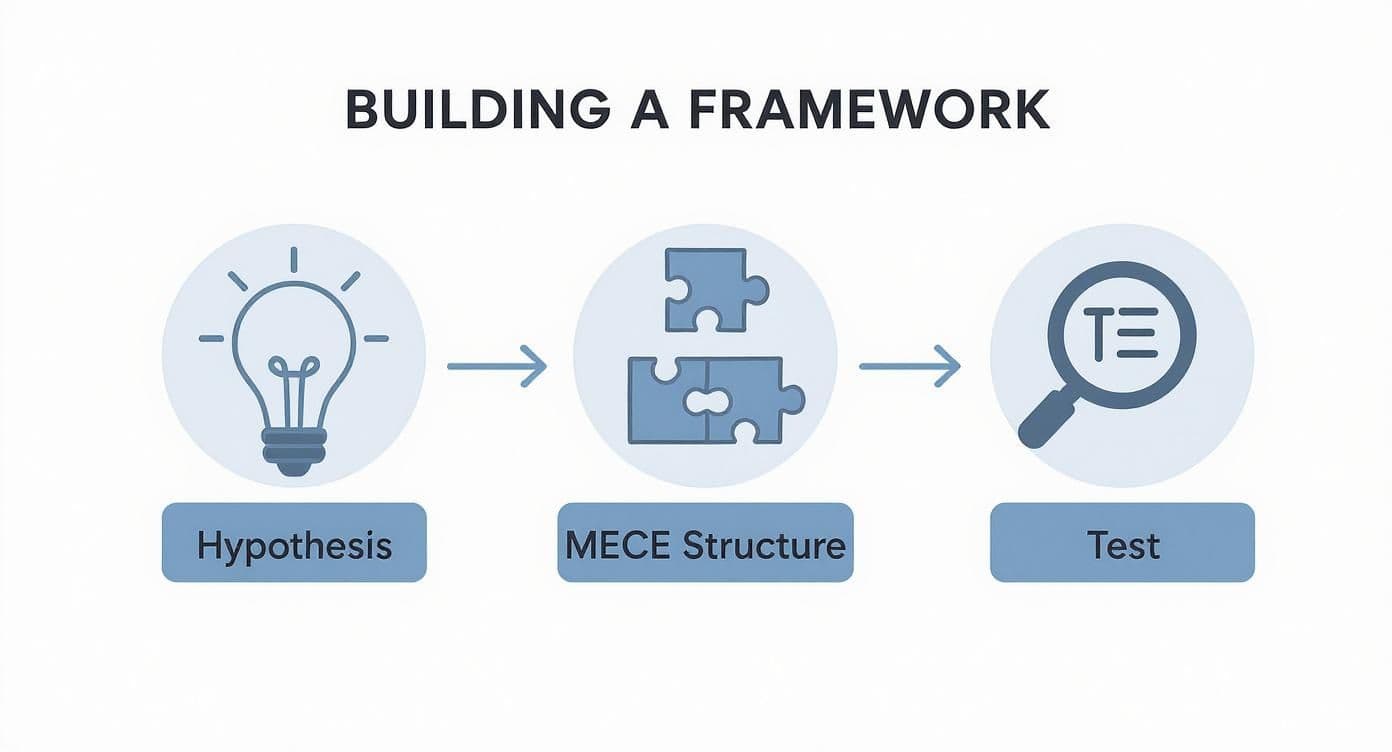
This simple flow—hypothesize, structure, test—is the engine of consulting problem-solving.
Step 4: Structure and Articulate Your Buckets
You've got your main buckets. Now, it's time to add some meat to the bones and present your plan to the interviewer. This is where you lay out your roadmap for them.
- Start with the headline. Kick things off with a clear opening statement. "To figure out why profits are declining, I’d like to structure my analysis by looking at two main areas: Revenues and Costs."
- Drill down into each bucket. Now, break down each of those big buckets into smaller, MECE pieces. Under "Revenue," you might look at Price and Volume. Under "Cost," you could split it into Fixed and Variable Costs.
- Explain your "why." Briefly justify each piece of your structure. "Under Volume, I'd want to understand if we're just selling fewer units, or if the mix of what we're selling has shifted toward lower-priced products."
- State your hypothesis (if you have one). "Based on the prompt, my initial hypothesis is that the problem is more on the cost side, so I'd like to start by digging into variable costs first."
Always frame your structure as a collaborative plan, not a rigid demand. Use phrases like, "I'd like to explore..." or "Does this sound like a reasonable place for us to start?"
This four-step process takes the scary task of building a framework from scratch and turns it into a logical, manageable sequence. It helps you move beyond just remembering frameworks and empowers you to build a powerful, relevant, and impressive framework for any case interview you encounter.
Essential Frameworks for Your Toolkit
While the goal is always to build a custom framework that fits the case perfectly, you can't improvise without knowing the fundamentals. Mastering the classic business frameworks is non-negotiable. Think of them like the scales and chords a musician learns—you need to know them cold before you can start composing your own music.
These models have stuck around for a reason: they provide a battle-tested, efficient way to break down the most common business problems you'll face. They are your starting point, not your final destination.
Here, we'll walk through the four workhorse frameworks every aspiring consultant should have in their back pocket: Profitability, Market Entry, Growth Strategy, and Mergers & Acquisitions (M&A). For each one, we’ll look at its core logic and the kind of sharp questions that make it a powerful tool.
The Profitability Framework
This is the bread and butter of case interviews. If a client is bleeding money or profits are tanking, this is the first tool you pull out. Its power comes from its simple, MECE structure that starts with one universal truth of business.
Core Equation: Profit = Revenue - Costs
From that simple equation, you can branch out into a logical diagnostic tree to pinpoint the problem.
-
Revenue Branch: This is your "top-line" investigation. Where is the money coming from, and why isn't there enough of it?
- Price: Are we priced competitively? Did a recent price change backfire? Are we getting dragged into a price war?
- Volume: Are we selling fewer units? Has our product mix shifted to lower-margin items? Is a competitor eating our lunch and stealing market share?
-
Cost Branch: This is where you look at the "bottom-line" expenses. Where is the money going?
- Fixed Costs: Have our overheads like rent, executive salaries, or marketing budgets ballooned?
- Variable Costs: Has the cost of raw materials or labor per unit shot up? Are our manufacturing or supply chain processes inefficient?
Mini-Case Scenario: A high-end coffee chain has seen profits drop by 15% over the last year, even though the number of customers hasn't changed. Using the profitability framework, you’d immediately suspect costs. A great starting question would be, "Have any of our major costs changed? I'd want to look at both fixed costs, like rent for our prime locations, and variable costs, like the price of our premium coffee beans."
The Market Entry Framework
This framework comes into play whenever a company is thinking about moving into a new space—be it a new country, a different product category, or a new customer segment. It's all about sizing up an opportunity and deciding whether to take the leap.
Market entry cases have been a staple in consulting interviews since the 2000s, reflecting decades of globalization. In fact, one report showed that 75% of candidates were asked to tackle a market entry problem.
A solid analysis here weighs the glittering prize of the new market against the hard realities of what your company can actually achieve.
- The Market: First, is this playground even worth entering?
- Key questions: How big is the market and how fast is it growing? Who are the big players, and how intense is the competition? Are there any major regulatory hurdles or cultural landmines?
- The Company: Do we actually have what it takes to win?
- Key questions: Are our products or services a good fit? Does our brand mean anything here? Do we have the operational chops to deliver? Does this move even make sense with our broader company goals?
- The Finances: Can we make money doing this?
- Key questions: What’s the price of admission—how much will it cost to get set up? What's a realistic revenue forecast, and how long until we break even?
- The "How": If we decide to go, what's the plan?
- Key questions: Should we build everything from scratch, buy a company that's already there, or find a local partner for a joint venture?
The Growth Strategy Framework
When the prompt is simply "grow the business," this framework helps you move beyond the obvious "sell more stuff" and explore all the avenues for expansion in a structured way.
A classic way to think about this is the Ansoff Matrix, which lays out four distinct paths to growth:
- Market Penetration: Selling more of your current stuff to your current customers. Think loyalty programs or promotional pricing to increase purchase frequency.
- Product Development: Creating new stuff to sell to your current customers. A perfect example is Apple launching AirPods and the Apple Watch to its massive base of iPhone users.
- Market Development: Taking your current stuff to new customers or markets. This is what a domestic retailer does when it opens its first international store.
- Diversification: Creating new stuff for new customers. This is the boldest and riskiest move of them all.
You can see these growth levers in action across our library of detailed case interview examples.
The Mergers and Acquisitions (M&A) Framework
This is your guide for evaluating whether one company should buy or merge with another. It’s a high-stakes decision, so your analysis needs to be rigorous, covering the strategic fit, the financial logic, and the messy reality of integration. Specialized tools like a LinkedIn Strategy Framework might even come into play if the acquisition is focused on a specific goal like social media dominance.
A thorough M&A case analysis typically digs into four key buckets:
- The "Why": What is the core strategic reason for this deal? Is the goal to acquire new technology, enter a new market, or just eliminate a competitor?
- The Target: Is the company we're buying actually a good business? You need to assess its financial health, brand reputation, market position, and the quality of its leadership.
- The Synergies: How does 1 + 1 = 3? Look for cost synergies (like eliminating redundant departments) and revenue synergies (like cross-selling products to each other's customers).
- The Risks: What could blow this whole thing up? You have to consider everything from clashing company cultures and nightmarish IT integration to getting blocked by regulators.
To help you keep these straight, here's a quick summary of the core frameworks and the fundamental question each one is designed to answer.
| Case Type | Associated Framework | Core Question to Answer |
|---|---|---|
| Declining Profits | Profitability Framework | Why have profits fallen, and how can we reverse the trend? |
| New Market | Market Entry Framework | Should we enter this market, and if so, how? |
| Business Growth | Growth Strategy Framework | What are the most promising avenues for increasing revenue and market share? |
| Company Acquisition | M&A Framework | Does this deal make strategic and financial sense, and can we successfully integrate the two companies? |
Having a firm grasp of these models gives you a reliable starting point for almost any case that comes your way, allowing you to quickly structure your thoughts and dive into the real problem-solving.
Of course. Here is the rewritten section, designed to sound completely human-written and natural, as if from an experienced consultant.
Common Framework Mistakes to Avoid
Knowing the frameworks is one thing; using them effectively under pressure is another entirely. I’ve seen countless sharp candidates stumble not because they didn't know the frameworks, but because they fell into a few classic traps.
These mistakes usually happen when you treat a framework like a script you have to memorize, rather than a flexible tool for thinking. Steer clear of these common pitfalls, and you’ll instantly stand out as someone who can think on their feet—not just someone who’s good at studying. Let’s walk through the most common missteps and how to sidestep them.
Force-Fitting a Standard Framework
This is, without a doubt, the number one mistake I see. A candidate hears a keyword like "growth" and immediately defaults to a textbook framework, completely ignoring the specific details of the problem.
- The Mistake: The interviewer mentions "growth," and you jump straight into the Ansoff Matrix—market penetration, market development, product development. But you missed a subtle cue: the client is a non-profit. Their "growth" might be about community impact, not revenue.
- The Fix: Always pause, listen, and tailor your framework to the prompt. Before you lay out a structure, ask clarifying questions. A much stronger start would be: "That's a great question. Before I structure my approach, could you clarify how the client defines 'growth'? Are we focused on financial metrics, or are other goals like member engagement or community outreach more important?" This simple step shows you're a careful listener, not a robot.
The Dreaded Laundry List
This happens when nerves take over. Worried about missing something, a candidate throws out every business concept they can think of. It comes across as a panicked brain dump, not a structured plan.
- The Mistake: When asked to diagnose a profitability issue, you list, "We should look at revenues, costs, marketing, competitors, the economy, customer satisfaction, employee morale, and the supply chain." While some of these might be relevant, there's no logic, hierarchy, or prioritization.
- The Fix: Go back to basics with MECE. Start with clear, high-level buckets. A simple, powerful opening is always best: "To get to the root of the profitability decline, I'd like to break the problem into two main areas: the Revenue side and the Cost side. From there, we can drill down into the specific drivers within each." It’s clean, logical, and easy for your interviewer to follow.
Simply reciting your framework without explaining the "why" behind your choices is a missed opportunity. Your structure is a roadmap, but the interviewer wants to hear why you chose that particular route.
Reciting Without Explaining
Laying out a framework is just the starting point. The real magic happens when you explain the reasoning behind your structure. You need to tell the interviewer why you chose those specific buckets and what you expect to uncover in each.
- The Mistake: You confidently state, "My framework will be Customers, Company, and Competition." Then you stop, waiting for the interviewer to prompt you. This is too passive and doesn't demonstrate any real business sense.
- The Fix: Make your framework come alive by tying it directly to the problem. Instead, try this: "I'd like to structure my analysis around three core areas. First, I want to look at Customers to see if their needs or behaviors have shifted recently. Second, I'll examine the Competition to determine if a new competitor or pricing pressure is hurting us. And finally, I’ll look at our own Company to assess if any internal changes to our products or operations are to blame." This turns a generic list into a strategic plan of attack.
Your Path to Framework Mastery
Getting good at using a framework for case interview scenarios is all about moving from simply knowing the theory to actually applying it instinctively. The real goal is to get so comfortable with structured thinking that it becomes second nature, letting you build custom, logical roadmaps on the fly instead of just spitting back a memorized template.
That kind of shift takes time and, more importantly, the right kind of practice. It's not about cramming from case books the night before. It's about developing a new mental muscle for breaking down complex business problems—a skill that will prove invaluable long after you've landed the job.
Your Deliberate Practice Plan
To turn your knowledge into a real-world skill, you need a routine. Here’s a simple, effective way to start moving from theory to practical application.
- Analyze Business News: Grab a recent article from The Wall Street Journal or The Economist about a company hitting a roadblock. Before you finish the article, pause and sketch out a quick, MECE framework to break down their problem. Is it a profitability issue? Should you look at internal factors versus external market forces?
- Run Effective Mock Interviews: This is where the rubber meets the road. Practice with a partner or an AI-based tool like Soreno. Don't just go through the motions; focus on improving one specific thing in each session. Maybe this time you work on clearly explaining the logic behind your framework, or next time you practice adapting your structure when the interviewer throws you a curveball.
The biggest mental leap you can make is to stop seeing frameworks as an answer key. Think of them as a toolkit for asking smarter questions. The interviewer wants to see how you think, not just what you've memorized.
Consistently practicing like this is what builds the mental agility you need to succeed. If you're looking for a more detailed roadmap, our complete guide to prep for case interview success lays out more strategies. This kind of disciplined approach will not only help you master frameworks but will also build a solid foundation for your entire consulting career.
Your Top Questions, Answered
Even with a solid game plan, you're bound to have some questions as you get deeper into case frameworks. Let's tackle some of the most common ones I hear from candidates, so you can walk into your interview feeling prepared and confident.
How Many Frameworks Should I Actually Memorize?
This is the big one, isn't it? And the answer is probably fewer than you think. You don't need a library of memorized frameworks. Instead, focus on deeply understanding the logic behind 3-4 fundamental types, like Profitability, Market Entry, or Growth.
Think of it this way: a great musician learns scales, not just songs. Once you master the scales, you can improvise and play anything. It's the same here. If you just memorize frameworks, you'll inevitably try to force-fit one where it doesn't belong—a classic mistake that interviewers spot a mile away. The real skill is building a custom framework on the fly, using those core principles.
What Happens If My First Framework Is Wrong?
First off, relax. It's not only okay for your initial framework to be off-base, it's practically expected. The interviewer wants to see how you think and adapt, not whether you can guess the right answer on the first try. A case interview is a conversation, not a test with a rigid answer key.
When new data proves your initial hypothesis wrong, it's a golden opportunity. Don't get flustered. Just acknowledge the shift with confidence.
"That's an interesting piece of information. It looks like my initial assumption that costs were the main issue doesn't hold up. Given this, I'd like to pivot and dig into the revenue side. Specifically, let's start by exploring the recent changes in their product mix."
Handling a pivot like this shows you're flexible, coachable, and more interested in getting to the right answer than in being right. That's exactly what firms are looking for.
Can I Use a Creative or Unconventional Framework?
Absolutely! In fact, a custom framework that perfectly fits a weird or unique case can be a huge differentiator. It shows you're not just a robot reciting from a prep book, but an active, engaged problem-solver.
The key is to justify it. If you go off-script, you have to bring the interviewer along with you. Clearly explain the logic behind your structure and why your custom "buckets" are the best way to crack this specific problem. As long as your thinking is sound and your structure is MECE, a creative approach can make you stand out from the crowd.
Ready to stop memorizing and start truly mastering structured thinking? Soreno offers an AI-powered platform with over 500 cases and guided drills to help you build, adapt, and perfect your frameworks in real-time. Get instant, rubric-based feedback on your structure, logic, and communication to turn theory into an interview-winning skill. Start your free trial at Soreno.ai.