
Brain Teasing Questions Interviews: 8 Unforgettable Prompts for Candidates 2026
Explore brain teasing questions interviews that reveal how top candidates think, with 8 unforgettable prompts to test problem-solving and fit.

In the high-stakes world of consulting, finance, and tech, a stellar resume is just the entry ticket. The real test often comes in the interview room, where hiring managers need to assess a candidate's raw analytical horsepower and problem-solving agility. This is precisely why top firms still rely on a specific tool: the brain teaser. While they might seem like abstract puzzles, these questions are powerful diagnostic instruments designed to reveal how you approach ambiguity, test assumptions, and structure your thoughts under pressure.
Mastering the art of solving these challenges is less about finding a single "correct" answer and more about demonstrating a logical, structured, and creative thought process. The ability to break down a complex, unfamiliar problem into manageable components and communicate your reasoning clearly is a skill universally prized in demanding fields. Brain teasers are particularly prevalent in technical interviews, and you will often encounter them when applying for competitive software engineering roles where logical deduction is paramount.
This guide moves beyond simple answers. We will dissect eight classic brain teasing questions interviews frequently use, providing not just the solutions but the underlying frameworks needed to solve them. For each puzzle, you will learn:
- Step-by-step logical breakdowns to structure your thinking.
- Common pitfalls and incorrect assumptions to avoid.
- Think-aloud scripts to help you articulate your process.
- Key variations and follow-up questions to prepare for.
Our goal is to equip you with a repeatable methodology, turning these intimidating challenges into a prime opportunity to showcase your analytical prowess and secure that coveted offer.
1. The Bridge and Torch Problem
This classic logic puzzle is a staple in high-stakes interviews, especially in consulting and tech. It's one of those brain teasing questions interviews use to evaluate a candidate's ability to think critically under strict constraints. The setup is simple: four people need to cross a rickety bridge at night with only one torch. Each person crosses at a different speed (e.g., 1, 2, 5, and 10 minutes). The bridge can only hold two people at a time, and any group crossing must have the torch. When two people cross, they must move at the slower person's pace. The goal is to get everyone across in the minimum possible time.

This puzzle excels at testing optimization skills. It forces you to move beyond the most intuitive solution, which is often suboptimal, and uncover a more efficient, counter-intuitive path.
How to Tackle It
The key is to systematically map out the moves. Each "round" consists of a forward trip (with the torch) and a return trip (with the torch). The crucial insight lies in minimizing the time spent on return trips.
The common but incorrect approach involves always sending the fastest person back with the torch. The optimal solution, however, involves a strategic move where the two slowest people cross together, saving time by consolidating their slow journey into a single trip.
Optimal Solution (for 1, 2, 5, 10-minute speeds):
- Trip 1 (Forward): Person 1 and 2 cross. Time: 2 minutes.
- Trip 2 (Return): Person 1 returns with the torch. Time: 1 minute.
- Trip 3 (Forward): Person 5 and 10 cross. Time: 10 minutes.
- Trip 4 (Return): Person 2 returns with the torch. Time: 2 minutes.
- Trip 5 (Forward): Person 1 and 2 cross again. Time: 2 minutes.
Total Time: 2 + 1 + 10 + 2 + 2 = 17 minutes.
Actionable Tips for Your Interview
- Verbalize Your Logic: Start by stating your assumptions. For example, "I'm assuming the goal is to minimize total elapsed time. I'll track the location of each person and the torch after every move."
- Explore All Paths: Don't just present the final answer. Discuss the intuitive (but wrong) path first. Explain why sending the fastest person back repeatedly is less efficient. This showcases your thoroughness.
- Use a Whiteboard: If available, draw the two sides of the bridge and physically move the "people" (represented by their crossing times) back and forth. This helps you track the state of the puzzle clearly.
- Anticipate Follow-ups: Be ready for variations. An interviewer might ask, "What if the bridge could hold three people?" or "What if there were two torches?" These extensions test your adaptability.
2. The Monty Hall Problem
A classic probability puzzle, the Monty Hall problem is one of the most famous brain teasing questions interviews use to test a candidate's grasp of conditional probability and their ability to overcome strong cognitive biases. The scenario involves a game show: you choose one of three doors. Behind one door is a car, and behind the other two are goats. After you pick a door, the host, who knows what's behind each door, opens one of the other two doors to reveal a goat. You are then given the option to stick with your original choice or switch to the other unopened door. The question is: should you switch?
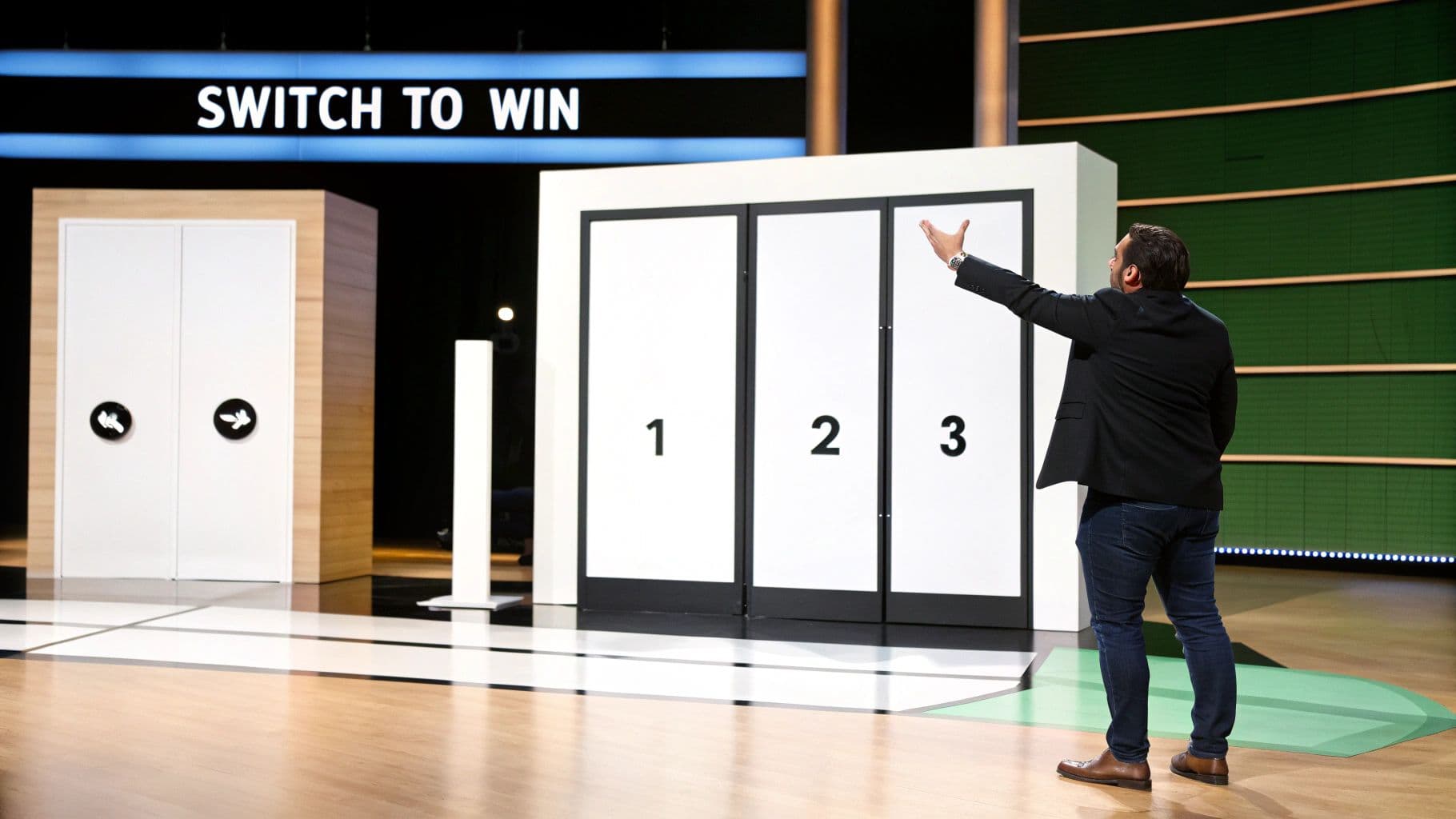
This puzzle is particularly effective in finance and quantitative roles because it reveals how a candidate handles counter-intuitive information. The correct answer, to switch, feels wrong to most people, but it is mathematically sound. Success requires challenging initial assumptions with rigorous, probabilistic thinking.
How to Tackle It
The key is to recognize that the host's action of revealing a goat provides new, valuable information. Your initial choice had a 1/3 chance of being correct and a 2/3 chance of being wrong. When the host reveals a goat, the initial 1/3 probability for your door doesn't change. However, the 2/3 probability that the car was behind one of the other two doors now consolidates entirely onto the single remaining unopened door.
By switching, you are essentially betting that your initial choice was wrong, which it was 2/3 of the time. Sticking with your original choice only wins if you were right on the first pick (a 1/3 chance).
Optimal Solution (Breaking down the scenarios): Let's assume you pick Door #1. There are three possibilities:
- Car is behind Door #1: You picked correctly (1/3 probability). The host opens Door #2 or #3. If you switch, you lose.
- Car is behind Door #2: You picked incorrectly (1/3 probability). The host must open Door #3. If you switch to Door #2, you win.
- Car is behind Door #3: You picked incorrectly (1/3 probability). The host must open Door #2. If you switch to Door #3, you win.
By switching, you win in two out of the three possible scenarios. Switching doors doubles your probability of winning from 1/3 to 2/3.
Actionable Tips for Your Interview
- Verbalize Your Logic: Start by acknowledging the puzzle's counter-intuitive nature. Say, "My initial gut feeling is that it's 50/50, but let me think through the probabilities based on the host's action, which provides new information."
- Explore All Paths: Systematically list the three possible scenarios as shown above. Explicitly state the initial probabilities (1/3 for your door, 2/3 for the other two combined) and show how the host's action reallocates that 2/3 probability to the single remaining door.
- Use a Whiteboard: Draw the three doors. Walk the interviewer through each scenario, showing what the host does in each case and what the outcome is if you "stick" versus "switch". This makes your logic easy to follow.
- Anticipate Follow-ups: An interviewer might ask, "What if there were 100 doors, and the host opened 98 of them?" This extension is designed to solidify the logic. In this case, your initial pick has a 1/100 chance, and switching gives you a 99/100 chance of winning, making the benefit of switching even more obvious.
3. Market Sizing Through Lateral Thinking
Known as Fermi problems, these are quintessential brain teasing questions interviews use to gauge a candidate's problem-solving structure and comfort with ambiguity. Questions like, "How many golf balls fit in a school bus?" or "How many gas stations are in the US?" are not about finding the correct number. Instead, they test your ability to logically break down a complex, seemingly impossible question into manageable, well-reasoned components. Elite consulting firms like McKinsey, BCG, and Bain, as well as tech giants like Google, use these to assess analytical horsepower and business acumen.
This type of question is powerful because it mirrors real-world business challenges where precise data is unavailable. It forces you to make and justify assumptions, structure a logical framework, and communicate your thought process clearly-all critical skills in strategy and operations roles.
How to Tackle It
The key is to create a "top-down" or "bottom-up" estimation model. You start with a broad figure (like the US population) and segment it logically, or you start with a small unit (like a single gas station's revenue) and build up. The goal is to show the interviewer how you think, not what you know.
Let's take "How many gas stations are in the US?" as an example. A top-down approach focuses on demand, while a bottom-up approach looks at supply.
Sample Logic (Top-Down Approach):
- Population: Start with the US population, roughly 330 million.
- Drivers: Assume about 80% of people are of driving age and own cars. That’s ~264 million drivers/cars.
- Refuel Frequency: Assume the average car refuels once a week. That's 264 million fill-ups per week.
- Station Capacity: Estimate how many cars a single gas station can serve in a week. Let’s say an average station has 8 pumps, is open 16 hours/day, and each fill-up takes ~5 minutes. This gives us a capacity per station.
- Calculation: Divide the total weekly fill-ups by the capacity of one station to get the total number of stations needed.
Actionable Tips for Your Interview
- Verbalize Your Logic: Announce your approach upfront. "I'm going to tackle this using a top-down, demand-driven model, starting with the US population. My assumptions will be clearly stated."
- State Assumptions Loudly: Before any calculation, state your assumption. "I'll assume an average car gets gas once a week. This might be high for some and low for others, but it's a reasonable starting point."
- Use a Whiteboard: Visually map out your logic tree. This makes your structure easy for the interviewer to follow and helps you stay organized. This process is a core component you can learn more about by exploring what is market sizing.
- Anticipate Follow-ups: A good interviewer will pressure-test your assumptions. Be ready to defend them or adjust your model. "If we assume people in cities drive less, how would that change your estimate?" This tests your flexibility.
4. The Blue Eyes and Logic Puzzle
This is a famous and notoriously difficult logic puzzle, reserved for interviews where advanced, multi-layered reasoning is paramount. These types of brain teasing questions interviews use to test a candidate's grasp of recursive logic and their ability to handle complex, abstract scenarios. The setup involves an isolated island of 100 people with blue eyes and 100 people with brown eyes. They can't see their own eye color, and communication is forbidden. A visitor arrives and makes a public statement: "I can see at least one person here with blue eyes." The rule is that anyone who deduces their own eye color must leave the island that night.
This puzzle is a masterclass in evaluating a candidate's ability to think about what other people are thinking (a concept called "common knowledge"). It’s not about a simple trick but a rigorous, step-by-step logical deduction that builds upon itself.
How to Tackle It
The key is to ignore the large numbers and start with the simplest base case. What if there was only one person with blue eyes? Then expand the logic from there. The visitor's statement, which seems obvious, is the critical new piece of information that sets the entire logical cascade in motion.
Working through the problem step-by-step is the only way to solve it. It requires you to track the logical state of the group day by day, based on the fact that no one is leaving.
Optimal Solution (for 100 blue-eyed people):
- Base Case (n=1): If there were only one blue-eyed person, they would look around, see only brown-eyed people, and immediately know their eyes must be blue. They would leave on the first night.
- Case (n=2): If there are two blue-eyed people (A and B), Person A sees one other blue-eyed person (B). A thinks, "If I have brown eyes, then B is the only blue-eyed person, and he should leave on the first night." When B doesn't leave on the first night, A deduces that her initial assumption was wrong; she must also have blue eyes. Both A and B leave on the second night.
- Recursive Logic: This logic extends. If there are n blue-eyed people, each one sees n-1 others. They will all wait n-1 nights. When no one has left by the (n-1)th night, every blue-eyed person realizes they must also have blue eyes, completing the group of n.
- Final Answer: Therefore, all 100 blue-eyed people will leave on the 100th night.
Actionable Tips for Your Interview
- Start Small: Immediately state that you will solve for n=1, then n=2, to find a pattern. This demonstrates a structured problem-solving approach.
- Narrate the Logic: This is a "show your work" problem. Clearly explain the thought process of one of the islanders. For example, "Let's consider Person A's perspective. They see 99 other blue-eyed people and wonder..."
- Focus on the New Information: Explain why the visitor's statement is crucial. It creates common knowledge, ensuring everyone knows that everyone else knows there's at least one blue-eyed person.
- Don't Get Bogged Down: The numbers are irrelevant beyond establishing the final day of departure. The core task is to explain the recursive logic, not to perform complex calculations.
5. The Scales and Counterfeit Coins Problem
This is one of the most elegant and challenging logic puzzles often found in brain teasing questions interviews. It’s a classic for a reason, assessing a candidate's ability to create a systematic, efficient process to isolate a variable. The typical setup involves 12 visually identical coins, one of which is counterfeit and has a different weight (either heavier or lighter). The goal is to identify the counterfeit coin and determine if it's heavier or lighter in just three weighings using a simple balance scale.

This puzzle is a masterclass in information theory. Each weighing has three possible outcomes (left side heavier, right side heavier, or balanced), so three weighings yield 3x3x3 = 27 possible outcomes. The problem requires you to design a process where each outcome uniquely identifies the counterfeit coin and its weight difference from among the 24 possibilities (12 coins x 2 states: heavier/lighter).
How to Tackle It
The key is to maximize the information gained from each weighing. This means avoiding a simple binary split (like 6 vs. 6) and instead dividing the coins into three groups. A common strategy involves grouping the 12 coins into three sets of four.
This approach ensures that regardless of the outcome of the first weighing, you narrow down the possibilities significantly, setting you up for a definitive solution by the third weighing. It requires careful tracking of which coins were weighed, which were set aside, and the result of each balance.
Optimal Solution (One of several variations):
- Weighing 1: Place coins on the left and on the right. Keep off the scale.
- If it balances: The counterfeit is in . Weigh against (known good coins). If it balances, #12 is the fake. If it tips, you know if the fake is heavier or lighter and which of the three it is. The final weighing confirms the single coin.
- If it tips (e.g., left side is heavier): The counterfeit is either one of and is heavy, or one of and is light.
- Weighing 2: Take from the scale and weigh them against (where 9 is known good). The outcome of this strategic swap and comparison will drastically reduce the remaining possibilities.
- Weighing 3: Based on the second weighing's outcome, you will be left with only two or three potential coins. A final weighing of one potential fake coin against a known good coin will give the final answer.
Actionable Tips for Your Interview
- Outline Your Strategy First: Begin by saying, "My goal is to maximize the information from each weighing. I'll divide the coins into three groups of four because this allows me to test eight coins while isolating a control group of four."
- Draw a Decision Tree: If you have a whiteboard, visually map out the process. Show the initial groups, and then branch off based on the three possible outcomes of the first weighing (Left Heavy, Right Heavy, Balanced). This demonstrates structured thinking.
- Explain Grouping Logic: Justify your choice of groups. Explain that dividing into three groups (4, 4, 4) is more efficient than two (6, 6) because the "balanced" outcome provides definitive information about a large subset of coins.
- Think in Terms of States: Frame the problem as identifying one of 24 possible states (Coin 1 is heavy, Coin 1 is light, etc.). This shows the interviewer you understand the core complexity of the puzzle.
6. The Two Doors and Guard Logic Puzzle
This famous logic puzzle is a classic in consulting and finance interviews. It’s one of those brain teasing questions interviews use to test your ability to construct a foolproof logical argument under pressure. The setup involves two identical doors: one leads to a reward (e.g., treasure, a job offer), and the other to a penalty (e.g., a tiger, rejection). Each door is protected by a guard. One guard always tells the truth, and the other always lies. You don't know which guard is which. Your task is to ask a single question to one of the guards to determine the correct door.
This puzzle is brilliant for evaluating pure logical deduction. It requires you to create a question where the answer is reliable regardless of whether the person you ask is a truth-teller or a liar. This skill mirrors due diligence, where you must get to the truth despite potentially biased or misleading information.
How to Tackle It
The key is to formulate a question that forces both the liar and the truth-teller to point you toward the same incorrect door, thereby revealing the correct one. The question must embed a hypothetical scenario that gets manipulated by the liar's nature.
You need to ask a question about what the other guard would say. This layered logic is the secret. By asking what the other guard would point to, you essentially get two layers of truth/lies. The truth-teller will honestly report the liar's lie. The liar will dishonestly report the truth-teller's truth. Both scenarios result in the same outcome.
Optimal Solution (The Question):
- Approach either guard.
- Point to one of the doors (e.g., Door A) and ask: "If I were to ask the other guard which door leads to the treasure, what would they say?"
The Logic:
- If you ask the Truth-teller: He knows the other guard is a liar and would point to the wrong door (Door B). So, the truth-teller will honestly tell you, "He would point to Door B."
- If you ask the Liar: He knows the other guard is the truth-teller and would point to the correct door (Door A). But since he must lie, the liar will tell you the opposite: "He would point to Door B."
In both cases, the guard points to the door of doom. Therefore, you simply choose the opposite door.
Actionable Tips for Your Interview
- Verbalize Your Logic: Walk the interviewer through your thought process. "I need a question where the answer is the same regardless of who I ask. Let's analyze the potential states: asking the liar, and asking the truth-teller."
- Test Your Question Aloud: Before settling on your final question, test it against both scenarios. "Let's assume the treasure is behind Door A. If I ask the truth-teller... he will say... Now, if I ask the liar... he will say..." This demonstrates a rigorous, error-checking mindset.
- Explain the Elegance: After giving the answer, briefly explain why it works. Mention that the double negative (a lie about a truth, or a truth about a lie) always results in a lie, reliably indicating the wrong door.
- Anticipate Follow-ups: Be prepared for variations. An interviewer might ask, "What if there are three guards: a truth-teller, a liar, and one who answers randomly?" This tests your ability to adapt your logical framework to new constraints.
7. Fermi Estimation and Numerical Brain-Teasers
This category of question, famously named after physicist Enrico Fermi, moves away from pure logic and into the realm of structured estimation. These brain teasing questions interviews use to assess a candidate's ability to reason with numbers, make logical assumptions, and break down a complex problem into manageable parts. You might be asked, "How many piano tuners are there in Chicago?" or "How much does the Empire State Building weigh?" The goal isn’t to get the exact answer, but to demonstrate a sound, logical process.
These puzzles, often called market sizing or guesstimation cases, are staples in consulting (McKinsey, BCG) and finance (Goldman Sachs) interviews. They test your comfort with ambiguity and your ability to build a quantitative argument from scratch, a critical skill for any analytical role.
How to Tackle It
The key is to create a logical "waterfall" of assumptions and calculations. Start with a broad, known figure (like the population of Chicago) and progressively narrow it down using reasonable estimates. Each step should flow logically to the next, forming a clear chain of reasoning that the interviewer can follow.
For the "piano tuners in Chicago" question, you would break it down by estimating the number of households, the percentage that own pianos, the frequency of tuning, and the workload of a single tuner.
Example Solution Path (Piano Tuners in Chicago):
- Population: Start with the population of Chicago (e.g., ~3 million people).
- Households: Assume an average household size (e.g., 3 people/household), leading to 1 million households.
- Piano Ownership: Estimate the percentage of households with a piano (e.g., 10% are affluent enough, and of those, 1 in 5 own one, so 2%). This gives 20,000 pianos.
- Tuning Frequency: Assume pianos are tuned once per year, resulting in 20,000 tunings annually.
- Tuner Capacity: Estimate a tuner's workload. If a tuning takes 2 hours and they work 8 hours/day, 5 days/week, for 50 weeks/year, that’s 1,000 tunings per year per tuner.
- Final Calculation: 20,000 annual tunings / 1,000 tunings per tuner = 20 piano tuners.
Actionable Tips for Your Interview
- Verbalize Your Logic: Announce every assumption you make. Start with, "To solve this, I'm going to start with the population of Chicago and work my way down. My first assumption is that there are about 3 million people..."
- Use Round Numbers: This isn't a calculator test. Use easy-to-manage numbers (e.g., 3 million instead of 2,746,388) to keep the mental math simple and reduce the risk of errors. The process is more important than precision.
- Sanity-Check Your Answer: Once you have a final number, ask yourself if it sounds reasonable. Is 20 piano tuners a plausible number for a major city? Is 20,000? A quick check shows your thought process is grounded in reality.
- Anticipate Follow-ups: Be prepared for the interviewer to challenge your assumptions. "Why did you assume 2% piano ownership? What would happen to your estimate if that number was 5%?" This tests your ability to adapt your model. If you want to dive deeper into these skills, you can learn more about preparing for numerical reasoning assessments.
8. Sequential Logic and Deduction Puzzles (The Hat Puzzle Variants)
A favorite in consulting, finance, and law interviews, the Hat Puzzle is a quintessential logic problem that tests your ability to reason from another person's perspective. It's one of the most effective brain teasing questions interviews employ to assess how a candidate handles asymmetric information and sequential deduction. The typical setup involves a group of people, each wearing a hat of a certain color (e.g., red or blue), who can see others' hats but not their own. They must deduce their own hat color based on the statements-or silence-of others.
This puzzle is brilliant at testing chain-like reasoning. You must think, "If Person A saw X, they would have said Y. Since they were silent, they must not have seen X, which tells me Z." This mirrors real-world business scenarios, like inferring a competitor's strategy from their market actions (or inaction).
How to Tackle It
The key is to understand that each person's statement (or lack thereof) provides new information to the entire group. You must work through the logic sequentially, starting from the simplest possible scenario that would allow someone to deduce their color.
Consider a classic version: Three logicians stand in a line. The person at the back sees two hats, the middle person sees one, and the front person sees none. There are five hats in total (three blue, two red). Each must announce their own hat color if they can deduce it. After a moment of silence, the person in the front correctly states their hat color. How?
Optimal Solution (for the 3-person, 5-hat variant):
- Person in the Back (Person C): Looks at the two hats in front (A and B). If they were both red, C would know their own hat must be blue (as there are only two red hats). C remains silent, which tells everyone that A and B are not both red.
- Person in the Middle (Person B): Hears C's silence. Person B knows that "A and B are not both red." B then looks at Person A's hat. If A's hat were red, B would know their own hat must be blue. B also remains silent.
- Person in the Front (Person A): Hears that both C and B are silent. Person A deduces: "My hat is not red, because if it were, Person B would have seen it and known their own hat was blue. Since B was silent, my hat must be blue."
Answer: Person A's hat is blue.
Actionable Tips for Your Interview
- Verbalize Your Meta-Reasoning: Don't just solve it. Explain the logic of deduction. Say, "I'm going to reason from the perspective of the person with the most information first. Their silence is a new piece of data for everyone else."
- Start with Simpler Cases: If you're stuck, ask to solve a two-person version first. This demonstrates a methodical approach to deconstructing complexity before tackling the full problem.
- Use a Whiteboard: Draw out the logicians and their lines of sight. As information is revealed (e.g., through silence), write it down as a new shared "fact" for the group. This keeps the logic clean.
- Connect to Business Applications: After solving, you can add, "This is similar to how a firm might interpret a competitor's decision not to enter a new market. Their inaction provides valuable information about their own assessment of the market's profitability." To sharpen these skills, you can test your deductive reasoning with more advanced puzzles.
Comparison of 8 Interview Brain-Teasers
| Puzzle | 🔄 Complexity | ⚡ Resources & time | 📊 Expected outcomes | Ideal use cases | ⭐ Key advantages & 💡 Tip |
|---|---|---|---|---|---|
| The Bridge and Torch Problem | Moderate–high: multi-step sequencing and trade-offs | Low props; moderate interview time | Reveals optimization under constraints and clarity of reasoning | Consulting operations/strategy case screens | Strong for showing resource optimization; tip: narrate each step and consider extremes |
| The Monty Hall Problem | Low conceptually but counter-intuitive probability | Minimal; very quick to run | Tests probabilistic updating and resistance to bias | Quantitative finance, PE, numeracy screens | Excellent for assessing probabilistic thinking; tip: enumerate scenarios and compute probabilities |
| Market Sizing Through Lateral Thinking | Moderate: open-ended decomposition and assumptions | No props; moderate time for explanation | Evaluates estimation skill, creativity, and communication | Consulting, product strategy, market assessments | Shows business intuition and structure; tip: state assumptions and cross-check with a second approach |
| The Blue Eyes and Logic Puzzle | High: recursive, multi-layered deduction | No props; high time requirement (can be lengthy) | Demonstrates deep logical reasoning and patience | Senior consulting, complex M&A, advanced logic roles | Distinguishes advanced deductive thinkers; tip: start from small base cases and scale up |
| The Scales and Counterfeit Coins Problem | High: information-theory style optimal design | Minimal props; moderate time for decision trees | Tests experimental design, information optimization | Operations, due diligence, strategy technical rounds | Good for structured experiment thinking; tip: draw decision trees and justify group sizes |
| The Two Doors and Guard Logic Puzzle | Low–moderate: single clever-question design | No props; very quick to administer | Assesses ability to craft questions that extract maximal info | Due diligence, stakeholder interviewing, quick logical checks | Efficient for testing question design; tip: validate your question against all guard scenarios |
| Fermi Estimation and Numerical Brain-Teasers | Moderate: multi-step numeracy with assumptions | No props; moderate time for back-of-envelope math | Measures numeracy, structured assumptions, and business intuition | Consulting, investment banking, PE market sizing tasks | Strong for numerical confidence and storytelling; tip: always state units and assumptions, then cross-check |
| Sequential Logic and Deduction Puzzles (Hat variants) | High: sequential/meta-reasoning across rounds | No props; potentially long multi-round reasoning | Reveals inference from action/inaction and cascading logic | Consulting, strategy, negotiation, information-asymmetry roles | Excellent for meta-reasoning and interpreting silence; tip: whiteboard rounds and explain meta-assumptions |
From Puzzles to Performance: Turning Practice into Offers
You have now journeyed through some of the most classic and challenging brain teasing questions interviews can throw at you. From the sequential logic of the Bridge and Torch problem to the probabilistic counter-intuition of Monty Hall, and from the grand-scale estimation of Fermi problems to the pure deduction of the Hat Puzzles, a clear pattern emerges. These are not arbitrary riddles; they are sophisticated diagnostic tools designed to reveal the architecture of your thinking.
The ultimate goal of preparing for these questions isn't to build a memorized library of solutions. Instead, it is to internalize a versatile problem-solving framework. Interviewers are less interested in whether you immediately recall the answer to the counterfeit coin problem and far more interested in how you structure your approach, articulate your assumptions, and adapt your logic when faced with a new, unseen variation. They want to witness your mind at work.
Distilling the Core Competencies
Across all the puzzles we’ve dissected, success hinges on a handful of core competencies that are directly transferable to high-stakes business environments. Mastering your approach to brain teasing questions interviews is a direct investment in these skills:
- Structured Thinking: Can you break down an ambiguous, complex problem into smaller, manageable components? This was central to solving the Market Sizing and Fermi Estimation questions.
- Logical Deduction: Are you able to follow a chain of reasoning from premises to a conclusion, eliminating possibilities methodically? This is the essence of the Blue Eyes, Two Doors, and Hat puzzles.
- Creative Problem-Solving: Do you default to conventional thinking, or can you identify and leverage non-obvious constraints and possibilities, as required by the Bridge and Torch problem?
- Probabilistic Reasoning: How comfortable are you with concepts of probability, conditional probability, and expected value? The Monty Hall problem is a famous test of this, but it underlies many strategic business decisions.
- Effective Communication: Crucially, can you narrate your thought process clearly and concisely? The "think-aloud" component is not optional; it is the primary source of data for the interviewer.
From Practice to a Polished Performance
The bridge between understanding these puzzles and confidently solving them under pressure is deliberate, focused practice. Simply reading through solutions is passive learning. True mastery comes from active engagement: setting a timer, talking through your logic out loud, and identifying your specific failure points. Did you miscalculate under pressure? Did you fail to state a key assumption? Did you get flustered and abandon your structure?
This is where self-assessment becomes critical. As you work to hone your skills and translate practice into successful offers, adopting an effective interview notes format can significantly aid in self-assessment and improvement. By meticulously documenting your approach during practice sessions, you can pinpoint weaknesses and track your progress, ensuring each repetition makes you stronger, clearer, and more confident.
Ultimately, walking into your next interview should not feel like entering an exam room. It should feel like a performance you have rehearsed. You have the frameworks, you know the common pitfalls, and you have practiced articulating your logic until it is second nature. These brain teasers are your opportunity to showcase the intellectual horsepower and structured thinking that define a top-tier candidate. They are your chance to prove not just what you know, but how you think.
Ready to move from theory to execution? Soreno provides an AI-powered interview platform with a vast library of brain teasers and case studies to simulate the real interview experience. Get instant, data-driven feedback on your communication, logic, and problem-solving structure to turn practice into a polished, offer-winning performance.