
8 Challenging Brain Teasers for Interview Success in 2025
Master the 8 toughest brain teasers for interview settings. Get detailed solutions, strategies, and tips for logic, probability, and lateral thinking puzzles.

Brain teasers aren't just about finding the 'right' answer; they're a window into your problem-solving process. In high-stakes interviews for consulting, finance, and tech, interviewers use these puzzles to gauge your analytical rigor, creativity under pressure, and ability to structure ambiguous problems. The goal isn't necessarily to arrive at a perfect numerical conclusion but to demonstrate a logical, well-communicated approach.
This guide moves beyond simple questions and answers, breaking down the most common types of brain teasers for interview scenarios you'll encounter. We'll explore the specific skills each puzzle tests, from quantitative estimation and probability to lateral thinking and system design. For a comprehensive guide on overall interview readiness and to understand the broader context of an interviewer's intent, explore these expert interview preparation tips.
Understanding the 'why' behind each brain teaser is the first step to mastering it. This comprehensive listicle provides:
- Step-by-step solutions that break down complex problems into manageable parts.
- Common pitfalls to avoid, ensuring your thought process remains clear and on track.
- Actionable strategies to help you demonstrate your thinking process clearly and confidently, even when you don't know the answer immediately.
By learning to deconstruct these challenges, you can turn a daunting interview task into a prime opportunity to showcase your strategic thinking and analytical capabilities. We will dissect classic riddles, logic puzzles, probability paradoxes, and more, equipping you with the frameworks needed to tackle any abstract problem thrown your way. Let’s dive into the puzzles and the core competencies they are designed to reveal.
1. The Classic Riddle: How Many Tennis Balls Fit in a School Bus?
This is arguably one of the most famous brain teasers for interview scenarios, a classic estimation puzzle popularized by companies like Google and McKinsey. The interviewer doesn't expect a precise, correct answer. Instead, they are evaluating your ability to handle ambiguity, structure a complex problem, and clearly communicate your thought process.
This question tests your skills in dimensional analysis, estimation, and logical reasoning under pressure. The goal is to demonstrate a structured approach, not to magically know the volume of a bus.
Solving the Puzzle: A Step-by-Step Approach
Breaking down this seemingly impossible question into manageable parts is the key to success. Your entire answer should be built on a foundation of clearly stated assumptions.
-
Estimate the Dimensions of a School Bus: Start by estimating the interior dimensions. Don't worry about being perfect. A reasonable guess might be:
- Length: 40 feet (or ~12 meters)
- Width: 8 feet (or ~2.5 meters)
- Height: 7 feet (or ~2 meters)
- This gives a total volume of 40 * 8 * 7 = 2,240 cubic feet.
-
Account for Obstructions: A bus isn't an empty box. You must subtract the volume taken up by seats, the engine compartment, the driver's area, and wheel wells. A reasonable assumption is that these components occupy about 20-30% of the space. Let's assume 25%.
- Usable Volume: 2,240 * (1 - 0.25) = 1,680 cubic feet.
-
Estimate the Volume of a Tennis Ball: Next, estimate the dimensions of a single tennis ball. A standard tennis ball has a diameter of about 2.7 inches. To simplify calculations, you can approximate it as a cube with sides of 3 inches (0.25 feet) to account for packing inefficiency.
- Volume of one "packed" ball: 0.25 * 0.25 * 0.25 = 0.015625 cubic feet.
-
Calculate the Final Number: Divide the usable bus volume by the volume of one packed ball.
- Total Balls: 1,680 / 0.015625 = 107,520 tennis balls.
Key Insight: The final number is less important than the logic used to arrive at it. Always walk the interviewer through your assumptions and calculations, showing them how you think. This structured approach is similar to tackling larger business problems, making it a valuable skill to demonstrate. For a deeper dive into this style of problem-solving, explore these market sizing interview questions.
2. Logic Puzzle: The Five Houses Problem (Zebra Puzzle)
This classic logic puzzle is a powerful tool used by consulting and tech firms to assess a candidate's ability to manage complex information and apply systematic reasoning. Often attributed to Albert Einstein, this brain teasers for interview challenge requires no specialized knowledge, only pure logical deduction and meticulous organization.
The interviewer's goal is to observe how you structure an ambiguous problem with multiple variables and constraints. They are evaluating your attention to detail, your ability to create a framework for analysis, and your patience in working through a complex data set without making errors.
Solving the Puzzle: A Step-by-Step Approach
The key to solving this puzzle is creating a visual grid or matrix to track the relationships between all the variables (house color, nationality, pet, drink, and brand). This turns an overwhelming set of clues into a manageable a process of elimination.
Let's use a simplified version for demonstration. Imagine three houses with clues:
- The Brit lives in the red house.
- The Spaniard owns the dog.
- The person in the red house drinks tea.
- Create a Matrix: Set up a grid with houses 1, 2, and 3 as columns and categories (Nationality, Color, Pet, Drink) as rows.
| Category | House 1 | House 2 | House 3 |
|---|---|---|---|
| Nationality | |||
| Color | |||
| Pet | |||
| Drink |
-
Systematically Input Direct Clues: Start with the most direct information. The first clue tells us the Brit lives in the red house. Let’s place that in House 1. The third clue adds that the person in the red house drinks tea.
- Matrix Update: House 1 is now Brit/Red/Tea.
-
Use Deduction to Fill Gaps: The second clue states the Spaniard owns the dog. Since the Brit is in House 1, the Spaniard must be in House 2 or 3. You would then use other clues to narrow this down, methodically filling cells and eliminating possibilities until the entire grid is complete.
-
Verbalize Your Process: As you fill the grid, explain your reasoning aloud. For example, "Clue one connects the Brit to the red house, so I am placing these two attributes together. Clue three connects the red house to tea, so I can add tea to this same column."
Key Insight: This puzzle isn't about speed; it's about accuracy and methodical thinking. Demonstrating a clear, organized approach is far more valuable than rushing to an answer. A well-structured grid proves you can handle multi-variable problems, a core skill in any analytical role. To build these foundational skills, you can practice with a deductive reasoning skills test.
3. The Monty Hall Problem: Decision-Making Under Uncertainty
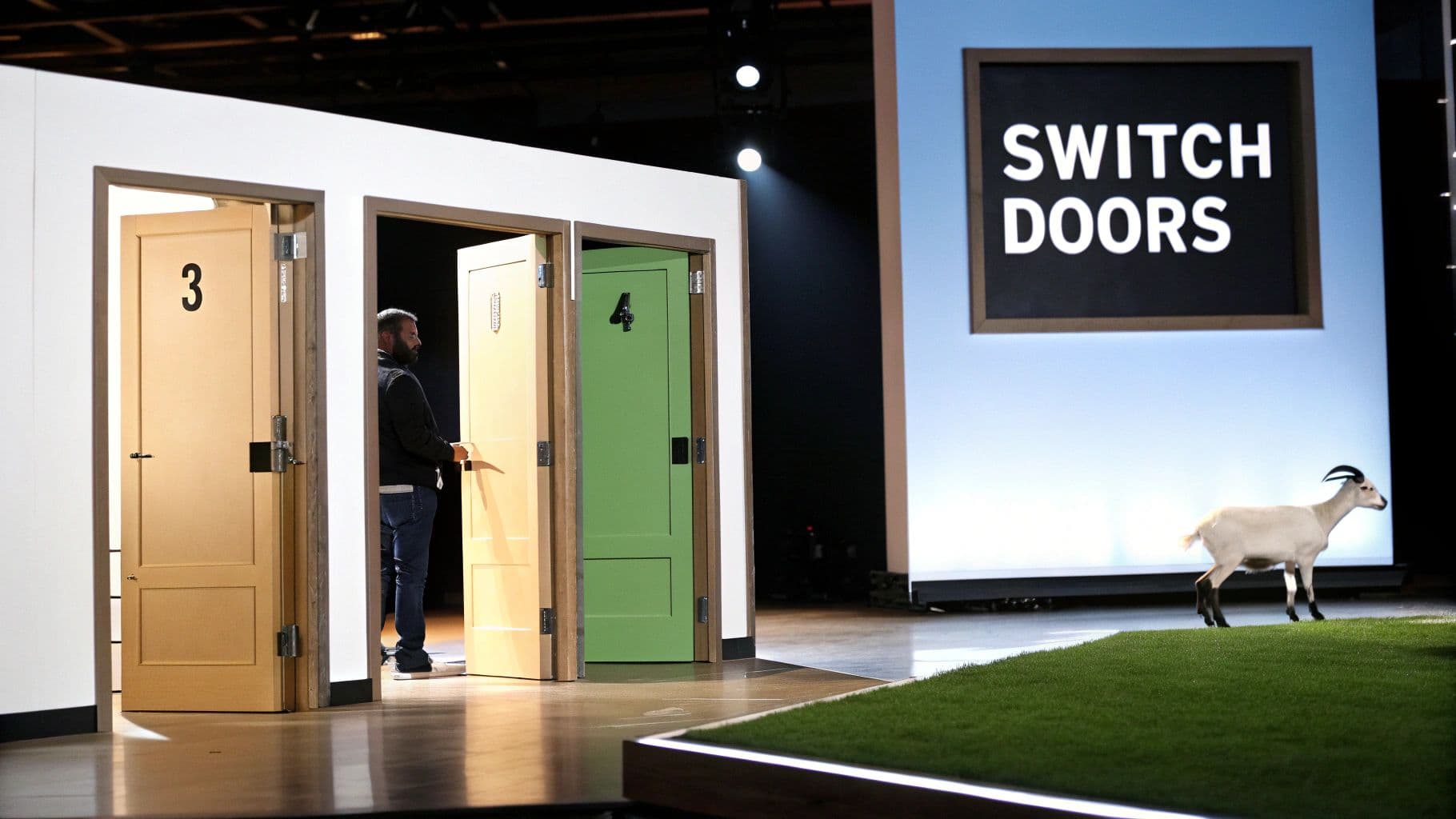
This is one of the most famous probability puzzles and a staple in interviews that test statistical reasoning and logical deduction. The Monty Hall problem is a powerful brain teaser for interview scenarios because it pits raw intuition against mathematical probability. Interviewers use it to see if a candidate can overcome cognitive bias and apply a structured, logical framework to a counterintuitive problem.
The question evaluates your ability to reassess a decision when new information is introduced. It specifically tests your understanding of conditional probability and your composure when faced with a problem that famously stumps even highly intelligent people.
Solving the Puzzle: A Step-by-Step Approach
The key is to ignore your gut feeling, which often suggests that the odds are 50/50 after one door is opened. Instead, you must analyze how the host's action provides new, crucial information.
-
State the Initial Probabilities: At the start, there are three doors. The prize is behind one of them.
- Your Chosen Door: The probability the prize is behind your first-choice door is 1/3.
- The Other Two Doors: The combined probability the prize is behind one of the other two doors is 2/3.
-
Analyze the Host's Action: This is the most critical step. The host, who knows where the prize is, will always open a door that is a) not your door, and b) does not have the prize. This action isn't random; it's a deliberate revelation of information.
-
Re-evaluate the Probabilities: The host's action doesn't change the initial 1/3 probability that your first pick was correct. However, the host has now concentrated the entire 2/3 probability of the "other two doors" onto the single remaining closed door.
- Your Original Door: The probability remains 1/3.
- The Remaining Unopened Door: Its probability is now 2/3.
-
Make the Final Decision: By switching doors, you are moving from a 1/3 chance of winning to a 2/3 chance of winning. Therefore, you should always switch.
- Decision: Switch doors.
- Improvement: You double your chances of winning the prize.
Key Insight: The host's knowledge is the game-changer. By revealing a goat, they are giving you information about the doors you didn't pick. Your ability to recognize this and update your strategy is exactly what the interviewer is looking for. Explore more challenges like these with these additional brain teasers for interviews.
4. Lateral Thinking: The Blue Eyes Island Puzzle
This is a famous logic puzzle that ranks among the most challenging brain teasers for interview scenarios. Popularized in consulting and tech interviews, it tests your ability to think recursively, understand the concept of common knowledge, and reason about how information flows within a group. The interviewer is not looking for a quick guess but a meticulous, step-by-step deconstruction of the logical chain.
This question evaluates your capacity for rigorous, abstract reasoning and your patience in working through a complex, counterintuitive problem. The key is to demonstrate clarity of thought and the ability to build a logical argument from a simple base case.
Solving the Puzzle: A Step-by-Step Approach
The solution hinges on inductive reasoning. The best way to solve it is to start with the simplest possible scenario and build up to the more complex case of 100 blue-eyed islanders.
-
Establish the Base Case (N=1): Imagine there is only one person with blue eyes on the island. This person sees no one else with blue eyes. Since the guru announced there is at least one person with blue eyes, that person must be them. They will leave on the first night.
-
Scale to the Next Case (N=2): Now, imagine two people have blue eyes (Person A and Person B).
- Person A sees one person with blue eyes (Person B). Person A thinks, "If I don't have blue eyes, then Person B is the only one. He would have seen no blue-eyed people and left on the first night."
- When Person B doesn't leave on the first night, Person A deduces that their assumption must be wrong. The only reason Person B didn't leave is because he also saw someone with blue eyes: Person A.
- Realizing this on the second day, both Person A and Person B will leave on the second night.
-
Identify the Pattern (N=3): With three blue-eyed people (A, B, C), each one sees two others.
- Person A sees B and C. Person A thinks, "If I don't have blue eyes, then only B and C do. Based on the N=2 logic, they should both leave on the second night."
- When B and C do not leave on the second night, Person A knows their initial assumption was false. The only reason the N=2 scenario didn't play out is that there is a third blue-eyed person they couldn't see: Person A themselves.
- All three blue-eyed people reach this same conclusion and leave together on the third night.
-
Apply the Logic to the Final Number (N=100): This pattern continues. If there are 100 people with blue eyes, each one sees 99 others. Each will wait 99 nights, expecting the 99 they see to leave based on the N=99 logic. When nobody leaves on the 99th night, all 100 will simultaneously deduce their own eye color and leave on the 100th night.
Key Insight: The guru's statement, while seemingly telling everyone something they already knew (that blue-eyed people exist), is crucial. It transforms the private knowledge of seeing blue eyes into common knowledge, allowing everyone to start the same chain of synchronized logical deduction. This demonstrates how a shared piece of information can be the catalyst for solving a complex problem.
5. System Design Challenge: How Would You Weigh an Elephant?
This is a classic creative problem-solving and engineering-style brain teasers for interview question. It's not about knowing a single "right" answer but about demonstrating your ability to approach a novel problem with creativity, logic, and an understanding of physical principles. The interviewer is assessing your resourcefulness, your ability to analyze trade-offs, and your systematic approach to problem decomposition.
This question tests your ability to think outside the box, apply basic scientific principles, and consider practical constraints like cost, safety, and feasibility. It's a test of how you would tackle a real-world engineering or system design challenge where off-the-shelf solutions aren't available.

Solving the Puzzle: A Step-by-Step Approach
The best way to answer is to propose several distinct methods, explaining the principles behind each and evaluating their respective pros and cons. This shows the interviewer you can generate multiple solutions and critically assess them.
-
Water Displacement Method (Archimedes' Principle): This is a common and elegant solution.
- Process: Lead the elephant onto a large, sturdy barge or boat in a contained body of water like a large pool or lock. Mark the water level on the side of the barge. After the elephant gets off, add standard weights (like sandbags or barrels of water of a known mass) onto the barge until the water level returns to the original mark. The total mass of the added weights equals the elephant's mass.
- Evaluation: This is scientifically sound but requires significant resources (a large barge, a pool, and many known weights).
-
Pressure-Based Method: This approach uses the concept of pressure (Force / Area).
- Process: Have the elephant stand on a large, robust hydraulic platform supported by one or more pistons filled with a fluid (like water or oil). The elephant's weight will exert force on the platform, creating pressure in the fluid. This pressure can be measured with a standard pressure gauge. Using the formula
Force = Pressure * Area, you can calculate the force (weight) if you know the surface area of the pistons. - Evaluation: This is a more direct and potentially more precise method, but it involves constructing specialized equipment.
- Process: Have the elephant stand on a large, robust hydraulic platform supported by one or more pistons filled with a fluid (like water or oil). The elephant's weight will exert force on the platform, creating pressure in the fluid. This pressure can be measured with a standard pressure gauge. Using the formula
-
Leverage and Fulcrum Method: A classic physics-based solution.
- Process: Create a giant seesaw with a very strong, long plank and a sturdy fulcrum. Place the elephant on one end of the lever. On the other end, start adding known weights (or even a vehicle of a known mass) until the plank balances. Using the principle of moments (
Mass1 * Distance1 = Mass2 * Distance2), you can calculate the elephant's mass. - Evaluation: This is conceptually simple but presents major practical challenges in terms of scale, material strength, and safety.
- Process: Create a giant seesaw with a very strong, long plank and a sturdy fulcrum. Place the elephant on one end of the lever. On the other end, start adding known weights (or even a vehicle of a known mass) until the plank balances. Using the principle of moments (
Key Insight: The goal is to demonstrate a versatile problem-solving mindset. Start with the most straightforward ideas (like finding a truck scale) and then move to more creative, first-principles solutions. For each method, discuss the assumptions you're making (e.g., "assuming we have access to a large body of water") and analyze the practical limitations and trade-offs. This showcases a thought process that is both creative and grounded in reality.
6. Pattern Recognition: The Missing Number in Sequences
This category of brain teasers for interview is a direct test of your inductive reasoning and logical deduction skills. Interviewers use sequence puzzles, both numeric and visual, to see how quickly you can identify underlying patterns and extrapolate a logical conclusion. Unlike estimation puzzles, these often have a single correct answer.
The core challenge is to analyze a given set of elements, uncover the rule that governs their progression, and apply it to find the missing piece. This skill is highly valued in roles that require data analysis, forecasting, and strategic planning, as it mirrors the process of finding trends in complex datasets.
Solving the Puzzle: A Step-by-Step Approach
Your ability to methodically test hypotheses and articulate the governing rule is more important than just blurting out the right number. A structured approach is key.
-
Analyze the Initial Sequence: Look at the relationship between consecutive numbers. Is it addition, subtraction, multiplication, or division? Consider more complex operations.
- Example Sequence: 1, 4, 9, 16, ?, 36
- Initial Observation: The numbers are increasing, and the gap between them is also increasing (4-1=3, 9-4=5, 16-9=7).
-
Formulate a Hypothesis: Based on your observation, propose a rule. The numbers appear to be perfect squares.
- Rule: The sequence consists of the squares of consecutive integers, starting from 1.
- 1 = 1², 4 = 2², 9 = 3², 16 = 4²
-
Verify the Pattern: Check if your proposed rule holds true for the entire given sequence. In this case, it does.
- The last given number is 36, which is 6². This fits the pattern perfectly.
-
Calculate the Missing Number: Apply the verified rule to find the missing element. The missing term should be the square of 5.
- Missing Number: 5² = 25.
Key Insight: Always state the pattern you've identified before giving the answer. For example, say, "I've noticed that each number is the square of its position in the sequence. Therefore, the fifth number should be five squared, which is 25." This verbalizes your reasoning and demonstrates a clear, logical thought process, which is the ultimate goal of these brain teasers for interview.
7. Probability Brain Teaser: The Birthday Paradox
The Birthday Paradox is a classic brain teasers for interview scenario that highlights the difference between intuition and mathematical probability. It asks: "What is the minimum number of people you need in a room so that there is at least a 50% chance that two of them share the same birthday?" The answer is surprisingly low, making it a great test of a candidate's ability to approach problems logically rather than relying on gut feelings.
This question tests your understanding of probability, particularly combinatorial principles and the concept of complementary events. Interviewers at quantitative finance firms and data science companies use it to see if you can identify a more efficient way to solve a complex probability problem.
Solving the Puzzle: A Step-by-Step Approach
Our intuition often leads us astray here. We think about the chance of one specific person matching another, which is low. The key is to realize we are looking for any pair among all possible combinations of people in the group. The easiest way to solve this is by calculating the probability of the opposite event: that no one shares a birthday.
-
Define the Complementary Event: The opposite of "at least two people share a birthday" is "everyone has a unique birthday." If we can calculate the probability of this (let's call it P(A')), we can find our desired probability (P(A)) by using the formula P(A) = 1 - P(A').
-
Calculate the Probability of Unique Birthdays:
- Person 1: Can have any birthday (365/365).
- Person 2: Must have a different birthday from Person 1, so there are 364 available days (364/365).
- Person 3: Must have a different birthday from the first two, leaving 363 available days (363/365).
- This continues for n people. The probability of n people all having unique birthdays is: P(A') = (365/365) * (364/365) * (363/365) * ... * ((365-n+1)/365).
-
Find the Tipping Point: We need to find the smallest number n where the probability of everyone having a unique birthday drops below 50%. This means we are looking for the point where 1 - P(A') > 0.50, or P(A') < 0.50.
- With 22 people, the probability of no shared birthday is ~52.4%.
- With 23 people, the probability of no shared birthday drops to ~49.3%.
-
State the Conclusion: Therefore, the probability of at least one shared birthday is 1 - 0.493 = 50.7%. The minimum number of people required is 23.
Key Insight: This puzzle demonstrates the power of combinatorial explosion. The number of possible pairs grows much faster than the number of people, making a match more likely than intuition suggests. Thinking about the complement of an event is a powerful problem-solving shortcut, applicable in many quantitative and strategic scenarios. It shows an interviewer that you can reframe a problem to find a more elegant solution.
8. Scenario Analysis: The Bridge and Torch Puzzle (Logic and Optimization)
This is a classic logic and optimization puzzle that frequently appears in interviews for consulting, finance, and tech roles. The interviewer presents a scenario with strict constraints and asks for the fastest possible solution. They are not just looking for the right answer; they are evaluating your ability to manage constraints, think strategically, and work through a problem systematically.

This question tests your skills in optimization, logical deduction, and time management. The goal is to find the most efficient sequence of moves, which often requires a counter-intuitive step. It's a great example of how the most obvious path isn't always the best one, a common theme in complex business challenges.
Solving the Puzzle: A Step-by-Step Approach
The key is to methodically map out the moves and calculate the cumulative time for each trip across the bridge. Let's outline the problem and its constraints first.
The Scenario: Four people need to cross a rickety bridge at night.
- Person A: Crosses in 1 minute
- Person B: Crosses in 2 minutes
- Person C: Crosses in 5 minutes
- Person D: Crosses in 10 minutes
The Constraints:
- The bridge can only hold two people at a time.
- They have only one torch, which is required for every crossing.
- When two people cross together, they move at the speed of the slower person.
-
Trip 1 (Forwards): A and B cross together. The torch must be with them.
- Time: 2 minutes (B's speed).
- Total Time: 2 minutes.
-
Trip 2 (Backwards): The fastest person, A, brings the torch back. This is an efficient use of time.
- Time: 1 minute (A's speed).
- Total Time: 2 + 1 = 3 minutes.
-
Trip 3 (Forwards): This is the critical, non-obvious step. The two slowest people, C and D, cross together. This "pairs up" the biggest delays into a single trip.
- Time: 10 minutes (D's speed).
- Total Time: 3 + 10 = 13 minutes.
-
Trip 4 (Backwards): B, who was waiting on the other side, brings the torch back.
- Time: 2 minutes (B's speed).
- Total Time: 13 + 2 = 15 minutes.
-
Trip 5 (Forwards): The final two people, A and B, cross the bridge together.
- Time: 2 minutes (B's speed).
- Total Time: 15 + 2 = 17 minutes.
Key Insight: The solution hinges on the counter-intuitive move of having the two slowest people cross together. A common mistake is to always send the fastest person back and forth, which results in a longer total time (19 minutes). This puzzle teaches that optimizing individual steps doesn't always optimize the entire system, a crucial lesson for project management and business strategy.
8 Interview Brain Teasers — Comparative Guide
| Item | 🔄 Implementation complexity | Resource requirements | ⚡ Speed / efficiency | 📊 Expected outcomes / ⭐ Quality | 💡 Ideal use cases |
|---|---|---|---|---|---|
| The Classic Riddle: How Many Tennis Balls Fit in a School Bus? | Moderate — dimensional estimates & packing assumptions | Low — pencil, calculator, rough measurements | ⚡ Medium (10–20 min) | 📊 Reveals estimation skill, spatial/math reasoning; ⭐ Emphasizes process over a single correct number | 💡 Estimation practice, interviews assessing approximation and communication |
| Logic Puzzle: The Five Houses Problem (Zebra Puzzle) | High — many variables and constraint propagation | Moderate — grid/matrix and time | ⚡ Low (20–30+ min) | 📊 Tests systematic deduction, attention to detail; ⭐ Strong indicator of formal logical rigor | 💡 Deep logical reasoning roles, assessing persistence and organization |
| The Monty Hall Problem: Decision-Making Under Uncertainty | Low — simple probability conceptually, counterintuitive | Low — ability to explain conditional probability | ⚡ High (5–10 min) | 📊 Measures Bayesian/conditional reasoning and bias correction; ⭐ Good quick probe of quantitative thinking | 💡 Data science/quant interviews, testing probabilistic intuition |
| Lateral Thinking: The Blue Eyes Island Puzzle | High — recursive "thinking about thinking" chains | Low — conceptual discussion, time for iterations | ⚡ Low (lengthy discussion possible) | 📊 Tests meta-reasoning and information flow interpretation; ⭐ Distinguishes recursive/abstract thinkers | 💡 Roles valuing abstract, recursive problem solving and clear explanation |
| System Design Challenge: How Would You Weigh an Elephant? | Moderate–High — engineering trade-offs and feasibility analysis | Moderate — domain knowledge, creativity, reference principles | ⚡ Medium (10–20 min) | 📊 Reveals resourcefulness, trade-off analysis, applied physics; ⭐ Strong for practical ingenuity | 💡 Engineering/product interviews emphasizing real-world constraints |
| Pattern Recognition: The Missing Number in Sequences | Low — identify simple numeric/visual rules | Low — pen/paper and quick checks | ⚡ Very high (2–5 min) | 📊 Tests inductive reasoning and pattern-spotting speed; ⭐ Useful for rapid screening | 💡 Early-stage screening, roles needing quick analytical insight |
| Probability Brain Teaser: The Birthday Paradox | Low–Moderate — combinatorics via complement probability | Low — basic probability calculation | ⚡ High (5–10 min) | 📊 Assesses combinatorial thinking and ability to challenge intuition; ⭐ Strong for quantitative literacy | 💡 Data science, statistics teaching, explaining counterintuitive results |
| Scenario Analysis: The Bridge and Torch Puzzle | Moderate — constrained optimization and sequencing | Low — pen/paper, time to test strategies | ⚡ Medium (10–20 min) | 📊 Demonstrates optimization, constraint management, trade-off insight; ⭐ Highlights systems/strategic thinking | 💡 Consulting, operations, product strategy interviews |
From Puzzles to Performance: Turning Practice into Offers
As we've journeyed through a landscape of classic brain teasers for interview settings, from the estimation-driven Tennis Ball Problem to the rigorous logic of the Zebra Puzzle, a central theme emerges. The goal isn't to arrive at a single "correct" answer that you've memorized beforehand. Instead, it is to master a versatile, repeatable process for deconstructing ambiguity and building a logical, transparent case for your conclusion. Interviewers use these puzzles as a crucible to test not what you know, but how you think. They want to see your intellectual horsepower in action.
The true value of practicing these challenges lies in developing a mental toolkit that allows you to remain composed under pressure. When an interviewer presents a seemingly impossible question like weighing an elephant without a scale, they are observing your initial reaction, your ability to structure the unstructured, and your creativity in applying foundational principles to a novel scenario. Each puzzle we've covered targets a specific cognitive muscle: the Monty Hall Problem hones your probabilistic intuition, the Blue Eyes Island Puzzle tests your capacity for recursive logic, and the Bridge and Torch Puzzle measures your skill in optimization and time management.
Key Takeaways: From Theory to Interview-Ready Skill
Mastering these concepts requires moving beyond passive reading and into active, simulated practice. Here are the core principles to internalize as you prepare:
- Structure is Everything: Before uttering a single number or assumption, always state your framework. Whether it’s breaking down the volume of a bus or outlining the steps to weigh an elephant, a clear structure demonstrates a methodical and organized mind. This is non-negotiable in consulting and finance interviews.
- Assumptions are Your Allies: Ambiguous problems are ambiguous by design. Your ability to state, justify, and sanity-check your assumptions is more critical than the assumptions themselves. Voice them clearly: "Assuming a standard 72-passenger school bus..." or "Let's assume the torch has a fixed burn time with no variability..."
- Verbalize Your Thought Process: A silent genius is indistinguishable from a stumped candidate. Narrate your entire problem-solving journey. Talk through your initial hypotheses, the dead ends you encounter, and the reasons you're pivoting your approach. This "thinking out loud" is precisely what the interviewer is there to evaluate.
- Embrace the Iterative Approach: Don't be afraid to refine your answer. Start with a high-level estimate and then add layers of nuance. For example, in the tennis ball problem, after a basic volume calculation, you might refine it by accounting for the irregular shapes of seats or the packing inefficiency of spheres. This shows intellectual rigor.
Your Actionable Path Forward
Ultimately, success with brain teasers for interview preparation hinges on deliberate, targeted practice that mirrors the real-world environment. While solving puzzles on paper is a great start, it doesn't replicate the pressure of a live performance. It's crucial to integrate this focused preparation into your broader strategy. For comprehensive interview readiness, combine your brain teaser practice with a broad range of actionable job interview preparation tips to ensure you're polished across all facets of the hiring process.
The journey from seeing a puzzle for the first time to confidently solving a new variant in front of a managing director is built on repetition and feedback. It’s about building the mental reflexes to categorize a problem, deploy the right framework, and communicate your solution with clarity and conviction. This skill set transcends the interview room; it is the very foundation of analytical roles in top-tier firms. By dedicating yourself to this process, you are not just preparing to answer a question, you are preparing to be the strategic, logical, and creative thinker they are looking to hire.
Ready to move from theory to mastery? Soreno provides an AI-powered mock interview platform with an extensive library of brain teasers, market sizing questions, and case studies. Get instant, rubric-based feedback on your structure, communication, and analytical rigor to turn your practice into a polished, offer-winning performance.