
Mastering the Deductive Reasoning Skills Test
Ace your deductive reasoning skills test with this complete guide. Learn key strategies, question types, and proven prep techniques to land your dream job.

A deductive reasoning skills test is a type of pre-employment assessment that looks at one thing: your ability to take a set of general rules or statements and arrive at a guaranteed, logical conclusion. Think of yourself as a detective. You’re given a handful of clues (the premises), and your job is to figure out the one conclusion that must be true based on those clues alone.
It’s less about guesswork and more about pure, cold logic.
Decoding the Purpose of Deductive Reasoning Tests
At its heart, a deductive reasoning test isn’t trying to quiz you on your existing knowledge. Instead, it’s designed to see how you think. Employers use these tests as a window into your analytical and decision-making skills, making them a strong predictor of how you'll perform on the job.
Picture a consultant trying to solve a client's problem. They're handed a stack of data and a list of company policies. Their task is to connect the dots and recommend a specific strategy that’s guaranteed to work within those constraints. That entire process—moving from general rules to a specific, certain outcome—is deductive reasoning in action. Companies want to know if you can handle that kind of structured thinking, especially when the pressure is on.
Why Employers Rely on These Assessments
Deductive reasoning tests have become a staple in hiring, especially in competitive fields like finance, law, consulting, and tech. They provide an objective way to measure a candidate's raw cognitive ability, cutting through the noise of polished resumes and smooth interviews.
The numbers back this up. A 2023 survey of Fortune 500 companies in the US found that 87% use some form of psychometric testing, with deductive assessments being a popular choice. In the UK, it's a similar story, where 72% of top graduate programs in banking and consulting use them right at the start of the hiring process. You can explore more about how top firms use these tests to screen candidates.
So what exactly are they measuring? These tests effectively evaluate a few key skills:
- Logical Thinking: Can you follow a rigid line of reasoning without letting your own assumptions or outside knowledge get in the way?
- Problem-Solving: Are you able to break down a complex scenario into smaller, more manageable pieces and apply the rules you’re given?
- Attention to Detail: Can you spot the tiny details? In these tests, one missed word can completely change the answer.
- Rule-Based Decision Making: How good are you at making calls based only on the information you've been provided?
Deductive vs Inductive Reasoning: A Crucial Distinction
To really get a handle on what these tests are about, it’s important to know the difference between deductive reasoning and its counterpart, inductive reasoning. They're both types of logic, but they move in opposite directions and produce very different kinds of answers.
Deductive reasoning is about certainty. It starts with a general rule and applies it to a specific situation to reach a conclusion that is 100% guaranteed.
Inductive reasoning is about probability. It starts with specific observations and tries to create a general rule, but the conclusion is only likely, not guaranteed.
Think of it this way. A detective using deductive reasoning would say, "The rulebook says the thief had to get through a locked door. This suspect doesn't have a key, so they are definitely not the thief."
An inductive detective, on the other hand, might say, "I've seen three break-ins this week, and in each case, a window was smashed. Therefore, the thief probably smashes windows to get in."
Getting this distinction down is the first real step to mastering the logic you’ll need to ace the test.
To make it even clearer, here’s a quick breakdown of how the two types of reasoning stack up.
Deductive vs Inductive Reasoning At a Glance
This table lays out the core differences side-by-side, helping you quickly see how these two logical approaches work.
| Attribute | Deductive Reasoning | Inductive Reasoning |
|---|---|---|
| Starting Point | General principle or premise | Specific observations |
| Direction | Top-down (general to specific) | Bottom-up (specific to general) |
| Conclusion Type | Certain and guaranteed if premises are true | Probable but not guaranteed |
| Goal | To prove a specific conclusion | To form a general hypothesis |
| Example | All dogs bark. Fido is a dog. Therefore, Fido barks. | My dog barks. My neighbor's dog barks. Therefore, all dogs probably bark. |
Grasping these fundamentals is key. A deductive reasoning test is purely about that first column—applying established rules to find a guaranteed truth.
Cracking the Common Question Types
To do well on a deductive reasoning test, you first need to know what you’re up against. These tests aren't just a random collection of brain teasers. They’re built around a few core question types, each designed to probe a specific logical skill. Once you can spot the different formats, you can stop feeling overwhelmed and start applying a clear strategy for each one.
It’s a bit like learning the rules for different card games. Once you know the objective and how the pieces move, you can start thinking a few steps ahead. The same logic applies here. Recognizing a question as a "syllogism" or an "arrangement puzzle" immediately gives you a framework for how to attack it.
This whole process is about moving from established facts, through logical processing, to a rock-solid conclusion, as this infographic shows.
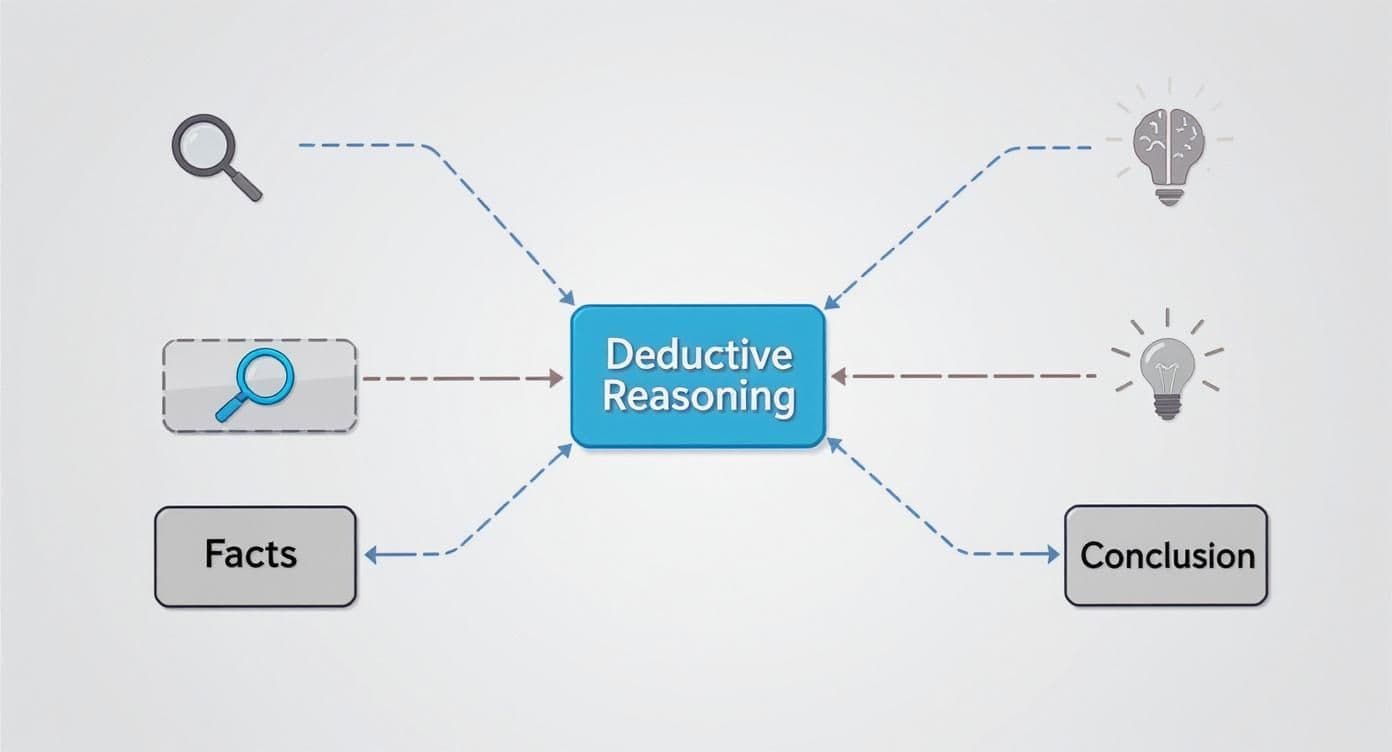
This visual is a great reminder that every question is a self-contained puzzle. Your only job is to use the facts they give you—and nothing else—to find the right answer.
The Classic Syllogism
The most fundamental question type you’ll face is the syllogism. This is a classic logic puzzle that gives you two or more premises (statements you have to assume are 100% true) and then asks you to figure out which conclusion logically follows from them.
The trick is to accept the premises at face value, even if they sound completely bizarre or contradict what you know about the real world. Your job is to analyze the relationship between the statements, not to fact-check them.
Here's a simple example:
- Premise 1: All squares are rectangles.
- Premise 2: All rectangles have four sides.
- Conclusion: Therefore, all squares have four sides.
In this case, the conclusion is guaranteed to be true because of the logical link between the premises. Test designers love to throw in tricky options, like conclusions that seem plausible but aren't actually supported by the premises.
Untangling Arrangement Puzzles
Arrangement puzzles are another staple. These questions give you a set of items or people along with a list of rules that govern their position relative to one another. You might be asked to order people in a queue, seat them around a table, or schedule them into a rota.
The single best strategy here is to grab some scratch paper and sketch it out. Use simple slots, boxes, or circles to represent the positions and start filling them in as you digest the rules. Always start with the most concrete rules—the ones that lock an item or person into a specific spot.
Tackling these puzzles demands a visual approach. Trying to hold all the moving parts in your head is a recipe for disaster. A quick sketch transforms an abstract jumble of rules into something you can actually see and solve.
This method helps you spot the gaps and infer relationships that aren't explicitly stated, which is often the key to finding the correct answer.
Solving Grouping and Sequencing Tasks
Grouping questions are a close cousin to arrangement puzzles, but instead of ordering things, you’re assigning them to categories based on a set of conditions. For instance, you might have to assign employees to different project teams, making sure each team meets certain criteria (like having at least one manager and one designer).
Sequencing questions, on the other hand, are all about putting events or steps into the correct chronological or logical order. You’ll get a series of statements describing various actions and have to piece them together into a coherent timeline.
Both of these question types are designed to test your ability to juggle multiple constraints at once. The key to success is a methodical, step-by-step approach.
Over the years, the structure of these tests has become fairly standard. A typical deductive reasoning test from a major provider like SHL will have between 19 and 23 questions with a tight 20-minute time limit. Data shows that syllogisms make up about 35% of these questions, with ordering and sequencing at 30%, and grouping tasks at 25%. The remaining 10% is usually a mix of other logic puzzles. You can find more detail on modern test structures and question breakdowns to get a feel for what to expect.
How These Tests Are Scored and Interpreted
Knowing how to answer the questions is only half the battle. To really gain an edge, you need to understand how your deductive reasoning test will be scored. Many people get tripped up by this part, but once you pull back the curtain, you can build a much smarter test-taking strategy.
The most important thing to know is that your raw score—how many questions you got right—is almost never what the employer sees. Instead, that score is converted into a percentile rank.
Understanding Percentile Scoring
Your score is compared against a "norm group," which is just a fancy term for a specific pool of other people who took the same test. This group could be other graduates applying for the same scheme, current employees in a similar role, or even a broad sample of the working population.
Think of it like running a race. Clocking a time of 20 minutes doesn't mean much on its own. But if you find out everyone else finished in 30 minutes, your 20-minute time suddenly looks fantastic. If the average was 15 minutes, however, it's a different story. That’s exactly how percentile scoring works.
A score in the 80th percentile means you performed better than 80% of the people in that comparison group. This is the number that recruiters care about. They aren't just looking for someone who can pass; they're hunting for candidates who stand out from the crowd.
Your goal isn't just to get answers right; it's to perform better than the majority of other candidates. Aiming for a score above the 75th percentile is a solid benchmark for competitive roles.
This is precisely why practice is so critical. You’re not just training to hit a certain number of correct answers—you’re preparing to outperform a large pool of other sharp, motivated applicants.
The Speed Versus Accuracy Dilemma
Deductive reasoning tests are almost always a race against the clock. This forces you into a classic dilemma: do you focus on speed or accuracy? Go too fast, and you'll make silly mistakes. Go too slow, and you'll leave easy points on the table by not finishing the test.
So, what’s the best approach? The answer hinges on one crucial detail: negative marking.
- No Negative Marking: If wrong answers don't cost you points, your best bet is to answer every single question. If time is running out, a quick, educated guess on the remaining items is far better than leaving them blank.
- With Negative Marking: This changes everything. When incorrect answers come with a penalty, accuracy is king. You should only answer the questions you feel confident about. Wild guessing becomes a risky gamble that can seriously hurt your score.
Before you start, always read the instructions carefully to see if negative marking is used. This one piece of information should completely dictate how you manage your time and approach the test. Adapting your strategy to the scoring rules is a key skill in itself and can make all the difference in your final percentile rank.
Proven Strategies for Effective Test Preparation
It's easy to say "just practice," but what does that actually look like? Crushing a deductive reasoning skills test isn’t about luck or just doing endless questions. It’s about smart, methodical preparation that builds both your skills and your confidence.
Think of it as training for a mental marathon. The right strategies can completely shift your approach from frantic guessing to calm, proactive problem-solving. Let’s walk through a roadmap that will give you the tools to perform at your best when it counts.

Create a Structured Practice Schedule
Last-minute cramming is a recipe for disaster. Consistency is your best friend here. A structured schedule helps build the mental stamina you’ll need for these high-pressure, timed tests. The goal is to make the logical process feel like second nature.
Don't try to block out huge, draining study sessions. Short, focused bursts are far more effective. Try to set aside 20-30 minutes of dedicated practice each day for at least a week or two before your test. This keeps you sharp without leading to burnout.
And here’s the non-negotiable part: always time yourself. The only way to get comfortable with the pace of the real thing is to simulate that time pressure. Use a stopwatch and hold yourself to the typical per-question time limits, which are usually around 45-60 seconds.
Master Key Problem-Solving Techniques
Going through practice questions isn't enough—you have to actively use specific strategies to dismantle them. The highest scorers have a repeatable process for every question, which saves precious time and mental energy.
First, learn to instantly identify the question type. Is it a syllogism? An arrangement puzzle? A grouping task? Recognizing the format right away lets you pull the right tool from your mental toolkit, setting you on the fastest path to the answer.
Visualization is one of the most powerful techniques you can learn, especially for those tricky arrangement and grouping puzzles.
- Draw Simple Diagrams: Don't try to juggle all the complex rules in your head. Grab some scratch paper and draw out slots, tables, or simple flowcharts. This gets the information out of your brain and onto the page, making the relationships between different elements crystal clear.
- Start with Absolute Truths: Look for the most concrete, definite rules first. If a statement says, "Sarah must be in seat 3," lock that in on your diagram immediately. You can then build the rest of your solution around these fixed points.
- Use Process of Elimination: This is your secret weapon. When you can’t immediately spot the right answer, switch gears and focus on proving which options are impossible. Every incorrect option you cross off dramatically improves your odds.
The heart of great preparation is building a systematic approach. When you learn to turn confusing scenarios into simple visuals and methodically chip away at the impossible, you replace chaos with clarity. This is the essence of structured thinking.
If you want to go deeper on this, our guide on structured problem-solving techniques offers a fantastic framework for tackling all kinds of analytical challenges.
Analyze Your Performance and Adapt
The final, crucial piece of the puzzle is reflective practice. After every timed session, you absolutely have to review your results with a critical eye. This is where the real learning happens.
Don't just glance at the questions you got wrong. You need to dig into why you got them wrong.
- Categorize Your Errors: Did you misread the question? Make a simple mistake in your diagram? Follow a flawed logical path? Or did you just run out of time?
- Identify Weak Areas: Are you consistently getting tripped up by syllogisms with negative statements like "None" or "Not all"? Maybe complex seating arrangements are your bottleneck.
- Refocus Your Practice: Once you know your weak spot, dedicate your next study session to it. Drill that one question type until you feel your speed and accuracy start to climb.
This simple feedback loop—practice, analyze, adapt—is the single fastest way to turn your weaknesses into strengths. It makes sure your prep time is targeted and efficient, so you're spending your energy on what will actually boost your score.
Using Practice Platforms to Sharpen Your Skills
When it comes to prepping for a deductive reasoning test, the old saying "work smarter, not harder" has never been more true. While you need to understand the theory, the real progress happens when you get your hands dirty and simulate the actual test experience. This is where dedicated practice platforms give you a serious competitive edge.
These platforms aren't just glorified quiz sites. They're meticulously designed to mimic the exact format, question style, difficulty level, and—most importantly—the intense time crunch of the real assessments from big names like SHL, Kenexa, and Watson Glaser. Throwing yourself into this realistic environment is the quickest way to build the mental stamina you'll need on test day.
Here's a look at what a typical dashboard on a test prep platform might look like. It's all about tracking your performance so you can see exactly where you stand.

This kind of feedback turns your prep from a guessing game into a focused strategy. You can immediately spot your weak points and start working on them.
Unlocking Data-Driven Improvement
The single biggest benefit of using these tools is the performance analytics. You don't just get a final score; you get a complete breakdown that tells you exactly where you need to put in the work.
Most good platforms will give you a dashboard tracking a few crucial metrics:
- Accuracy by Question Type: Are syllogisms tripping you up? Or are arrangement puzzles your real weakness? This tells you instantly.
- Average Time per Question: This metric is pure gold. It shows you if you're getting bogged down on certain problems, which is a major red flag under tight time limits.
- Performance Over Time: See your scores climb as you practice. This is fantastic for motivation and for confirming your strategies are paying off.
This is the difference between just practicing and engaging in deliberate practice. By analyzing your own data, you can pinpoint your personal bottlenecks—whether it's raw speed, a specific logical trap, or a type of puzzle—and focus all your energy on fixing them.
This targeted approach makes your preparation far more efficient and delivers a much bigger impact on your final score.
The Power of Detailed Explanations
It’s one thing to know you got an answer wrong. It’s another thing to know why. The real learning happens in the detailed solution walkthroughs that practice platforms provide. After every question, you should be able to see a step-by-step breakdown of the logic.
These explanations don't just give you the answer; they teach you the thought process. They'll often point out common mistakes and show you the most direct path to the correct conclusion. Reviewing your errors this way is where the concepts really stick, helping you internalize the right logical frameworks for good.
At the end of the day, consistent, reflective practice is what sets the top candidates apart. If you want to see where you currently stand, you can test your deductive reasoning skills with our own set of questions. Using platforms to drill, analyze, and fine-tune your approach is how you build the skill and confidence to ace the test when it really counts.
Answering Your Top Deductive Reasoning Test Questions
It’s one thing to understand what a deductive reasoning test is, but it's another to know the practical ins and outs of taking one. Let’s tackle the common questions that pop up so you can walk into your test feeling prepared, not panicked.
Knowing the logistics is just as important as knowing the logic.
How Long Should I Practice for a Deductive Reasoning Test?
Forget about cramming the night before. The key here is consistent, focused effort. Plan on practicing for at least one to two weeks before your test date.
Short, daily sessions of about 20-30 minutes work wonders. This approach builds up your mental stamina and makes the test format feel familiar, which is a huge advantage when the clock is ticking.
Can I Use a Pen and Paper During the Test?
For most tests, the answer is a relieving yes. The vast majority of online platforms allow you to use scratch paper, which is a lifesaver for mapping out those tricky arrangement and grouping puzzles. Calculators, on the other hand, are almost never needed or permitted.
Pro Tip: Always, always read the test instructions carefully before you click "start." Confirming the rules beforehand means no surprises, and you can be sure you're using every tool you're allowed.
This kind of preparation shows you're thorough—a quality employers are definitely looking for. For many of these roles, they're also testing your ability to think on your feet, which we cover in our guide to strategic thinking interview questions.
What Is Considered a Good Score on These Tests?
Don't look for a simple "pass" or "fail" mark. A good score is all about context and is almost always shown as a percentile. This compares your performance to a specific group of other test-takers.
While every company sets its own bar, landing in the 75th percentile or higher is a solid target for competitive roles. It tells the employer you scored better than 75% of the people in the comparison group. Your goal should be to answer as accurately and quickly as possible to get the best rank you can.
Ready to master the logic and land the offer? Soreno provides an AI-powered platform with hundreds of drills and mock interviews to sharpen your analytical skills. Start your free trial and practice with an AI interviewer trained by MBB consultants at https://soreno.ai.