
Top 10 Consulting Behavioral Interview Questions for 2025
Ace your interview with our expert guide to the top 10 consulting behavioral interview questions. Includes STAR frameworks, sample answers, and key tips.

Cracking the case is only half the battle in a consulting interview. The behavioral portion, often called the 'fit' interview, is where firms like McKinsey, BCG, and Bain decide if you have the client-facing polish, resilience, and leadership potential to succeed. This isn't just a formality; it’s a critical evaluation of your past experiences designed to predict your future performance.
While case interviews test your analytical horsepower, consulting behavioral interview questions are designed to uncover the core competencies that separate good analysts from great consultants. Interviewers are specifically probing for evidence of your skills in stakeholder management, leadership, learning agility, and influence. A generic answer won't suffice; they are looking for structured, impactful stories that prove you have what it takes.
This guide breaks down the 10 most common and crucial behavioral questions you will almost certainly face. For each one, we provide a structured approach using frameworks like STAR (Situation, Task, Action, Result) and detail what interviewers are really looking for. We'll offer actionable tips and sample responses to help you craft compelling, authentic narratives that showcase your readiness for a demanding consulting career. Let's transform your experiences into your strongest asset.
1. Tell Me About a Time You Had to Manage a Difficult Stakeholder
Consulting is fundamentally about influencing people. This question probes your ability to manage relationships, navigate conflict, and drive alignment, which are core daily activities for a consultant. Interviewers want to see evidence of your emotional intelligence, communication skills, and problem-solving abilities when faced with interpersonal challenges.
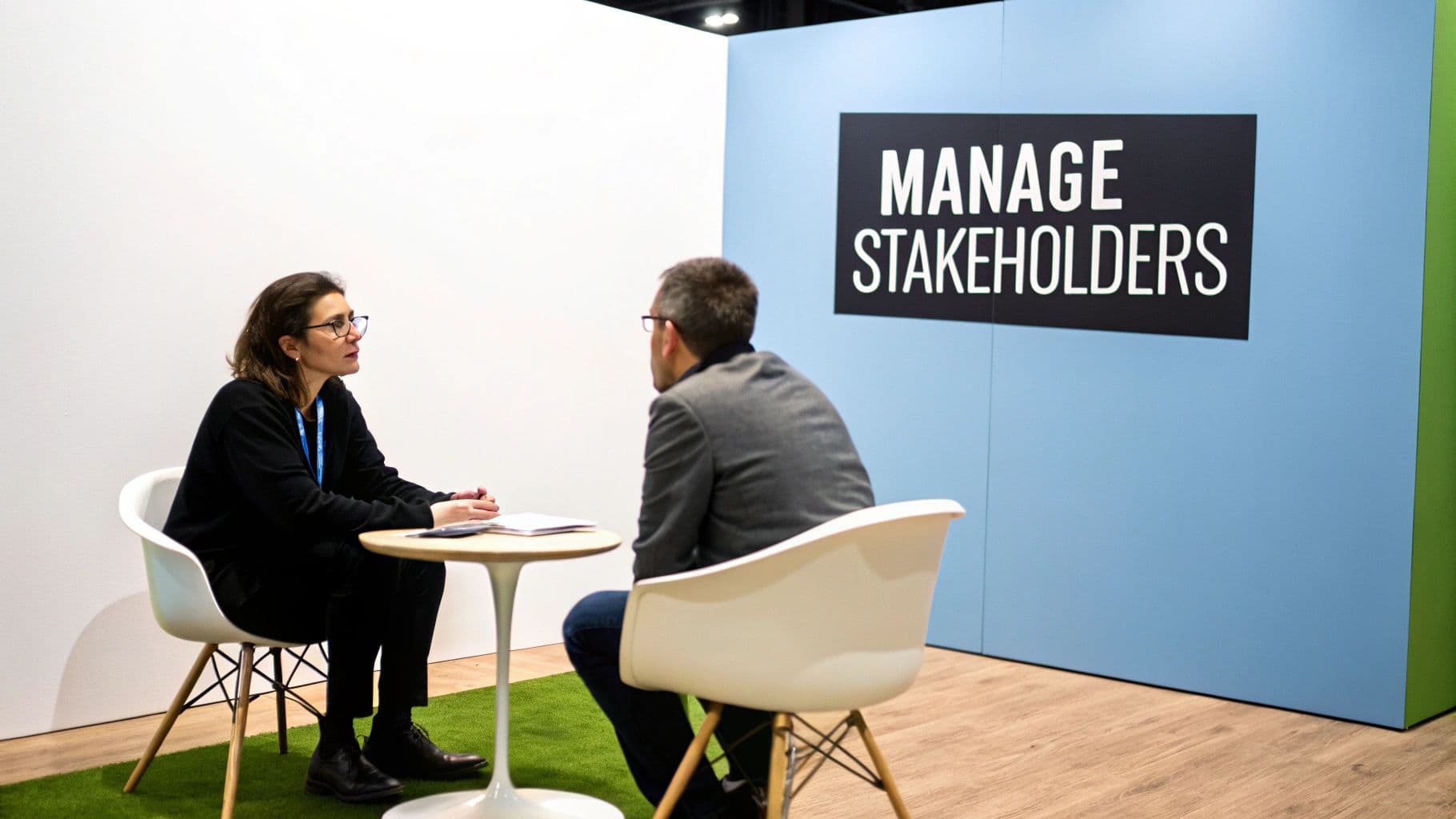
This classic prompt is a staple in consulting behavioral interview questions because it reveals how you handle pressure and maintain project momentum despite resistance. A strong answer will demonstrate that you don't just solve analytical problems but can also manage the human element of a project effectively.
How to Structure Your Answer
The STAR (Situation, Task, Action, Result) method is the gold standard for structuring your response. It provides a clear, logical narrative that is easy for the interviewer to follow.
- Situation: Briefly set the scene. Describe the project and the stakeholder, explaining why they were "difficult." (e.g., "On a market entry strategy project, a key client sponsor was consistently skeptical of our data-driven approach, preferring anecdotal evidence.")
- Task: Clearly state your specific goal. (e.g., "My task was to gain their buy-in to ensure the project’s recommendations would be implemented.")
- Action: Detail the specific, proactive steps you took. Focus on empathy and strategy. Did you hold a one-on-one meeting to understand their concerns? Did you present data in a new way tailored to their perspective?
- Result: Quantify the outcome. Explain how your actions resolved the situation and positively impacted the project. (e.g., "By creating a custom dashboard that bridged our quantitative data with their industry experience, the stakeholder became our strongest advocate, leading to a successful project sign-off and a 15% increase in projected market share.")
2. Describe a Project Where You Led a Cross-Functional Team
Consultants rarely work in a silo. This question tests your ability to lead and collaborate with diverse groups who may have competing priorities and different working styles. Interviewers want to see how you influence without direct authority, foster collaboration, and unify a team toward a common objective.

This prompt is a crucial part of consulting behavioral interview questions as it assesses your leadership potential and project management capabilities. A strong answer will highlight your communication, organization, and interpersonal skills, proving you can drive complex projects to completion by effectively managing people.
How to Structure Your Answer
Again, the STAR method provides a compelling and easy-to-follow narrative for your experience.
- Situation: Briefly describe the project and the cross-functional team involved. Explain why their collaboration was essential. (e.g., "I was tasked with leading a product launch that required close coordination between Engineering, Marketing, and Sales teams, each with its own timeline and goals.")
- Task: State your specific objective as the leader. (e.g., "My goal was to align all three departments on a unified launch strategy and timeline to ensure we hit our Q4 release date.")
- Action: Detail the specific leadership actions you took to unite the team. Did you establish a central communication plan? Did you facilitate workshops to align on goals? How did you mediate conflicts? Focus on enablement and alignment, not just command.
- Result: Quantify the outcome of your leadership. (e.g., "By creating a shared project dashboard and holding weekly alignment meetings, we resolved key dependencies early. The product launched on schedule, exceeding initial sales targets by 20% in the first month.")
3. Tell Me About a Time You Failed and What You Learned
Consulting firms prize a growth mindset. This question tests your self-awareness, resilience, and ability to learn from setbacks. Interviewers are less interested in the failure itself and more focused on your capacity for honest self-reflection and your commitment to continuous improvement. It reveals your maturity and ability to take ownership.

This prompt is one of the most insightful consulting behavioral interview questions because it shows how you handle situations when things don't go according to plan. A strong answer demonstrates humility and a proactive approach to personal development, which are critical for thriving in a feedback-intensive environment.
How to Structure Your Answer
The STAR+L (Situation, Task, Action, Result + Learning) method is perfect here. It extends the classic STAR framework to explicitly highlight the key takeaway.
- Situation: Briefly describe the context. Choose a real, professional failure with tangible consequences, not a trivial mistake. (e.g., "In my previous role, I was responsible for building a financial model for a client's five-year forecast.")
- Task: State your objective and where you fell short. (e.g., "My task was to deliver a final, error-free model, but I missed a critical assumption about market growth, which skewed the initial projections.")
- Action: Detail the steps you took after realizing the failure. This is crucial. How did you take ownership and rectify the situation? (e.g., "I immediately informed my manager, owned the mistake with the client, and worked overnight to correct the model with updated assumptions.")
- Result & Learning: Explain the outcome and, most importantly, articulate what you learned. Show how you've applied this learning since. (e.g., "We delivered the corrected model and rebuilt trust with the client. The key learning was the importance of pressure-testing all core assumptions with a senior team member, a practice I have now institutionalized in my workflow.")
4. Describe a Situation Where You Had to Influence a Decision Without Direct Authority
Consultants are change agents who rarely have formal authority over the client teams they advise. This question directly tests your ability to be effective in this common scenario. Interviewers want to see how you build credibility, use data and logic to construct a persuasive argument, and navigate organizational dynamics to achieve a desired outcome.
This prompt is one of the most critical consulting behavioral interview questions because it gets to the heart of what consultants do: drive change through influence. A strong answer demonstrates your leadership potential, strategic thinking, and emotional intelligence, proving you can create impact without relying on a title.
How to Structure Your Answer
Use the STAR method to build a compelling narrative that showcases your ability to persuade stakeholders and guide decision-making.
- Situation: Briefly describe the context and the key players. What was the decision that needed to be made, and why did you lack direct authority? (e.g., "During a post-merger integration project, I identified an opportunity to consolidate two disparate software systems, but the decision-maker was the head of a different department who was resistant to change.")
- Task: State your objective clearly. (e.g., "My goal was to convince the department head and their team to adopt the new, unified system to realize significant cost savings and efficiency gains.")
- Action: Detail the specific steps you took to build your case and influence the outcome. Focus on your research, communication strategy, and coalition-building. Did you meet with key users to understand their pain points? Did you create a tailored business case with clear ROI projections?
- Result: Quantify the positive outcome of your influence. (e.g., "After presenting the business case, which incorporated feedback from their own team members, the department head championed the initiative. This led to a successful system migration, reducing annual licensing costs by $200,000 and improving process efficiency by 25%.")
5. Tell Me About a Time You Managed a Tight Deadline or High-Pressure Situation
The consulting world operates at a rapid pace, with projects often facing shifting timelines and urgent client demands. This question directly tests your resilience, prioritization skills, and ability to deliver high-quality work under pressure. Interviewers want to see how you structure your approach, manage stress, and communicate effectively when the clock is ticking.
This is one of the most common consulting behavioral interview questions because it provides a window into your work ethic and organizational skills. A strong response will highlight your capacity to think logically and strategically, rather than just working harder or longer hours. It demonstrates maturity and an ability to navigate the inevitable crunches of a project lifecycle.
How to Structure Your Answer
The STAR method remains the best framework to provide a concise and impactful story about your performance under pressure.
- Situation: Briefly describe the context. What was the project, and what created the tight deadline or high-pressure environment? (e.g., "On a due diligence project, the client moved up the deal deadline by a week, compressing our analysis timeline by 50%.")
- Task: State your objective clearly. What specific outcome were you responsible for delivering under this new constraint? (e.g., "My task was to deliver the complete market sizing and competitive landscape analysis without sacrificing analytical rigor.")
- Action: Detail the specific steps you took to manage the situation. Focus on prioritization, efficiency, and communication. Did you triage tasks? Did you renegotiate scope? Did you rally the team? (e.g., "I immediately created a 24-hour work plan, focusing only on the highest-impact analyses. I proactively communicated with my manager to de-scope a non-essential part of the model and secured an extra analyst to parallel-path the data collection.")
- Result: Quantify the outcome of your actions. How did you meet the deadline, and what was the impact on the project? (e.g., "We successfully delivered the required analysis a day ahead of the revised deadline. The client praised the report's clarity, and our work was instrumental in their 'go' decision for the acquisition.")
6. Describe a Time You Disagreed With Your Manager or Client and How You Handled It
Consultants are expected to have a point of view backed by data, even if it challenges the status quo or a superior’s opinion. This question assesses your professional courage, judgment, and ability to navigate dissent constructively. Interviewers want to see if you can advocate for a better solution while respecting hierarchy and maintaining crucial relationships.
This prompt is a cornerstone of consulting behavioral interview questions because it reveals your maturity. A strong answer shows you can disagree respectfully, argue with facts rather than emotion, and ultimately commit to a final decision, a concept known as "disagree and commit."
How to Structure Your Answer
The STAR method provides a clear, compelling framework to narrate your experience with professional disagreement.
- Situation: Briefly describe the context and the point of contention. (e.g., "During a cost-reduction project, my manager proposed cutting the R&D budget, but my analysis indicated this would jeopardize long-term product innovation.")
- Task: State your objective clearly. (e.g., "My goal was to present an alternative cost-saving measure that would not harm the company's future competitiveness.")
- Action: Detail the steps you took to handle the disagreement. Focus on your communication and analytical rigor. Did you request a private meeting? Did you prepare a data-backed presentation showing the potential negative impact and your proposed alternative?
- Result: Explain the outcome of your actions. (e.g., "After reviewing my analysis, my manager agreed to a revised plan that reduced operational costs instead, preserving the full R&D budget. This protected a key revenue stream projected to grow by 20% over the next three years.")
7. Tell Me About a Time You Had to Learn Something Completely New and Unfamiliar
Consultants are professional learners, parachuted into new industries, companies, and functional areas with the expectation of delivering expert-level insights quickly. This question directly tests your learning agility, resourcefulness, and ability to get up to speed under pressure, which is the reality of project-based work.
This prompt is a cornerstone of consulting behavioral interview questions because it reveals your approach to ambiguity and your intellectual curiosity. Interviewers are looking for a structured, proactive learning process, not just a passive absorption of information. A strong answer shows you can confidently tackle the unknown and quickly become a credible advisor.
How to Structure Your Answer
The STAR (Situation, Task, Action, Result) framework is ideal for demonstrating a clear, logical learning process. It helps you tell a compelling story about your adaptability.
- Situation: Briefly describe the context. What project or role required you to learn something entirely new? (e.g., "I joined a project for a client in the agricultural technology space, an industry I had zero prior experience in.")
- Task: State your objective. What level of proficiency did you need to achieve and why? (e.g., "I needed to understand the complex regulatory landscape and key market drivers within two weeks to build a credible financial model.")
- Action: Detail the specific steps you took to learn. Focus on your methodology. Did you interview internal experts? Did you analyze industry reports? Did you build a knowledge map or a learning plan? Show that you were systematic.
- Result: Quantify the outcome. Explain how your newfound knowledge directly benefited the project or team. (e.g., "By quickly mastering the subject, I identified a niche regulatory opportunity others had missed, which we incorporated into our final recommendation, ultimately adding a projected $5M in revenue for the client.")
8. Describe a Time You Delivered Bad News or Difficult Information to a Key Stakeholder
Consultants are often the bearers of uncomfortable truths, whether it's a project delay, budget overrun, or a finding that contradicts a client's core belief. This question tests your executive presence, emotional intelligence, and ability to maintain trust while delivering difficult news. Interviewers want to see that you can handle these high-stakes conversations with professionalism, empathy, and a forward-looking, solution-oriented mindset.
This scenario is a common part of the job, making it a critical entry in any list of consulting behavioral interview questions. Your ability to navigate this challenge shows you can preserve a client relationship even when the message is hard to hear, a skill that separates good consultants from great ones. For more insights, you can review key communication skills for interviews.
How to Structure Your Answer
The STAR method remains the best framework for delivering a clear, impactful story that highlights your strategic communication skills.
- Situation: Briefly describe the project and the specific bad news you had to deliver. (e.g., "During a cost-reduction project, my analysis revealed that the client's pet initiative, which they believed was profitable, was actually losing the company $2M annually.")
- Task: State your objective clearly. (e.g., "My task was to communicate these sensitive findings to the project sponsor who championed the initiative, and to recommend its termination without damaging our relationship.")
- Action: Detail your preparation and delivery. Did you anticipate their reaction? Did you prepare data visualizations and a clear, concise narrative? Emphasize that you presented solutions, not just the problem. (e.g., "I scheduled a private meeting, presented the data unemotionally, acknowledged their personal investment in the project, and immediately pivoted to two alternative strategies to reallocate the freed-up resources for a higher ROI.")
- Result: Quantify the positive outcome. How did the stakeholder react, and what was the impact on the project and relationship? (e.g., "Though initially disappointed, the sponsor appreciated the data-backed approach and our focus on solutions. They approved our recommendation, and the reallocation of funds led to a 5% increase in divisional profitability the next quarter, strengthening our advisory role.")
9. Tell Me About a Time You Achieved a Measurable Result Against a Challenging Goal
Consulting is a results-driven industry where clients expect tangible, measurable impact. This question directly tests your business acumen and your ability to connect actions to quantifiable outcomes. Interviewers are looking for evidence that you are goal-oriented, resilient, and capable of creating real value.
This prompt is a cornerstone of consulting behavioral interview questions because it separates candidates who simply complete tasks from those who drive meaningful change. A powerful answer will highlight your analytical skills in setting a goal, your strategic thinking in overcoming obstacles, and your clarity in measuring success.
How to Structure Your Answer
The STAR (Situation, Task, Action, Result) framework is ideal for showcasing your impact in a clear and compelling narrative.
- Situation: Briefly describe the context and the business challenge. (e.g., "While interning on a product team, we noticed a 20% drop in user engagement for a key feature over two quarters.")
- Task: State the specific, measurable goal you were responsible for. (e.g., "My task was to diagnose the root cause and implement changes to increase monthly active users for that feature by 15% within three months.")
- Action: Detail the steps you took to achieve the goal. Emphasize your analytical approach and initiative. Did you run A/B tests? Did you analyze user data to form a hypothesis? Did you lead a cross-functional team to deploy a solution?
- Result: Quantify the final outcome with specific metrics. (e.g., "Through targeted UI improvements and a revised user onboarding flow, we successfully increased monthly active users by 18%, exceeding our goal and generating a projected $50k in incremental annual revenue.")
10. Describe a Situation Where You Had to Gather and Synthesize Information to Solve a Complex Problem
Consulting is the art of turning ambiguity into clarity. This question gets to the heart of a consultant's analytical process: how you deconstruct a vague, complex problem, identify critical data points, and synthesize them into a coherent, actionable recommendation. Interviewers use this prompt to evaluate your structured thinking, intellectual curiosity, and ability to derive insight from noise.

Your response must go beyond simply listing data sources. A top-tier answer showcases a methodical approach, demonstrating how you move from raw information to a powerful conclusion. It's a key part of the consulting behavioral interview questions lineup because it mirrors the daily workflow of hypothesis-driven problem-solving. For more details on this methodology, you can explore various structured problem-solving techniques.
How to Structure Your Answer
The STAR method is perfectly suited to demonstrate your analytical journey from problem to solution. Frame your narrative to highlight your thought process, not just the final outcome.
- Situation: Describe the complex problem you faced. Be specific about the initial ambiguity. (e.g., "A retail client was experiencing declining foot traffic across its stores, but the root cause was unknown, with theories ranging from marketing ineffectiveness to new competition.")
- Task: State your objective. (e.g., "My goal was to synthesize data from marketing, operations, and external market reports to pinpoint the primary drivers of the decline and propose a solution.")
- Action: Detail your analytical process. Explain how you identified the necessary data, the frameworks you used to structure it (like a MECE analysis), and your synthesis method. (e.g., "I integrated customer survey data, store-level operational metrics, and competitor location analysis. The synthesis revealed that our decline was sharpest in areas with new 'quick-commerce' competitors, a connection missed by siloed teams.")
- Result: Quantify the impact of your insight. Show how your synthesis led to a specific, valuable outcome. (e.g., "My analysis directly led to a pilot program for a 'click-and-collect' service in 20 stores, which subsequently boosted in-store traffic by 12% in the first quarter.")
10-Item Comparison: Consulting Behavioral Interview Questions
| Behavioral Question | Implementation complexity 🔄 | Resource requirements ⚡ | Expected outcomes ⭐📊 | Ideal use cases 💡 | Key advantages ⭐ |
|---|---|---|---|---|---|
| Tell Me About a Time You Had to Manage a Difficult Stakeholder | Medium — interpersonal complexity, negotiation | Low — interview time & probing | Moderate — reveals communication, EQ 📊 | Assess stakeholder management roles | Authentic insight into conflict handling |
| Describe a Project Where You Led a Cross-Functional Team | High — coordinate multiple functions & priorities | Medium — time, stakeholders, facilitation | High — shows leadership & delivery ⭐📊 | Leadership, program delivery, matrix environments | Demonstrates influence and coordination ability |
| Tell Me About a Time You Failed and What You Learned | Low–Medium — needs candid reflection | Low — minimal resources, careful questioning | High — exposes learning agility & resilience ⭐📊 | Assess growth mindset and self-awareness | Differentiates authentic learners from rehearsed responses |
| Describe a Situation Where You Had to Influence a Decision Without Direct Authority | High — political acuity and strategy | Medium — stakeholder mapping, evidence gathering | High — predictive of change-driving capability ⭐📊 | Roles requiring persuasion across teams | Reveals strategic influence and alliance-building |
| Tell Me About a Time You Managed a Tight Deadline or High-Pressure Situation | Medium–High — prioritization under constraint | Medium — team coordination and rapid execution | High — shows pressure management and trade-offs 📊 | Fast-paced projects, crisis responses | Assesses prioritization and sustainable approaches |
| Describe a Time You Disagreed With Your Manager or Client and How You Handled It | Medium — diplomacy and judgment required | Low — conversation-focused, evidence needed | Moderate — shows professional courage and judgment ⭐📊 | Client-facing, advisory, governance roles | Reveals ability to challenge respectfully and accept outcomes |
| Tell Me About a Time You Had to Learn Something Completely New and Unfamiliar | Low–Medium — structured learning approach | Medium — time, mentors, resources | High — indicates adaptability and resourcefulness ⭐📊 | Onboarding, new industries, stretch assignments | Predictive of rapid ramp-up and curiosity |
| Describe a Time You Delivered Bad News or Difficult Information to a Key Stakeholder | Medium–High — framing and emotional management | Low–Medium — prep, alternatives, follow-up | High — tests communication and credibility 📊 | Senior stakeholder communications, escalations | Demonstrates executive presence and solution orientation |
| Tell Me About a Time You Achieved a Measurable Result Against a Challenging Goal | Medium — goal-setting and execution rigor | Medium–High — data, effort, cross-functional work | High — provides quantifiable impact evidence ⭐📊 | Results-driven roles, commercial consulting | Objective assessment of business impact and ownership |
| Describe a Situation Where You Had to Gather and Synthesize Information to Solve a Complex Problem | High — analytical depth and synthesis | High — data, tools, cross-source research | High — yields actionable insights and recommendations ⭐📊 | Strategy, diagnostics, complex problem-solving | Core indicator of structured thinking and insight generation |
Your Next Step: From Preparation to Performance
You’ve now explored the ten most common consulting behavioral interview questions that top firms use to identify future leaders. From managing difficult stakeholders to influencing decisions and learning from failure, each question is a window into your past performance and a predictor of your future success. Understanding the why behind these prompts is the foundational first step.
The true differentiator, however, isn't just knowing the questions; it's mastering the art of the response. The goal is not to have a perfectly rehearsed script for every scenario. Instead, the strategic approach is to develop a portfolio of five to seven powerful, versatile stories from your professional, academic, or personal experiences. These core stories, when structured effectively, can be adapted to answer a wide range of behavioral prompts, showcasing different facets of your skills and personality.
Building Your Story Portfolio
Think of your experiences as raw data. Your task is to refine this data into compelling narratives. For each core story, apply the STAR method rigorously:
- Situation: Concisely set the scene. What was the context?
- Task: Clearly define your specific responsibility or goal.
- Action: Detail the steps you took. Use "I" statements and focus on your individual contributions, even within a team project. This is where you demonstrate your thought process and problem-solving abilities.
- Result: Quantify the outcome whenever possible. Did you increase revenue by 15%? Reduce project time by 20%? Improve client satisfaction scores? Concrete metrics make your impact undeniable.
From Theory to Application
Once your story portfolio is developed, the critical phase begins: practice. Reciting your answers in your head is not enough. You must practice speaking them out loud to refine your tone, pacing, and clarity. This is where you move from having a good story to delivering a great one. The aim is to sound natural and confident, not robotic.
Consider this transition from preparation to performance as the final 10% of your effort that yields 90% of the results. This is where you can gain a significant competitive edge. For candidates serious about landing an offer, leveraging advanced tools can make all the difference. High-repetition, targeted practice is the key to building the muscle memory required to excel under pressure.
By combining a deep understanding of what interviewers are screening for with dedicated, intelligent practice, you transform your preparation. You will walk into your interviews ready not just to answer questions, but to tell a compelling story about why you are the ideal candidate for the role and the firm.
Ready to turn your preparation into a powerhouse performance? Soreno offers unlimited mock interviews with an AI coach trained on MBB best practices. Get instant, data-driven feedback on your story structure, communication style, and delivery to build the confidence you need to ace your consulting behavioral interview questions. Start your free trial at Soreno today.