
Case Study Interview Mastery: Ace Your Prep
Conquer the case study interview with a practical, step-by-step prep plan and proven frameworks for consulting and finance roles.
A case study interview is basically a live-action simulation of the job itself. It’s designed to test how you analyze problems and come up with solutions on the spot. You'll be given a real-world business problem and asked to break it down, sift through some data, and propose a sensible solution—all while the clock is ticking.
Think of it as a test drive for your brain.
What Is a Case Study Interview Really About?

Imagine a chef getting a mystery box of ingredients and being told to whip up a gourmet meal. They aren’t being judged on a specific recipe they’ve memorized. Instead, they’re judged on their process: how they evaluate the ingredients, pair flavors, manage their time, and present the final dish.
That’s exactly how a case study interview works. It's not a memory quiz; it's a live demonstration of how you think. Companies use this method to see how you handle pressure and ambiguity before they bring you on board.
It's Not About Finding the "Right" Answer
The biggest trap candidates fall into is desperately searching for the one "correct" solution. Truth is, there often isn't one. The interviewer cares far more about how you get to your recommendation than the recommendation itself.
They're watching you closely and scoring you on specific skills:
- Structured Thinking: Can you take a big, messy problem and break it into smaller, logical pieces?
- Analytical Horsepower: Are you comfortable with numbers? Can you look at a chart, make sense of it, and pull out the key insights?
- Communication Skills: Can you explain what you're thinking clearly and persuasively?
A case study interview is really a conversation. It's a two-way, problem-solving session where your ability to engage with the interviewer, ask smart questions, and tell a compelling story is just as important as your math.
Why Top Firms Swear By This Method
There’s a good reason why top-tier firms in consulting, finance, and tech have made this the heart of their hiring process: it works.
Look at the big consulting firms—McKinsey, BCG, and Bain use case interviews for nearly 100% of their generalist consulting hires. It doesn't stop there; this method is common for over 70% of management consulting roles and is now part of more than half of all hiring processes at elite investment banks and private equity firms.
The cost of a bad hire is incredibly high, often running 1.5–2.0x an employee's annual salary, so companies need a reliable way to vet candidates. You can explore more data on why case interviews are central to modern hiring practices.
Ultimately, the case study interview gives a company the best possible preview of how you’d perform on a real project. Success isn't about already knowing the answer; it's about proving you have the skills to figure it out.
Decoding the Different Case Interview Types

Just as a mechanic instantly knows the difference between a flat tire and a busted engine, you need to quickly recognize the kind of problem you’re facing in a case interview. They aren't all the same; each type is a unique puzzle designed to test a specific part of your strategic thinking.
Think of these case types as different game modes. Once you learn to spot the core business challenge in front of you, you can instantly pull the right tools and frameworks from your mental toolkit. It’s all about pattern recognition.
While every case is unique, most fall into a few common categories. Knowing these archetypes helps you anticipate the interviewer's focus and structure your analysis effectively.
Common Case Interview Types and Their Focus
| Case Type | Primary Objective | Example Question | Core Skills Tested |
|---|---|---|---|
| Market Sizing & Estimation | Estimate a large, unknown number using logic and reasonable assumptions. | "How many EV charging stations are needed in California?" | Logical structuring, quantitative reasoning, comfort with ambiguity. |
| Profitability | Diagnose the root cause of declining profits and recommend solutions. | "Our client's flagship product has seen a 20% drop in profit. Why?" | Diagnostic thinking, financial analysis (revenue vs. cost), structured problem-solving. |
| Market Entry | Evaluate whether a company should enter a new market or launch a new product. | "Should a luxury coffee chain expand into Southeast Asia?" | Strategic analysis, risk assessment, market analysis, competitive landscape evaluation. |
| Mergers & Acquisitions (M&A) | Assess the viability and strategic fit of a potential acquisition. | "Should a major software firm acquire a niche cybersecurity startup?" | Financial acumen, synergy analysis, strategic evaluation, comprehensive business judgment. |
These core types form the foundation of most case interviews, though you'll often encounter hybrids that blend elements from two or more categories. Now, let's break down what each one really entails.
Market Sizing and Estimation Cases
Often used as a warm-up or a standalone question, market sizing cases are the classic "how many" problems. You might be asked to estimate the number of golf balls sold in Florida each year or the size of the global market for fountain pens.
Don't be fooled—this isn't a trivia contest. The interviewer is testing your ability to logically structure a problem from the top down. They want to see you make reasonable assumptions, break a massive, intimidating number into smaller, bite-sized pieces, and clearly walk them through your thought process.
Profitability Cases
Profitability cases are the absolute bread and butter of consulting interviews. The premise is straightforward: a company's profits are sinking, and they've hired you to figure out why and, more importantly, how to fix it.
Your primary job here is to play detective. Is this a revenue problem (are we selling less or at a lower price?) or a cost problem (are our expenses out of control?), or maybe both? You’ll need to dissect the company’s financial vitals, breaking down revenues (Price x Volume) and costs (Fixed vs. Variable) to pinpoint the source of the bleeding.
A strong performance in a profitability case goes beyond just diagnosing the issue; it’s about proposing sharp, actionable solutions. Simply saying "they need to increase sales" won't cut it. A much better answer would be suggesting a targeted digital marketing campaign to boost volume among a key customer segment.
Market Entry and Growth Strategy Cases
In these scenarios, you're stepping into the shoes of a strategic advisor. The client is at a crossroads and needs your help deciding on a major move, like whether a European fast-fashion brand should enter the South American market or how a B2B software company can double its user base in three years.
Here, you're expected to weigh the opportunity against the risks. This means doing a deep-dive analysis of the market size, the competitive landscape, the potential for profit, and whether the company actually has the capabilities to pull it off. It’s a true test of your strategic mind and your ability to build a compelling business case.
Mergers and Acquisitions (M&A) Cases
Think of M&A cases as a more complex blend of market analysis, strategy, and financial evaluation. An interviewer might ask you to advise a large consumer goods company on whether it should acquire a smaller, direct-to-consumer startup.
These cases require a 360-degree view. You'll need to assess the strategic fit between the two companies, analyze market dynamics, quantify potential synergies (like cost savings or new revenue opportunities), and flag the biggest risks. It’s one of the most comprehensive tests of pure business judgment you'll face.
The best way to get comfortable with these formats is to see them in action. Exploring a variety of case interview examples will give you a much clearer picture of how these problems are actually structured and solved in a live interview setting.
How Interviewers Actually Grade Your Performance
It might feel like a free-flowing business conversation, but behind the curtain, your interviewer is using a structured and surprisingly consistent scorecard. They aren’t just looking for a "good" answer; they're systematically grading you across several key dimensions.
Knowing how they score is like getting the answer key before a test. It demystifies the whole process.
Think of your interviewer as a gymnastics judge. They’ve got a checklist for your entire routine—from your initial approach to your final recommendation. A single stumble won’t sink you, but consistently strong execution across all categories is what wins the gold medal, or in this case, the job offer.
While the exact weighting might differ slightly between firms like McKinsey, BCG, and Bain, the core pillars they evaluate are almost identical.
The Big Three Scoring Pillars
Your entire performance really boils down to three main buckets. To get an offer, you have to nail all three.
-
Structure and Problem Framing: This is all about how you organize your thinking. Can you take a huge, messy problem and break it down into a logical, MECE (mutually exclusive, collectively exhaustive) framework? A top candidate never just regurgitates a generic framework; they adapt it on the fly to fit the specific problem they've been given.
-
Analysis and Insights: This is where they measure your analytical horsepower. It’s not just about doing the math right. It's about what you do with the numbers. Can you glance at an exhibit, pull out the most important data, run a quick calculation, and—this is the crucial part—turn that number into a powerful business insight?
-
Communication and Presence: This is the “consultant-like” factor. Are you guiding the interviewer through your logic with clarity and confidence? Do you take ownership of the case and drive it forward, or are you just passively waiting for the next prompt?
Your ability to clearly and persuasively walk someone through your thought process is everything. A brilliant analysis that’s poorly communicated is just as useless as a bad one. If you want to make sure your ideas stick, you have to improve your business communication.
Seeing Through the Interviewer’s Eyes
Let’s make this more concrete. Picture two candidates tackling the same profitability case.
Candidate A (Average): "Okay, profits are down. I'll use the Profitability Framework. Let's look at revenues, then costs." It’s not wrong, but it's generic and doesn’t show much real engagement.
Candidate B (Top-Tier): "Profits have declined despite steady industry growth. To figure out why, I’d like to start with revenues, specifically by breaking down price per unit and volume sold for each of our three main product lines. After that, I’ll dig into our cost structure, especially variable costs, as I have a hunch that recent supply chain issues could be the culprit."
Candidate B is already in a different league. They didn't just state a framework; they customized it and formed initial hypotheses. This shows sharp business intuition, earning them top marks for both Structure and Analysis right out of the gate.
This is exactly what modern prep tools are designed to drill into you. AI platforms like Soreno are built around these precise scoring rubrics. When you practice with an AI interviewer trained on MBB evaluation criteria, you get immediate, targeted feedback on your structure, your math, and your communication style.
Soreno gives you a peek behind the curtain, showing you exactly how an evaluator sees your performance. It provides specific, actionable feedback to help you turn weaknesses into strengths long before you step into the real interview.
Building Your Case Interview Toolkit With Key Frameworks
Think of case interview frameworks as a chef's knife set. You wouldn't use a cleaver for delicate slicing, and you certainly wouldn't use a paring knife to break down a whole chicken. The point isn't just to have the knives; it's knowing which one to pick for the job and how to wield it with skill. Frameworks are your mental toolkit for dissecting messy business problems.
They give you a solid starting point—a structured way to organize your thoughts so you don't miss anything critical. But here’s the secret: the real art is in adapting them, not just reciting them. Simply announcing, "I'm using the Profitability Framework," is a rookie mistake. A top-tier candidate knows how to customize these tools on the fly.
Let’s walk through the essential frameworks you'll need, focusing on how to apply them flexibly to show you're a true critical thinker.
The Profitability Framework: A Company Health Check
This is the bread and butter of your toolkit. When a client’s profits are tanking, this framework is your stethoscope for diagnosing what’s wrong. It all comes down to a simple but incredibly powerful equation: Profits = Revenue - Costs.
Imagine you’re a doctor performing a health check on a company's finances. You start by examining the two main "vitals":
- Revenue Streams: Is the problem with the money coming in? You can drill down further here into
Price x Volume. Has the company dropped its prices recently? Or is it simply selling fewer units than before? - Cost Structures: Or is the issue with the money going out? This splits neatly into
Fixed Costs(like rent and salaries) andVariable Costs(like raw materials or shipping). Did the price of steel just spike? Did the company just hire a whole new department, ballooning its fixed expenses?
By breaking down each piece of the puzzle methodically, you can pinpoint the root cause of the financial sickness instead of just guessing at the symptoms.
The 3Cs Framework: The Strategic Snapshot
When you're facing a broader strategic question—think market entry, a new product launch, or a growth plan—the 3Cs framework gives you a quick, comprehensive snapshot of the entire business landscape. It forces you to analyze three core pillars:
- Company: What are our internal strengths and weaknesses? What are our core products, our biggest assets, and our unique capabilities?
- Customers: Who are we actually selling to? What do they value, how are their needs changing, and how can we group them into different segments?
- Competitors: Who are we up against? What’s their market share, what are their strategies, and what are their key advantages over us?
Using this framework ensures your final recommendation is grounded in reality. After all, a brilliant product idea is completely useless if your company can't manufacture it, or if a major competitor already has a stranglehold on that customer segment.
Porter’s Five Forces: The Competitive Arena
For cases that demand a deep dive into an industry’s attractiveness and the competitive dynamics at play, Porter's Five Forces is your go-to model. It helps you understand where the power lies within an industry by examining five key pressures:
- Threat of New Entrants: How easy is it for new players to set up shop and start stealing market share?
- Bargaining Power of Buyers: How much power do customers have to drive down prices?
- Bargaining Power of Suppliers: How much leverage do suppliers have to jack up their costs?
- Threat of Substitute Products or Services: How likely are customers to switch to a completely different type of solution?
- Rivalry Among Existing Competitors: How intense is the dogfight among the current players in the market?
This analysis tells you whether an industry is a profitable place to be or a cutthroat battleground where margins are razor-thin.
The most impressive candidates treat frameworks not as a checklist to complete, but as a dynamic lens through which to view the problem. They blend elements, create custom issue trees, and always tie their structure back to the client's specific question.
The key to mastering these tools is practice and understanding how to apply them to both quantitative and qualitative information. To effectively tackle the often subjective nature of case problems, mastering qualitative data analysis techniques will be a powerful addition to your toolkit.
Ultimately, your goal in a case study interview is to show you can think like a consultant. That means using structured, logical approaches to solve ambiguous problems. These frameworks are the foundation, but your ability to adapt and apply them is what will set you apart. To explore these concepts in greater detail, check out our complete guide on frameworks for case interviews.
Your Four-Week Case Interview Preparation Plan
Staring at the mountain of prep material for your case interview? I get it. It can feel like you need to learn everything, all at once. But the secret isn't cramming; it's a smart, structured approach that builds your skills layer by layer.
This four-week roadmap breaks the entire process down into manageable chunks. Think of it as a training plan for a mental marathon. Each week builds on the last, giving you the skills, confidence, and muscle memory you need to walk in on interview day and nail it.
Let's dive in.
The classic frameworks—Profitability, 3Cs, Five Forces—are your starting point. You need to master these foundational tools before you can tackle more complex strategic problems.
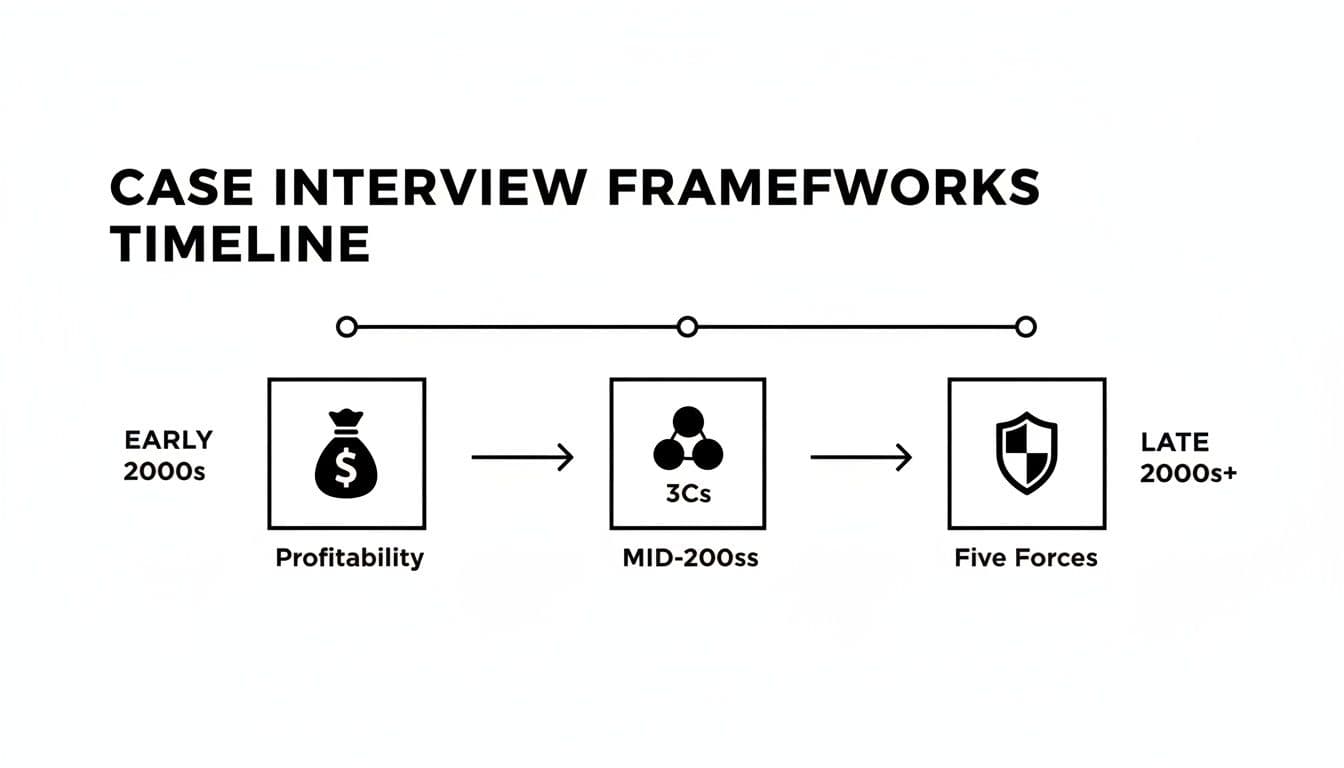
This progression is key. You can't analyze a competitive landscape if you haven't mastered how to diagnose a company's core operations first.
Week 1: Laying the Foundation
Your first week is all about absorbing the fundamentals. Don't even think about doing a full mock interview yet—that’s like trying to run a marathon without knowing the route. The goal here is to understand the why behind the case interview and get comfortable with the essential frameworks.
Here’s what you should focus on:
- Learn the Core Frameworks: Go deep on Profitability, the 3Cs, Market Entry, and Porter’s Five Forces. Don't just memorize the diagrams; understand the business logic behind every component.
- Study Case Examples: Read through 10-15 detailed case interview examples. Notice how top candidates structure their thinking, the kinds of questions they ask, and how they present their final recommendation.
- Watch Expert Walkthroughs: Find videos of experienced consultants solving cases. This gives you a feel for the pacing, the language, and the communication style that interviewers expect.
Soreno’s library is perfect for this. You can read through dozens of cases, filter them by industry or type, and see exactly what a top-tier solution looks like before you ever have to say a word.
Week 2: Drills, Drills, Drills
Okay, time to build your speed and accuracy. This week is all about sharpening the micro-skills that separate a good candidate from a great one: structuring and mental math. A shaky issue tree or a slow calculation can completely derail an otherwise brilliant analysis.
Repetition is the name of the game:
- Mental Math Practice: Carve out 15-20 minutes every single day for math drills. You need to be fast and confident with large numbers, percentages, and quick back-of-the-envelope calculations.
- Structuring Drills: Grab a bunch of case prompts and give yourself just five minutes for each one to outline a custom framework. The goal isn't to solve the whole case—it's to practice creating logical, MECE issue trees on the fly.
- Chart Interpretation: Get in the habit of looking at a chart or graph and pulling out the key business insight—the "so what?"—in under 30 seconds.
This is exactly what Soreno’s guided drills are designed for. You can run unlimited, targeted exercises on market sizing, profitability calculations, and chart analysis, getting instant feedback to sharpen your quantitative skills.
Week 3: Full Mock Interviews
With a solid grasp of the fundamentals and sharp micro-skills, you're ready for the main event. This week is all about live practice through full-length mock interviews. You need to simulate the real thing to build stamina and learn how to communicate clearly under pressure.
Your target should be at least 5-7 full mock interviews. Find partners through your school's consulting club, online forums, or your own network. After every single case, do a detailed debrief. Don't be afraid to ask for tough, specific feedback.
This is where you find your blind spots. Maybe you rush your math when you're nervous, or maybe your final recommendations aren't backed by enough data. Mocks are designed to expose the weaknesses that solo practice can't.
If you’re struggling to find reliable partners, a tool like Soreno becomes a game-changer. You can run unlimited mock interviews on demand with an AI partner trained on MBB grading rubrics, giving you a consistent, high-quality practice environment without the scheduling headaches.
Week 4: Refine and Polish
The final week isn't about learning new things; it’s about smoothing out the rough edges. You’ve put in the hard work, and now it’s time for those marginal gains that make all the difference. The focus shifts from raw problem-solving to storytelling, executive presence, and handling curveballs with grace.
Your final checklist should include:
- Review Your Recordings: If you can, watch replays of your mock interviews. Listen for filler words ("um," "like," "you know"), check your pacing, and see how you look when you're thinking.
- Practice Storytelling: Don't just list your findings. Frame your final recommendation as a compelling, actionable story for a busy executive. Start with the answer, then provide your supporting points.
- Prepare for Curveballs: What will you do if you mess up a calculation? Or forget a key piece of data? Or just get totally stuck? Brainstorm these scenarios and have a plan.
Soreno’s video analysis can give you objective data on your communication style, flagging things like filler word count and eye contact. The time-stamped feedback lets you zero in on the exact moments where you can improve. For firm-specific prep, dig into resources like these practice cases for McKinsey to get a feel for their unique interview style.
To help you stay on track, here's a simple, actionable schedule that pulls all these pieces together.
Actionable 4-Week Case Interview Prep Schedule
This structured plan breaks down your preparation into weekly focus areas and activities, showing you how to build your skills progressively. Following this schedule will ensure you cover all your bases, from foundational knowledge to polished delivery.
| Week | Focus Area | Key Activities | Soreno Feature to Use |
|---|---|---|---|
| 1 | Foundation Building | Learn core frameworks (Profitability, 3Cs, etc.). Read 10-15 case examples. Watch expert walkthrough videos. | Case Library: Read through dozens of solved cases to understand structure and flow. |
| 2 | Skill Sharpening | Daily mental math drills (15-20 mins). Practice 5-minute structuring drills. Run chart interpretation exercises. | Guided Drills: Use targeted drills for market sizing, math, and chart analysis to build speed and accuracy. |
| 3 | Live Practice | Complete 5-7 full-length mock interviews with partners. Conduct detailed debrief sessions to identify weak spots. | AI Mock Interviews: Practice on-demand with an AI partner for consistent, high-quality feedback. |
| 4 | Polishing & Finesse | Review mock interview recordings. Practice storytelling for recommendations. Prepare for curveballs and difficult questions. | Video Analysis: Get data on filler words, pacing, and eye contact to refine your communication style. |
This four-week plan is a proven roadmap. It's intense, but it systematically builds the skills and confidence you need. By focusing on one layer at a time, you'll be more than ready to tackle whatever comes your way in the interview room.
Of course. Here is the rewritten section, designed to sound completely human-written and natural.
Your Top Case Study Interview Questions, Answered
Even with the best preparation, a few nagging questions can throw you off your game. Let's walk through some of the "what-if" scenarios that keep candidates up at night, so you can walk into your interview with total confidence.
How Much Math Do I Really Need to Do?
Let's be clear: you won't be doing calculus. What you will be doing is a lot of practical business math. Think percentages, break-even points, and calculations with big numbers (millions and billions).
The goal isn't to test your complex theoretical knowledge. The interviewer wants to see if you're comfortable with numbers and can use them to make a business case. A typical task might be calculating a company's market share or forecasting revenue growth over the next three years. Quick and accurate mental math is your best friend here.
What if I Know Nothing About the Industry?
Don't panic—this happens all the time. In fact, it's often part of the test. Interviewers are much more interested in how you think than in what you already know about a specific industry.
The best move is to acknowledge it upfront. Show them you can tackle a problem from scratch by asking smart questions to get your bearings.
Your ability to structure a problem in an unfamiliar context is precisely what they want to see. A great response often starts with, "I'm not familiar with the mining industry, so my initial approach would be to understand the key revenue drivers and cost structures..." before laying out your framework.
How Should I Structure My Final Recommendation?
End strong. Your final recommendation needs to be clear, confident, and straight to the point. Forget recapping your entire thought process; think of it as an executive summary.
Start with your direct recommendation. Then, immediately back it up with the 2-3 most important reasons you came to that conclusion, using the data you found during the case. To seal the deal, briefly touch on the potential risks and suggest concrete next steps for the client.
The only way to get truly comfortable with these situations is to practice them. With Soreno, you can run unlimited mock interviews and drills focused on sharpening your math, structuring, and communication skills whenever you need them. You can start your free trial today at Soreno.ai and turn these anxieties into strengths.