
Case Interviews Preparation: Master Frameworks, Mock Interviews, and Timelines
Master case interviews preparation with practical frameworks, structured mock interview routines, and a clear timeline to secure your consulting offer.

Cracking a case interview isn't just about knowing the answers; it's about showing how you arrive at them. Think of it as a journey from academic problem-solving to thinking like a seasoned consultant. You'll need a structured plan that builds theoretical knowledge, sharpens your practical skills through drills, and pressure-tests everything in mock interviews.
Let's get you ready.
Building Your Case Interview Foundation

Jumping into case prep can feel like training for a marathon and a chess tournament at the same time. The top firms—think McKinsey, BCG, and Bain—aren't hunting for a single "correct" answer. They're evaluating your thought process. Can you take a big, messy business problem, break it into logical pieces, ask smart questions, and build a compelling recommendation?
This is less about memorizing frameworks and more about internalizing a new way of thinking. Your real goal is to prove you have the raw skills to handle the day-to-day grind of a real consulting project.
Adopting the Consultant Mindset
The first, and most crucial, shift you need to make is mental. Move away from the academic world, where problems often have neat, tidy solutions, and embrace the consultant's mindset. Here, you'll live in ambiguity, using structure and logic as your guide. The interviewer is constantly asking themselves, "Could I put this person in front of a client tomorrow?"
At the heart of this mindset is a principle you'll hear over and over: MECE.
MECE (Mutually Exclusive, Collectively Exhaustive) is the bedrock of structured thinking. It means that when you break down a problem, your categories don't overlap (mutually exclusive) and, when combined, they cover all the possible factors (collectively exhaustive). It's the logic that keeps you from missing something critical or going down redundant paths.
For example, if a client’s profits are down, a MECE approach is to look at two main buckets: Revenues and Costs. These are distinct drivers that, together, fully explain profitability. From there, you can break each one down further—again, using MECE logic.
Gathering Your Essential Resources
Before you dive into practice, you need the right toolkit. Focusing on a few high-quality resources is far better than getting overwhelmed by a mountain of mediocre ones.
Here's what your starting lineup should look like:
- Classic Case Books: You can't go wrong with "Case in Point" or "Case Interview Secrets." They are the standard for a reason, giving you a solid overview of common case types and foundational frameworks.
- Business Publications: Get into the habit of reading The Wall Street Journal, The Economist, or the Financial Times. This builds the business intuition you'll need to make credible assumptions and recommendations.
- Modern Practice Platforms: A tool like Soreno is a game-changer. It gives you access to a huge library of cases and AI-powered mock interviews, so you can practice on your own schedule without always needing a partner.
While you're building this specific foundation, don't forget the basics of general interview skills. This guide on how to prepare for interviews offers great advice that applies to any role.
Setting a Realistic Study Schedule
Consistency beats cramming, every single time. The right schedule depends on how much time you have, but the core idea is to balance different types of practice to avoid burnout and hit all your development goals.
Start by blocking out specific, non-negotiable time each week. You'll get more out of a focused 30-60 minutes a day than a frantic eight-hour session on a Saturday. Your early weeks should be heavy on learning the theory and fundamentals. As you get more comfortable, your schedule should gradually shift to be dominated by mock interviews. This approach makes the entire process feel less daunting and a whole lot more effective.
Mastering Core Case Frameworks and Concepts
Think of frameworks as a consultant's toolkit. But here's the secret: you’ll fall flat if you treat them like a script. Simply reciting the "Profitability Framework" or the "4 Ps" won't impress an interviewer. The real magic is in understanding the logic behind them, which gives you the freedom to adapt, combine, or even create your own structure on the spot.
Most cases you'll face will fit into a handful of common patterns. Your job is to spot the pattern, grab the right tools from your kit, and then tailor your approach to the specific, messy details of the problem. That’s what shows you can think, not just memorize.
Deconstructing the Most Common Case Types
At a high level, you can sort most business problems into a few main buckets. Knowing these will help you get your bearings fast when the interviewer drops the prompt on you.
-
Profitability: This is the absolute classic. "Our client's profits are down for the third straight year. Why, and what do we do?" The anchor for this case is always Profits = Revenue - Costs. Your task is to dissect each side of that equation, find the leaky bucket, and plug the hole.
-
Market Sizing: "Estimate the number of electric scooters that could be sold in Paris next year." These questions aren't about getting the exact right answer. They're a test of your ability to make logical assumptions, structure a clear calculation, and keep your composure. Your thought process is what's being graded, not the final number.
-
Market Entry: "A top European snack company wants to expand into the US market. Should they do it, and if so, how?" This requires a multi-faceted analysis: you'll need to evaluate the market itself, the competition, your client's ability to actually compete, and whether the numbers even make sense.
-
Mergers & Acquisitions (M&A): "Our client, a big PE firm, is thinking about buying a regional coffee chain. Is it a good idea?" This usually means digging into the target company's value, hunting for potential synergies, and flagging all the risks that could blow up the deal post-acquisition.
Thinking Through Frameworks, Not Just Memorizing Them
One of the biggest rookie mistakes is hearing "profits are down" and immediately launching into a rigid, pre-packaged structure. A much stronger approach is to use the core concept—like Profits = Revenue - Costs—as a compass to ask smart questions and build a custom issue tree from scratch.
Profitability and revenue growth cases are everywhere, making up to 40% of evaluations at some top firms, so you have to nail this. You might even find a market sizing problem tucked inside a bigger profitability case. For instance, what if you were asked to estimate the annual revenue for organic toothpaste in the US as part of a larger analysis? You'd need to start with the population, break it down logically, apply some reasonable assumptions about who buys it and at what price, and come up with a number you can defend.
Your issue tree is your best friend in a case interview. It's a visual map that breaks the core problem into smaller, more manageable pieces, ensuring your analysis is both structured and complete.
For that profitability case, your first branches would be Revenue and Costs. You wouldn't stop there. You'd break them down again:
- Revenue might split into
Price per unitandNumber of units sold. - Costs could break down into
Fixed costsandVariable costs.
This method gives you a systematic way to hunt down the root cause of the problem. For a deeper dive into building these, check out our guide on frameworks for case interviews.
To help you get started, it's useful to connect the major case types to the kinds of questions you should be asking right out of the gate.
Core Case Interview Types and Key Questions to Ask
This table breaks down the primary case archetypes and connects them to the frameworks and critical opening questions that will help you structure your thinking from the very first minute.
| Case Type | Core Framework/Concept | Critical Opening Questions |
|---|---|---|
| Profitability | Profit = Revenue - Costs | "Have profits declined recently or over a longer trend? Are our competitors facing similar issues?" |
| Market Sizing | Top-Down or Bottom-Up Estimation | "To clarify, are we estimating the market in terms of units or revenue? Over what time period?" |
| Market Entry | Market Attractiveness, Competitive Landscape, Client Capabilities | "What is the client's primary objective for entering this market (e.g., profit, market share)? What is our timeline?" |
| M&A | Target Valuation, Synergies, Due Diligence | "What is the strategic rationale for this acquisition? What are the expected synergies, and are they cost or revenue-based?" |
Having these questions in your back pocket helps you take control of the case and demonstrate a structured, hypothesis-driven mindset from the get-go.
From Theory to Practice: A Real-World Scenario
Let's make this real. Imagine a client, "Brewtiful Coffee," is seeing its profits shrink across its downtown cafes.
Instead of just saying "let's look at revenue," you’d build a specific issue tree. You could break down revenue into (Average price per order) x (Number of orders). Then, you could segment "Number of orders" even further into (Number of unique customers) x (Frequency of visits).
Suddenly, you have a clear path forward with targeted questions. Is our average ticket size down? Are fewer customers walking in the door? Or are our regulars just not coming back as often? Each question opens a new line of investigation, all neatly organized by your structure. This is the difference between knowing a framework and using a framework to solve a problem—and that’s the key to acing your case interviews.
Building Your Personalized Prep Timeline
Random effort gets you random results. It's a harsh truth, but in the world of case interviews, a structured, personalized timeline is what truly separates the candidates who get offers from those who don't. Whether you've got an eight-week runway or just a two-week sprint, your entire plan needs to be built around deliberate practice—finding your weak spots and hammering them until they become strengths.
Think of your timeline as a strategic roadmap, not just a calendar. It dictates the right mix of activities at the right time, making sure you build a solid foundation of theory before you start pressure-testing your skills in live scenarios.
This visual gives you a great high-level overview of how the phases should flow, shifting from foundational learning to intensive, hands-on practice.
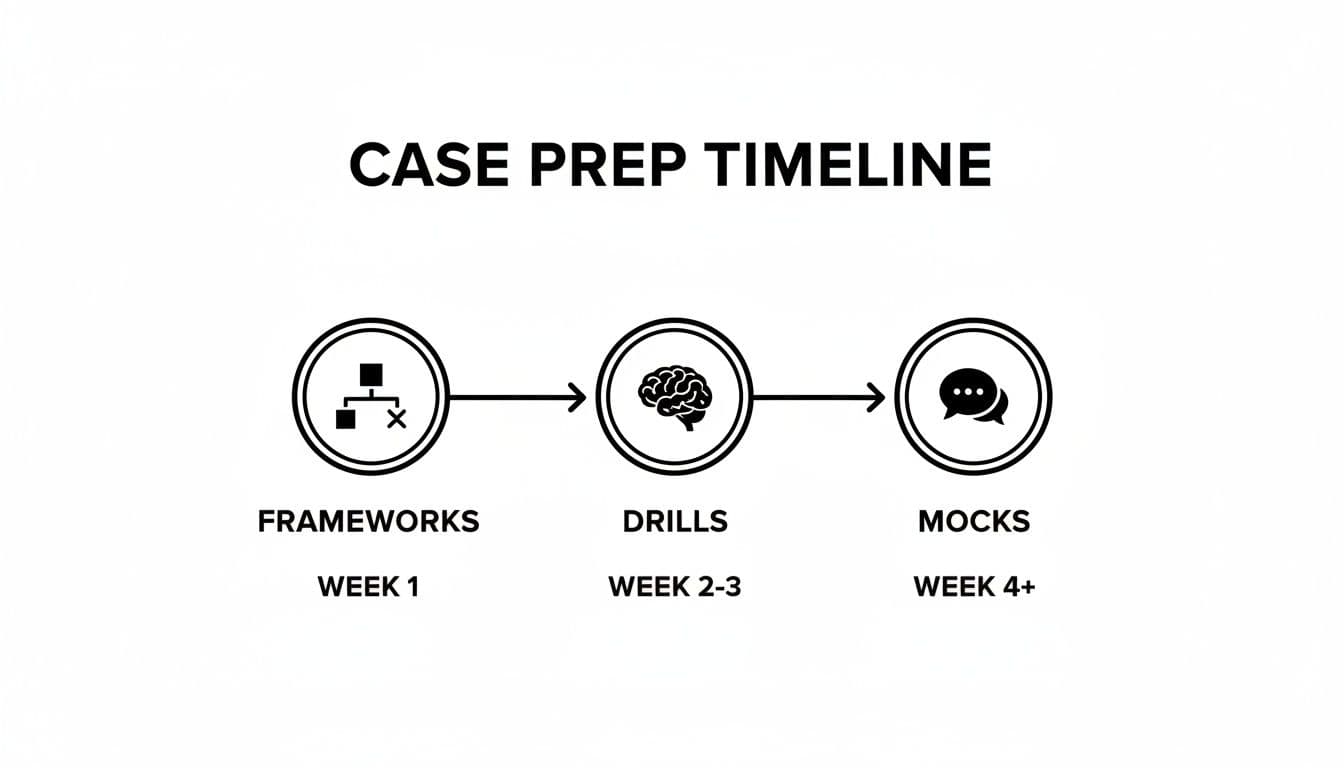
The key takeaway here is that progressive shift. You start heavy on theory and reading, but you finish almost entirely in the ring, sparring with mock interviews.
The 8-Week Marathon Plan
Having eight weeks is the gold standard for case prep. It gives you enough breathing room to systematically improve without burning out. This is your chance to really absorb the concepts, practice them into muscle memory, and make meaningful adjustments based on the feedback you get.
Here’s a practical way to break it down:
- Weeks 1-2: Focus on Fundamentals. Your entire world should be about absorbing the core frameworks for profitability, market sizing, and market entry. Spend about 70% of your prep time here buried in case books and mastering the theory. Use the other 30% for solo drills like basic market sizing problems.
- Weeks 3-4: Transition to Application. This is where the rubber meets the road. Start doing full mock interviews, either with a live partner or an AI tool like Soreno. You should be aiming for a 50/50 split between your solo drills and these full-length mock cases. You're starting to translate what you know into what you can do under pressure.
- Weeks 5-8: Intensive Mocking. Now it’s all about volume and feedback. At least 80% of your time should be dedicated to mock interviews. The goal is to see as many different case types as possible and polish your communication and structuring skills until they're second nature.
A longer runway like this is perfect for building the kind of deep business acumen that interviewers can spot from a mile away.
The 2-Week Sprint Plan
Sometimes, an incredible opportunity pops up with almost no notice. A two-week sprint is an intense, all-out effort that demands ruthless prioritization. You simply don't have time for leisurely learning; every single session has to be high-impact.
Your sprint needs to look something like this:
- Days 1-3: Rapid Framework Review. These first few days are for cramming the absolute essential frameworks. You have to get the basics down fast so you can move on to actually using them. No excuses.
- Days 4-14: Non-Stop Practice. From this point on, your life is mock interviews. Seriously. Try to get in 1-2 mock interviews every single day. Using a platform that provides instant, detailed feedback is a game-changer here because it dramatically speeds up your learning loop.
In a compressed timeline, inefficiency is your worst enemy. You can't afford a single wasted practice session. An AI interviewer guarantees you get targeted, consistent feedback every single time, which is invaluable when you can't find a live partner at a moment's notice.
Why Volume and Consistency Are Everything
The link between prep volume and success isn't just anecdotal—it's backed by data. Candidates who log 50-100 hours of practice consistently see their pass rates climb to around 70% for top-tier firms. Compare that to those with under 30 hours, who are often stuck hovering closer to 20%.
This is especially critical for career switchers and MBA students who are fundamentally learning a new way of thinking. This is where getting unlimited reps on a platform like Soreno becomes a huge advantage. You can track your progress with replays and pinpointed feedback, which effectively cuts your learning curve in half. It’s not uncommon to see offer odds jump from a meager 10% to over 50% in major consulting markets just through consistent, high-volume practice.
No matter your timeline, the core principle is the same. Start with the "what" (frameworks), move quickly to the "how" (drills), and then spend the vast majority of your time actually performing under realistic conditions. This structured approach builds more than just competence; it builds the unshakable confidence you need to walk into that interview and absolutely nail it.
Getting the Most Out of Your Mock Interviews

Let's be clear: theory gets you in the door, but live practice gets you the offer. You can read every casebook on the planet, but it's a completely different game when you're live with an interviewer staring back at you.
Mock interviews are where you build real-world muscle. It's how you learn to think on your feet, handle unexpected curveballs, and turn those abstract frameworks you memorized into a smooth, convincing conversation. Getting this part right is absolutely critical.
Finding the Right Practice Partners
Your choice of a practice partner can literally make or break your prep. A great partner will push you, give you sharp, honest feedback, and simulate the pressure of a real interview. A bad one, on the other hand, can reinforce bad habits and just be a waste of your time.
So, what should you look for?
- Matching Intensity: You need someone who is just as serious about landing an offer as you are. They’ll come prepared, pay attention, and give you the kind of detailed feedback that actually helps.
- A Bit of Variety: Don't just practice with your classmates. Try to find partners with different backgrounds or who are maybe a few weeks ahead of you in their own prep. Their perspective can be incredibly valuable.
- Tough but Fair Feedback: The best partners tell you what you need to hear, not just what you want to hear. They can point out your blind spots without being discouraging and give you specific, actionable advice.
To keep a steady flow of high-quality partners, it's worth exploring the best sites for interview practice online where you can connect with other motivated candidates.
How to Structure Feedback for Real Improvement
A mock interview without a solid debrief is just a chat. The real learning happens after the case is done. Both giving and receiving feedback are skills in themselves, and you need to get good at them.
When you're the one getting feedback, your only job is to listen. Seriously. Don't argue, don't get defensive, and don't try to explain away your mistakes. Just take detailed notes and ask clarifying questions to make sure you understand exactly where you went wrong and how you can fix it.
I see it all the time: candidates get so hung up on whether they got the "right" final number that they completely miss the point. A great mock interview debrief focuses on the process—how you structured the problem, the quality of your questions, and the logic behind your recommendations.
The MBB Evaluation Rubric
Top-tier firms like McKinsey, BCG, and Bain are all looking for a remarkably similar set of skills. If you understand what they're grading you on, you can focus your practice on what actually moves the needle. Deep down, they're constantly asking one question: "Would I feel comfortable putting this person in front of my client?"
Here are the core areas they’re always evaluating:
- Structure & Logic: Can you take a messy, ambiguous problem and break it down into a clean, MECE (Mutually Exclusive, Collectively Exhaustive) framework?
- Analytical & Quant Skills: Are you quick and confident with numbers? This means solid mental math, chart interpretation, and the ability to pull the right insights from data.
- Business Insight & Creativity: Do you have genuine business sense? Can you move beyond the framework to brainstorm creative—but still practical—solutions?
- Communication & Presence: How do you carry yourself? You need to be poised, articulate, and able to guide the interviewer through your thought process like a true consultant.
This is where AI-powered tools like Soreno can give you an edge that a human partner might miss. It can analyze your pacing, flag filler words, and even provide feedback on your "executive presence," giving you data-driven insights to polish your delivery.
For a deeper dive into what these firms are looking for, our guide on how to practice cases for McKinsey breaks it down even further. At the end of the day, there's no substitute for consistent, feedback-driven practice. It’s the single most effective way to improve and walk into your interview ready to win.
Tailoring Your Approach for Different Industries
Not all case interviews are created equal. One of the biggest mistakes I see candidates make is using a one-size-fits-all strategy, but the truth is, different industries test for vastly different skills. To really stand out, you have to tailor your practice to what your target firm actually cares about.
Think about it: the strategic, wide-open problem you’d get at a top consulting firm is a world away from the valuation-heavy case you’d face in a private equity interview. Understanding these differences is what separates a good candidate from a great one. Your goal is to show them you already think like part of the team.
Honing Your Skills for Management Consulting
When you're aiming for management consulting giants like McKinsey, BCG, and Bain (MBB) or the Big 4, the entire game revolves around strategic thinking and structured creativity. These firms need to see how you wrestle with big, ambiguous problems.
Frankly, your interviewer doesn't care if you know the ins and outs of the global shipping industry. What they do care about is whether you can build a logical, MECE framework from scratch to bring clarity to any messy situation they throw at you.
For these roles, you need to live and breathe:
- Hypothesis-Driven Problem Solving: Can you form a smart initial guess, figure out the key questions to test it, and then systematically work through your structure without getting lost?
- Brainstorming and Ideation: You'll often be asked to think up creative solutions for growth or market entry. It’s about thinking broadly first, then narrowing down to a handful of practical, defensible ideas.
- Qualitative Analysis: The numbers are crucial, but the story you weave around them is what truly sells your recommendation. You have to synthesize data into a compelling narrative that a CEO can understand and act on.
At the end of the day, a consulting interviewer is asking one simple question: "Can this person think clearly under pressure?" They're testing your ability to create order from chaos, not your existing knowledge.
Quantitative Rigor in Finance Interviews
Now, pivot to private equity (PE) or investment banking (IB), and the whole vibe of the case shifts. The spotlight is now on quantitative rigor, valuation, and M&A drivers. Strategic thinking is still a plus, but it takes a backseat to your ability to quickly and accurately tear apart a company's financials.
The questions here are much more direct and numbers-driven. You won't be brainstorming a new marketing campaign. Instead, you'll be asked to build a quick LBO model on a whiteboard, calculate a company's enterprise value, or pinpoint the key risks and upsides of a potential investment.
Your prep needs to be drilled down on:
- Financial Modeling and Valuation: You have to be fluent in concepts like DCF, comparable company analysis, and the key levers that make or break a leveraged buyout.
- Market and Company Due Diligence: The focus is on what makes a company a good or bad investment. Think market growth, competitive landscape, and defensible moats.
- Mental Math and Data Interpretation: The pace is lightning-fast. You're expected to crunch numbers and interpret financial statements with both speed and precision.
The Hybrid World of Product Management
Product Management (PM) interviews, particularly in tech, often use a unique hybrid case. These interviews blend classic business strategy questions with what's called "product sense." Your interviewer wants to see if you can connect a high-level business goal directly to a specific product feature or user experience.
You might be asked to design a new product for a specific user, figure out how to improve an existing one, or diagnose why a key metric like user engagement suddenly plummeted. This requires a different kind of thinking that marries sharp business acumen with genuine user empathy.
A critical part of your case interviews preparation for any of these roles is getting lightning-fast at market sizing. Mastering this is a cornerstone of the process, as consultants rely on key global stats to deliver solid estimates under pressure. For instance, knowing that the world population is around 8 billion people, the Gross World Product is about $96 trillion USD, and global life expectancy averages 73 years provides a bedrock for any top-down estimation.
In the US, a market of 330 million people drives common examples. Say you need to estimate annual diaper sales: you'd start with 4% of the population as babies (roughly 13.2 million), assume 6 diapers per day for 365 days, and land on approximately 29 billion diapers a year. It's a test of your mental math and your ability to make logical assumptions on the fly. You can dive deeper into the essential statistics to know for case interview success.
Handling Those "What If" Moments in a Case Interview
No matter how much you prepare, a few nagging questions always seem to surface. These are the tricky, unexpected scenarios that can throw you off your game if you're not ready for them. Let's walk through how to handle these moments so you can step into your interview ready for anything.
Knowing how to navigate these edge cases is what really separates a strong candidate from a truly exceptional one. It proves you're not just following a script; you can think on your feet when things don't go exactly as planned.
What if I Know Nothing About the Industry?
This is a classic fear. The interviewer throws you a case about something incredibly niche, like specialty chemicals for the aerospace industry or risk modeling for agricultural futures. Don't panic. This is actually a golden opportunity.
The key is to own it. Be upfront about your lack of familiarity and turn it into a positive. You could say something like, "That's a fascinating industry, and one I'm not deeply familiar with. I'll be approaching this with a fresh perspective, relying on first principles and asking some clarifying questions to get my bearings. To start, could you tell me a bit more about the primary business model and who the major competitors are?"
Interviewers aren't trying to test your encyclopedic knowledge; most consultants are generalists by trade. What they are testing is your ability to structure a problem you've never seen before, ask smart questions, and use pure logic to find a path forward.
What Should I Do if I Mess Up the Math?
It happens to the best of us. Under pressure, it's easy to drop a zero or mix up a percentage. The mistake itself isn't the problem—it's how you handle it that matters. The second you catch the error, just pause and correct it.
"Hold on, let me quickly re-check that calculation. Ah, I see I made a small error here. The correct figure is actually $1.5M, not $15M. That changes my earlier point slightly. Based on this new number, the market share is much smaller than I initially thought, which means..."
This simple correction is incredibly powerful. It demonstrates self-awareness, intellectual honesty, and a commitment to accuracy, all of which are critical traits for a consultant. The absolute worst thing you can do is ignore it and hope they didn't notice. They almost always do.
How Much Creativity Is Too Much?
Creativity can be a massive differentiator, but it has to be reined in by business sense. The brainstorming part of a case—like coming up with growth ideas—is the perfect time to flex those creative muscles. Don't be afraid to suggest something unconventional.
But you always have to ground it in reality. For every creative idea you propose, be ready to defend it with a quick business case. Ask yourself:
- Why this? What specific problem does this idea solve for the client?
- So what? What’s the potential impact on revenue, profit, or market share? Even a back-of-the-envelope estimate is great.
- What are the risks? What are the top one or two hurdles to making this happen?
This shows you can think beyond the obvious without losing sight of what actually matters: delivering practical, valuable recommendations for the client. It’s the difference between being innovative and being reckless.
Getting comfortable with these tricky situations is a huge confidence booster. For unlimited, on-demand practice with an AI interviewer that can throw these curveballs at you, check out Soreno. The platform gives you instant, detailed feedback to help you turn every "what if" into a major strength. You can learn more at https://soreno.ai.