
Mastering Brain Teaser Interview Questions
Struggling with brain teaser interview questions? Our guide offers proven frameworks, real examples, and expert tips to impress any hiring manager.

Ever had that moment in an interview where you get a question like, “How many golf balls can you fit inside a school bus?” and your mind just... stops? It feels like a trick, right? Some impossible riddle designed to trip you up.
But here’s the secret: these questions aren't about getting the right answer. They’re a window into how you think.
Why Do Interviewers Still Ask These Weird Questions?
Let's be honest, asking how you'd weigh a jumbo jet without a scale seems absurd. No one expects you to know the exact weight of a Boeing 747 off the top of your head. The real goal is to see what you do when you're faced with a completely unexpected, ambiguous problem. It's a strategic way to observe your mind at work.
Hiring managers, especially at top firms, aren't looking for a human encyclopedia. They want to see if you can build a logical, defensible argument from nothing. It's a live-action assessment of competency in several key areas that a resume just can't show:
- Your Problem-Solving Framework: How do you tackle a massive, vague problem? Can you break it down into smaller, more manageable pieces?
- Your Logical Reasoning: Do you state your assumptions clearly? Are the connections you make reasonable and easy to follow?
- Your Communication Style: Can you actually walk the interviewer through your thought process step-by-step, making your logic transparent?
- Your Composure Under Pressure: What happens when you don't know the answer right away? Do you get flustered and give up, or do you stay calm and start building a solution?
The continued use of these puzzles signals a major shift in what companies value. In fact, studies from major consulting firms reveal that candidates who methodically break down these problems score 40-50% higher in their overall evaluation than those who just hazard a guess. You can see more examples in this guide to consulting brain teasers and their impact.
The brain teaser isn't about the answer. It's a live demonstration of your analytical and communication skills—a direct preview of how you’ll handle complex, data-poor challenges on the job.
At the end of the day, these questions mimic the real world of strategy and high-level problem-solving. Out there, clean, simple answers are incredibly rare, but the ability to structure your thinking and navigate ambiguity is everything.
A Practical Framework to Solve Any Puzzle
Let's be honest: when an interviewer throws a brain teaser at you, the first instinct for most people is panic. Your mind can go completely blank, and the pressure suddenly feels crushing. But here’s the thing—the candidates who nail these questions don’t have some secret encyclopedia of puzzle answers. They have a reliable process.
Having a repeatable framework is your best defense. It transforms an intimidating, ambiguous puzzle into a series of manageable steps. More importantly, it gives you a way to organize your thoughts and speak them out loud, which is precisely what the interviewer is listening for. They want to see how you reason under pressure, a skill far more valuable than stumbling upon the "right" answer.
Ultimately, these questions are designed to test three core abilities: how you handle ambiguity, apply logic, and communicate your thought process.
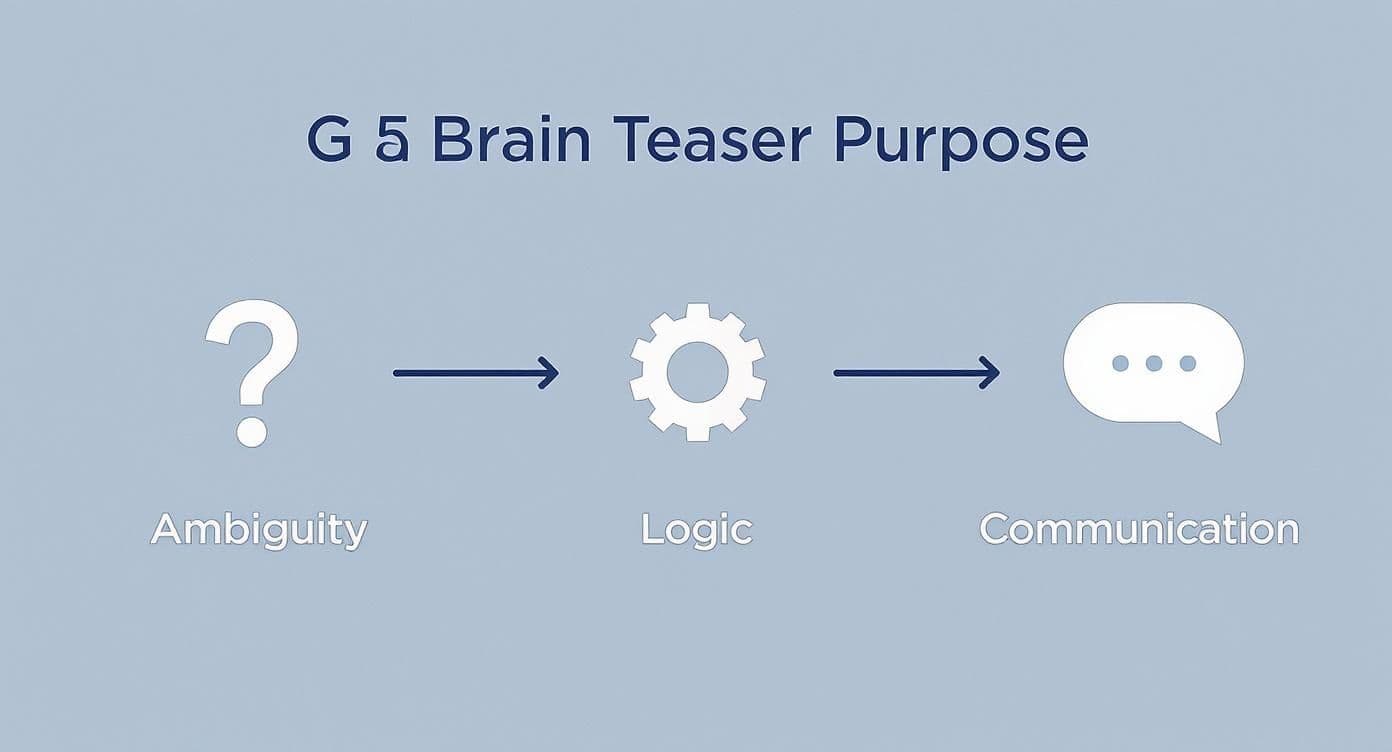
A brilliant solution that stays locked inside your head is worthless in an interview. The goal is to make your thinking visible and prove you can move from a fuzzy problem to a clear, logical conclusion.
To help you do this consistently, I've broken down the problem-solving process into four distinct stages. This framework will help you stay composed and methodical, no matter what question comes your way.
The Four-Stage Brain Teaser Solving Framework
| Stage | Objective | Example Action |
|---|---|---|
| Clarify | Remove ambiguity and define the problem's scope. | "When you say 'ping pong balls,' are we assuming standard size? Is the 747 empty of seats and cargo?" |
| Structure | Outline your high-level approach before diving into details. | "First, I'll estimate the volume of the plane. Then, I'll calculate the volume of a single ball, and finally, I'll divide to get a rough number, adjusting for packing inefficiency." |
| Solve | Execute your plan step-by-step, explaining your math and assumptions. | "Let's assume the plane's interior is roughly X cubic meters. A ping pong ball is about Y cubic centimeters. I'll need to convert units before dividing..." |
| Conclude | Summarize your answer and discuss potential refinements or weaknesses. | "So, my final estimate is Z million balls. This is a rough figure, as it doesn't perfectly account for the irregular shape of the fuselage or the space between balls." |
Using this structure turns a performance into a collaborative exercise, allowing you to show the interviewer how you think, not just what you know.
Stage 1: Clarify Your Assumptions
Before you even think about solving, your first job is to push back on the vagueness. Brain teasers are intentionally open-ended because the interviewer wants to see if you'll make blind assumptions or if you'll take control by asking smart questions.
This is your first chance to show you're a careful, methodical thinker. For a classic like, "How many windows are in New York City?" you should immediately start probing the boundaries of the problem.
- Are we talking about just Manhattan or all five boroughs?
- Do "windows" include those on vehicles, like cars, taxis, and subway trains?
- Are we counting residential buildings, commercial skyscrapers, or both?
Asking these questions shows the interviewer that you don't just rush into calculations. You're defining the problem first, which is a critical step in any real-world project and a key part of learning how to think on your feet in high-stakes situations.
Stage 2: Structure Your Approach
Once you've narrowed the scope, resist the urge to start doing mental math. The next move is to lay out your roadmap. Tell the interviewer how you're going to tackle the problem, step by step.
For our NYC windows example, your verbal outline might sound something like this:
"Okay, great. So, focusing just on buildings in Manhattan, I'll approach this by first breaking the buildings down into categories—say, residential and commercial. Then I’ll estimate the number of buildings in each category. After that, I’ll estimate an average number of windows for each building type and multiply it out to get a total for each. Finally, I’ll add those totals together."
This step is non-negotiable.
Structuring your logic out loud proves you can organize complex ideas before getting lost in the weeds. It also brings the interviewer along with you on the journey, giving them a chance to nudge you in the right direction if you're about to go wildly off track. It turns a one-sided test into a collaborative problem-solving discussion.
Getting a Handle on Common Brain Teaser Types
While the "think aloud" framework is your all-purpose tool, you'll gain a serious edge by recognizing the type of brain teaser you're up against. Interviewers tend to draw from a few classic buckets, each designed to probe a slightly different part of your analytical mind. Spotting the pattern early helps you snap into the right problem-solving gear from the get-go.
Think of it like a seasoned mechanic. They have a whole chest of tools, and while a standard wrench gets a lot of jobs done, they know exactly when they need a socket set versus a pair of pliers. In the same way, knowing you're facing an estimation puzzle versus a logic riddle lets you pull out the most effective mental tools right away.
Estimation Puzzles (The "Fermi Problem")
This is probably the most famous category, often called a "Fermi Problem." The name comes from physicist Enrico Fermi, who was a master at making shockingly accurate estimates with very little hard data. The classic example you’ve probably heard is, "How many piano tuners are in Chicago?"
These questions aren't a test of your knowledge. The interviewer has no expectation that you know the answer. They want to see if you can build a logical model out of thin air.
What they're really watching for is your ability to:
- Deconstruct the Problem: Can you break a huge, unknowable figure into smaller, manageable pieces that you can make assumptions about?
- State Assumptions Clearly: You need to voice every assumption you make along the way—things like the population of Chicago or how often a piano needs tuning.
- Perform Sanity Checks: As you go, pause and ask yourself, "Does this number feel right?" This shows you're grounded in reality.
The classic volume-based puzzle, like "How many tennis balls fit in a school bus?", is one you'll see time and again. Probability challenges, such as the infamous Monty Hall Problem, also pop up frequently, especially in data science and engineering interviews. There's a reason these specific categories stick around—they're incredibly effective at gauging on-the-job thinking. In fact, some firms have reported that a candidate's performance on these puzzles can predict their six-month job success with 65-75% accuracy. You can dive into more examples of these powerful questions and their answers to see just how revealing they can be.
Example Question: "How much does the Empire State Building weigh?"
What the Interviewer is Thinking: Can this person structure a complex problem? I want to see them tackle a physical estimation and make logical assumptions for components they couldn't possibly know.
Your Walk-Through:
"That's a great question. Off the top of my head, I have no idea, but I can definitely build an estimate. I'd break the building's total weight into two main buckets: the steel structure itself, and then all the non-structural stuff like concrete, glass, and interior fittings.
Let's start with the steel frame. I need its volume first. The building is about 102 stories high. If we say each story is roughly 12 feet, that gets us to about 1,200 feet tall. For the base, I'll approximate it as a rectangle, maybe 400 feet by 200 feet. So, the total volume is roughly 1200 x 400 x 200... which is about 96 million cubic feet.
But a skyscraper is mostly empty space. The steel skeleton probably only makes up a small fraction of that total volume. I'm going to estimate it's about 2% steel. That gives me a steel volume of around 1.92 million cubic feet.
Now, I need the density of steel. I remember from a physics class that it's super dense, somewhere around 490 pounds per cubic foot. So, if I multiply that by my steel volume... I get about 940 million pounds just for the steel.
Okay, now for the other materials. This part is trickier, but I'll assume the concrete, facade, and everything else might add another 50% on top of the steel's weight. So I’ll add another 470 million pounds.
Adding those two together, I land on a ballpark estimate of around 1.41 billion pounds. Obviously, this is heavily dependent on my initial assumptions, especially the percentage of the building that is actual steel, but it's a structured starting point."
Logic Riddles (The "Light Bulb Puzzle")
These are a different beast entirely. Logic riddles aren't about numbers; they're about process, constraints, and finding clever workarounds. They test your ability to isolate variables, understand cause-and-effect, and sometimes, to literally think outside the box.
The interviewer wants to see if you can be methodical in eliminating possibilities and if you can get creative when the obvious path is blocked.
Example Question: "You are standing outside a sealed room with three light switches. Inside the room, there are three light bulbs. You know each switch controls one bulb, but you don't know which is which. You can flip the switches as much as you want, but you can only enter the room one time. How do you figure out which switch controls which bulb?"
What the Interviewer is Thinking: This person knows a switch makes a light go on or off. Can they think about other properties of the system? I'm testing their ability to consider all variables, not just the most obvious one.
Your Walk-Through:
"Okay, so the core constraint is that I only get one look inside the room. This means I need to create a unique, identifiable state for each of the three bulbs before I open that door. Just using 'on' and 'off' will only let me identify two states.
I need a third state. Light bulbs produce more than just light... they also produce heat. I can use that.
Here’s my plan:
- I’ll flip Switch #1 on and leave it on for about five minutes. I want that bulb to get nice and warm.
- Then, I’ll turn Switch #1 off.
- Immediately after, I’ll flip Switch #2 on and leave it on.
- I’ll leave Switch #3 in the off position the entire time.
Now, I open the door and walk in.
- The bulb that is lit is connected to Switch #2.
- I’ll then touch the two dark bulbs. The one that is off but warm is connected to Switch #1.
- That means the bulb that is off and cold has to be connected to Switch #3.
Using this method, I can figure out all three pairings with just one trip into the room."
Tackling Real-World Estimation Questions
"How many windows are in New York City?"
When an interviewer throws a question like this at you, it's easy to freeze. But here's the secret: they don't actually care about the right answer. There probably isn't one they can look up.
What they're really testing is your ability to handle ambiguity. Can you take a massive, impossible-sounding problem and build a logical framework to solve it, all while thinking on your feet? They want to see you reason, make sensible assumptions, and articulate your process clearly.
The trick is to immediately start outlining your path forward, showing them how you think.

Breaking Down the Problem
The best way to attack an overwhelming question is to break it into smaller, bite-sized pieces. You can usually approach this from two different angles.
- The Top-Down Approach: This is where you start with a big, generally known number (like the population of NYC) and start slicing it up. You might go from population to households, from households to residential buildings, and then from buildings to windows.
- The Bottom-Up Approach: Here, you start with the smallest units and build your way up. You could segment the city by building type—residential towers, commercial skyscrapers, single-family homes, government buildings—and estimate the number and average window count for each before adding them all together.
A pro move? Try both. If your top-down and bottom-up estimates land in the same ballpark, you can be much more confident in your logic. If they're worlds apart, it's a great signal that one of your initial assumptions needs a second look. For a deeper dive into these techniques, explore our guide on https://soreno.ai/articles/market-sizing-questions.
Stating Your Assumptions Loud and Clear
Every single assumption you make is a building block for your final estimate. You absolutely have to state them out loud. This is non-negotiable.
Key Takeaway: The goal is not to be a human calculator but to demonstrate that you can build a defensible case based on sound assumptions. Your logic is far more important than the final number.
Take another classic: estimating the global chicken population (which was ~26.56 billion in 2022). Interviewers often say that 70-80% of candidates stumble right out of the gate because they just guess a huge number. The successful ones start by establishing a baseline, maybe looking at per-capita meat consumption.
These kinds of data-backed questions are becoming more common, now making up 40-45% of quantitative brainteasers at top tech companies.
By saying something like, "Okay, to start, I'm going to assume an average of 5 windows per apartment in a residential high-rise," you're not just plucking a number from thin air. You're making your thought process transparent and turning the interview from a test into a collaborative problem-solving session.
How to Practice for Your Interview

Knowing the frameworks is one thing. Executing them calmly when the pressure is on? That's a completely different ballgame. Confidence isn’t built by reading articles—it’s forged through deliberate practice. The real goal is to build the muscle memory you need to articulate your logic clearly when you're in the hot seat.
Start by running some solo drills. Grab a list of common brain teasers and set a timer. Give yourself a strict limit, maybe five or seven minutes per question, to get used to the time constraints of a real interview.
The trick is to talk through your entire process out loud, even if it’s just you in the room. I know it feels awkward at first, but it’s absolutely critical. You're training yourself to make your internal monologue external and coherent on command.
Classic Drills for Solo Practice
To get you started, here are a few classic questions that are perfect for timed reps. Set your timer and start verbalizing your approach from the very first second.
- How many golf balls can you fit inside a standard school bus?
- You have a 3-gallon jug and a 5-gallon jug. How do you measure out exactly 4 gallons of water?
- Estimate the total number of commercial flights in the air worldwide right now.
- Why are manhole covers round?
After you run through each one, take a minute to reflect. Did you state your assumptions clearly? Was your structure logical? Where did you get stuck? This kind of self-assessment is where the real learning happens.
The Power of Mock Interviews
Solo drills are great for building your foundational skills, but nothing beats practicing with another person. A mock interview with a friend, mentor, or career coach adds the invaluable elements of real-time feedback and pressure. This is where you test not just your problem-solving chops, but also how well you engage with the interviewer.
When you ask someone to run a mock interview, be specific about what you need. Don't just ask, "How did I do?"
Ask targeted questions instead. Try something like, "Was my initial framework clear and logical?" or "Were there any points where my explanation got confusing?" This pushes your partner to give you actionable advice you can actually use.
This kind of practice is so important because it directly strengthens the exact skills you'll need. For more on this, check out our article on essential communication skills for interviews. The more you practice explaining your logic, the more natural and confident you'll sound when it really counts.
Answering Your Biggest Brain Teaser Interview Questions
Even with a solid game plan and tons of practice, it’s completely normal to feel a little anxious about brain teasers. Let's walk through some of the most common "what if" scenarios that trip people up, so you can go into that room feeling prepared for anything.
Most of these worries boil down to fears about how you'll be perceived. But once you understand what the interviewer is really looking for, you can put those concerns to bed.
What if I Get the Final Answer Completely Wrong?
Honestly, it’s rarely a deal-breaker. For many estimation puzzles, there isn’t even a single “correct” answer to begin with. The interviewer is far more interested in how you navigate the problem than where you end up.
A well-reasoned, logical process that leads to a flawed conclusion is a million times better than a lucky guess you can't explain. If you get to the end and your number seems way off, don't just clam up. Call it out.
Expert Insight: Pointing out a potential flaw in your own logic is a huge plus. You could say something like, "That number feels a bit high. I think my initial assumption about X might have been too aggressive." This shows incredible self-awareness and critical thinking—exactly the skills they want to see.
Turning a potential mistake into a moment of reflection shows that you can evaluate your own work and understand how different variables impact the outcome. That's a huge win.
How Should I Handle a Brain Teaser I've Heard Before?
Just be honest. Trying to act like you're hearing it for the first time is a risky game. It can easily come across as fake, and some interviewers even use well-known puzzles as a subtle integrity test.
The best move is to be upfront right away. A simple, "That's a great one—I've actually run into a similar puzzle before," is perfect.
But don't stop there. Immediately pivot to showcasing your problem-solving method. Follow up with, "Here’s how I would structure my thinking to solve it," and then meticulously walk them through your framework. This lets you prove your analytical chops without just blurting out the answer, which is a major red flag for any interviewer.
Are Brain Teasers Common in All Industries?
Definitely not. They're heavily concentrated in fields that demand sharp analytical and problem-solving skills as part of the day-to-day job.
You're most likely to see these questions pop up in interviews for:
- Management Consulting: Market sizing and estimation questions are practically a staple.
- Investment Banking & Finance: Expect puzzles focused on math, probability, or quantitative reasoning.
- Big Tech: Logic riddles and out-of-the-box problems are common for product management and software engineering roles.
- Data Science: Questions here often test your intuition for statistics and probability.
The type of brain teaser is usually a clue about the role itself. A quant finance interview might throw a heavy math puzzle at you, while a consulting interview will almost always favor a broad, ambiguous estimation case.
Ready to stop dreading brain teasers and start acing them? Soreno provides an AI-powered platform with guided drills and a library of questions to build your confidence. Get unlimited, on-demand practice with an MBB-trained AI interviewer that gives you pinpointed feedback on your structure, communication, and logic. Start your free trial today.